
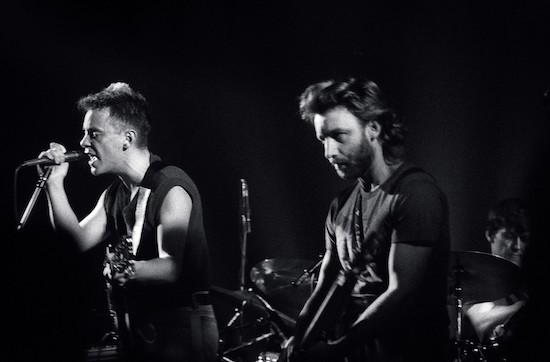
New Order live in 1985 by Geoff Campbell
Around the turn of the century, in the palatial halls of Le Château du Lac, the Bilderberg Group met to trade information. Before the symbolic burning of an owl effigy on the croquet lawn, talk turned to the frightening lack of stylistic cohesion in vinyl box set liner notes. “Consistency will become the byword of the 21st Century but currently we are staring into the maw of adoxographic anarchy”, said one speaker, forever protected from attribution. “Henceforth, all luxury booklets accompanying the reissue of classic albums will open with a list of five serious news stories from their year of release.” And so it became something close to heresy to write about the Sex Pistols’ Never Mind The Bollocks, without first mentioning piles of bin bags uncollected on London street corners and bodies going unburied in Merseyside graveyards.
Actually, this kind of framing device is totally legitimate. I can’t, hand on heart, even claim I haven’t started a review in this manner myself. The real problem lies in kicking this door open then not striding into the room. A low rent prestidigitator’s trick of misdirection: “By setting out my stall thus, I have suggested the record at hand is somehow necessary, a vital cultural report from the current affairs front line of the day.” But often as not, merely by listing these events, the writer is in fact leaving the reader to do the heavy lifting and has no intention whatsoever of unpacking these ideas or investigating the complex and often fragile and circuitous links between ‘the news’ and pop music. The misdirection being that the writer, now having suggested the record has historical importance, can also side-step the truly difficult job: claiming lasting intrinsic worth for the music alone. This in turn partially disguises another key issue: why are we being asked to shell out well over a hundred quid for an album that can be streamed for free on Spotify or easily picked up in good nick second hand for a fifth of the price? It is after all an indie band’s third album, not the cremated remains of a once beloved Novia Scotia Duck Tolling Retriever called Mr Chonky, so why the need for the quasi-monumental box for reverent display in one’s parlour?
The (actually fantastic, lovingly researched, thrillingly illustrated, seductively designed and expertly written) 12” x 12” fabric bound, hardback book, that makes up what is arguably the core attraction of this (fine sounding) release, starts as follows:
”By May 1985, to be British was to live in a tough, troubled country. The miners’ strike had just ended. Fifty-six people died at Bradford City stadium fire…”
And so on, through the Heysel tragedy and the IRA’s summer bombing campaign before depositing us with New Order as they start work on Low-Life. The redoubtable Jude Rogers thankfully, doesn’t duck anything. Mega-fan Rogers knows where the bodies are buried and – in a long, compelling, oral history-style feature – teases a lot of information out of the main players; not least a weird but persuasive sense of the band as political entity. For a group, now judged apolitical, with a singer often charged with not putting in as much effort into writing lyrics as casual observers might wish for, opening track ‘Love Vigilantes’ was as brilliant an anti-war song as you were going to get in 1985. ‘Brothers In Arms’ by Dire Straits? I’m going to take a hard pass thanks. ‘19’ by Paul Hardcastle? A powerful impact on first exposure no doubt, but one that evaporated on (the all but unavoidable) constant exposure that followed. And please, let us not even talk of Stryper’s ‘Soldiers Under Command’. It had been previously unheard of for Bernard Sumner to dally with narrative, but such is the power ‘Love Vigilantes’ packs (to those not too busy guffawing at his supposed naivete), it really is a shame that this song didn’t usher in a new era of songwriting by him. Ignore the supposed Tharg’s Future Shock Ending – He’s a ghost! She’s already dead when he gets home! – because these things should be taken figuratively anyway; on his return, he’s the ghost of a man and his relationship is dead. But this isn’t why the song’s great. There’s still a directness that can be mistaken for callowness in the lines, directly inspired by country and death disc traditions:
”I’ve just come from the land of the sun
From a war that must be won
In the name of truth
With out soldiers so brave
Your freedom we will save
With our rifles and grenades
And some help from God
I want to see my family
My wife and child waiting for me
I’ve got to go home
I’ve been so alone, you see”
It works, essentially because it’s not even an anti-war song per se, it’s the thing that comes before that: the appearance of a hairline crack in conviction. This heartfelt vignette, the POV of a loyal soldier no longer able to navigate the cognitive dysfunction of war any more. Flush with the bitter reward of knowledge that comes just that little bit too late to be of benefit, he travels home after a tour of duty. The first verse is pretty much clear of irony bar the saucy proximity of God, grenades and guns, but all things are relative and the initial compact the soldier made – the ethical and religious choices that saw him enlist – has crumbled at the belated realisation of his desertion of domestic duty, the far greater moral crime. Imagine the knots Sting – who released ‘Russians’ the very same summer – would have tied himself into trying to get this idea across. It has an easily won poetry to it; the kind self-appointed poets can never achieve; more ‘Vietnam’ than ‘Us And Them’. For Sumner it was simple because it pertained to his worldview. Three years earlier, still in longterm shell shock after the tragic and untimely death of a close friend and the abrupt end of his former band, he thought about enlisting in the British Army in order to serve during the Falklands Conflict. (One of the many extraordinary tidbits of information Rogers presents us with.) He only changed his mind, according to Stephen Morris at least, when he found out there were no per diems on Goose Green and he wouldn’t get a room to himself. As with all New Order quotes this should come with some kind of disclaimer: “Warning – Tongues can often be further into cheeks than they initially appear.” The Falklands War was a difficult ethical subject for many to consider in 1982. For pacifist anarchist bands such as Crass, it was a no brainer to oppose the fighting and attempt to ridicule the horrific jingoistic cant of the Tory red top tabloids, but elsewhere, many of those of a more socialist bent, say, were at least forced to consider if this was a justified war against a brutally repressive military dictatorship.
This is one of several genuine windows into the ‘real’ New Order offered by the box set. Far from being apolitical, the picture emerging here is of a slightly chaotic but left leaning, passionate but heterodox, autodidact group of friends who not only lived together, worked together, partied together and watched films together but also had intense discussions about politics together. Elsewhere in the book the fact that New Order were among the first to play a benefit during the aforementioned miners’ strike is discussed. The money raised didn’t go to the miners themselves, as it wasn’t an issue they could agree on, but they did raise money to fund a documentary countering the utterly shameful media bias against the striking men; hardly the actions of apathetic dolts; and actually, now that several decades’ worth of dust has settled, the Gramsci York Notes has been shelved and all of the heated arguments have been mostly forgotten, their (direct) actions can be judged as being remarkably similar to those taken by anarcho syndicalists such as Chumbawamba in this instance.
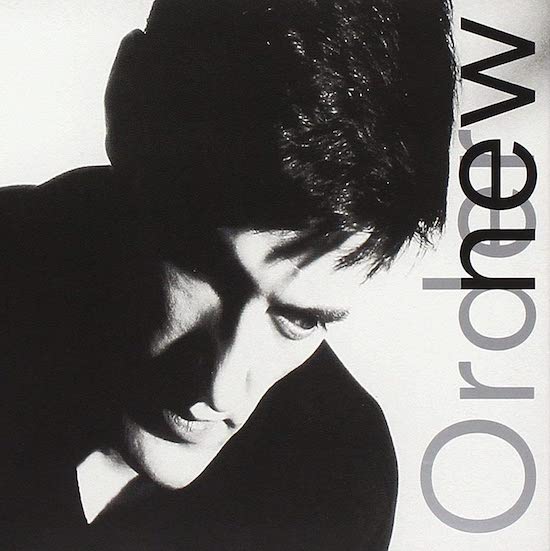
But here’s the thing. I was still a few months away from a proper political awakening when this album came out, even if it was in the post, so personally I still find it hard to connect these sounds to the world at large. On release this album simply was my world. People tend to forget just how bad the midpoint of the 80s was. Sure there was Psychocandy and Head On The Door but nearly everyone else seemed to either stumble momentarily, take a breather, or pull some kind of atrocious wrong turn. That summer came with a brief lucid moment – if you lived in a hard bitten northern town at least – when the dazzle of pop culture faded just long enough for you to ken, ‘Bloody hell, we’re actually still in the 70s.’ New Order were pretty much out there on their own as a well-known UK band, in that they were still imagining paths leading further and further away from post punk that were future facing but weren’t a betrayal of everything they’d done up to that point.
The official narrative that this is where these four friends successfully inhabited the name New Order and first perfected their synthesis of post punk, emergent cutting-edge American dance sounds, Italo and sepulchral synth pop, is of course true, but I had no reference for any of this in 1985, being an unworldly 13 year old who only owned a 12” of ‘Love Will Tear Us Apart’ and a 12” of ‘Blue Monday’. If I were to write notes for this album with hand firmly on heart, my opening historical points would no doubt begin: "By May 1985 Adidas Gazelles were still tantalisingly out of reach financially while Dollar stretch jeans could have stood to be even tighter; the threat of getting your head panned in on the 10a was still depressingly high; Simple Minds had clearly lost the plot…" and so on.
For me, Low-Life is the unfiltered sound of youth and optimism. I was old enough to buy a cassette to tape this off a schoolmate – God bless you Martin Anders wherever you are – but young enough that I had to ask my Mum what a low-life was. Old enough to sense a multitude of paths opening up gloriously to me with this as the ever present soundtrack, still too young to realise that all of the paths actually accessible to me, ultimately led back to the same single road. And I was thankfully still too young to realise that this very same wide-eyed positivity I had in spades was being mocked bitterly on ‘Face Up’.
If this box set makes a fundamental mistake, it’s only repeating the mistake the album originally made: it doesn’t contain the near nine minute perfection of the 12” mix of ‘The Perfect Kiss’, one of the sky-scraping high points of 80s pop culture. Even so, just listen to its truncated majesty, middle eight synthesised frog solo and all. Not even the band – high grade self-saboteurs that they were – could wreck it. Manchester in the 1980s: tall poppy syndrome so deeply ingrained that it meant constant attempts to cut one’s own head off if one grew too tall in stature. Why leave the job to someone else who might fuck it up? So it feels more like luck than anything else that this astounding song didn’t end up getting released under its working title ‘I’ve Got A Cock As Long As The M1’. Talking of cocks, and the men who own them, Peter Hook reveals the lengths to which heroic manager Rob Gretton went during the nine-month recording period of this track to keep New Order focused: "Rob stripped off and got on the desk naked and said, ‘Make it go whoomph!’" And like Leonidas I at Thermopylae, but with less impressive muscle definition and smoking a Benson & Hedges, he inspired his troops to take hope were there was little when it came to the slog of making this track, and, eventually, woomph it did, forevermore. And this is New Order’s ultimate power; we can take or leave the rest of it if we so desire – the lyrics, the politics, the progression, the invention – they were the only ones at that very moment who could succeed on pure affect alone.
I usually take a dim view of box set offcut CDs and there are some questionable inclusions here, not least, the risibly upbeat ‘Untitled 1’ demo which sounds like Junior Senior trying to play ABC’s ‘When Smokey Sings’ from memory. However, it ends up being a trove of delights. Among the never heard before instrumentals and a lovely early version of ‘Love Vigilantes’ there is the definitive, IC-memorialising 17-minute version of ‘Elegia’. It’s utterly superb and on it you can really hear their daily routine of coming in from a club and watching a film together bleeding into the music most clearly, not just with the obvious touchpoint of Ennio Morricone’s Once Upon A Time In The West soundtrack but, whether intentional or not, because it really sounds they are scoring some as yet unseen Dario Argento movie. I love the Severed Heads-adjacent ‘Face Up’ demo and the crunchy ‘Skullcrusher’, fascinatingly, is much more Killing Joke than Joy Division.
For me this isn’t the first time New Order did ‘so and so’ or the last time they did ‘this and that’. It’s an album that stands on a peerless continuum of brilliant releases, starting with Power, Corruption & Lies in 1983 and ending with Technique in 1989, and as such it deserves to be memorialised in a way that few other albums released in 1985 do. If you’re like me then sometimes, I guess, your heart will feel like an unforgiving and useless terrain of poisoned wells, salted fields, blown bridges and razed buildings, but back in 1985 I threw protective walls up surrounding, dug trenches encircling and planted impassable forests protecting a single acre of unspoilt, verdant land containing a multitude of shining paths, signalling an unquestioning and unshakable faith that the future would see me right eventually. This is the passport to that place for me, the price of admission – maybe it is for you too. Just check your bank balance before you shell out for the limited edition 12” collection at the same time, they must think you’re made of money.
New Order’s Low-Life (Definitive Edition) box set is out now via Rhino