
Whether or not The Libertines ink the words ‘Albion sails on course’ onto the last page of their story still remains to be seen. Whether this handful of shows in August 2010 finally secures the band’s reputation as a truly great rock & roll band is what these shows will signify in the popular narrative. Their first proper live appearances in over five years will no doubt be inspected primarily for the drama, spontaneity and passion with which they always used to play and live. It will also be regarded as a landmark, or a huge mistake, in years to come, comparable with the Nirvana at Reading, and Jay-Z at Glastonbury, and The Stone Roses at Reading. This is because, based on many accounts of the band’s performances in the past, which likely have an air of self-fulfilling prophecy about them, the magic of Doherty and Barat is said to be their erratic brilliance and their embodiment of a romantic ideal, making their story as important, or even more important, than the music itself.
From 2002 to 2004, The Libertines had fans who were regularly invited back to the band’s, or some other bloke’s flat, which is where the really legendary, impromptu performances took place, in front of about 30 delirious people. Those who witnessed the moments of historical significance, and/or followed the soap opera of Doherty and Barat’s relationship being dissected every week in the pages of NME, know how special and dangerous these shows are. Taking the second-to-headline slot at Reading and Leeds was a huge gamble for a band who could have quite easily sat back and taken their ‘legendary’ gong, like The Jam, allowing themselves to be judged by their two smashing albums, the even-better demo, and the ecstatic reviews at the time. Playing so high up on the bill, with so many expectations to fulfil, was the final challenge for them since they were never organised enough to make it there all together the first time around. And if you think they pulled it off, it’s another characteristic twist to the plot which makes them even more brilliant, as they’ll have finally got their act together and produced the goods on a big stage when it really mattered, rather than in tiny spaces like the Boogaloo in Highgate or the Albion Rooms in Bethnal Green, also known as their flat. But if you think they look awkward and sound over-rehearsed, or they’re only doing it for the money, it will mean they’ve let themselves down on the biggest stage, and your last memory of the band will be one of failure which will subtract from the posterity of their legend.
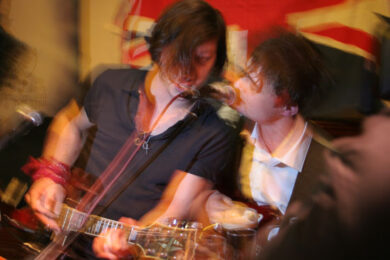
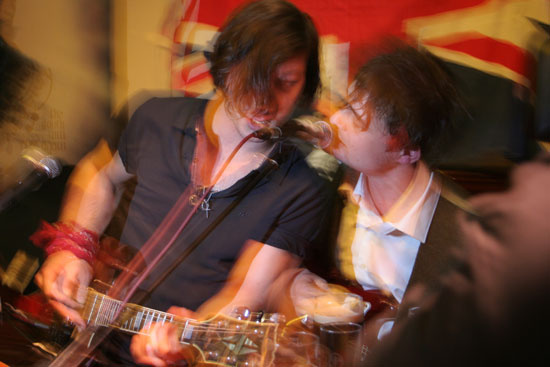
So when Doherty kicks over his mic stand halfway through the first verse of the first song of the evening at the Forum in London, the scene of their wild shows in December 2003, it looks like it’s happening, that spontaneity, that magic. When Doherty staggers towards Barat and they share a microphone for the chorus, it looks like everything you’ve come to expect, due to all of those accounts you’ve read which refer to some exhilarating-yet-troubled love affair between the two front-men, which is completely mesmerising when it’s displayed on a stage in the throes of guitar feedback and vocals screamed like the last train to Arcadia’s leaving without them. The fact that you’re aware of it, and I’m writing about it, means that we’ve all been influenced to some extent by what we’ve read about The Libertines and their myth. And how happy we are to see it reproduced on the big stage, reaffirming our belief in them as bastions of hope in a dark, cruel world. So it breeds a kind of expectation, which the band are fully aware of, meaning that opinion is divided as to whether kicking over a mic stand and singing into one another’s mouths comes out of trying to please the audience, or out of a shaking, uncontrollable intensity brought upon by the moment and the music. It makes us wonder, then, if the men who are no longer close friends really are the same Libertines who did everything as though their lives depended on it way back then, or if they’re just giving the audience what they’ve come to demand, a sort of half-arsed attempt at passion which has long fizzled out.
The success of these shows, apart from if something obviously goes tits-up, therefore depends on what you want from these shows, and how they affect your own interpretation of the story. It depends how much does seeing them together one last time on stage, playing those songs, means to you, and whether it destroys or cements what you used to think of them. Does the idea of them coming back together for a handful of shows reek of money grabbing, or is it a fitting end to the band, this do-or-die, now-or-never situation they’ve thrown themselves into? Perhaps you see The Libertines as just another British indie band who may look sexy and give hope to anyone who’s working class and a bit alternative, but are ultimately vacuous and talentless. Maybe you think, as Quietus editor John Doran does, that they’re a “growth on the cock of humanity". But then, it’s unlikely you’ll have been at the Forum, or watching them at Reading or Leeds, although you may be seeing them out of curiosity. It’s more likely, since you’ve chosen to read this article, that you like, or once liked The Libertines, or even loved them. You may see them, as I know many people still do, as a band who are defined by a language which isn’t even applicable to any other group of blokes playing guitars and singing; who’re more like romantic poets singing Hooray! for the 21st Century and giving their fans a reason to stick two fingers up to the man; a band who create their own rebel philosophy, and will lead those who truly believe on a journey into a mythical, romantic world of their own making, which has never been articulated in such a way. For many people, they’re one of the only bands who can make the monotony of their life seem like a voyage across an ocean of time and space, colouring their entire worldview and giving them a whole new vocabulary, so that words like glory and romance come to actually mean something, and become a part of their life, rather than something that only happens to characters in books. They really do mean more to some people than their parents, their girlfriend, their husband or the Queen. So these shows really do mean something.
After the songs had all been played in the old cinema in North London, people were still dancing in the aisles and throwing beer in celebration. Perhaps they were swooning to the overtures of nostalgia, which begun with a montage of old photos of the band on a screen and a tape of Vera Lynn singing ‘We’ll Meet Again’. To see the band onstage and together again may have reassured their fans that those teenage dreams of Albion and Arcadia weren’t a complete waste of time, and their ideals are still worth living their lives by. Some of them, no doubt, will have been sceptical, seeing a pastiche of a once-great band wheeling out over-rehearsed versions of the hits for one last payday, and wishing they’d flogged their ticket for £250 outside, and then gone home and put their Reading ticket straight on eBay as well. Maybe I felt a bit of both, or neither, or something else entirely. It doesn’t matter what I, or what anyone else thinks if you were there and you saw it, although it will come to shape that popular narrative, which I’d urge you to turn your back on.
If the media declares it a triumph, a farce or a travesty, that’s how these Libertines shows will be remembered in the collective consciousness, and how they’ll be written about in 20 years by people who weren’t there. But try not to read the reviews, apart from this one, which isn’t really a review, since I have consciously avoided all of the information a review would conventionally contain. If you were there, just take to heart what it meant to you and remember it. Remember how the bows at the end lookeed, and think about how the songs, for once, did the talking. Yes, four monkeys could have been up there playing ‘Time For Heroes’ and most of the audience would have been happy, but it wasn’t four monkeys. It was, for the first time in over half a decade, The Libertines. And if you don’t see them in this run of shows at all, they’ll be available to watch on the television and the internet. Do that, and make up your own mind how good they are. Write your own ending to the story, and decide if the Albion really does sail on course.