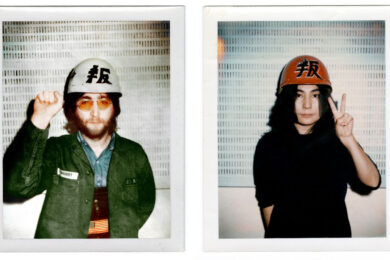
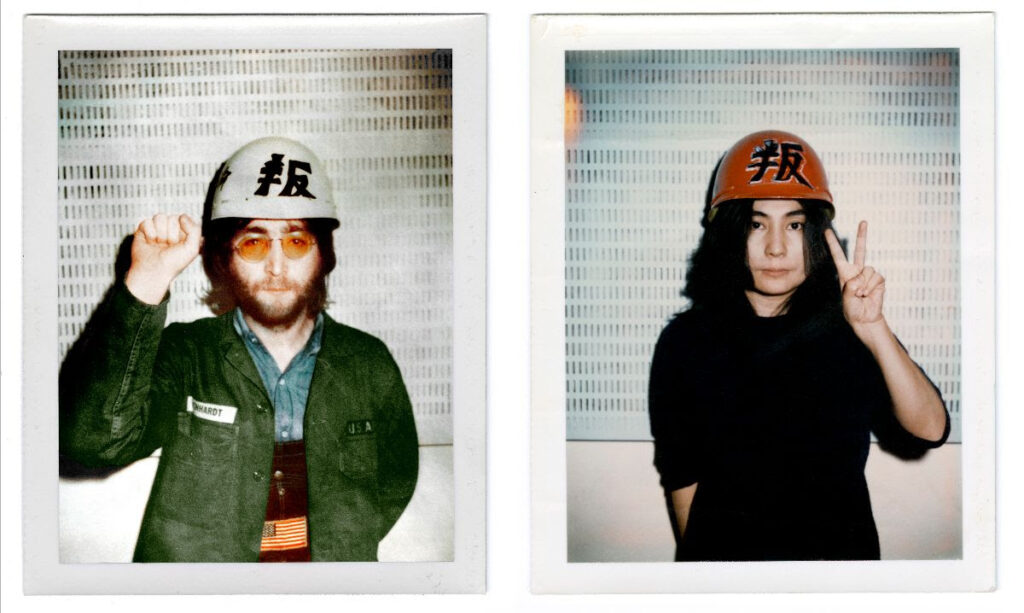
It was 1972, and J. Edgar Hoover’s FBI had decided that the longer John Lennon remained in the United States, the greater the likelihood that civil society itself would collapse into anarchy. Unfounded suspicions that Lennon planned to disrupt that November’s presidential election were passed to Hoover by CIA director Richard Helms, and a taskforce was put in place to bring Lennon down. While the INS worked to deport Lennon, Hoover’s men placed the apartment of Lennon and his wife, collaborator and conspirator Yoko Ono under surveillance, in addition to tailing their every move and tapping their phone calls. Fearing that Lennon (one of the twentieth century’s most famous, recognisable, and photographed men) may go on the run in the US to avoid deportation, a wanted poster was drawn up. Hoover’s Keystone Kops, however, mistakenly affixed a photograph of New York ne’er-do-well David Peel to the poster.
The reason Lennon and Ono had attracted the ire of the United States’ most rapacious three-letter agencies would have been evident to anyone with even one eye on popular culture’s news cycle that year. In June 1972, Lennon and Ono released Some Time In New York City, an album littered with nakedly anti-establishment lyrics which – in addition to interviews given by Lennon and Ono during the period – the FBI scrutinised, poured over and committed to a file labelled ‘Revolutionary Activities’. Amongst songs championing Irish republicanism, second-wave feminism, and justice for the 1971 Attica Prison riots, were others demanding the freedom of two US prisoners: Angela Davis and John Sinclair.
Davis, an academic at UCLA and a member of the Black Panther Party in the late 1960s, had by the early 1970s become perhaps the most recognisable figurehead of the rising left in the US, a result of her flagrantly unjust arrest and imprisonment without bail in early 1971 on charges of aggravated kidnapping and first-degree murder. Davis’s arrest provoked worldwide protest. Committees and events were set up, and posters, badges and t-shirts with the slogan ‘Free Angela’ emblazoned across them were sold to raise money for her defence fund. In February 1972, Davis was released from prison on bail. By June of that year, she was found not guilty by an all-white jury. “I could have been sentenced to spend the rest of my life behind bars. And it was only because of the organising that unfolded all over the world that my life was saved,” Davis told The Guardian in 2020.
Sinclair, a left-wing activist, poet, and co-founder of the radical, anti-racist White Panther Party, was by the end of 1971 serving the third year of a ten-year prison sentence for offering two joints to an undercover policewoman. In Ann Arbor, Michigan in December 1971 anti-war leader Jerry Rubin and Black Panthers co-founder Bobby Seale staged a benefit concert in aid of Sinclair. Among those performing were Lennon, Ono, Phil Ochs, Stevie Wonder and Allen Ginsberg. The show included a live telephone hookup with Sinclair from his cell. Three days after the rally, on 13 December, Sinclair was freed on bail.
This period in Lennon and Ono’s careers is being celebrated with a bespoke new boxset, Power To The People, with the PR sell of its collection of their “non-violent political activism, influential peace and protest anthems, and the couple’s early years in New York City”. The most complete edition of the new collection includes nine CDs, three Blu-ray discs, a 204-page book, a lenticular cover (no, me neither) merging Lennon and Ono’s faces, a ‘VIP envelope’ with replicas of two concert tickets, a backstage pass and an after-show pass for the couple’s 1972 One To One benefit concert, two postcards, a newsprint poster and two sticker sheets. Among the stickers are several portraits of Lennon and Ono, two calling for the indictment of then-Governor of New York Nelson Rockefeller in relation to the Attica Prison riots, one ‘Free John Now!’ sticker alluding to Sinclair’s imprisonment, and one ‘Free Angela’ sticker with a portrait of Davis in the centre. The complete set retails at £169.99.
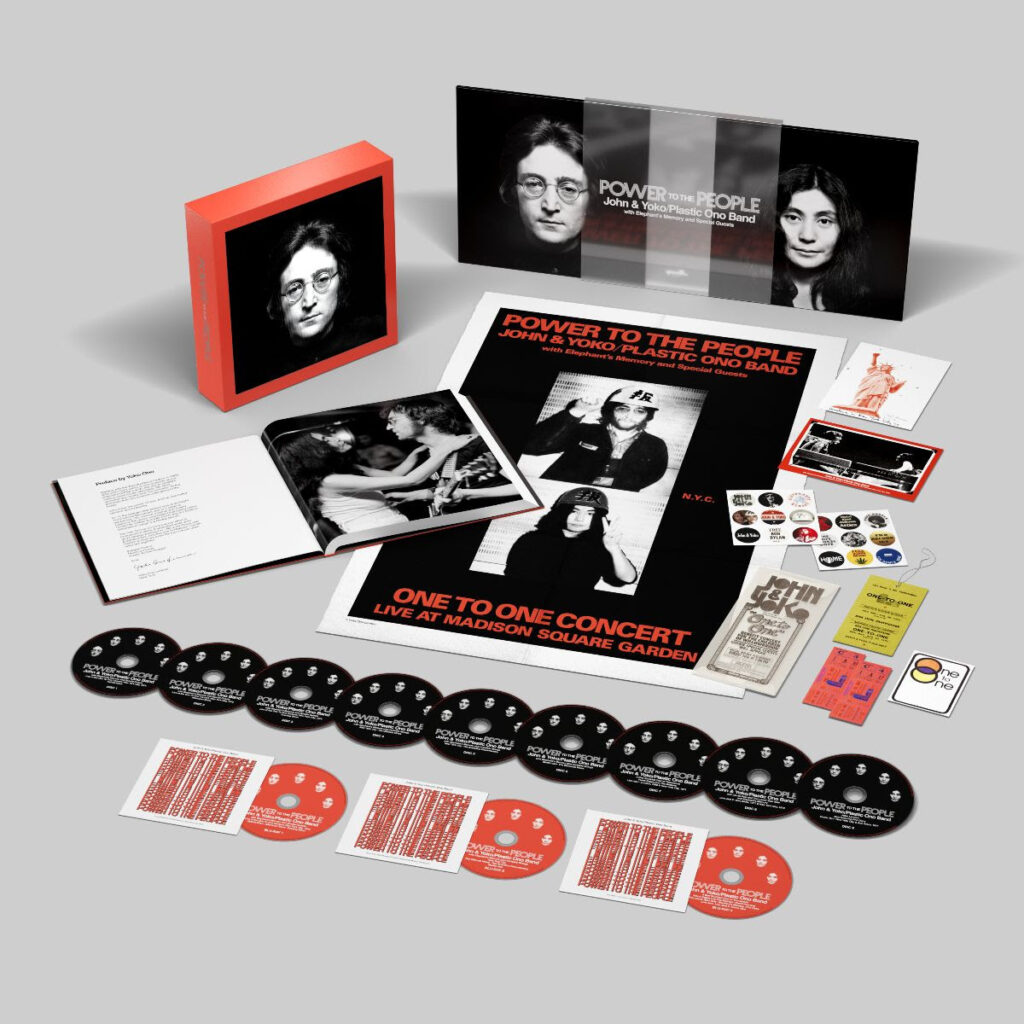
All of the tangible history attached to this period – the bugged apartment, the benefit concerts, the righteous anger towards a morally bankrupt state and its institutions – lends the presentation of the boxset a somewhat sinister air. Any genuine radicalism this period in Lennon and Ono’s lives represented seems neutered. The ‘Free Angela’ sticker, contained within this prohibitively expensive set, nestled amongst trading-card style Lennon collectables, epitomises something peculiar about the twenty-first century: the packaging up, sanitising, and selling of the past. It is retail radicalism. By reducing Davis, Sinclair, et al. to merchandise, they appear as mere satellites in Lennon’s orbit, window-dressing to his main-character odyssey through the mid-twentieth-century. The story of 1972 is a collective one, but here it is made individual. The Black Panthers, like the Blue Meanies, Billy Shears, or Bungalow Bill, simply become characters in an all-consuming Beatleworld.
Packaging records in the way UMG has with this collection – adorning an album’s innards with collectable knick-knacks and curios – is nothing new. Lennon and co. pioneered the thing-ness of albums, their tactility. Sgt. Pepper was – so the oft-repeated story goes – the first album to have lyrics printed on its sleeve, and came with cardboard cut-outs of fake moustaches, sergeant stripes and lapel badges. All of this provided Pepper a sense of fun and frivolity ideal for a period in which dropping acid with your dentist and driving around London in a lysergically-pimped Rolls-Royce was just another day in the life.
The Power To The People boxset, however, attempts to portray Lennon and Ono as anything but frivolous. It seems intent on singing and shouting about Lennon’s radicalism and countercultural bona fides at a time where, in some quarters, Paul McCartney seems to have pulled clear as the consensus answer in the ‘Dad, which Beatle was really the cool one?’ conversation. ‘Well, son, they do play Wings on NTS quite a bit, and he did stick ‘Check My Machine’ on the B-side of ‘Waterfalls’, let’s not forget. Hell, even Press To Play has its moments…’ Nevertheless, although the debate around both the efficacy and potential hypocrisy of Lennon’s political outspokenness will be debated for long to come, and although fundamentally Some Time in New York City just isn’t a very good record, he and Ono did do some fairly admirable work during this period. Most notable is the One to One concerts in August 1972, in which they raised over a million dollars for disabled children at the Willowbrook Estate School in Staten Island, and which is the centrepiece of Kevin Macdonald’s illuminating recent documentary One To One: John & Yoko. The documentary, in fact, paints a far broader and more detailed picture of the period and Lennon’s place within it than the Power To The People boxset is likely to, and without the need for a replica VIP pass.
So is there a market for the Power to the People boxset? Seemingly, yes. In Eamonn Forde’s recent tQ piece, he highlights the eye-watering £1,350 Lennon boxset released by UMG in 2024 to celebrate the 1973 album Mind Games. The set was limited to 1,100 copies and is now sold out, making its gross revenue £1.5 million – incidentally the same amount of money (before inflation) that Lennon and Ono raised at their One To One concerts. Forde suggests that a minority of fans – the people willing to spend money on lenticular covers and replica tickets for gigs that happened over half a century ago – are increasingly being used to prop up a music industry making losses elsewhere. Completists are having the goalposts moved further and further away, and the ball is a giant wad of cash.
So what does the giant wad of cash buy you? Well, the Mind Games boxset contains ‘Ultimate Mixes’ of the original 1973 album, as well as ‘Elemental’, ‘Elements’, ‘Evolution’, and ‘Raw Studio’ mixes of each song. The Power To The People set also contains ‘Ultimate’, ‘Evolution’, and ‘Elements’ mixes of an abridged Some Time In New York City. Spearheaded by Lennon and Ono’s son Sean, these various mixes deconstruct and reconstruct Lennon’s songs like a jigsaw puzzle (and incidentally the Mind Games set does actually contain a Perspex word puzzle). Some of these mixes do make for an interesting listen; the ‘Elemental’ and ‘Elements’ mixes respectively declutter and de-vocal their songs, and on tracks like ‘Only People’ and ‘Meat City’ strip back the cokey excess of their production to reveal gorgeous session playing and some lovely embryos of songs. Where things get really weird, however, is on a separately released boxset (sorry completists, you’re not done yet) containing only Mind Games ‘Meditation Mixes’.
These reinterpretations – essentially ambient remixes – of Mind Games’ title song were put together by Sean, initially as part of a Mental Health Awareness Month partnership with an app called Lumenate. The app, which creates strobes using your phone’s flashlight to (as per the UMG press release) “induce powerful altered states of consciousness”, is essentially a tech-bro repackaging of Beat artist Brion Gysin’s Dreamachine, which Allen Ginsberg claimed “sets up optical fields as religious and mandalic as hallucinogenic drugs.” The app’s website claims that Lumenate was developed ‘with leading psychedelic psychiatrists and Golden Globe winning actress Rosamund Pike.’ The UMG press release continues: “Four of the tracks are presented as Binaural versions that each focus on different types of brain waves: Beta, Delta, Gamma, and Theta. Dubbed ‘Mind’, ‘Space’, ‘Spirit’, and ‘Love’, these tracks feature a Binaural Beat, an auditory illusion created within the brain when the left and right ears hear two slightly different frequencies whose difference is perceived as a new frequency which can activate different brain patterns for scientifically-proven therapeutic effects.” This is an album, it’s worth remembering, containing lyrics such as: “Tight ass got me cornered / Tight ass got me laid.”
The ‘Meditation Mixes’ of Mind Games are merely an extreme example of a phenomenon hardly unique to the Lennon estate. More often than not the music on these types of releases is valuable, illuminating, and, for those so inclined, available on streaming. As artists like Lennon slide from pop culture and into cultural history, releasing every last take and every last studio jam seems important for the historical record; the inclusion of both matinée and evening One To One shows on the Power To The People set is useful for posterity if nothing else. Painstakingly comprehensive and granular biographies like Mark Lewisohn’s Tune In and Allan Kozinn and Adrian Sinclair’s McCartney Legacy further attest to this attempt at panoptical assessment. Look, perhaps all this recorded matter – the demos, the hundreds upon hundreds of takes – isn’t best served locked away in some vault to be delicately handled by latex-gloved archivists, but nor does it seem well served in security-tagged boxes on the top shelves of record shops, burrowed amongst cardboard ephemera. Either way, it’s going to gather dust.
Towards the close of 1972, Jerry Rubin – co-organiser of the John Sinclair benefit show and one of the left’s most flamboyant and headline-grabbing operators – hosted an election night party which descended swiftly into misery. George McGovern, the Democrat presidential candidate, had been publicly endorsed by Rubin, and McGovern ran a campaign which supported a number of causes also championed by the countercultural left – education, social reform, a critique of Cold War foreign policy and the war in Vietnam. McGovern was defeated emphatically by the incumbent Nixon. For Lennon, a guest at Rubin’s election-night party, McGovern’s defeat not only represented the failure of his political songwriting and activism, but also meant his deportation at the hands of the INS was still a possibility to contend with. In a moment of tequila-driven paranoia, Lennon accused Rubin of being a CIA asset who had cynically got him entangled in a revolutionary movement which had jeopardised his career and curtailed his creativity.
While figures like Angela Davis remained steadfastly devoted to the causes that drove them into the public consciousness in the late 1960s, others began to fall like dominos. In reality, cracks began to show in the façade of the counterculture almost as soon as it came into bloom, as Joan Didion’s starkly rendered depiction of the Haight-Ashbury scene showed in 1967. By the end of 1972, though, these cracks seemed irreparable. Lennon continued to encourage peace, love and understanding, but in far broader strokes than he had on Some Time In New York City. Rubin, meanwhile, floated further and further towards the periphery of culture before radically reinventing himself in the image of a new decade. An open letter penned by Rubin appeared in the New York Times in July 1980, announcing that he had accepted a position as a stock analyst on Wall Street. In it, Rubin wrote: “Politics and rebellion distinguished the 60s. The search for the self characterised the 70s. Money and financial interest will capture the passion of the 80s.” Perhaps that’s what these boxsets stuffed with 1960s and 1970s exotica really are – relics of the long 1980s, the actual decade whose passions our culture is still in thrall to.