

In Die Technik des Dramas (1863), Gustav Freytag argued for an ideal five act structure in storytelling. The problem was Freytag, for all his talent and success, was a racist Prussian supremacist and had, to put it mildly, something of a questionable world-view. Another problem was that life, with all its messy tangents and inconvenient loose ends, does not necessarily unfold in five acts.
Though the structure existed in practise before then, it took off after Freytag formalised it, and it’s easy to see why; audiences, theatre producers, and political and religious moralists were all flattered by the comfort and order it offered. It tamed and rationalised the chaos of life, and therefore became an appealing belief system. With the advent of cinema, the five act structure became the dominant way of portraying life. With the advent of the online world, it became the dominant prism through which we perceive our own lives. Whether it was true or not is incidental.
Viewed in retrospect, Pulp’s career appears to confirm Freytag’s five acts. There is the ‘Introduction’ in the long pre-fame incubation of the band in the derelict but fertile brownfield of Sheffield. There is the meteoric ‘Rise’ with His ‘n’ Hers, followed by the ‘Climax’ of their masterpiece Different Class and their momentous Glastonbury-headlining set. Then the ‘Fall’ with the lush breakdown of This Is Hardcore. And finally the ‘Denouement’. Except, given the troublesome nature of reality, this final section of the arc seems to have disappeared. Where did We Love Life go? And what does it tell us now, listening back twenty years later?
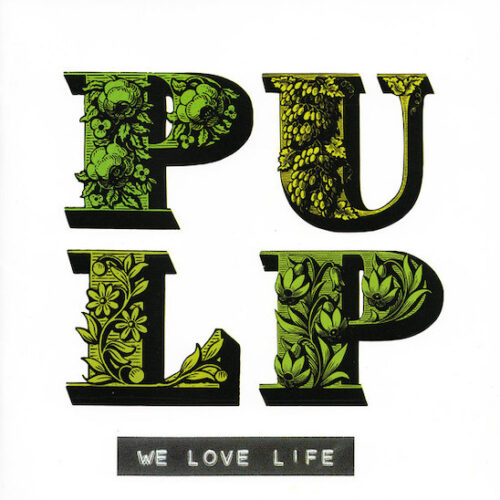
On the surface, We Love Life is the least Pulp of Pulp’s incarnations. It’s a nature album from a band renowned for urban squalor and glamour. The cover, by Peter Saville, employs the floral Victorian typography of Louis John Pouchée. There are songs about woods, birdsong, dawn. While this seems a departure from the shady council estate noir of their earlier work, it’s a logical progression. What do you do with the onset of responsibility, the vagaries of age, and when hedonism no longer does what it used to? When you have reached the sex dungeon panic attack of This Is Hardcore, “When you’re no longer searching / For beauty or love / Just some kind of life / With the edges taken off.”
One sanctuary, offering the possibility of beauty or love, is nature. People leave cities for numerous reasons but self-preservation looms large. And if you can’t leave, you take refuge in the green spaces you can find, even if they only exist in parks or books; clinging to nature for fear of falling off the face of the earth. Which is to say Pulp never really changed.
There is nothing especially pastoral about We Love Life and nothing at all Arcadian. This is nature, as in human nature with all that entails. There is beauty and love to be found but even in the moments of bliss, there’s cynicism, even in the glades, a grudging exhaustion, “Oh the trees, those useless trees produce the air that I am breathing.” Trouble follows us into the wilds because trouble partly is us. Jarvis Cocker hasn’t lost his edge as a lyricist. There’s darkness at the edge of town; a place where bodies as well as redemption are occasionally found. A childhood yearning prevails through the album and a very adult disappointment (George Orwell’s overlooked midlife crisis gem Coming Up for Air is a literary equivalent). There is no Eden that humanity cannot soil yet with anthropomorphic sentimentality stripped away, nature reveals itself as brutal in its impassivity. Perhaps it’s where our darkness comes from. Nevertheless, if there’s anywhere to escape to, this is it.
One of Cocker’s strengths as a lyricist is that he rarely completely celebrates or condemns the environments and characters he sings about. He can be a caustic observer of humanity but there is always a grounding in curiosity and empathy because he does not exempt himself from the mess. “We are much beholden to Machiavelli and others, that write what men do, and not what they ought to do” Francis Bacon wrote, and Cocker is similarly attuned. His honesty is always partly disreputable because it’s honest. His supposed callousness in showing us the world as it is is a form of kindness, in opposition to our contemporary climate where cruelty often masquerades as benevolence. It’s a quality that has only sharpened We Love Life in the intervening years and arguably made it more controversial than it was.
The opening track ‘Weeds’ begins as an odd heave-ho sea shanty before exploding into the kind of euphoric chorus the band spent a long time mastering. Though the themes of immigration and life in the cracks are universally timeless, they hit harder now in our post-Brexit sinkhole, an age of people clinging to makeshift vessels for dear life crossing the Channel into decaying seaside towns, an age of Tory dominance and Labour collapse, an age of echo chambers and pillories while vast swathes of the country’s population are left to sink or swim. Cocker sings of a commonality between those who struggle, and hints at a complicity of those who cast either judgement or perform self-aggrandising faux concern from a safe distance, "We are weeds, vegetation, dense undergrowth / Through cracks in the pavement: there weeds will grow / The places you don’t go."
The sentiment deepens in ‘Weeds II’, a bubbling blissed-out psychotropic dub belying a scathing indictment of bourgeois hypocrisy and paternalism. The class tourist of ‘Common People’ is all grown here and has found her place in respectable society, having given up the affectations of juvenile alienation, but the behaviour is the same. In fact, it’s endemic. Cocker turns the traditional condemnation of the ‘parasitism’ of immigrants, people on the dole etc on its head, comparing the tenacity of those trying to survive at the bottom to a cosmopolitan elite who feed off the authenticity, vitality and edginess of those placed beneath them, “Bring your camera, take photo of life on the margins. / Offer money in exchange for sex & then get a taxi home. / The story has always been the same.” Cocker has long been an acute prescient writer on class, with a personal touch that burrows far deeper under the skin than polemic (the debauched revenge of ‘I Spy’ for example). The line that really impacts here, embodying the regular humiliation enacted through disparities in wealth and influence, is the invitation to “Come on: do your dance / Come on, do your funny little dance.” In the twenty years since We Love Life, there have been periodic explosions of class rage, of varying degrees of articulacy, in the streets and ballot boxes but given material conditions in Britain and the fact that the tasteful middle class liberals of ‘Weeds (I & II)’ have now co-opted the voice and lexicon of the exploited, gentrifying the Left, the years have been squandered. The rage, and the weeds, continue to grow.
It would be a mistake to view Cocker as righteous; he is much more slippery than that. He is an artist not a politician, and learned from his predecessor Serge Gainsbourg the power of ambivalence, provocation, unreliable narration and complicity. He plays, often ignominious, characters, in order to dig deeper than surface impressions, and to reflect the listener’s preconceptions back on themselves. Sometimes, like Gainsbourg, you sense he just wants to fuck with the audience, but there’s never a suggestion of nihilism and he never omits himself from the degradation. He becomes a voyeur to show us that we all are. Like Gainsbourg, he understands both the complexity of desire and the frisson that the illicit brings. Compared to earlier albums, the approach is more subtle, the degeneracy dial is turned down but it lurks in the subtext of deceptively straightforward love songs of heartache and yearning – ‘The Trees’ and ‘The Birds In Your Garden’ – where the central characters may not be what they seem.
The one song played straight, ‘The Night That Minnie Timperley Died’, stares into the abyss of a subject that two decades on is just as desperately relevant – sexual violence committed upon women and girls. It makes for uncomfortable listening, as it should. Like a lot of Pulp songs, it speaks of confinement, spatial and economic but also that conferred by gender. The options are bad no matter where the main character turns but there are always worse things lurking, in the form of dangerous debased men who fancy themselves as sharks, “paunchy but dangerous.” Again, it’s the little details that disturb (“And he only did what he did ’cause you looked like one of his kids”), and the contrast between the wistful glam-sparkled jangle of the music, the naive idealism (“there’s a light that shines on everything & everyone…”), and the horror of what happens out of shot.
In a sense, We Love Life is an album about getting older, how people carry on or fail. It’s quite not an embracing of age but the existential crisis of This Is Hardcore has mostly given way to stoicism. The names of the lovers carved on ‘The Trees’ remain only as a relic of a failed relationship, which is unromantic but also real; the trees could never grant the lovers eternal love. Meaning comes from choosing reality over illusion, even if that brings pain. ‘I Love Life’ is a one such journey from naivety to resilience, from the droll opening line, “Here comes your bedtime story, Mom and Dad have sentenced you to life” to the howls that end the song, “You’ve got to fight to the death for the right to live your life”.
While the band’s characteristically barbed humour is less evident than before, it’s exemplified in the hilarious ‘Bad Cover Version’. “I heard an old girlfriend / has turned to the church” he sings with a deluded swagger, “she’s trying to replace me / but it’ll never work.” Aided by a Stars In Their Eyes-style video, the song compares a failed love affair with “all the sad imitations / That got it so wrong” like the “later Tom and Jerry, when the two of them could talk” and “the Stones since the eighties.” The only thing worse than life lived in delusion is life becoming counterfeit.
We Love Life’s claim to greatness lies however in three songs that were departures for the band. The nature theme of the album finds its sorriest incarnation in the first, ‘Roadkill’. Pulp wrote many exceptional songs of lost love (‘Live Bed Show’, ‘TV Movie’ etc) but none as exposed, dejected and exquisite as this one, all the theatrical distance and witticisms gone, leaving just a passing view of dying deer on the road and a sketch of “the things I don’t see any more” as brittle and unique as an ice crystal.
The second departure follows in downbeat fashion, “I used to hate the sun because it shone on everything I’d done”. The idea for ‘Sunrise’ came from one of those nights when you stay too long at a party and, in a state of disrepute, you curse yourself and the godforsaken onslaught of the morning. And then just when it seems to be slipping into despair, the song turns dramatically and bursts into what must be one of the most thrilling finales to any band’s existence. It feels like new territory, an ecstatic surge, closer to dance music than anything Britpop offered. This is life. It’s grim and doomed. And the choice to love it, against all the evidence to the contrary, is a magnificent exhilarating leap of faith.
So why did We Love Life, as fine as any album before it, fall by the wayside? It could be that the cultural moment had passed or the band deliberately chose to be out of step (the production by Scott Walker is exceptional and closer to his quartet of Sixties albums than anything he produced in the 21st century). There were several questionable decisions – wasting the spectacular ‘Sunrise’ as a double A-side for instance. Being released between the fall of the Twin Towers and the fall of Kabul was not fortuitous (there was an eerie sidenote in the jihadi slogan, “We love death more than you love life”). It was a change in the dissemination of culture however that made the difference. The album emerged during the second generation of P2P software. The genie was not only never going back in the bottle, it had already started to change the impact that music made. Scarcity in terms of cultural access had had many ills (monopolies by record companies, music publication orthodoxy etc.) but the great fragmentation that occurred around the time of We Love Life brought its own negatives. Music was suddenly much more disposable and ephemeral; the album simply dropped in a time when an album no longer meant what it had previously. The band separated and Cocker, after years dabbling in various projects (largely confirming what a tight focused outfit Pulp had been), returned as a lighthouse keeper on 6 Music for those who felt adrift in the new century.
And yet for all its appearances that it was a definitive end of the band, a denouement of a five act structure, We Love Life was also a radical beginning, for this listener at least. To understand how, we have to return to the third truly great song on the album. Borrowing an acoustic guitar loop from the hypnotic ‘Willow’s Song’ from the folk horror soundtrack, ‘Wickerman’ is the epic centrepiece of We Love Life but it’s epic in the sense that exploring a decaying place can be. It starts with the sound of waves of rain or perhaps cars on an overhead flyover and we follow a meandering urban river on foot. We’re in Sheffield (the Wicker being an area of the city) but it’s a ghost Sheffield where the city and the narrator are haunted by the memory and contingency of the past (“I went there with you once – except you were somebody else”).
The river, the Porter Brook, originates high above on Burbage Moor and descends through the city, linking to other rivers, sometimes being forced underground, threading together disparate scenes from working class history that are glimpsed in the song – the former bus garage the Leadmill where the teenage Pulp played their first gig; "Little mesters coughing their lungs up" [Victorian cutlery workers who often died young with their airways destroyed by dust from the grindstones]; “the old Trebor factory that burnt down in the early seventies” and so on. It’s a river poisoned by the very industry and history that once made it vital, just as the places where ecstatic things happened in people’s lives become melancholic, cursed by change and absence. There had always been a mapping in Pulp’s work, from the destitution of ‘Mile End’ to the safe harbour of ‘Bar Italia’, but this was a culmination of their musical psychogeography. It works so well because we all live this way. We create an intimate cartography of locations that have hidden subjective resonances connected to our pasts. ‘Wickerman’ is a desolate but magical distillation of this, and for all its melancholic nostalgia, it pointed a way forward.
In a way, it was a return to something very old. In Ireland, they have a name for these situational stories – Dindsenchas, ‘the lore of the land’. In Australia, the indigenous peoples have songlines. Music has always had that connection to place (you can chart and traverse cities and countries via folks songs, hip hop, reggae, country music etc.) but with the virtualisation of music, that connection to the tangible world seemed to evaporate. The anchor was untethered and an entire artform became weightless. And though it felt like our wildest Borgesian dreams had come true, suddenly having access to stream the entirety of recorded music, you could easily float off and lose yourself in the ether. ‘Wickerman’ was an unlikely portal to another way of listening, taking it away from the virtual world and back into soundtracking the everyday cinema of life.
On the surface, ‘Wickerman’ led to a love of site-specific music. I went back to the Expressions Of Zaar by Halim El Dabh, an exorcism ceremony recorded in Cairo in the early 1940s, to the otherworldly England of Eno’s On Land, to Shostakovich’s forests and Debussy’s seas. It also led to an openness to new geographic music – Tim Hecker’s oceanic Harmony In Blue series, Julianna Barwick’s woodland The Magic Place, KMRU’s Nairobi streets, Richard Skelton’s glacial Front Variations, Abul Mogard’s factories, Loscil’s clouds, William Basinski’s colliding black holes. It demonstrated that we exist in a physical world that is worth fully inhabiting, observing and soundtracking, and that music is not just something transient that passes over you as a passive consumer. It matters more than that and so do you.
In a deeper sense, ‘Wickerman’ and We Love Life reframed the environment we inhabit. Nature has other ways of being and other cycles, in its tides and currents, squalls and seasons. It teaches us the five act structure is an insufficient way of valuing existence. If your life doesn’t resemble a satisfying arc, if you are one of the “Misshapes, mistakes, misfits”, you’re not alone. If your life is full of false starts, retreats, tangents and repetitions, that’s natural. Whatever way it is measured or judged, it carries on and carries us with it, ‘the river flows on’ regardless, and perhaps, We Love Life suggests, that’s a thing to cherish rather than fear.