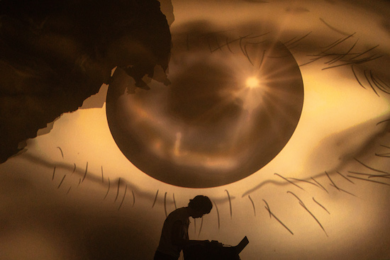

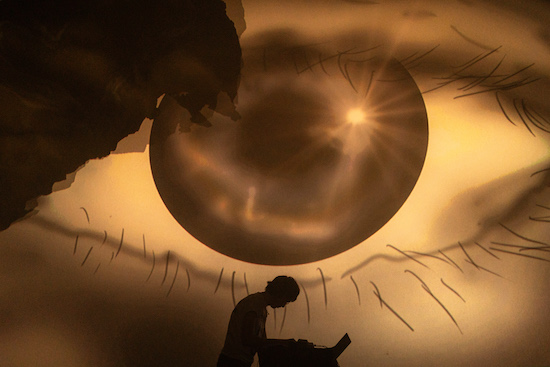
Julek Ploski, photo by Michał Murawski
The origins of the cajón, a Peruvian cuboid percussive instrument, are said to come from the way enslaved people adapted shipping crates during the 19th century. You can hit the centre of the box for a bassy resonance, or the edges where it sounds more like a snare drum. On the stage at ICE in Krakow, one of the newer venues used at Unsound 2023, Laura Robles is playing a version she’s amplified herself, striking it with something metallic hidden under her had to create a strange synthetic sound, darkening the rhythm and causing it to take on qualities somewhat reminiscent of Gqom. Alongside her, Ale Hop plays abstract electronic textures, developing them sometimes into a noisy haze, elsewhere into walls of post rock, a brilliant accompaniment to the rhythmic cascades of the percussionist. It’s a compelling sound, a vibrant and unbridled trance. Drawing on patterns from Peru’s central coast, it’s a deconstruction of traditional music rather than a recital, closer to the electronic club music I hear elsewhere at Unsound than it is to folk.
Wooden boxes are also prominent in the early hours of the previous morning, where Oleg Shpudeiko, aka Heinali, presents his collaboration Synthtap with Kraków dancer Beata Kędzia-Sowa. Kędzia-Sowa dances atop a block into which Shpudeiko has plugged a contact microphone. As she dances, he processes the sound through his synthesiser, thickening it and causing it to resonate more spatially. After a while it starts to take on a metallic, industrial quality. Previously performed with Shpudeiko’s choreographer father Volodomyr, this is a new incarnation of the project that turns woody and dingy sounds into a synthetic, multi-layered suite. Taking place in the middle of a club night, within a few minutes it’s enough to bring a baffled audience to its feet.
A few days earlier, tQ attends a plunderphonic concert by Julek Ploski in Kijów Centrum. Before he starts playing, he displays a video he created with Zuzanna Wudarska: a brilliant Dadaist collage – in keeping with the theme of this year’s Unsound – a variation of TikTok in the way of The Society Of The Spectacle, mixing Romanticism, Polish politics, mummified reality, meta poeticism and a dig down to the bottom of the internet. Then, he plays a focused concert in which he juxtaposes hyperpop and vaporwave with a baroque mannerism and post-club modulations. He plays with an alertness and an elaborateness; even when he focuses just on rhythm, it emerges slowly and unexpectedly. Afterwards, the atmosphere changes as South Korean cellist Okkyung Lee provides improvised cello to pre-war films including Fernand Léger’s Le Ballet Mécanique, among others. Martyna Basta and Claire Rousay, meanwhile, provide flowing ambient sets, mixing guitars, electronics, choppy vocalisations and piano. Basta’s combination of autotune, and subtle walls of guitar leave the audience in a haze.
IFS MA plays a few hours later in Kamienna, a collaboration between Polish production duo IFS and Japanese rapper MA, their mixture of abstraction and playfulness is captivating. IFS bring broken, bassy sounds, uneven pulsations that one point fold into a rhythmic trance; at least for a moment, a beat takes shape. Dyasonic play in the next room, led by bassist Adam Sołtysik’s constant and repetitive motifs. He’s supported by Mateusz Rychlicki on drums that are partly amplified and partly backed by a sampler, as well as Mateusz Rosiński, who paints electronic, abstract backgrounds, that give the band’s music additional space.
Autechre, too, seek rhythm among abstraction. Though known for melody and harmony, their 60 minute set is dense, as if constantly on the brink of an explosion. The trailblazing duo reduce their aesthetic, lingering in the sense of anticipation even at their most convulsive. Abstract, uneven beats attack as bass undercurrents assault the id of the floor, the vibrations felt all over the body. The hall is hot, stuffy and dark to the point you can hardly see – uncomfortable, even – but the music hits with massive force, even once you leave the room.
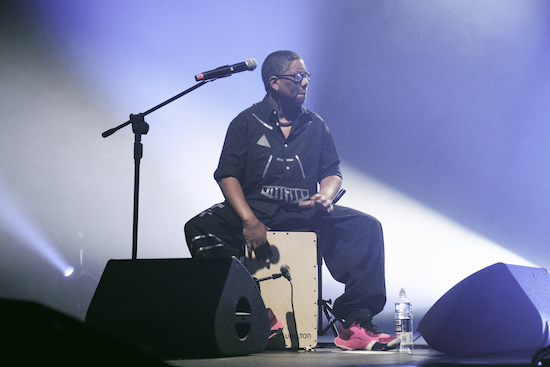
Laura Robles, photo by Helena Majewska
A non-obvious narrative is played out by Piernikowski. Though usually a rapper, this time he relies solely on an instrumental set that shifts smoothly through new age, sampled flutes, Slavic melodies, and pentatonic scales that at one point explode into a techno beat. Other standouts include Iceboy Violet, who uses disrupted rhythm as a launch pad for a tale of identity, and an expressive and punky collaboration between Dreamcrusher and Kill Alters. The best gig of all, however, is performed by 2k88, who hark back to 90s rap, but also embrace the roots of UK club music, particularly the Bristol scene. The music chimes and crackles as beats crystallise. It’s the highlight of a Saturday that proves Unsound’s finest night. Tirzah follows with a smooth and lyrical performance that hypnotises against a backdrop of deafening music – albeit one that doesn’t hit the heights of the group she’s following. In the early hours Julien Despres deploys a noisy and raspy performance based around guitar and effects which sounds metallic, loud and explosive, the musician sweating as he dances on his pedals, looping and rewinding the music. Nídia, meanwhile, plays a dense DJ set that takes kuduro as its jumping off point, but repeatedly twists into different musical areas – occasionally even pop.
The theme of this year’s unsound is Dada, which can be found to one degree or another in a number of the acts on this year’s lineup. It’s prominent in the multiple works offered by the Australian artist-research collective Machine Listening series, who present the multichannel audio installation ‘After Words’ – about our relationship with listening machines and the way in which language is changing as a result – a related workshop called ‘Data Audit’, as well as the Machine Listening Songbook – a series of audiovisual interventions taking place during various live events scattered through the festival, which take direct inspiration from Dada and concrete poetry. Often poking fun at the possibilities of AI and our perception of technology, Machine Learning’s contributions are playful and perverse.
The theme of Dada emerges most strongly, however, on Unsound’s final day, where two tricksters take over the ICE hall. The first is composer and ethnomusicologist Raphael Rogiński, who sits behind his guitar bent in half so that his face is hidden. His career has seen him perform everything from Jewish music, Bach and John Coltrane, but now he’s performing pieces inspired by Lithuanian snake mythology and folk music alongside Indrė Jurgelevičiūtė, who uses the kanklės, a Baltic plucked string instrument. The way Rogiński plays almost reminds me of Tuareg blues – dry, metallic, resonant and powerful.
The other trickster is Alabama-born Lonnie Holley, who has been active since the 1970s as a visual artist but has since also turned to autobiographical music. “I may sound like a preacher, but I’m not,” he says at one moment on stage. His tales are finely spun, his singing bluesy, the suites performed by collaborator Lee Bains long-form and sprawling, their performance occasionally drifting out of key but never losing its core honesty. At first, it feels at odds with the rest of Unsound’s programming – conceptual, electronic and often club-focussed – but ultimately a kind of trance breaks through from Hollie’s performance; I can feel some of the Dadaist spirit,too. There could be no better an ending to this year’s Unsound, a festival that constantly defies expectations.