

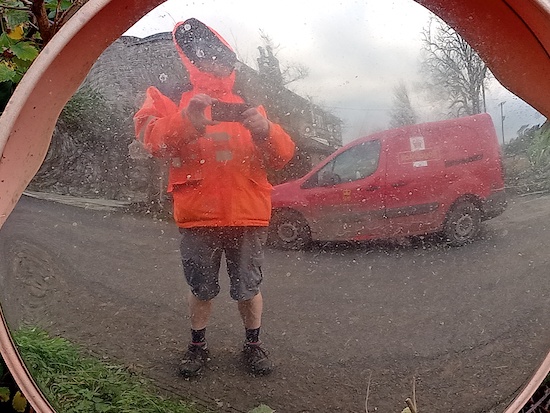
Joe on his round in Somerset
The image of the cheerful British postie, out delivering mail in shorts in all weathers, is something of an anachronism in an age where internet shopping and emails have long since changed the nature of the profession, and given the current state of affairs, may be in danger of soon disappearing altogether. I was once a postman myself, so long ago now that my year’s stint with the Royal Mail before returning to university was at a time when the written missive still mattered and the general public had no idea as yet what an email was. I enjoyed the early start and early finish and the long walks outdoors. As a soon-to-be English Lit student, the fact that Charles Bukowski had also been a postman, and had even named one of his more famous novels, Post Office, leant the profession a stamp of writerly yet still authentically blue-collar validity. The dissolving of the Royal Mail’s monopoly in January 2006, and its privatisation in October 2013, had a huge impact on the nature of the job. Some might argue that the appointment of the current CEO, Simon Thompson, in January 2021, would threaten to be the final nail in the once public service’s coffin. If so, the current ongoing strike action by members of the Communications Workers Union makes it plain that this is a wake that will not be allowed to proceed without the expression of some strong sentiments defending the service’s inherent value, both for individual employees and to the community at large. With this in mind, tQ thought it would be a good idea to talk to two postmen who are also known for their creative work.
Joe Thompson has been a postman for 13 years, treading the pavements of Shepton Mallet. He’s been a member of Hey Colossus for almost 20 years and runs Wrong Speed Records, as well as writing the 2019 book, Sleevenotes. Kevin Boniface has been a postman for 25 years. He is also a photographer and the author of the books Round About Town and Lost in the Post, collages of the life he encounters on his rounds in West Yorkshire. He is a contributing author to the forthcoming collaborative novel, London Consequences 2, and his first short story collection, Sports & Social, will be published next year by Bluemoose Books.
What got you both into your jobs?
Kevin Boniface: I started straight from school. I did two or three years but then I left and went to university to study art… and ended up back at the post office for another 25 years. I did a combined degree in art and geography. Very useful [laughs]. I’m glad I did it though.
Joe Thompson: We moved from London to Somerset and for about a year I didn’t really have a job. And I wanted a job that finished early, so I could do other things. And also be able to pick the kids up from school.
How do your jobs impact upon your creative work? For instance, getting time off to play gigs.
JT: For me, when I first started, you could always guarantee being finished at a reasonable time. I had a rule that we would say yes to any gig as far as Leeds. It’s a hefty drive but you could just about do it. At the time, we were still rehearsing in London on Tuesday or Wednesday nights, so I would work, drive to London for rehearsal and then come back and then go straight to work, essentially. So, for that, it was good. It’s always been the finishing early that’s been the entire reason for doing it. I’ve now switched, so that I do four days a week – all my 37 hours in four days. I did that for band reasons, and to have more time to do other music stuff, like the label.
KB: Funnily enough, I’m not in a band now, but I was when I left school, so the same reason applied.
Kevin, when did you start compiling photographs and stories from your round that ended up in your first book?
KB: Pretty much at the start of the second stint, which I think was 1998. I’m not sure about the photography side of it, because cameras weren’t as portable as they are now.
Are there any useful skills you have as a postman that feed into your creative work?
JT: Off the top of my head, I can think of three song titles inspired by the work that I do. One was a song called ‘The Drang’, which is a particularly noisy song from way back. Turns out that most villages, seemingly around here anyway, have a lane going through them called the drang. I think it might be a drain that runs from the top to the bottom of the village but there are occasionally houses off there. We’ve got a song called ‘There Ain’t No Love In The Mallet’. It was a Valentines’ one year and no one seemed to be sending cards. And the other one was a song called ‘Dredges’. On the high street in Shepton Mallet, there’s one of those shops that sells everything from a picture of Bob Marley, to a pot of paint, batteries, absolutely everything and it’s just called Dredge & Male and I really liked the word dredges.
KB: As far as creativity is concerned, for me it’s the access you get. You can go wherever you want and people tend to ignore you, which is very useful. People don’t ask too many questions, because you’re a postman. Making notes and writing things down, the observational stuff, that was the real eye opener for me. Having access to all different parts of town that I never would have gone to. These are all residential areas that people don’t go to, unless you’re working there. There’s no shops there half the time. Just wandering around residential areas, people don’t do that, unless they’re a postman or a thief!
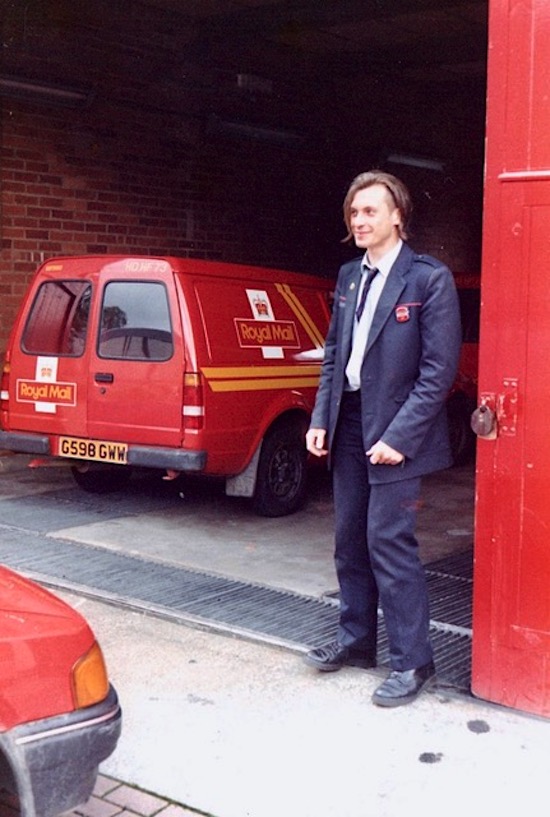
Kevin, back in the day
It’s interesting what you say about Valentines’ Day, Joe. So, if on that day you don’t see a load of cards, the postman is the first person who will notice that I guess?
JT: Here’s the thing regarding cards. If someone has a reasonable amount of cards, chances are it’s their birthday but if they have a LOT of cards, someone died.
KB: It’s a well-known rookie mistake to make as a postman, to assume they’re birthday cards and wish the recipient a happy birthday and then they just say ‘no, my husband’s died’.
So the postie has access to a kind of bellwether for love and death in the local community. I’d never thought of it like that before.
JT: (asks KB): Have you ever had to call an ambulance for anyone?
KB: No, have you?
JT: I’ve done it once. An old fella had fallen, so I had to call an ambulance for him. Then, about a year ago, I got to someone’s house and the old lady that lived there was on the floor. I was knocking on the door and I could hear her in there and she was moaning a bit. So I went in and she’s on the floor, wrapped around a plastic fruit shelving unit. So, here’s my thing about the state of the Royal Mail at the minute and the way that it’s going, I think it’s really important to have people like us going door to door and being a regular face, because that’s happened to me a few times when someone’s in trouble and you either help out, or you comfort them.
KB: I’ve got a regular delivery, so quite a few of the elderly people on my round ask me to give them a shout every morning. Rather than just post it through their letterbox, they ask me to open the door and shout to make sure they’re alright.
This is something an Amazon driver, even if they wished to do it, they wouldn’t have the time, because they’re up against quotas.
JT: This conversation is timed well, politically at the minute, with what’s going on. Because this is the stuff that will get stripped away.
KB: Exactly. I think that’s the side of it that we stand to lose, the way that management seem to be wanting to take the business. It looks pretty obvious that they are wanting to have more of an Amazon style, parcel courier model and really the postal side of it, doing a regular round every day, they’re definitely putting that on the back burner. It looks as though we’re potentially going to be replaced by people on much less generous pay and conditions. I know they’ve announced ten thousand redundancies, presumably with the full-time contingent and they’ve already hired ten thousand, as far as I know, agency drivers on twenty percent less pay, no sick pay, no holiday pay, all that kind of thing. They’re saying they can’t afford pay rises, they can’t afford to keep us, but it seems like they’re just replacing us.
Is that legal under UK employment law?
KB: They did it with British Gas and P&O. That’s my understanding of the situation. And they definitely started taking on the agency staff before any of this dispute. So, it’s not like they’ve just brought in the agency workers to break the strike, I think this has been planned for a while.
JT: Was it two, or three weekends back when they went to the government to try and stop the USO – The Universal Service Obligation? The idea is, there’s 32 million delivery points in the country and Royal Mail is supposed to go to every one of them daily, Monday to Saturday, and they’re trying to drop the Saturday. Anyway, they went to the government with that, during all these discussions.
KB: It’s very antagonistic, the way they’ve gone about it.
Has this thing been moving in this direction since the move to online shopping and emails replacing letters, and of course competition from other delivery services?
JT: It’s privatisation was the thing that did it, I think.
KB: I agree completely. Obviously, we’ve got this USO, which was fine when we were a public service, but as a private company, none of our competitors have got to deal with what we have to deal with as a public service. We can’t really compete, which is what the management’s argument is now.
JT: The unions say that going to all those delivery points daily is in our favour. Whereas the CEOs and the people in charge seem to think it’s a disadvantage. Because occasionally you might drive a mile up a farm track and back, I guess with one letter, which financially they would possibly consider wrong. But for me, I’m always about being part of a community. It’s important that you go up there and come back down again. And if nothing else, while we’re doing it, we’re advertising the company. The red van driving over a hill, down a track, is an iconic image. I think the value and importance of this is being entirely lost in the discussions.
KB: We used to go out on a bus, with a bag on your back. I think we had 30 or 40 vans, now we’ve got more like 100. We can’t even keep them all on site. Obviously, the deliveries are mostly parcels now.
How do you think the situation is going to progress? There are more strikes coming in the lead up to Christmas.
KB: We’re losing a lot of money, it’s problematic. We’re losing two day’s pay a week at the minute. We’re going to carry on fighting obviously.
Do you think if you lost the service agreement that it would help? I mean financially and your ability to compete, it wouldn’t help the community obviously.
KB: It wouldn’t be a public service any more.
JT: The thing with that is, that the way I see it the shareholders are making so much money. I think, I might be wrong, they paid out £500m in dividends to shareholders over the last couple of years and at the same time, they say they’re losing money. I don’t know how that makes sense. I think that’s common knowledge.
KB: I heard between four and five hundred million. Something like that.
It’s one of the last professions to have that community aspect. People have trouble seeing a doctor face-to-face. Some communities, as you say, some of those lonely people are probably only seeing the postman on any regular basis. It’s going to be something that’s lost completely.
JT: And here’s the thing, the company’s been going for over half a millennium! Over 500 years.
KB: I remember when George Osborne tweeted, when they privatised it, that ‘we’d finally brought the Royal Mail back into the private sector’ and I remember commenting that it had never been in the private sector, that it had been a public service for over 500 years.
JT: There are adventures though. Meeting people and whatnot. I’m quite down on it at the moment to be honest, because of the situation, but I’m finding positives, the more I talk about it.
KB: At the minute, yeah, it’s kind of quite depressing but at times I do love it. I’ve always liked working outside. There’s something very reassuring about just the mundanity and the regularity of things. That might be just my personality but I find the fact that you kind of see the same things every day, you see little stories playing out.
JT: I’ve crashed two or three times… notably. One of the things that I did, you know on an estate, some of the drives have got electric boxes that are covered, that do the electricity for the whole area? There was this grey box and it was about three foot high, very visible but I didn’t see it and I reversed over it and it exploded and the whole estate’s electric went out. So, enormous fire, all the electric out in the village, obviously there are some insurance issues, but I never hear much about it, apart from when I go back there the next time, the family are over the moon that it’s not on their driveway anymore. The electric company had come along and they’d buried it underground. They said: It’s the best thing that’s ever happened to our front garden.
Which is where it should have been to begin with, presumably.
JT: Just to bring it back… because it’s the Quietus, right, and it’s a music/arts site. You always know when you’re delivering vinyl. I have a rule where I don’t hand over the parcel, unless they tell me what’s in it. So today, for instance, I was all excited because someone had a record and I knocked on the door and said: ‘you can’t have this unless you tell me what’s in it’. I’m doing it in a friendly way, of course.
Because you’re curious, because you’re a record collector and a musician.
JT: Exactly. I do explain myself, because it’s probably not right that they tell you what’s in their parcel. Anyway, today the guy said it was Kylie Minogue… (both sound disappointed) But sometimes, it’s good stuff.
KB: I’ve got a story that relates to a vinyl delivery. It was a regular customer and he wasn’t at home and small parcels would fit under his garage door. This 12” vinyl was packaged. It was pissing down with rain and it wouldn’t quite go under and I thought ‘I can’t leave it half hanging out like that’, so I pulled it back out, and it was absolutely covered in shit. They’d obviously got their dog in there and it had shat. So I just pushed it back and it was all smeared all over. I imagine that didn’t go down too well.
Not really your fault though is it. I mean, you didn’t try to fold it in half or anything. Maybe it was Kylie Minogue and not the dog’s cup of tea. Everyone’s a critic, as they say. Joe, What’s the most interesting record you’ve delivered?
JT: For whatever reason, I was working in the office where you have to go collect your parcel after you’ve been left a little red card (they’re called 739 cards, if anyone’s interested). And a fella came in to collect a record that someone had tried to deliver but had been brought back to the office. It was a 7” single, and I was like: what’s the single? He said it was a really early, white label 7” by The Who, which was worth many thousands of pounds. I watched him. He took it from me and he walked straight across and put it in the bank. Didn’t even open it. Just took it and put it straight in the bank and walked out again.
It’s an investment, I guess.
JT: Absolutely baffling to me.
Kevin, how many books have you done, and do you have a new project coming up?
KB: I’ve had three published, they’re all Royal Mail based and I’ve got some short stories coming out next year. I’m also contributing to a collaborative novel, London Consequences 2, along with a bunch of other fantastic writers. It’s quite exciting.
With regard to your short story collection, are there any writers in particular you admire?
KB: There are a lot of writers I like. Those exponents of what the great Georges Perec called the ‘infra-ordinary’, people like Joe Brainard, B S Johnson, Ian Breakwell — as well as Perec himself, of course. Writers I’ve enjoyed more recently: Wendy Erskine, Tim Etchells, Tony White, Sayaka Murata, Amy MacAuley, Rónán Hession and Dan Rhodes who is very very funny and also another postman in his spare time — there’s something about this job. I think he’s based in Derbyshire. They’ve all got something of the infra-ordinary about them.
What about you Joe, is there a new Hey Colossus album in the works? The one that you intended to be with Mark Lanegan.
JT: Yeah, we just finished it, a couple of weekends back.
Looking forward to hearing it. And reading your short story collection Kevin. Finally, I’d just like to wish you all the best of luck with your strike action, from our writers and editorial staff, and our readers too. To find out more about the reasons why Royal Mail staff are striking, please visit the CWU website