


Daniel Miller photo by Diane Zillmer. Steve Davis photo by Katie Davies
It doesn’t take long for a conversation tQ has organised between Steve Davis, former professional snooker player turned high-calibre psychedelic musician, and Daniel Miller, founder and long-time boss of Mute Records, to turn to modular synthesisers. Both are deeply, deeply passionate about the instrument. For Davis, after futile attempts at the piano and the harmonica, the modular synth was the first instrument on which he could lead with his ideas, rather than dexterity. He now holds his own alongside seasoned musicians Kavus Torabi (with whom he’s just published the joint musical memoir Medical Grade Music) and Michael J York in phenomenal psych trio The Utopia Strong.
For Miller, a forthcoming album of ferocious modular synth improvisations with long-time friend and collaborator Gareth Jones, with whom he operates as Sunroof, is the culmination of decades’ worth of fascination with electronic music. Like Davis with the piano and harmonica, he found himself a rotten player when it came to early attempts at the guitar; it was his first semi-modular synth which allowed him to express the kind of brilliance that made his debut single, The Normal’s ‘T.V.O.D / Warm Leatherette’, such an enduring record.
Though they’re both lovers not only of the instrument itself but the life that surrounds it – they’ve all but organised a modular synth meet in the basement of Andy Fletcher’s pub by the end of our conversation – what’s most heartening about an hour spent in their company is that they have the enthusiasm of artists, not anoraks. Between asides that cover the perils of bringing snooker cues on planes and doomed Jools Holland collaborations, their conversation makes it plain that what they get from modular music is a sense of genuine psychic fulfilment.
tQ: Hi Steve, hi Daniel, how long have the two of you known each other?
Steve Davis: We met at a Michael Rother and Thurston Moore gig, at a strange venue under a bridge in Chelsea.
Daniel Miller: We’d already been in touch a bit over email and text. Steve wrote to me because Katherine Blake, who was in a band on Mute many years ago called Miranda Sex Garden, gave him my email address. He was talking about his new band at the time, but we immediately dived into nerdism and started talking about modular synths. That wasn’t too long ago, then things moved on, Covid happened and here we are!
Can you each remember when you first became aware of each other’s work?
DM: I used to watch snooker from time to time, I liked it in black and white to be honest, and of course I knew Steve Davis because he was a national figure. What really struck me was when he booked the Roundhouse to have Magma play. I thought it was a joke at first, like a lot of people did. I didn’t know Steve was into modular until he got in touch with me. That’s my pre-history…
SD: As a kid I was into prog stuff, I knew a lot of artists that would have been going down that path, but I jumped ship and became a soul music fan, put blinkers on and through the rest of the 80s and the beginning of the 90s I never listened to anything else. I’m still picking up on artists whether they be on Mute or something similar.

Daniel Miller photo by Diane Zillmer
Modular synths are both of your instruments of choice at the moment. In Medical Grade Music, Steve, you talk about how it was the only instrument you found truly accommodating to you after failed attempts with more traditional instruments…
SD: It was the first thing I stumbled upon where I thought I could have some fun. I think a lot of people approach it to dive in and lose themselves. There’s this common bond that starts to appear with people that have gone down the same road of trying to harness its power. I’m very much into repetitive music, I think that’s where the modular really does shine. It’s relentlessly going away, it does its job like a cart horse. There’s other aspects to it as well but it goes through a phase, especially if you make a patch up at home, you think ‘that’s quite nice’, then 15 minutes later you think ‘it’s getting a bit samey now,’ but then 45 minutes to an hour later it’s become totally psychedelic, you’re hearing things that weren’t in there to start with, and the rest of the night it just becomes mesmeric. The repetition, it’s like brainwashing I think. It’s the best type of torture I’ve ever experienced.
What’s your own relationship with modular music like, Daniel?
DM: I got into electronic music first as a fan, I was always in bands at school, and I had all these sounds in my head but I could never get them out. I was a hugely useless guitar player. I was in a band at school, it was the ‘60s so everyone was in a band, and the musicians gravitated towards other musicians of their own standard. You had the best band in the class, and we were the worst. I found it frustrating. Electronic music was a way of me getting my ideas down onto tape. It was a revelation really. I got more seriously into modular about ten years ago when I first heard about Eurorack. Before that, if you had a Moog or a Roland modular you could only have Roland or Moog modules in there. With Eurorack it’s a standard format so you can have lots of different makes.
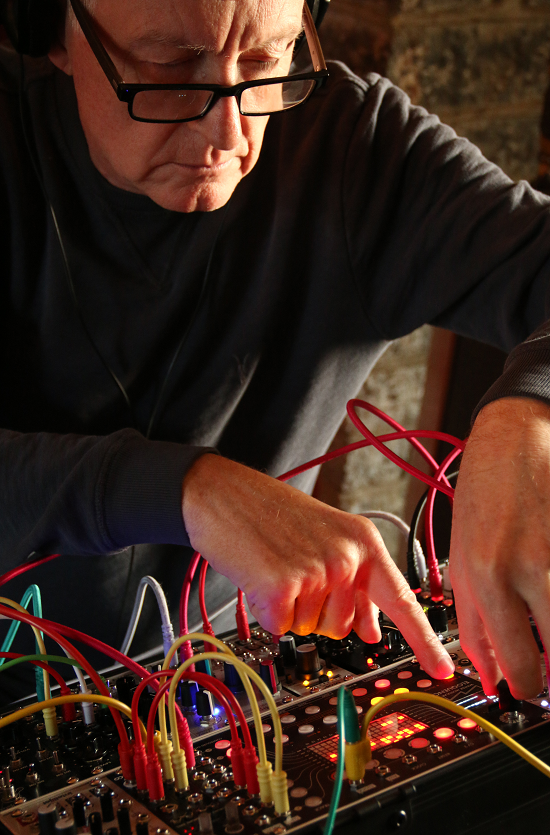
I don’t have an end in sight when I start with the modular, I just start with a blank canvas, you start plugging, something starts to happen, then it inspires the next step. It’s that hypnotic quality that Steve talks about that I really like. Especially in the last year under lockdown, I’ve spent the most time I have with it ever, it’s really helped me actually. I’m still working, running the label during the day, then in the evening I just plug a few things in and let it buzz away. It’s really good therapy.
SD: You just need knowledge, you don’t need any dexterity. It’s a different type of instrument, and for that reason it opens it up to a lot of people.
Both of you also have ongoing collaborative modular projects, Steve with The Utopia Strong and Daniel with Sunroof. What about the modular synth as a collaborative instrument?
DM: It has potential to be collaborative as much as any instrument, it’s more about your mindset. Gareth Jones, who’s the other half of Sunroof, and I have worked together for 35 years. It’s the same with a lot of instruments, you get things going then you start playing off each other, and then somebody creates a sound or a rhythm or a sequence, then you build on that. Gareth and I is more like jazz I suppose, the process of people playing off each other, it’s all improvisation.
Didn’t you once try and collaborate with Jools Holland in the 80s, Steve?
DM: I really have to know more about this…
SD: Yamaha had sponsored a snooker event. I was going to Ronnie Scott’s a lot back then, so I thought ‘I want to learn how to play the piano,’ as if it’s that easy. I was in Sheffield at the snooker event, and instead of going into Warp Records in Division Street I hired this guy for a couple of piano lessons, who taught me some scales to practise. I went off and ended up buying a Yamaha CP80 and had it in a terraced house underneath the stairs. I don’t know why but I also tried to play the harmonica. The end result was that for some reason, Jools Holland’s ‘people’ got in touch with my ‘people’ and said, ‘Jools wants to come round to have a jam and make a record’. The next thing is, Jools knocks on the door, he sits down and plays the CP80 Electric Grand, I get the harmonica out, and we try and make some music. He must have thought, ‘What the fuck am I doing here.’ I don’t know if he had a dip in his life, but it was when he was between bands I’m sure. He was probably searching for other directions. We wished each other the best of luck, it was never going to go anywhere. I think that probably cemented the fact that I was not going to play a musical instrument. I was quite happy bumbling along going to gigs, until I saw this modular synthesiser. I don’t know if Jools has ever gone down the modular road…
DM: I don’t know if you can do boogie woogie piano on a modular…
SD: So you were first into the semi-modular, when was that?
DM: I think it was 1979
SD: That was really early on, before it went digital…
DM: Long before. My first synth was a second hand Korg 700S, which is what I made my first record on. That record did OK, and I saw an ARP 2600 for sale in the back of Melody Maker, it was a reasonable price so I went along to a huge warehouse full of equipment. It was Elton John’s equipment they were selling off after a massive world tour, so I got Elton John’s ARP 2600. I’ve still got it. When I started working with other musicians, producing bands like Fad Gadget and Depeche Mode, I used it a lot on those records then as time went on and we were able to afford to get more things I got into the Roland System-100M. When VSTs started coming out, I thought ‘God, I can have my whole studio on the laptop.’ I was completely obsessed with the software. Until recently I’d been travelling a lot for various reasons and in theory to have my studio in my laptop was an amazing concept, but I didn’t really enjoy it that much. It’s all about the hands-on, physical aspect of electronic music that makes it especially enjoyable. It becomes a living organism. You touch one fader or one knob and the whole thing changes. Steve, how did you first get into it? Who introduced you?

SD: I went to Café Oto to see a band that the Quietus had just put out on their label, called Chrononautz. They were having a record launch party, Chrononautz were the second band on, the headliners were Sly And The Family Drone, who as usual ripped up the place, then the first act were Hirvikolari, which had Mike Bourne of Teeth Of The Sea playing modular synth. I was transfixed. Next thing I knew I was seeking out buying one. It took time before I got to grips with it, but I started to learn. Then it’s like peeling the onion, it’s more fascinating the more layers you peel.
DM: I’m interested to know if your snooker playing informs the way you work with modular in any way. I don’t know anything about playing snooker, but I assume you’re constantly thinking ahead.
SD: I feel like I’m a different person when I’m doing music. Playing snooker’s all about body awareness, you’re always aware of exactly how you’re standing and how you’re feeling, trying to get the cue to go through. It’s not as defined as chess, if anything you’re much more improvisational playing snooker. You play a shot and you know, as long as you get the white ball in that area, that’s a good area for continuing the break and scoring more points. You’re just trying to get this white ball into an area for your next shot. Maybe professional musicians might see it as similar thing to this, but I can’t see it at the moment. Maybe as I get a bit more in tune with where the wires go…
When I interviewed you with The Utopia Strong in 2019, you said the most immediate difference you noticed moving from snooker to musicianship was having to haul your own gear around.
SD: The snooker cue was a liability on an aeroplane but it certainly wasn’t as bad as the pole vaulter. Some modular stuff is manageable, you can get that in one bit of hand luggage.
DM: I would never put it in the hold. Never check in a modular. That was my priority when I was looking for a case.

Steve Davis with DJ partner and Utopia Strong bandmate Kavus Torabi
SD: Snooker cues are no longer allowed on aeroplanes; we have to check it into the hold. You could have somebody’s eye out with it. I feel aggrieved that guitarists seem to be able to take their guitars on, the musicians union lobbied or whatever, a guitar would be much more dangerous than a snooker cue.
DM: Just think of the double bass players, they have to book an extra seat.
SD: Any electrical item you take through as hand luggage, every now and again they want to prove that they work. Imagine you get to the airport and they say ‘what’s all this,’ and you’ve got to plug it in and prove it to the guy that’s searching you, and under pressure patch it up and make something that doesn’t sound awful. If it sounded awful you’d say ‘obviously there’s something else going on here, that isn’t music!’
DM: I live in Berlin now, when you go through security they just look at you and go ‘oh, another modular. Next!’
SD: Back in the day a lot of snooker players played with one-piece cues. I was in America playing a one off showcase thing, and I was in the hotel lift with my cue case which is about 5 foot long. I had a dress suit on as well, a three-piece suit, jacket and bowtie. When the American guy in the lift asked what was in the case I managed to convince him that I was in the band playing in the hotel lobby and it was a bass harmonica.
Earlier you mentioned that modular synth playing’s been therapeutic during the trials of the pandemic. Have your relationships to music changed over the last year?
DM: God yeah. There’re obviously no gigs so I spent more time in the studio. Through the label, seeing how musicians are coping with it in different ways, that’s also been very interesting. Generally speaking, it’s been very positive the way they’ve responded. We work with a few DJs who also make records. In the old times they were always out and about, and it was quite hard to get a record out of them. Now that they’ve been stuck at home for a year, they’ve come up with some really great things that you wouldn’t necessarily expect. They’re not just focussing on ‘can I play this out or not, will this track work in a club,’ they’re thinking in a more general musical sense. On the other hand there’s also people we work with who just haven’t been able to work at all because they work with live musicians. It’s been very sad, very frustrating.
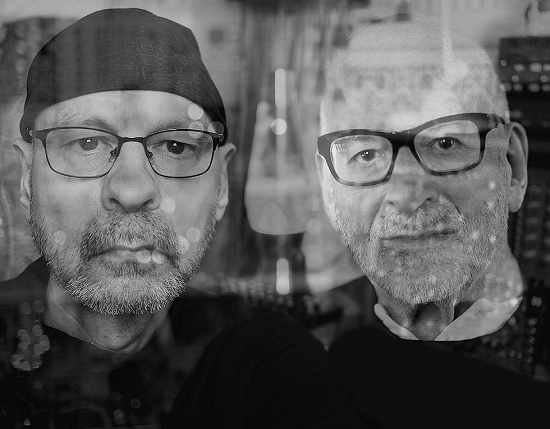
Daniel Miller (R) with Sunroof bandmate Gareth Jones. Photo by Diane Zillmer and Gareth Jones
SD: A lot of people that I’ve spoken to have said that even though they’ve had so much time, it’s still not been the right headspace for them to make music. I remember thinking I’d do a lot more, but early on in lockdown I just sat staring at walls. I don’t think anyone should beat themselves up. You need something to aim for, something coming up. Everything’s in limbo, hopefully by the back end of the summer, once there’s something booked for a musician, the enthusiasm will come back.
DM: I’m very curious to know how it’s going to be in clubs. I think for a while people are only going to want crazy fast ravey stuff and very hard techno to get it out of their system.
The Utopia Strong managed to play a social-distanced gig with Teeth Of The Sea in that weird winter lull before the third lockdown. What was that like?
We just felt lucky that we’d sneaked one in! Everyone was delighted to be out, The Clapham Grand theatre is quite an amazing place to play. We were the first thing they’d done in months, and unfortunately because things hadn’t been well-oiled the heating wasn’t working. We had to supply blankets to the crowd. Then, all of a sudden, they locked things up again.
It was nice to do one, but every show is nerve wracking. I thought I’d finished being nervous in my life when I retired from snooker. It’s something I’m never going to get used to. It’s the same butterflies in the stomach as with snooker, but it’s more of a journey into the unknown for me. I did know what I was doing exactly with a snooker cue. With a modular it’s like a runaway horse, you’re just trying to hold on to the reins.
DM: And when you’re playing live, especially solo modular, you have to keep it moving, you have to keep it interesting.
SD: I’m looking forward to at some point watching Daniel play solo. It would be good to start up some kind of modular meet somewhere, I don’t know how many there are in the London area…
DM: Funnily enough we have been talking about it. Andy Fletcher from Depeche Mode owns a pub and we were thinking about doing some modular events down in the basement. It’s usually a jazz club and only holds about 50 people, which is perfect. Maybe we could collaborate Steve!
Steve Davis and Kavus Torabi’s book ‘Medical Grade Music’ is out now via White Rabbit, and can be found here. Daniel Miller and Gareth Jones’ new album as Sunroof, ‘Electronic Music Improvisations Vol. 1’, is released on May 21 via Mute’s Parallel Series and can be pre-ordered here.