

There is a moment in DC’s disastrous Batman v. Superman film of 2016 when the camera pans out from the bright lights of Metropolis to reveal the lurking presence of shadowy Gotham City right by its side. It’s a moment that brings the Manichean backbone of the superhero universe into stark relief: good and evil, the light and the dark, made physical in the gleaming spires of one city and the blackened smokestacks of the other.
In his 2009 novel, The City and the City, British speculative fiction author China Miéville showed the duality of every city, how these two sides of any urban centre can inhabit the very same space, overlapping and superimposed, the one upon the other, with the residents of each scrupulously unseeing the other. But the DC universe splits these two sides topographically and divides them by a river, as if for analytic purposes.
On one level we know that Gotham and Metropolis are both representations of New York, a kind of oneiric wish-fulfilment that the big apple’s crime and its glamour might be separated, that the messiness of cities might be made clear. They are cities that could only be fantasies, projections – just as Smallville, Superman’s putative hometown, could only exist in the form of a nostalgic memory.
The Marvel universe is different. Spiderman grows up in Queens, with all its local colour, contradictions, and diversity. Captain America is from the Lower East Side. Tony Stark is a native of Long Island. Bruce Banner, The Hulk, was born in Dayton, Ohio. Hawkeye is from Waverley in Iowa. Each one a real American city. Only when Marvel’s characters travel overseas do we enter fictional spaces: the anonymised Eastern European state of Sokovia, a kind of grim repository for all the West’s fantasies about the East, the meta-Balkan Transia, and, of course, Wakanda.
Though we might easily see the accumulated prejudices that make up Sokovia, the sedimented preconceptions enumerated by Agata Pyzik in her book Poor but Sexy that seem inevitably to draw Europe’s East, in the eyes of its West, as “in love with feudalism and despotism, subjugational, undemocratic ‘by nature’”; Wakanda, the fictional location of the vast majority of Marvel’s new Black Panther film, seems initially to be a more complex situation. Not just another “shithole country” in the midst of a “savage dark continent”; Wakanda is a pan-African utopia, a high-tech “El Dorado”, as Andy Serkis’s Ulysses Klaue here calls it, transposed from South America to the shores of Lake Turkana.
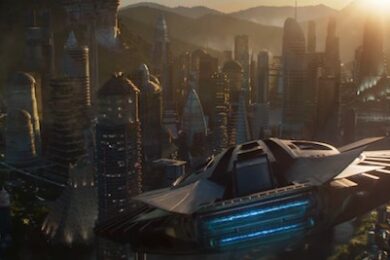
In Ryan Coogler’s film, Wakanda appears as a kind of subtropical Gulf megalopolis, all angular chrome skyscrapers and neo-expressionist organic hybrids seemingly airlifted from Dubai, London, or Beijing, and set amongst buildings based on Southern African rondavels. But when it first appeared in print, in July 1966’s Fantastic Four number 52, Wakanda is a “world of sheer wonderment”, surrounded by mechanically-controlled jungle foliage, with King T’Challa’s own apartment, a space-age bachelor pad “even Hugh Hefner couldn’t improve on”. There’s an element of the quasi-mystical hipness eulogised in Norman Mailer’s The White Negro. The name ‘Wakanda’ is unfortunate, recalling the murderous Congolese tribe – the Wakandas – in Edgar Rice Burroughs’s deeply problematic (1915) novel The Man-Eater.
Though the Black Panther comics would have to wait for Billy Graham’s tenure at Marvel in the mid-70s before an African American artist would take up the hero’s authorship, it did not take long before American and European readers of African descent began to take a degree of ownership over the character. Roughly contemporary with the Black Panther’s illustrated origins, the British cultural theorist Stuart Hall would develop a new model of media consumption whereby audiences would no longer merely passively receive texts, as if by hypodermic syringe, but would play an active role in “decoding” mass communications – sometimes in ways quite opposed to their author’s intentions. In the Financial Times recently, broadcaster and former ICA director Ekow Eshun describes how, growing up in a 1970s Britain whose dominant narrative regarding Africa was still defined largely by “mud-hut-dwelling natives”, the Black Panther and other comics characters helped him to see that “being black could be its own kind of superpower.”
Much as all Marvel films now are condemned to suffer under the burden of multiple endings, Ryan Coogler’s film begins, effectively, twice. This superhero origin story is given two origins. There is first the beginning as mythological fantasy, immediately followed by a more recognisably real-world beginning, the founding trauma tentatively screened by its dreamlike predecessor. In contradistinction to the opening’s vague distant past, this second foundation takes place in a specific place at a specific time: a cramped apartment in Oakland, California, in 1992. This spatio-temporal locus is significant, acting as a knot that ties together multiple histories, both political and personal.
It was in 1992 that Wesley Snipes first proposed a Black Panther film, a year after the racist beating of Rodney King spurred riots down the coast in Los Angeles. Coogler himself was born and raised in Oakland and probably first discovered the Black Panther comic character in his local comic shop in about 1992. As well as the birthplace of Ryan Coogler, Oakland, California, was also the home of the Black Panther Party. And it was from an Oakland apartment very much like the one depicted in the film that bandleader Sun Ra was unceremoniously ejected following a disagreement with Black Panther Party founder Huey Newton, twenty-one years earlier in 1971.
By that time, Ra had already been supplementing performances by his Arkestra with a personal mythology every bit as speculative and elaborate as that underpinning Black Panther for close to twenty years. Where Coogler’s film explains the powers of his hero with a story about ancient aliens depositing stocks of vibranium in Wakanda, Sun Ra had come to see himself as a native of Saturn. He encouraged his band to “think space … to expand beyond the earth plane” and infuse their playing with that kind of out there sensibility. Through interviews, record sleeves, and song titles, Ra elaborated what he described as an “astro-black mythology” combining Egyptian mythology with science fiction and black history.
“African Americans, in a very real sense, are the descendants of alien abductees;” wrote Mark Dery in 1994, “they inhabit a sci-fi nightmare in which unseen but no less impassable force fields of intolerance frustrate their movements; official histories undo what has been done; and technology is too often brought to bear on black bodies (branding, forced sterilization, the Tuskegee experiment, and tasers come readily to mind).” Dery coined the potent neologism “Afrofuturism” to describe this blend of African-American themes and twentieth century technoculture, drawing together the imagery of musicians like Sun Ra, Lee Perry, and George Clinton, authors Samuel Delany and Octavia Butler, films like Brother from Another Planet and Lizzie Borden’s Born in Flames.
In his 2003 essay ‘Further Considerations on Afrofuturism’, Kodwo Eshun would link Sun Ra to a seam of ‘afrophillia’ arising in the popular consciousness between the Black Power of the 1960s and the Pan-Africanism of the 1970s. Ra’s lifework, Eshun wrotes, “constitutes a self-created cosmology” establishing an “oscillation between preindustrial Africa and scientific Africa”. With its technological utopia hiding behind a veneer of simple agrarian culture, its high-rise rondavels and weird mix of ancestor worshipping magic and future tech driven by alien power sources, Black Panther inhabits precisely this interval. And if the joins between the preindustrial and postindustrial might occasionally risk exposure, it’s the brilliant soundtrack by Kendrick Lamarr and Ludwig Göransson, fusing thumb pianos and drum choirs with trilled electronic hi-hats and digital sub-bass, that sells it. “What is the power of your machine?” a voice asks Sun Ra in his (1974) film Space is the Place. “Music,” he answers. Coogler’s Wakandans, likewise, control their public transport with “sonic stabilisers”, fight with “hand-held sonic cannons”.
But Ra’s outerspace ecstasies would also set him into conflict with one of the era’s other major proponents of black nationalism and black power. The Black Panther Party were formed in Oakland, California, in October, 1966, just a few months after their namesake made his debut in the pages of a Fantastic Four comic. Quasi-militaristic in dress, fiercely anti-imperialist in outlook, the movement’s founders Huey Newton and Bobby Seale took the group’s name not from the young superhero but from the logo of a Mississippi activist group, the Lowndes County Freedom Organization, organised by civil rights leader Stokely Carmichael.
Though there would appear to be no direct connection between the original Black Panther comic character and the Black Panther Party, in a recent fan comic Seeking the Black Panther James Gunderson, Ivan Brandon, and Eric Battle re-imagine the comic character’s origins by picturing Marvel artist Jack Kirby passing through Lowndes County immediately before coming up with his new superhero. What is sure is that the historical conditions that made one possible led equally to the other: the civil rights movement, Malcolm X, the Watts riots. As Cathy Thomas, one of the curators of a 2017 exhibition at UC Santa Cruz, put it, “You have to imagine Stan Lee and Jack Kirby in their office in the garment district.… There is no way that Stan Lee, a Jewish man who had changed his name [from Stanley Martin Lieber] in order to be employable, is not thinking of these things.” And Coogler’s film implicitly draws on this connection, by starting his film in Oakland and posing his lead actor, Chadwick Boseman, on a throne for the movie poster in a shot seemingly making reference to a famous photo of Huey Newton.
As University of North Carolina professor Daniel Kreiss has argued, the Black Panther Party and Sun Ra both sought to appropriate technological artefacts and liberatory rhetoric. They shared a desire to use performative strategies to change consciousness. But their different approaches – the one militarised and community-based, determinedly terrestrial, eschewing space exploration as a coloniser’s distraction; the other pacific and utopian, cosmos-bound and through with an Earth society that leaves no place for people of colour – would ultimately prove irreconcilable, resulting in Ra’s eviction from the Panther residence in Oakland in 1971. Black Panther, the film, can then be seen as an attempt to reconcile these linked but opposing currents of mid-twentieth century black liberation.
Having established both the mythological and real-world origins of its characters, Black Panther soon takes us to London where Michael B. Jordan’s Eric Killmonger is pulling up a curator at the “Museum of Great Britain” on the colonial origins of their African artefacts exhibit. It soon becomes clear that Killmonger is in cahoots with the evil Ulysses Klaue, on a mission to steal the Museum’s (stolen) Wakandan treasure. The violence in this scene is intended to establish Jordan’s character’s bad guy status. But after he has so successfully handed the museum curator her arse on a plate, it’s hard not to feel sympathetic to his character.
In a way, the structural weakness of Black Panther is also one of its strengths. The standard scene-chewing movie baddie, Klaue, is disposed of early on, and we are left with the far more ambiguous character of Killmonger as antagonist. The hero T’Challa and his opponent then represent less the forces of good and evil in the traditional Manichean stand-off, more different approaches to national sovereignty: the one instinctively isolationist, the other internationalist, keen to use Wakanda’s power to help the global African diaspora. Though the film may end with the death of one and the victory of the other, it is only by adopting some of Killmonger’s global perspective that he is able to newly re-unite his fractured kingdom. We are a long way from the binary city of Gotham and Metropolis.
If we accept, then, as the film hints with its frequent references to Oz and to fairy tale kingdoms, that Wakanda is a fiction, a dream world, that there is no Black Panther, what, finally, is this film about? Arguably, it is a film about America, a warning against the nation’s current inward turn with all its fantasies of border walls and “terrorist” outsiders. More important than what the film intends to say to its audience, however, is what that audience will do with the film in turn. As Carvell Wallace argued in the New York Times before Black Panther‘s release, “The film arrives as a corporate product, but we are using it for our own purposes, posting with unbridled ardor about what we’re going to wear to the opening night, announcing the depths of the squads we’ll be rolling with, declaring that Feb. 16, 2018, will be “the Blackest Day in History.”"
Black Panther is at cinemas now