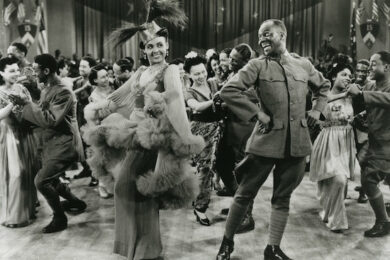


“Celebrating the magnificent contribution of the colored race to the entertainment of the world during the past twenty-five years.” A flyer with that enthusiastic pronouncement is just about the first thing you see in Stormy Weather. Released July 21, 1943, the movie, along with Cabin in The Sky from April 9 of the same year, are two of the most striking showcases of Black talent ever released on film. They remain a stunning testament to Black artistry—and a painful reminder of limits on Black art, which still have not been fully lifted.
Vincente Minnelli’s feature debut Cabin in the Sky is a filming of the 1940 stage play. It stars Ethel Waters as Petunia Jackson, a godly woman trying to save her basically decent but weak-willed gambler husband Little Joe (Eddie “Rochester” Anderson). The devil’s minion Lucifer Jr. (Rex Ingram) sets himself to fetch Joe’s soul to Hell despite Petunia’s prayers, enlisting in the task the decidedly ungodly Georgia Brown (Lena Horne.)
The movie’s censorious morality can be cloying—but part of the fun is watching the wonderful, knowing performers tear through the flimsy sackcloth the plot attempts to drape over them. Censors cut out Horne’s big bubble-bath number, but the actor is determined to make up for the excision; every scene she’s in is a poem of sensuous innuendo. The sequence in which Lucifer Jr. lies on her bed, “influencing” her to dress up in her half shirt, put on her best perfume, and “mosey” out to tempt Joe, is simultaneously ludicrous and hot enough to melt celluloid.
Ethel Waters as Petunia, though, goes that one better, tossing aside her modest domestic churchly attire in the finale for a glittery dress and a high-kicking, hip-swivelling dance that suggests twerking to come. Not to be outdone, the Duke Ellington Orchestra provides the background for a brilliantly choreographed dance scene in which patrons swivel and grind their way from the sidewalk into Jim Henry’s Paradise, a club of iniquity and sin.
Minnelli also, rather unbelievably, cut out Louis Armstrong’s solo set-piece; we only see him play the trumpet for about 30 seconds. Still, he manages to steal the show as one of Lucifer Jr.’s henchman, boasting in that gravelly voice about inventing the apple that tempted Eve and chuckling as he assures his boss that rich men always go to Hell. He’s almost impossibly charismatic. Armstrong appeared in many films, but rarely got a chance to stretch out in comic roles. That was very much cinema’s loss.
Cabin in the Sky has wonderful set pieces stapled to a not especially engaging plot. Stormy Weather avoids that problem by the simple expedient of being nothing but set pieces. The film is a kind of biography of Bill “Bojangles” Robinson. There’s almost no narrative though; it’s just one musical number after another—20 of them in a 78-minute film.
Fats Waller, who died soon after the release, gets a couple of numbers; his eyebrows are so eloquent you more than half expect them to take off and talk up the chorus girls on their own. Cab Calloway appears in full zoot-suited splendour, belting out hep jive at roof-sundering volume. Katherine Dunham and her troupe perform a quasi-ballet, capturing the title song’s bruised longing—the closest thing in the film to an acknowledgement, albeit an oblique one, of racial injustice.
The show-stopper, though, is an acrobatic tap routine by the Nicholas Brothers. Fred Astaire said that their performance was “the greatest movie musical number [I] had ever seen,” and it hasn’t been surpassed since. Leaping over one another to land in perfect splits over and over is impressive enough, but they perform each gasp worthy feat with matchless elegance. It’s kinetic, spectacular, and beautiful.
Cabin in the Sky and Stormy Weather feel like they’re just about to burst with talent. Both feature giants of Black music, theatre, and vaudeville piled one on top of the other, surging out of bit parts to dominate the screen for a set piece— Bubbles Sublett with a late tap routine in Cabin; Mantan Moreland and Ben Carter with a interrupted talk comedy sketch in Stormy Weather—before making way for the next world-class performers.
The density of genius is what makes both films so indelible, but it’s also a kind of indictment. So many Black performers were available for relatively small parts, because the opportunities for high-profile Hollywood appearances in respectful settings were rare. And even Stormy Weather, for all its classy trappings, wasn’t all that respectful. Director Andrew Stone reportedly disliked the Black performers, and berated Lena Horne in particular. Her experience on set was miserable, and the film’s success didn’t propel her to better roles.
The two films underline Hollywood’s racism in other ways, too. They show the undeniable, overwhelming superfluity of Black talent and vision in the arts. That talent and vision could express itself in music, dance, comedy. Movie-making, though, requires an enormous capital investment. Funders tend to be white and wealthy – Black people were shut out of those networks. You look at the Nicholas Brothers, or Louis Armstrong, or Ethel Waters, and you wonder—how many Black filmmakers of equal talent never shot a frame because racism, which could not completely block off access to all the arts, came close to blocking off access to this one?
Things have changed now, somewhat. Gina Prince-Bythewood, Ryan Coogler, Barry Jenkins, Steve McQueen, Spike Lee, Boots Riley, Jordan Peele, Nia DaCosta—there are many important and influential Black directors. And yet, music remains less capital-intensive and more open to Black performers, from Beyoncé to Rihanna, the Weeknd to Cardi B, Lizzo to Janelle Monáe to Lil Nas X. 80 years is a long time, but not long enough to change the dynamics of class and race, which continue to make film relatively inaccessible as a medium to Black people, no matter their genius. Stormy Weather and Cabin in the Sky are celebrations that Hollywood still, eight decades on, doesn’t quite appreciate, or deserve.