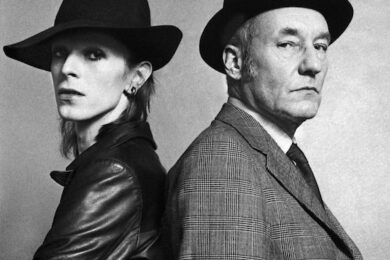


The most transgressive of Beat-era authors, William S. Burroughs was an animating and enigmatic force behind the evolution of rock & roll in the 20th century. Although professing little interest in music, he nonetheless served as a catalyst in the creative and personal lives of The Beatles, The Rolling Stones, Bob Dylan, Lou Reed, Patti Smith, David Bowie, and Sonic Youth, among many others. He eventually became something of a rock star himself — in addition to his own audio releases, Burroughs also collaborated with the likes of Kurt Cobain, Ministry, Tom Waits and R.E.M.
Books like Junkie, Naked Lunch and The Wild Boys not only blew minds in the 1960s and 70s, but subsequently inspired many of the post punk and industrial acts to follow. Burroughs’ audio experiments helped bootstrap sampling culture, and his spoken word archives remain catnip to hip hop and electronic producers. His influence is surprisingly pervasive, though to some extent subliminal. Burroughs once posited that language is a virus, so it is perhaps fitting that his wry prose and nasal whine have infected artists across space-time. The full story of his influence on music culture and more is told in my book, William S. Burroughs And The Cult Of Rock ‘n’ Roll.
Burroughs’ biography is as infamous as his novels. A homosexual drug addict from America’s Gilded Age who killed his wife in a drunken game of William Tell (officially ruled an accident), he spent many years abroad, with stays in Tangiers, Paris and London. Burroughs claimed his work was a means of exorcising an ‘Ugly Spirit’ inside him. But this wasn’t some self-help trip: his real battle was against an insidious force he called Control. In Burroughs’ estimation, “Word” is one of Control’s primary means of enslavement, to be subverted with the proper mindset and the right tools. An Underwood typewriter and a pair of tape machines were his go-to weapons (he liked guns, too), supplemented with a steady diet of opiates and alcohol. Burroughs was deeply committed to what is best described as a mixed-media occult practice. He believed that the randomisation and ‘playback’ of audio could at least momentarily disrupt Control, and perhaps alter past events or even predict the future. "This method is of course used in music, where we are continually moved backwards and forward on the time track by repetition and rearrangement of musical themes," he said.
Burroughs made extensive use of the so-called cut-up method. The original approach involved slicing up pre-written text from one or more sources into quadrants and rearranging the pieces at random. He would invite the arbitrary into his audio experiments, some of which were conducted on tape recorders provided by Paul McCartney in a flat owned by Ringo Starr. For Burroughs, cut-ups were both a means of creative production and a scrying mirror — as Bowie put it, "a kind of Western tarot". A plethora of artists from the Rolling Stones to Radiohead have experimented with cut-ups in their music. And whether they know it or not, today’s ’Tubers, who feverishly mash-up any and all media, are Burroughs’ direct descendants. Actually, the internet is the ultimate cut-up, with a properly Burroughsian dark side. The author envisaged a coming age where "small units of word and image" would be weaponised and communicated electronically. Welcome to the meme wars, here’s your avatar.
Though he’d hate to be called an ‘influencer’, Burroughs was sought out by other creative minds right up to his death in 1997 at age of 83. I first encountered Burroughs sometime in the late 1980s, via albums containing his various readings and spoken word experiments. There was, of course, generational reinforcement through bands like Sonic Youth, Ministry, and Nirvana as well as movies like Drugstore Cowboy, in which Burroughs made a memorable appearance. When I set out to write this book some three decades later, I was again struck not only by Burroughs’ connections to highly influential artists, but also his many direct contributions to audio culture. What follows is a survey of key releases featuring William S. Burroughs, the recording artist.
William S. Burroughs – Nothing Here Now But The Recordings
This collection of sundry audio experiments was originally released in 1981 on Industrial Records, the label of noise trailblazers Throbbing Gristle (and was more recently reissued on the Dais imprint). Here Burroughs’ sandpaper incantations are interlaced with disembodied broadcasts and so-called ‘electronic voice phenomenon’, or EVP. The overall product is disorienting and can hardly be described as musical. Still, one can see why Patti Smith referred to Burroughs as "a shaman… someone in touch with other levels of reality".
William S. Burroughs – ‘A Thanksgiving Prayer’ from Dead City Radio
Dead City Radio was the brainchild of the late Hal Willner, a brilliant curator of the peculiar who also produced sketch music for Saturday Night Live. In the late 1970s, Willner visited Burroughs in The Bunker, a windowless apartment in Manhattan’s seedy Bowery neighbourhood that the author called home. "Within an hour or two we were getting into some insane subjects", Wilner recalled. "I saw him as true Americana… that he should be right up there in front of a map or a railroad track or a flag, as you might see John Wayne or Johnny Cash." Their drinking session inspired Willner to make a record with Burroughs as the featured performer. Standout tracks include the delightfully mordant ‘A Thanksgiving Prayer’, which features Burroughs’ expert diagnosis of American hypocrisy – delivered in a dry croak – juxtaposed with patriotic-sounding orchestration.
Ministry – ‘Just One Fix’ from ΚΕΦΑΛΗΞΘ
In 1992, Burroughs appeared on the Ministry album ΚΕΦΑΛΗΞΘ, aka Psalm 69, after leader Al Jourgensen managed to get permission to sample the author’s recordings. Jourgensen was effusive about Burroughs’ influence on his own work: "It was really invigorating because I was using the same cut-up method that he used, only I was doing it with music." Not long after, the band visited Burroughs at his home in Lawrence, Kansas to shoot some footage for the ‘Just One Fix’ video. That’s not all they shot. "He knew he had to do a video with us, and he already agreed to do it," Jourgensen recalled. "But he wouldn’t do it without drugs." When the Ministry front man informed him that he was indeed holding, Burroughs replied, "Come on in."
Various Artists – A Diamond Hidden In The Mouth Of A Corpse
The writer Norman Mailer once complained that Burroughs was able to elicit belly laughs from audiences by simply mentioning the weather, a testament to his sardonic delivery. Some of that laughter may have been reflexive, as Burroughs’ material is often as off-putting as it is funny. Still, he was an adept satirist with a great sense of timing for whom there were no sacred cows—one could see him sharing a bill with Lenny Bruce or George Carlin. Exhibit A: Burroughs’ contribution to A Diamond Hidden In The Mouth Of A Corpse, a 1985 collection assembled by longtime associate John Giorno, on which Burroughs holds his own alongside a who’s-who of the era’s musical underground. Even decades later, it’s fun to hear the author rasp his way through a few twisted texts, peppered with the kind of crowd guffaws that made Mailer so jealous.
William S Burroughs & The Disposable Heroes of Hiphoprisy – ‘Words Of Advice For Young People’ from Spare Ass Annie And Other Tales
In 1993, Burroughs participated in a collaboration few probably saw coming when he joined forces with the Disposable Heroes Of Hiphoprisy. MCs don’t come much more ‘dope’ than Burroughs, and as it turns out, his peculiar ‘rap’ works well over the buoyant beats to be found on Spare Ass Annie. With Hal Willner once again in the producer’s chair, the album includes such classic Burroughs routines as ‘The Talking Asshole’ and ‘Dr. Benway’. My personal favourite is ‘Words Of Advice For Young People’, in which Burroughs instructs the listener on how to avoid fools, hucksters and sundry psychic vampires. His rants are waggishly on-point: "If you’re doing business with a religious son of a bitch, get it in writing; his word isn’t worth shit, not with the good Lord telling him how to fuck you on the deal."
Tom Waits – ‘T’Ain’t No Sin’ from The Black Rider
In the early 90s, Burroughs wrote the text for The Black Rider — a theatrical collaboration with Robert Wilson and Tom Waits, which was eventually also released as a Waits solo record. A ‘magical fable’ that borrows from the story of Faust and echoes Burroughs’ accidental shooting of his wife, the stage version of The Black Rider is still performed around the world to critical acclaim. The album also holds up. On it, Waits’ carnival barker growl is buoyed by skeletal arrangements that split the difference between Kurt Weill and a noisy machine repair shop.
Standout tracks include ‘Just The Right Bullets’ a hoary romp about meeting the devil in the forest, and ‘Crossroads’, a metaphorical distillation of Burroughs’ own struggles with addiction. More unusually, Burroughs actually sings on one of the tracks — the standard ‘T’ Ain’t No Sin’ – in a charmingly creaky drawl.
Bill Laswell with William S. Burroughs – ‘Soul Killer’ from The Road To The Western Lands
In 1992, bassist and producer Bill Laswell released The Road To The Western Lands, based on the Burroughs novel. For much of his life, Burroughs was interested in Hassan-i-Sabbah, the ‘the Old Man of the Mountain,’ who once controlled wide swaths of the Arab world, using his cult of hashish-fuelled mercenaries, the Assassins. Sabbah’s motto, "Nothing is true; everything is permitted" was taken to heart by Burroughs, who repeated it often in print, interviews, and readings. In keeping with the source inspiration, Laswell’s compositions evoke vast deserts and shifting sands stained red with blood. The music is well suited to Burroughs’ bone-dry recitations, especially on the track ‘Soul Killer’, with rants about a high-level conspiracy to extinguish the souls of humankind using atomic weapons. “Look at the prison you are in, we all are in,” Burroughs venomously declares. "This is a penal colony that is now a death camp."
William S. Burroughs & R.E.M. – ‘Star Me Kitten’ from Songs In The Key Of X: Music From And Inspired By The X-Files
In 1992, R.E.M. experienced a blast of mainstream success with back to back albums Out Of Time and Automatic For The People. In between globe-spanning tours, the band found time to collaborate with Burroughs on a cover of their song ‘Star Me Kitten’ for a compilation album inspired by the hit TV show The X-Files. It works surprisingly well, in part because Burroughs’ recitation isn’t really so far apart from singer Michael Stipe’s low-toned mumble on the original. Actually, Burroughs sounds in his element reciting the lines, "You are wild and I’m in your possession/ Nothing’s free so, fuck me, kitten." One almost wishes he’d had a crack at ‘Losing My Religion’.
Laurie Anderson feat. William S. Burroughs – ‘Sharky’s Night’ from Mister Heartbreak
In 1984, Burroughs appeared on avant-garde heroine Laurie Anderson’s album Mister Heartbreak, his terse prose set against abstracted dance-pop. "And Sharkey says: ‘Deep in the heart of darkest America. Home of the Brave.’ He says: ‘Listen to my heart beat. Paging Mr. Sharkey. White courtesy telephone, please.’" Like her late husband, Lou Reed, Anderson was a dyed-in-the-wool Burroughs fan. "I heard him speak before I read his books, so it was that voice that grabbed me first, that high-pitched sound made of sharp gravel… There was something about him that was oddly familiar, and yet completely alien," she said. A couple of years later, Anderson copped a key Burroughs concept for ‘Language Is A Virus (From Outer Space)’ and invited the author to join her as an onstage performer for her Home Of The Brave tour, released as a concert video in 1986.
Kurt Cobain and William S. Burroughs – ‘The Priest They Called Him’
To Kurt Cobain, Burroughs was more than a droll dispenser of junkie wisdom. By virtue of the fact that he had survived, the wan seventy-nine-year offered a glimmer of hope to the troubled young superstar. Burroughs was someone who had experienced the ravages of addiction and notoriety and come out the other side, integrity intact. In 1992, Cobain sought out the older writer to work on a project. "I’ve collaborated with one of my only idols William S. Burroughs and I couldn’t feel cooler," he wrote in his personal journal. Their collaboration, ‘The Priest, They Called Him’, was released in 1993 on a 10-inch vinyl picture disc. The two-song set features Cobain’s junk-sick guitar weaving webs of feedback around Burroughs’ laconic croak. After Cobain came to visit Burroughs in Lawrence, Kansas, the old man remarked, "There’s something wrong with that boy. He frowns for no good reason." And yet, Burroughs maintained a soft spot for Cobain. For the musician’s twenty-seventh birthday on February 20, 1994, he sent a photo of Kurt taken during their visit, along with a painting the old man had made himself. A note in cramped handwriting read: "For Kurt, all best on 27th birthday, and many, many more."
William S. Burroughs And The Cult Of Rock ‘n’ Roll is published this week by White Rabbit