
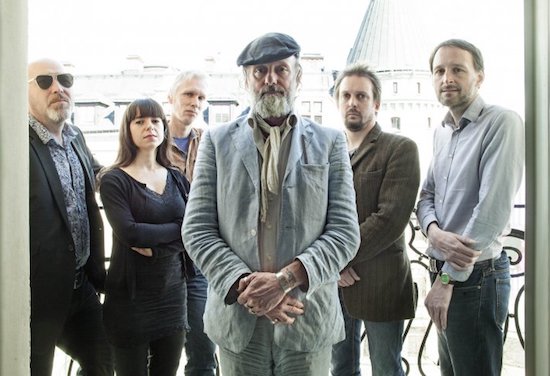
Portrait by Giulio Di Mauro
The world of Current 93 is a darkly splendid one. At its centre is David Michael Bunting, who’s better known by his Genesis P-Orridge given name, David Tibet. After four decades as the inner cog of the project, Tibet’s perverse vernacular has cemented him as one of the great unsung English poets. His lyrics are decadent and often esoteric, but at their core these songs are both beautiful and tragic. He writes words that are informed as much by gnostic poetry as the love and loss of his own pet cats.
Although born in Malaysia, Tibet’s music is very English and is primarily concerned with a queering of this supposedly idyllic landscape. In the world of Current 93, purity is spoiled by the pouring of blood and the presence of demons, in a sense which is both literal and metaphorical. In short they’re one of the most challenging groups of the modern world, with songs and albums densely littered with provocative allusions and secrets.
Although their primary and most iconic incarnation is often placed in the canon of neofolk, Current 93 have shifted through enough genres and aesthetic rebirths to match Bowie, and enough line ups to match The Fall. This perpetual shift in direction can make navigating through their vast back catalogue a daunting prospect, and though their prolific nature is admirable, it can be as much a burden as a blessing. After all, a wrong choice of first record could put you off for life.
Written about in David Keenan’s essential biography England’s Hidden Reverse, Current 93’s legacy is partnered with that of Nurse With Wound and Coil, dear friends and collaborators of Tibet. The book takes an unflinching look down the satanic and psychosexual back alleys of the English avant-garde. No amount of writing could ever truly expound the group and perhaps even Tibet himself couldn’t achieve that feat. Current 93 are a continuation of English folklore that deserves to be perverted by the passing of time. At the present time Tibet Resides in Hastings, and has just released a new album, The Light Is Leaving Us All on The Spheres.
Nature Unveiled (1984)
For the most part, labelling Current 93 an industrial group can feel reductive. The mid 80s was perhaps the only time in which this label was ever truly apt. Tibet had been a member of Psychic TV before forming Current 93 in 1982. The influence of bands like Throbbing Gristle and Whitehouse lay deep in the innards of their debut Nature Unveiled but Tibet doesn’t wallow illicitly in cliché. Instead, he forms a kind of ritual ambient. Monastic unholiness heightened by twisted Gregorian chants, his ostentatious delivery backed by the sinistrous sound design of Nurse With Wound’s Steven Stapleton. This partnership would henceforth become the bedrock of group. Nature Unveiled became the fons et origo of the signifiers that now define Current 93; the Crowlian ordena, the occult aesthetic, and above all the overbearing misery.
Swastikas For Noddy (1988)
As a child, my first understanding of racism came from Enid Blyton’s Noddy series. A disturbing effigy of ‘innocent’ little Noddy hosing down a ‘golliwog’ in order to cleanse them has been branded into my mind ever since. Noddy’s utterance of ‘ugly black face’ is inseparable from the character and series, making Current 93’s Swastikas For Noddy a perfect album for deeper reading. Tibet envisioned him crucified after taking acid with Rose McDowall of Strawberry Switchblade. Kicking off Tibet’s obsession with the character.
Like that vision, the album is stupendous and nonsensical, although not to its hindrance. In many ways, this is the one great oddity in C93’s discography and it is thematically erratic. On ‘Black Sun Bloody Moon’, Tibet paints an image of rampant deviance in which, “brother fights with brother, they butcher each other daughters and sons incestuously mix". The perversion continues with ‘Oh Coal Black Smith’ where he besmirches the traditional folk song ‘The Two Magicians’.
But the darkness isn’t constant. The rendition of Strawberry Switchblade’s ‘Since Yesterday’ is as kitsch as its source material. And there’s even a four to the floor dance beat at the beginning of ‘Beau Soleil’. It’s often called Current 93’s pop album, and while that might be a stretch, this record is easily their most irreverent.
Thunder Perfect Mind (1992)
Though the full peak of misery would arise later in Current 93’s discography, the story of Thunder Perfect Mind yields a potent sense of sorrow; immense sadness disguised by grandeur. The album is expansive and ambitious, yet deeply touching. This dichotomy may very well be deliberate. The record takes its name from the Gnostic poem, The Thunder Perfect Mind a work that itself deals in paradox.
‘A Sadness Song’ sees the woes of Tibet entwined with the death of all things: "When we touch the world and it falls away, when we feel that we’re born, just to fall apart." ‘The Descent of Long Satan And Babylon’ echoes the biblical Armageddon prophesied in the ‘Book Of Revelation’. Tibet’s own allegorical apocalypse is manifested in faux medieval folk songs; the music is ornate though unfathomably dark. ‘A Song For Douglas After He’s Dead’ is the most striking inclusion on the tracklist, in reference to the very much alive Death In June founder and ex-Current 93 member Douglas Pearce. The song makes frequent allusions to Pearce’s obsession with Nazism, pairing this fact and his subsequent departure from Current 93 as his metaphorical death.
If it wasn’t clear on Swastikas For Noddy the fact is cemented here – Current 93 are overtly anti-Nazi, unlike Sol Invictus and Death In June, groups who have clear neo-Nazi associations. ‘Hitler As A Kalki’ is dedicated to Tibet’s World War 2 serving father, while looking at the philosophy of Nazi activist Savitri Devi Mukherji who believed Hitler to be an avatar of the Hindu god Vishnu. In England’s Hidden Reverse, Keenan describes the song as “one of the most disturbing treatments of Hitler’s reign of terror to be put to wax”. This frightening climax of Thunder Perfect Mind: a record that’s the best way to familiarise yourself with the group.
Of Ruine Or Some Blazing Starre (1994)
“I have seen this world as a great howl of pain, I have seen this world as a great ocean of blood” declares Phoebe Cheshire atop the liminal drones of Steven Stapleton on ‘Moonlight’. This record is the aftermath, the ruins of Thunder Perfect Mind’s destruction. There’s an antithetical beauty to ‘Moonlight’ in spite of its lyrical cynicism. Its idea of beauty however is far from classical, it’s the kind of beauty you’d find when looking upon an unwithered animal corpse. Ghastly, but pure. These words define Of Ruine Or Some Blazing Starre. When the record’s beauty blossoms, Tibet feels warnful. I almost expect him to leap from the songs wearing a sandwich board that reads, ‘The end is nigh!’ But these readings are misleading; the message of fate is directed inward on Tibet himself, and the album primarily concerns self-struggle as opposed to a worldly one.
‘God Is Not Dead’ is climacteric in Of Ruine’s discourse. It’s a moment of hope on the ‘The Great, Bloody, And Bruised Veil And Bruised Veil Of This World’. A sad song made bonny by wispy chimes and the exquisite guitar work of Michael Cashmore. ‘All The World Makes Great Blood’ has a similar effect, furthering the image of the pretty world snagged with gore. Although similar to Thunder Perfect Mind, Of Ruine is no reprise. It peels away the former’s opulence leaving a solemn nakedness to David Tibet as a songwriter.
The Inmost Light Trilogy (1996)
The term castrato refers to a classical male singer whom is castrated before puberty, the process induces a quite literal vocal emasculation. One would be forgiven for assuming that the looming voice on ‘Where The Long Shadow Falls’ is that of a woman. In actuality it’s a sample of Alessandro Moreschi, the only known castrato to record as a soloist. This nineteen minute song is the first third of the much revered Inmost Light Trilogy, a phrase Tibet appropriated from an Arthur Machen short story to refer to things in and of themselves rather than their appearance to an observer. The aforementioned song and each track on The Inmost Light bestows upon the mind a sense of incertitude, a state in which perception and truth are disparate ideas.
The bulk of the trilogy is made up by it’s second part, All The Pretty Little Horses, an oddly structured albeit palatable mystic folk tale entangled with personal pain and grief. Pain exemplified exquisitely via the presence of death; ‘The Carnival Is Dead And Gone’, ‘The Bloodbells Chime’ and ‘The Frolic’. The latter, although an equivalent of the Thomas Ligotti story of the same name is itself singular. Exposing the dark side of the natural world, "The green of the grass and the blue of the sky are immense and terrifying." The song’s rural setting is tainted by the image of a dead child and writhing burning ants, hence removing the illusory twee costume British culture places upon nature.
In spite of its novelistic detail, this epic raises more questions than it answers by the end of its third and final part The Starres Are Marching Sadly Home. The androgynous Moreschi sample returns, but it’s obfuscated – a ghost. On the back end of the single track EP is the third and final of three renditions of ‘All The Pretty Little Horses’. The first is sung by Tibet, the second Nick Cave and third by Shirley Collins. The innocence of this lullaby drips red and this is the very of the essence of the Inmost Light, beauty and life are ensnared by mortality.
Soft Black Stars (1998)
The years 1992 to 2000 bookend a period of utmost brilliance for Current 93. By the late 90s, the group had masterfully created a middle ground between the anguish of Coil and the relative innocence of Shirley Collins. 1998’s Soft Black Stars sees the dense, esoteric references dissipate alongside the grand instrumentals. Excluding ‘Chewing On Shadows’, there’s no harpsichords, recorders or even guitars for the matter, just Tibet’s voice and Cashmore’s piano. There’s an impossible richness in the record’s bareness. The stakes of every line are high, yet not melodramatic. This is shown through faded memory on ‘A Gothic Love Song For N’: "Your fingers painted black, or blood red, I forget" and “Your letters came daily in French or in German but they meant to me nothing.” The trivial is mundane and yet still heartbreaking.
The release also deserts antiquity. The vividly painted setting is nocturnal present day London, the song ‘Antichrist And Barcodes’ is a perfect convergence of Tibet’s evangelical words with the modern world. Liz Harris’ 2014 release as Grouper, Ruins recalls Soft Black Stars sonically; it is tender and tortured; it feels eroded and desolate.
Current Ninety Three, Michael Cashmore & Christoph Heemann – Untitled (1999)
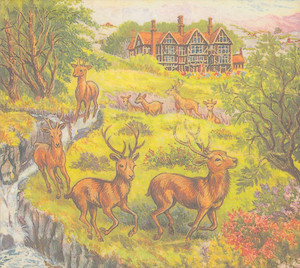
Tibet’s love of cats is potent. On ‘The Bloodbells Chime’ he struggles to accept the death of a feline friend. ‘The Cat Is Dead’, also an outtake from All The Pretty Little Horses continues on a similar tangent. The song truly is Tibet’s innocent pop song. It is unscathed by the impurity which surrounds it and for a moment the Magickal world becomes simply Magical. There is no recurrence on this compilation album, it consists of outtakes and discarded tracks from Current 93’s finest period. Fragile and obscured retellings of ‘Calling For Vanished Faces’, ‘All The Pretty Little Horses’, ‘Moonlight’ and ‘A Silence Song’ all appear. A charming collection, that betters the legacy of its surrounding records.
Sleep Has His House (2000)
Current 93’s music is never tethered to the kind of warmness and sentimentality that you can often find in modern folk music. Their songs are cold, disconcerting, sarcastic and a lot of the time disdainful. Interestingly, Sleep Has His House is less companionable with those descriptors, but it’s also their hardest record to penetrate. It’s dedicated to the memory of his Father, but not defined by that fact. ‘The Magical Bird In The Magical Woods’ is not only the best track on the record but also one of Tibet’s greatest odes, inaugurated with brooding harmonium which is the main constant on the album. His lyrics are distilled and his heart exposed: “By aimless pools with no surprise I counted the flickerings of your eyes And I saw the magical bird in the magical woods.” The song ends in a sound collage which seemingly foreshadows Coil’s Ape Of Naples, the tempered chimes are the closest he can get to the true sound of bloodbells. Magical, immense and frightening, these sounds are akin to the ambience of death itself.
Black Ships Ate The Sky (2006)
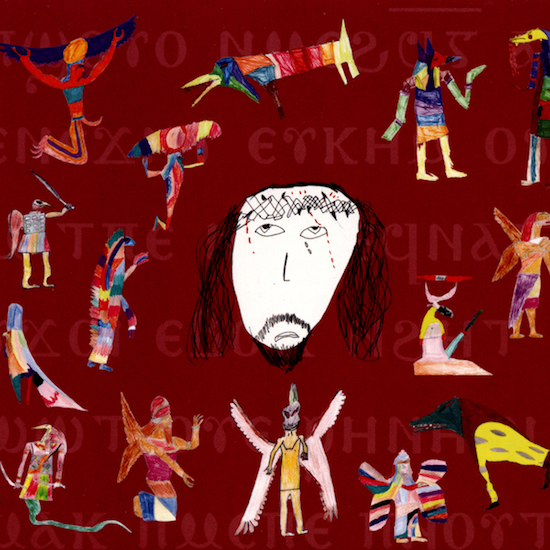
It’s quite astonishing that David Tibet’s divine spiels never become tiresome. A very distinct set of themes perpetuate in his lyrics. Love, grief, sin and sanctity are all mangled then reformed in a unique manner on each record. If their work was an anthology then it’s title would be Death. This fascination with the almighty end of existence is incarnate in the group’s late period gem Black Ships Ate The Sky. Charles Wesley’s Idumea is a recurrence, that’s recited by Anohni, Baby Dee, Bonnie Prince Billy and Marc Almond. These voices are engulfed by Tibet’s divine dystopia. This is a quintessential example of Current 93’s gift for collaboration, embellished by a vocal appearance from Cosey Fanni Tutti. The record feels climatic, even just in a titular sense. The phrase ‘Black Ships Ate The Sky’ is profoundly bombastic. A much more thrilling image of doomsday then the group had painted prior. It feels like a record that could perhaps exist in alternate gothic Hollywood, littered with cameos from the underground’s a-list.
Black Ships Heat The Dancefloor (2007)

Perhaps the biggest respite from the Tibet’s torment is Black Ships Heat The Dancefloor. It’s a surprisingly jovial reinterpretation of the prior mentioned Black Ships Ate The Sky. Tibet is topless on an inflatable on the cover that’s still packed with occult symbolism. A mischievous Matmos remix of Black Ships Ate The Sky stands out as a ravishing if also very cheesy excursion. There’s something truly delightful about Tibet wailing out "to be unborn" over an instrumental that amalgamates Acid era Psyhcic TV, Aphex Twin and mid 2000s Basement Jaxx. This short disruption in Current 93’s oeuvre is a ceasefire that brings up existential questions about the project’s purpose. One thing it does prove is is Tibet can match even the gloomiest times with levity.
The Light Is Leaving Us All is out now on The Spheres