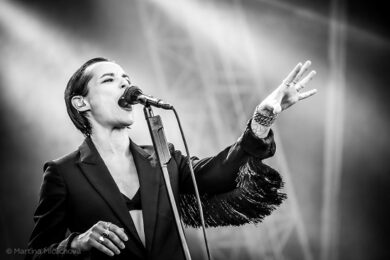
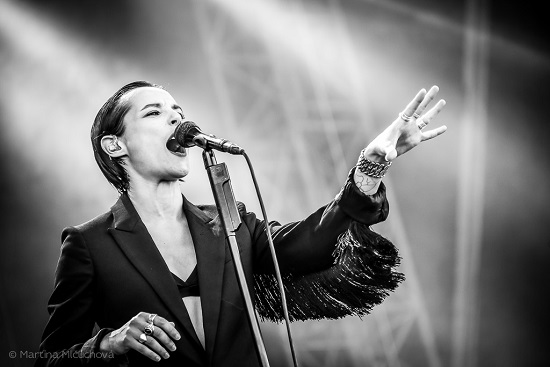
Photograph courtesy of Martina Mlcuchova
When you’ve grown up on an island, it’s easy to forget how straightforward it can be traversing the connected Eurasian landmass by road or rail. Certainly flying might not be the only option when you’re eyeing up prospective European cities to visit. Thanks to the Schengen agreement you can pass unimpeded from one state to the next, and you’ll only realise you’ve crossed a border when the language changes on the road signs, or the radio station tunes out. Bratislava, Budapest, Brno, Bucharest – they’re all options on the open road from Vienna International where I meet my pick up. We pass wind turbines spinning gracefully like ballerinas in red and white stockings on the border of Austria, and after a Euro house remix of ‘Flashdance… What A Feeling’ judders to its conclusion giving way to the news, I hear only one word in the broadcast that I recognise. Brexit.
The car circumnavigates Bratislava and we head for the city of Trenčín situated within a mountainous region near the Czech border. The Pohoda Festival is our destination. Pohoda caters for 30,000 punters yearly and has a fine reputation for cutting edge billings with a few big beasts thrown in, rolling out the carpet for Pixies, Pulp, Lou Reed, Nick Cave and the Bad Seeds, Suede and a host of others in the last five years alone. This year PJ Harvey, Mbongwana Star and Savages (who we’ll come to soon) are among the fine performers. Slovakia’s showcase musical event is celebrating its 20th year, and the country itself has other good reasons to be in celebratory mood.
The landlocked 50,000km² republic has recently been awarded the presidency of the council of the European Union for the first time, a position it will hold from July until the end of December. A year from now, Great Britain is scheduled to assume the mantle – the first time since Tony Blair in 2005 – an eventuality that must now surely be in doubt. Slovakia joined the EU in 2004 and adopted the single currency in 2009. The recently re-elected Prime Minister, Robert Fico, is a recalcitrant former Marxist who pulled Slovakia out of Iraq when he was elected to office in 2012. He’s overseen economic prosperity unparalleled in the rest of Europe.
“Mr Fico cuts a neat, almost pugilistic figure,” according to the BBC, “like a retired boxer still drawn to the ring.” Fico is openly hostile to the Slovak press, having openly called journalists “pricks” and “idiots”. Last year he mounted a legal challenge against the European Commission’s plans to distribute refugees from the Middle East amongst the 27 EU member states, comparing the borders of Schengen to Emmental cheese. He’s reputedly not fond of Islam either; following the Paris attacks last November, Fico told the TA3 news channel: “We monitor every single Muslim in Slovakia.” Such sinister rhetoric is the kind you might expect from – god forbid – President Marine Le Pen post-May 2017 (I’m not ruling anything out at this stage), and yet he calls Slovakia’s accession to full EU status “a success story”. According to the EU’s website, as president of the council, Fico will oversee negotiations and the adoption of EU law, coordination of policy – including foreign and security policy – and the conclusion of agreements between the EU and other countries or international organisations. The UK has presumably passed up this opportunity next year. As David Cameron kept reminding us, “you can’t fight unless you’re in the room.”
European inclusivity is the name of the game at the Pohoda site. Over the weekend a Croatian and a Brazilian both independently ask me “What happened?” with regards to Brexit. There is no short answer. Hanging proudly outside the Europa arena – where I witness a resplendent Anna Meredith set – is a European Union flag with the europa.sk address emblazoned below the 12 stars. Across the site there’s definitely a sense of cooperation, a weekend-long utopian friendliness and an impressive lack of litter on the ground. It’s one of the cleanest and friendliest festivals I’ve been to, a world away from T in the Park, or even Reading, where I’ve seen 50 Cent, the Rasmus and Daphne and Celeste all bottled off stage for daring to be different. Such myopic intolerance used to merely be an undercurrent that was suppressed by the prevailing social order. Now the same pricks are emboldened enough to petrol bomb Polish residences and Halal butchers shops. Bigoted woman Gillian Duffy is no longer an anomaly; during the referendum debate there seemed to be an endless stream of disaffected voters espousing views far more extreme than Duffy’s with no shame or apology. There is no need to apologise for xenophobia anymore. The idiots aren’t just winning, they appear to have won.
During bleak times like these you need a bold, uncompromising, indefatigable band like Savages to reawaken your stifled inner optimism. When divisive slogans like ‘take back control’; ‘we want our country back’ and ‘breaking point’ have done so much damage, theirs – from ‘The Answer’ (“love is the answer”); ‘Adore’ (“I adore life”) and ‘I Need Something New’ – sound like passionate manifestos of positivity. Even the more prescriptive ones (Silence Yourself; ‘Shut Up’) are at least constructive. (‘City’s Full’, meanwhile, isn’t meant in the Nigel Farage sense). Savages are the kind of band who offer hope where there is none.
It’s their first time here in Slovakia, and they arrive in the Balkan sunshine so pallid, gaunt and draped in blackness that they appear as though they might burst into flames at any moment. Gemma Thompson hides behind shades to keep out the refulgent rays, Jehnny Beth has hair slicked back like Lestat, with violent white heels gleaming in the evening sunshine.

Photograph courtesy of Ondrej Koscik
“You say it’s impossible,” she chants on opener ‘I Need Something New’ as Thompson’s guitar groans with hostility, “Trying to make things possible / I’m trying my best / To make it possible”. The unyieldingness rarely, if ever, lets up.
‘The Answer’, ‘Sad Person’ and ‘Cities Full’ pulverise us into submission, while ‘Slowing Down The World’ delivers a groove with a thick, expansive layer on top that is imperious one moment, desperate the next. ‘When In Love’ is rousing, ‘Husbands’ frantic. Then on the sadomasochistic ‘Hit Me’ they go into yet another gear, the crowd responding with extravagant dancing and rigorous moshing. ‘No Face’ and ‘T.I.W.Y.G.’ are even more brutal, driven furiously forward by Ayse of Bass and Fay Milton on drums. Their collective tenacity is such that you do start to feel even the impossible would be achievable if others had half their commitment to shit-kicking.
Savages are without question the tightest and most impressively cohesive unit to emerge for a while – maybe this decade – and I can’t think of another that depends on the traditional four-piece dynamic that can even hold a candle to them. They sonically stretch far beyond the capacities of their contemporaries, and they play with a telepathic ease and alacrity that can only come from hard work and a powerful bond forged through unique collective experience. On their arrival into the public consciousness, some elements of the press predictably focused on the sisterhood aspect of their makeup, with few commenting on the fact they were a pan-European operation. Savages are an English band while the singer is a Frenchwoman who lives in London and runs a label out of Paris.
The freedom of movement we’ve enjoyed for so long, and the right to up sticks and make a living anywhere you want within the EU, is something we’ve simply taken for granted all this time. An English band with a French singer doesn’t seem that unusual to anyone, and nor should it, and yet it could become a lot more unusual in the future. Savages are the embodiment of European cordialité, and yet as a result of recent developments, bands of their ilk could quite feasibly become an endangered species.
Just this weekend, Brexit minister David Davis was making overtures that new arrivals in Britain between now and exiting from Europe may have to be repatriated. “We may have to say that the right to indefinite leave to remain protection only applies before a certain date,” he told a Sunday newspaper. A law recently passed by the government which became operable this April just gone, means non-EU migrants need to earn over £35,000 a year to qualify for permanent settlement in the UK.
The Guardian ran a feature in March about legal aliens who now fall below that threshold and may have to return to their countries of birth. Among them is classically trained musician Alyson Frazier from Washington D.C., who earns about half that amount as the co-founder of Play For Progress, a therapeutic music programme for refugee children. Although skilled professions like nursing are exempt from meeting this preposterously high margin, it is a disaster for artistic homogeneity. Most people in the arts can only dream of making that kind of money, unless they’re really lucky. And all this remember, from a land that has already been stripped of much of its arts funding over the last six years because of austerity.
Such philistinism from the current Tory administration is impeding cultural progress, and a cap on EU migrants in the future similar to the one placed on non-EU migrants currently, will strangulate artistic diversity in the UK yet further. In a few years from now, new acts hoping to emulate Stereolab, Gong, dEUS, My Bloody Valentine, Desperate Journalist, The Chap, Lola Colt, The Loved Drones, Os Noctàmbulos, The Parkinsons, Art Brut, Art Bears, Salad, Ladytron, the current lineup of The Fall, Serge Gainsbourg and Jane Birkin and so on and so on, might never have the chance to form due to draconian laws restricting movement. And if Fico gets his way, or Wilders or Le Pen or Hofer, or any of the other emboldened far-right leaders of Europe (who could all inadvertently be swept to power), and if terrorism continues to blight our communities yet more frequently, then that twinned with the threat from within could eventually overturn Schengen and quickly make the privileges all Europeans enjoy now – without much thinking about them – part of a lost, halcyon past. The schismatic effect it could have on European culture as a whole doesn’t bear thinking about.
For now the hardest working European alternative band in show business continue unabated. Completing a perfect hour-long baker’s dozen, Savages finish with ‘Fuckers’, a song that feels particularly visceral right now. "This is for you if you’ve had a bad day, a bad week or a bad fucking year," says Jehnny Beth, signing off. You could be thinking that the fuckers in question right are undoubtedly the 52% (or maybe the moaning 48% if you voted out), while the divisive and horrific “bad fucking year” inexorably marches on.
Perhaps this is all too pessimistic. Perhaps it will all work out okay in the end. Perhaps Brexit will happen in name only, and the structures will remain broadly in place, just with tariffs and less bargaining power. Maybe the European Union will disintegrate over the coming decade like many are predicting, and now will prove to have been a prudent time to opt out. Maybe it’s just an intersubjective imagined order anyway, and we should spend less time paying attention to the harbingers of doom on social media and on the news.
In his book Sapiens, Yuval Noah Harari says: “We believe in a particular order not because it is objectively true, but because believing in it enables us to cooperate effectively and forge a better society. Imagined orders are not evil conspiracies or useless mirages. Rather they are the only way large numbers of humans can cooperate effectively.” For those of us who believed the European Union helped bind us together and foster cultural synergy, the last month has been a blow unparalleled in our lifetimes, and that pain is unlikely to go away, especially when things begin to change. British bands formed years from now may be forced to cooperate effectively without the influence or contribution of any of our European neighbours, and that can only be a tragedy. This island mentality risks becoming a pervading philosophy.