

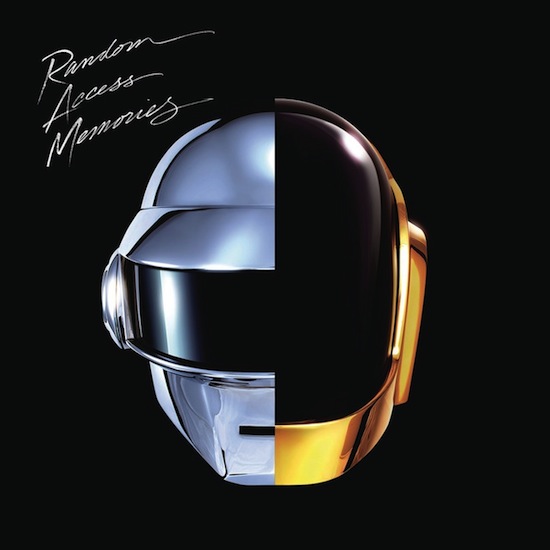
“The robots’ music is the power to separate itself from all else that exists. They’re not bound by time and space.” – Pharrell Williams
Daft Punk’s Random Access Memories arrives heavy with hyperbole. Guest vocalist Pharrell Williams would have you believe its release at the end of the month will be a metaphysical musical happening, ready to vaporise all popular culture with the press of a play button.
First there was a 16-second clip of single ‘Get Lucky’ premiered during Saturday Night Live, soon looped into an hour-long instrumental. A Coachella screen revealed a list of collaborators that doffs a robo helmet to disco pioneers Nile Rodgers and Giorgio Moroder, Muppets songwriter Paul Williams and Animal Collective’s Panda Bear. Next, a series of flashing images on Vine teased out song titles. Somewhere in between, news emerged of an album launch at an agricultural show in Wee Waa, Australia. But there’s nothing random about the build-up to Random Access Memories. Each slight detail, every slither of information, is engineered to send the internet into a tizzy.
There’s plenty of reason to await Daft Punk’s fourth studio album with intrigue. 1997’s Homework was the masked face of Parisian house. When Discovery followed in 2001, it quarried prog rock with warm, soulful results. If Human After All sounded austere, its hugely successful Alive world tour only perpetuated the image of Guy-Manuel de Homem-Christo and Thomas Bangalter as ongoing crusaders.
Random Access Memories is a gut-busting 75 minutes long. While too ambitious to evaluate after one listen, it’s a record that constantly surprises. At best, some of its melodies are freakishly familiar, testament to their strength. At worst, its overblown production makes confetti out of $100 notes. It’s a struggle to call RAM a dance record, even though the finest moments are elegantly funky, and the assembly of guest stars can make for an inconsistent listen.
“Where do they go from here?” asks an anonymous voice in a Random Access Memories YouTube video. “Up,” whispers Pharrell, without any discernable irony. “It’s where they belong. We’re lucky they hang out on the planet. They could just get back on the spaceship that brought ‘em here and go and leave us. But they’re gracious, they’re nice robots. They chose to stay.”
Give Life Back To Music
Nile Rodgers’ luxurious, syncopated guitar is the first thing you notice in this opening mantra, which, somewhat audaciously, appoints Daft Punk the chief resuscitators of music. “Let the music in tonight,” gurgles that voice behind a vocoder. If not exactly stately, it’s a relaxed, warm four-on-the-floor shuffle, supported by crowd whoops and cheers and a gliding Earth, Wind & Fire bass line.
The Game Of Love
Jubilation is short lived: this is what it sounds like when robots cry. “There is a game of love. Heading towards you. When you decided to walk away,” sobs another vocoder, barely concealing the sound of a tear dripping down the interior of a space helmet. The most devastating blow comes when a yelp of “I wanted you to stay,” melts into a synthesiser solo, where human and machine is inseparable. It’s as melodramatic as the breakdown in Kanye’s ‘Runaway’ and definitely not one for the barbecue playlist.
Giorgio By Moroder
“When I was 15 or 16, when I started to play guitar, I wanted to become a musician,” says Giorgio Moroder. It soon transpires that Moroder’s been wheeled out to deliver his life story in a monologue, which peddles a series of cinematic stock images: growing up in a small town, leaving school, driving to the disco, sleeping in a car. “It helped me to survive in the beginning,” he says. Talk turns to a metronomic click track ticking in the background. “I knew that could be the sound of the future,” he says.
A pretentious interlude, you think, before a distinctive Daft Punk gurgling arpeggio traverses boundaries of harmony and taste. Then some strings appear, then a guitar, next a drum solo, topped off with some DJ scratching. Rather than layers of instruments building to a climax, these developments are episodic. It’s a demonstrative journey across sound, a bit like Benjamin Britten’s The Young Person’s Guide To The Orchestra. Moroder returns, offset by explosive sound effects: “Free your mind about the concept of harmony and music being correct… Nobody told me what to do and there was no preconception of being told what to do.” Crikey.
Within
Despite opening with a flamboyant Chilly Gonzales flamenco piano solo, the sound here is restrained, with an understated brass part supporting another bad case of the computer blues. “There are so many things that I don’t understand,” sings the vocoder. “There’s a world inside me that I can’t explain. Many rooms to explore but the doors look the same. Looking for someone, please tell me who I am. I am lost I can’t even remember my name.” What was all that about giving life back to music?
Instant Crush
Julian Casablancas’ up-tempo appearance is built on shrill, dog whistle guitars. “Never be alone again,” he trills, in a soup of indistinguishable lyrics. We’re moving further away from a former incarnation of Daft Punk, as the collaborators on Random Access Memories drive and define the album’s sound. Sure, it’s an improvement on the latest Strokes record, but as for the future of electronic music, this isn’t it.
Lose Yourself To Dance
Here’s the album’s nearest ‘Get Lucky’ sequel, a sturdy funk track featuring Nile Rodgers and Pharrell again, the latter offering up his shirt as a sweat rag for his dance partner. “I know you don’t get a chance to take a break, or something,” he sings in a falsetto. “Sweat! Sweat! Sweat! Lose yourself to dance.”
Touch
“Touch. I remember touch,” croons Paul Williams, a capella. “Pictures came with touch. A tourist in a dream. A visitor it seems, tell me what you see. I need something more.” His delivery is straight out of musical theatre. Then there’s a massive drop, bringing in a Mediterranean-sounding orchestra. The only thing missing is a pair of castanets. A robot voice emerges, singing, “hold on, if love is the answer you want” in a theme that veers on parody when picked up by a children’s choir. This one is divisive and perplexing, but it’s clear that Daft Punk is circling galaxies far beyond ‘Around The World’ here.
Get Lucky

Beyond
Album filler of the most ostentatious sort: timpani rolls, fanfares, violin flourishes and more Paul Williams lyrics, declaring “the perfect song is framed by silence”.
Motherboard
The only song on the album to draw upon the traditional Daft Punk aesthetic: a cosmic-themed instrumental dripping in sci-fi effects.
Fragments Of Time
Todd Edwards sings this soft rock track destined for FM radio. “I’ll just keep playing back these fragments of time. Everywhere I go, is a moment to shine,” he sings. While its guitar-heavy chorus channels Parisian colleagues Phoenix, it still sounds rooted in West Coast Americana.
Doin’ It Right
Panda Bear’s contribution could be lifted straight from Merriweather Post Pavilion. “Let it go all night,” he yelps. “If you lose your way tonight that’s how you know the magic’s right” in another instance of the guest artist, at least on first listen, overshadowing Daft Punk’s contribution.
Contact
This DJ Falcon collaboration begins with a recording from Apollo 17, NASA’s final mission to the moon. The voice of Captain Eugene Cernan gasps: “A bright object. Rotating in rhythmic fashion. Look back on the earth… There’s something out there.” In an exercise in unsubtle cinematic suspense, we’re treated to drumrolls, crackling analogue tape and, finally, the infernal sound of an acceleration preparing for what sounds like Daft Punk’s attempted moon orbit. After an unbearable series of false endings, the pressure subsides and the sound contracts, as if sucked up through a giant straw. It’s a conclusion that evokes leaving the cinema after a summer Hollywood blockbuster, unpicking stray popcorn from your trousers and asking, “what was all that about?”