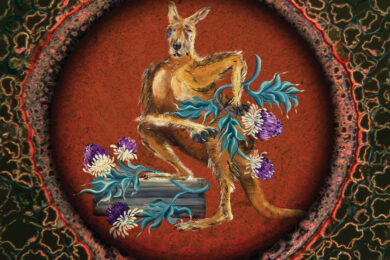
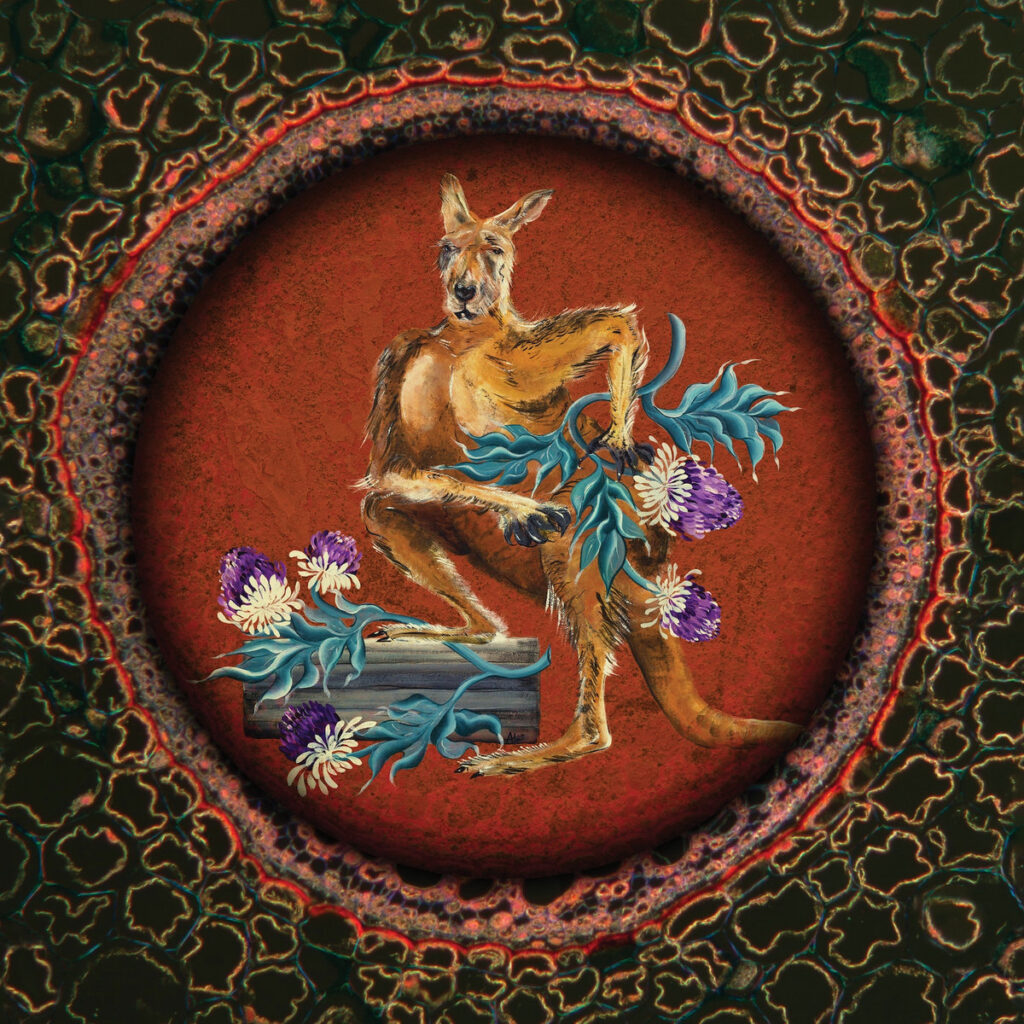
Arriving 26 years since Cardiacs’ last studio album and five years since the death of singer and principal songwriter Tim Smith, the circumstances behind LSD’s completion mark it apart from most other posthumous releases. One analogy might be Leonard Cohen’s final album, Thanks For The Dance, which featured new songs based on late period sketches by Cohen and was completed by his son Adam, although the gestation times and end results could hardly be more different. The fabulous art project David Bowie made of his last days with Blackstar is perhaps closer still, at least in spirit, in that they are both attempts to utilise the alchemical potential of art to transmute deeply sorrowful events into works of transcendent beauty. However, such a high degree of detail being added to the original works in progress, and Smith’s uncommon state of existence in a kind of “half-life” for over a decade – as bandmate and close friend Kavus Torabi described it in one of his most poignant Knifeworld songs – all contribute to making LSD a posthumous release that’s really without obvious parallel.
Yes, OK, I hear you say, but is it any good? As anyone who has read my writing about Cardiacs on tQ will already know, I became close friends with Smith and the band over 30 years ago, although I started out as a fan. However, I’m also useless at being tactful when expressing my opinions about art that I don’t like, whether it was made by friends or not. So, when I tell you that I spent almost an entire month writing the liner notes for this album, excitedly listening to it from beginning to end most days while interviewing six individuals for the story of its creation, for no financial gain but purely for the pleasure of being a part of this project, I am being entirely sincere and transparent.
Certainly, the story surrounding the album’s completion provides important context, and as a tale of overcoming the obstacles imposed upon creativity by human frailty, it is alternatively inspiring, sad, highly amusing, life affirming and resolute in its approach to death. The music also stands entirely on its own merit, to the extent that I consider it to be a late period masterpiece, even in a back catalogue already stocked with highlights. Despite the bitter cosmic irony of Smith having almost an album’s worth of tunes partially completed apart from vocals he could never record, the fact that the way he worked involved actual written scores was hugely significant for those attempting to finish LSD. Some of its 17 tracks existed as works in progress in various stages of completion, whilst others existed only in handwritten notational form. The interpretations of these latter pieces were all checked and approved by Smith with North Sea Radio Orchestra main man Craig Fortnam’s help, but only just before the former’s passing in July 2020. Sadly, Smith didn’t live long enough to hear the final mix, but the importance of the project, as a creative lifeline for both him and his friends, really can’t be overstated.
The two largest obstacles to completing LSD were the lack of a lead singer for the majority of the tunes, where a vocal was yet to be added, and the question of who would provide the final mix. While Smith does deliver vocals on around six of the tracks, Mike Vennart (of Oceansize) and Rose-Ellen Kemp (daughter of Maddy Prior and Rick Kemp of Steeleye Span), bring incredible talent across the rest of the record. In fact, it’s hard to imagine anyone better in those roles other than Smith himself. Vennart shines particularly throughout and especially on second single, ‘Downup’. Kemp features prominently on less of the songs but the ones she does act as lead vocal for are absolutely stunning, such as the hymnal opener ‘Men In Bed’, which is largely Kemp with just a touch of Vennart, and euphoric ‘Volob’, which might just be the most directly pop track that Smith ever wrote.
The production, by Adam Noble, has a greater clarity and warmth than Smith’s own on Sing To God or Guns, but crucially does not sacrifice detail for power, retaining the real sense of attack which was always integral to Cardiacs’ sound. Noble told me that he spent “a lot of time making sure the drums were punchy and crisp, [which] created space for the huge variety of other instruments and vocals,” adding that “ironically, sometimes a huge amount of processing was needed in order to make something sound warmer and less processed.”
With the right vocalists and mix engineer falling into place, obstacles which originally seemed unsurmountable eventually yielded compelling results. Although many years have passed since their original conception, the songs sound shiny and new yet are still instantly identifiable as the work of Tim Smith, particularly as a logical development from its predecessor, Guns. LSD also occupies a special place in Cardiacs’ back catalogue as the only Cardiacs album with Kavus Torabi, with Smith writing all the tunes and Torabi providing arrangements throughout, as well as his own distinctive psychedelic riffing via some of his finest guitar work to date. String and brass arrangements by Craig Fortnam likewise add further welcome detail to several tracks.
Bookended by the majestic but bittersweet hymn ‘Men In Bed’, which recalls Heaven Born And Ever Bright’s ‘Home Of Fadeless Splendour’ and the elegiac and madrigal-like ‘Pet Fezant’, LSD offers a broad spectrum of delights. From the classic full-throttle Cardiacs bangers of ‘The May’ and ‘Wooden Eye’, through the powerfully refurbished ‘Ditzy Scene’ with added strings and brass, the joyous Zappa meets Beatles off-kilter pop of ‘The Blue And Buff’, the frenetic but fun wild rides of ‘Skating’ and ‘Volob’, the symphonic delirium of ‘Busty Beez’ to the epic ‘Downup’, LSD is a trip, a technicolour experience for the inner eye that only reveals the full richness of its sound and imagery with repeated listening. Though largely euphoric in its emotional tone, if there is a touch more sadness inherent in this release than is usually the case with Cardiacs’ music, then that’s entirely apt, given that it’s essentially a goodbye to the band’s now departed frontman. Yet the feeling of jubilation that sadness comes wrapped up in, the wonder of finally getting it over the finish line, somehow transcends its melancholy shadow. With Tim’s brother and bandmate Jim Smith clear about his desire to tour the album with a new lineup including Torabi and Vennart, this feels more like a new chapter than a swansong.
On one of my first visits to see Tim Smith at the neurological centre where he was being cared for, I read an article about Cardiacs in Prog Magazine aloud to him. When I finished, we were both in tears. He spelled out (a little hesitantly, as it often took some time) on his letter board: “I don’t want Cardiacs to end,” as if this was the most distressing aspect of his situation. His sentiment was hardly surprising, given the fact that this had been the project of his life since the age of 16. The fact that Cardiacs haven’t ended, even after all this time, is hugely gratifying for all involved, and hopefully for the fans too, both long-time fans, and the new ones this release will surely attract. More than two decades on from their last studio release, Smith’s fusion of prog, punk, rock and psych structures within relatively short pop-shaped tunes sounds as singular as ever. There are other bands who on paper seem similar, such as California-era Mr Bungle, early Split Enz, or Chicago’s Cheer-Accident, but really Cardiacs are still out on their own, not so much ahead of time as outside of it, both back in the day and the present moment.
Cardiacs’ LSD is out now via The Alphabet Business Concern