
Many independent labels set out with high hopes only to end in dismal failure, whereas Crammed Discs began with modest aims and is still going strong 45 years later. Like Mute Records, the Belgian label was started first and foremost as an outlet to release the music of the artist who inaugurated it. Aksak Maboul, Marc Hollander’s band/collective/art project became the catalyst and, for a while at least, the proverbial footnote, that gave rise to an unlikely independent success story.
Crammed has released somewhere in the region of 400 albums so far with a roster that’s both eclectic and global, including Yasmine Hamdan, Bebel Gilberto, Juana Molina, Konono N°1 and Minimal Compact, to name but a few; and that’s before we get to its various subsidiaries, such as SSR and Ziriguiboom. Crammed predates the contentious world music genre term, and has constantly proved itself to be one of the most sonically adventurous and boundary breaking record companies on earth, laying the groundwork for unpredictable cross-cultural fusions and myriad collaborations, from electronic to the avant garde.
A big difference between Crammed and Mute’s origin story is that founder of the latter Daniel Miller’s The Normal only put out one record – the highly fetishised ‘TVOD’ / ‘Warm Leatherette’ single – before getting busy releasing the music of Fad Gadget, DAF, Depeche Mode and so on. Aksak Maboul‘s output, sporadic as it has been, is a little more voluminous. Formed in 1977 with Hollander’s friend Vincent Kenis, the group went on a three decade hiatus when, similarly, work took over at the label. Then, in 2014, Aksak put out Ex-Futur, an archival collaboration with Véronique Vincent, releasing music made between 1980 and 1983. The album was so emphatically received that it gave impetus to a second phase of activity for the group. Figures from 2020 and the mutant songspiel of 2023’s Une aventure de VV featuring Laetitia Sadier added further dimensions to a project that has always been amorphous and gleefully experimental.
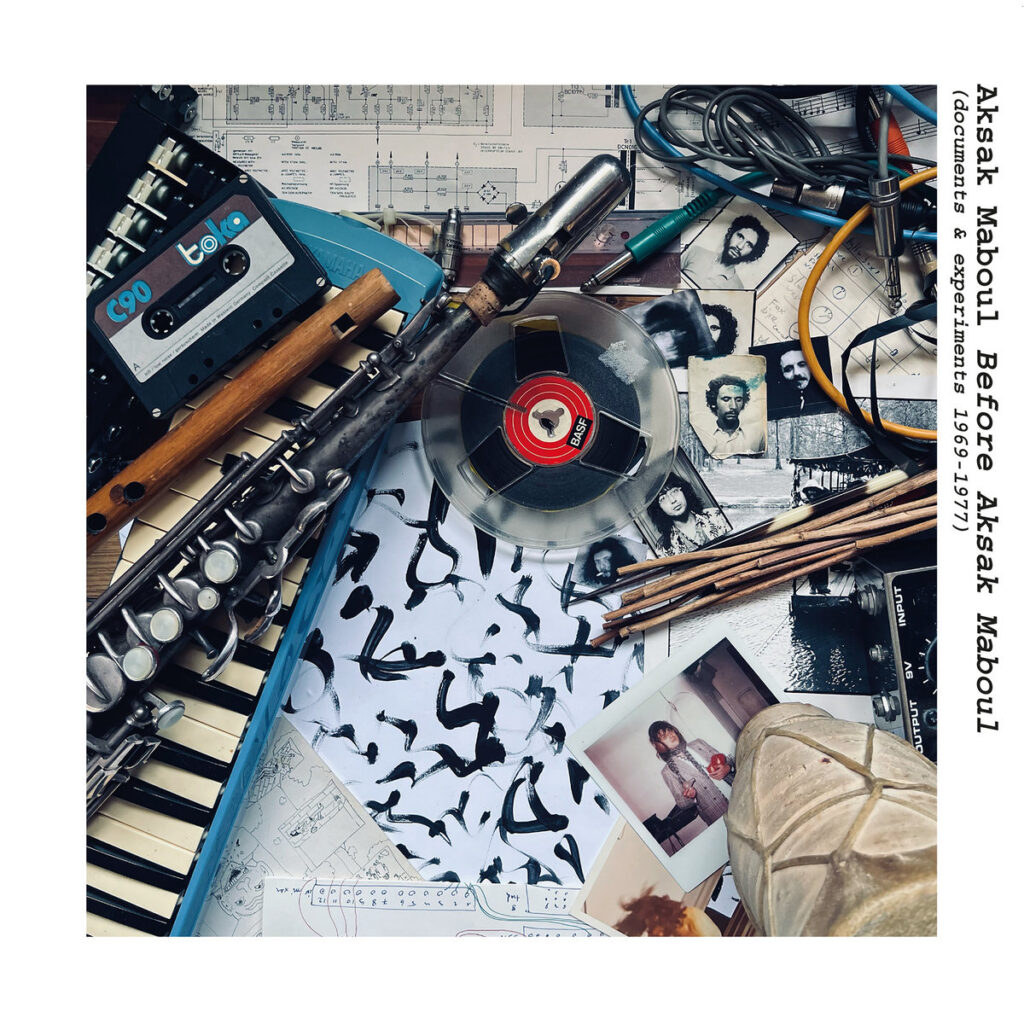
Having dug into the archives once with great success, Hollander has found himself going back further into the vaults in search of more arcane treasure. Before Aksak Maboul (Documents & Experiments 1969-1977), then, feels like the discovery of a residual tail, an essential part of the story that you didn’t even know existed, ergo, an extension of the label as well. To invoke Miller one more time: The Normal’s first and only single came out of nowhere almost perfectly formed, a solid artifact that was a statement release. Aksak is more abstract, diffusing stealthily and impossible to contain because there are no defined edges.
It makes perfect sense then that the music Hollander was making before Aksak Maboul is also Aksak Maboul, or Aksak before Aksak. These unearthed recordings fit with the ethos of the band name, which is a delightful hotchpotch of Turkish (‘aksak’ means to stumble) and French (‘maboul’ is apparently a slang word for crazy which possibly has its origins in Arabic). Even the nomenclature is imbued with a collagist internationalism that feeds into the project ethos. It’s very Belgian. It’s a very small country but has three official languages and a bloody colonial past. Montage and sonic cultural mix are baked into the philosophy of the band and the label.
The fifteen tracks on Before Aksak Maboul run for eight years from 1969 to 1977, the year when Hollander and Kenis formed the band, with players along the way helping to guide the ungainly ensoul along. These bit part players become the imaginal discs that help the chrysalis turn into a butterfly. With the release, Hollander uses the sleeve notes to construct a “fragmentary bildungsroman”, bringing surprising clarity and detail to these various and varied recordings from his youth.
First up is the free rock band Here & Now, which Hollander formed at Brussels University in 1969 with his friend Paolo Radoni, winning an amateur band contest in Heysel, setting him on his way. It’s where he first met Telex and Placebo (the Belgian jazz fusion band) founder Marc Moulin who was a member of the jury. ‘Here And Now, A Free Rock Tentet’ is actually a four-and-a-half minute extract from a longer 37-minute piece, which another Telex member, Dan Lacksman, recorded with his portable unit, and it feels like Belgian alternative music’s cosmic microwave background given how important these figures would all become in about a decade’s time.
More interesting, though, is when Hollander begins working by himself around 1973, with the fabulous ‘Five Sketches For A Short Film’ threading together vignettes that utilise variously a Farfisa organ, a tone generator, an Echocord super tape echo and a soprano sax, among other instruments and effects. It’s a beautiful, layered piece that brings a number of textural-based moods. Experiments abound, such as 1973’s ‘Lost In The Farmhouse’, a melange of keyboards, electronics and a Revox reel-to-reel; and ‘Gyrovagations’, perhaps a titular nod to Satie with pianos and xylophones overlaying each other on a one-minute piece that could have gone on for much longer.
Richest of all in this period is ‘Kosmisher Afternoon’ from 1975, a Cluster-like ambient synth piece that blips and pulses. As a collaboration with Vincent Kenis, it’s undeniably Aksak before Aksak. Their fragmentary, funky ‘The Big Slide’ from the following year – featuring a prototype drum machine – is another fascinating track that doesn’t outstay its welcome at a minute and a half in length. And Hollander ventures out to experiment with others too: ‘Modular Excursions At John’s’ is a generically-named experiment, presumably recorded at the home of late Belgian sax player John Van Rymenant. Rymenant lays down some modular noodling while Hollander accompanies him on keyboards and Bart Carette drops some tap guitar.



Hollander and Kenis’ compositions become more accomplished as the collection progresses, with ‘Proto-Kefak’ from 1976 displaying a gorgeous array of spectral, shimmer, while ‘Didn’t Make It 2: Angeloid’ is another jazz funk snippet with a frustratingly underdeveloped drum machine. Kenis, meanwhile, introduces a profusion of percussion on ‘Java Ney’ with the help of Alex El Mahouab, Gianni Manente and Christian Pinchart. If these all feel like preparations for the band, then they’re prep too for the label, which has always prided itself on bringing together disparate elements and disparate artists, especially with their Made To Measure series which was a gloriously heterogeneous procession of imaginary soundtracks and experiments that threw together artists like Hector Zazou, Benjamin Lew, Steven Brown, John Lurie and Fred Frith, and more recently, Aquaserge.
Before Aksak Maboul, then, is a playful and engrossing trawl through time and a tantalising glimpse into the methods and the madness that helped birth a counterintuitive success story. Sadly, the release is tempered with the terrible news that Véronique Vincent, Hollander’s partner in life and music, died from cancer in October. The likelihood is that the reemergence of the period before Aksak has cruelly coincided with its end too.