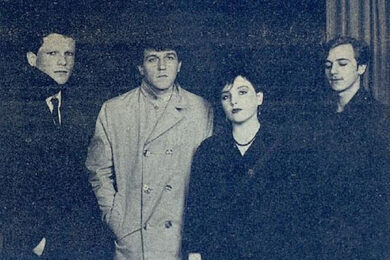

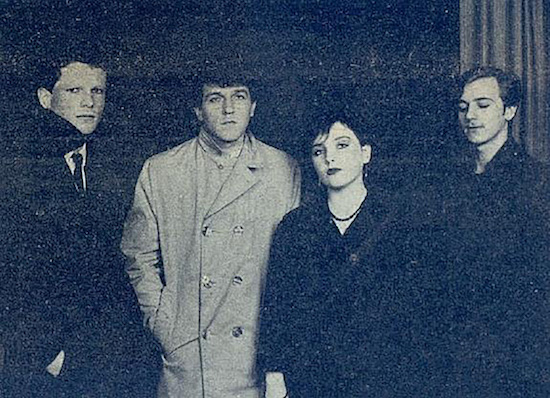
It’s a cold, wet Friday night in September 1980, and the back room of Dundalk’s Wine Tavern is buzzing to the sounds of synth-pop and disco. A crowd mills about in anticipation, dressed in scrappy new romantic uniforms from charity shop rails, waiting for a young local band called Choice to make their debut.
Made up Brian “Duggie” McMahon on bass, Ciaran Vernon on synths and guitar, Noel McCabe on drums, and Jaki McCarrick on vocals, Choice had formed just a few months before, and they wanted to make a splash. Inspired by the photos they’d seen in magazines of London’s Blitz Club, they wanted to bring that stylish scene to their industrial border town.
Under the pretence of a private party, they booked the space in one of Dundalk’s “more sophisticated pubs”, and kicked off their journey to becoming one of the most distinct Irish bands of the 1980s: one that ploughed its own furrow, and made sure every gig was an event to remember.
Choice take the stage at 11 30. With a nervous new wave energy and post punk grit, their influences are clear, citing everyone from Siouxsie And The Banshees, The Human League and New Order to Kraftwerk, Wire and Donna Sumner. At just 16, McCarrik’s voice radiates over the rugged bass and spiky guitars of ‘Experience’, ‘Stain Glass’, and ‘Pierrot’, while the band’s aloof demeanour and lack of audience interaction gives them an enticing air of mystery from the get-go, whether it’s intentional or not.
A handwritten review of the gig in local fanzine Too Late describes them as “real, aware, alive, challenging and simply light years ahead of anything else in this town”. It goes on to predict the band’s selective approach to gigs, and their evasion of the regular venue circuit. It’s an attitude they would stick to, and one that would earn them a loyal cult fanbase in Dundalk and
beyond.
A month later, Choice played their second show, this time in Dundalk’s Magnet Cinema. Remembering it now, McMahon says the venue “cost a fortune and was way too big”. There was no bar, and no lights, but it drew a crowd simply because it was a “strange setting”.
“No one had ever seen a group play there before, and we got to play on a real stage,” McMahon remembers.
With day jobs and school to think about, Choice were unphased by the prospect of success. They just wanted to sound good, and create special moments and memories at the shows they chose to play. “It was all about the art for me,” McCarrik says now, “I had very little interest in ‘rock stardom’.”
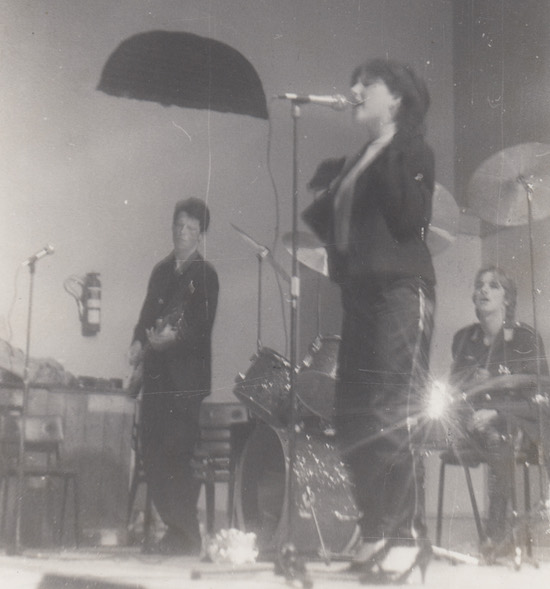
She remembers seeing bands like The Human League emerging from industrial UK towns like Sheffield, and drawing more influence from them than anything she heard in Ireland’s scene. “We considered that Dundalk was like Ireland’s Sheffield,” she says. Choice sought to “embrace the industrial environs of where we lived, to write songs that were close to ‘art’. We let that consume us rather than the idea of fame.”
Some success did come however, and after recording their first demo and a live video 1981 the group won RTÉ’s Youngline competition, which was broadcast on national television and garnered them widespread attention from the country’s music industry. “Going to the RTÉ studios was a thrill," McMahon remembers. “We had our own dressing room – complete with bulb lights around the mirror. We showed that it was possible to get on national TV, without a manager, without any contacts in the industry, and without having to play the usual gig scene.”
Choice soon became a three-piece, replacing McCabe’s live drums with a drum machine; a rarity in Ireland at the time. There were more recordings too, including one with the legendary Fanning Sessions. After winning Youngline, there was even an offer of a record deal, but they turned it down. “[We were] convinced we’d get a better offer,” McMahon wrote on his Brand New Retro blog. “We probably could have done with a manager. Or a phone… none of us or our parents had one!”

Not long after winning another prominent Battle Of The Bands in Trinity College in 1982 – beating Meelah XVIII from Finglas, who would go on to become Aslan – McCarrick and Vernon left for London, and just as their momentum grew, Choice disbanded, and Ireland fell into the grips of a deep recession. “[Early] in the 1980s, Dundalk was artistically vibrant,” McCarrik remembers. “Everyone I knew was doing something creative – whether it was art or writing or making his or her own magazine. Then, from the mid-80s onwards, recession really got a grip of Dundalk and of course these bonds between people began to break up. It’s a very sad thing about emigration in Ireland – recessions often strike at the most inopportune time.”
That short, brilliant buzz that Choice created in the Irish musical landscape stuck around however, and their music left an impression that lingers to this day. “In later years, people have told me how we got them into electronic music,” McMahon says.
“When I no longer had that project in my life I was bereft,” adds McCarrick, who is now a successful author and playwright. “We did have loyal followers, and today I am still in touch with some of them – they have tapes, recordings of us and so on.”
After their track, ‘Always In Danger’, appeared in the Strange Passion compilation on Finders Keepers Records in 2012, Choice reunited for a string of gigs, including Electric Picnic 2013, one alongside fellow Dundalk singer Jinx Lennon, and another in Dublin’s Grand Social. To McCarrick though, it wasn’t so much a reformation, as a continuation of something that never fully went away, and never will. “I like to think of the band as something that is always there,” she says. “That we can pick up or let go whenever the body wants to say something, make itself heard. It’s very organic – probably because from the start it was never about fame – just a group of people trying to make art together.”

Choice made their mark by making every gig count; a concept we’ve all had to get used to in 2020. Socially distanced live shows around the country in late summer were revitalising, while live streams like Lankum’s jaw dropping A National Disgrace from the Abbey Theatre and Jennifer Walshe’s Ireland: A Dataset at the National Concert Hall transcended distance to create shared moments of release between music fans in a digital landscape. The eerie sight of a performance in empty theatre took on a profound new meaning; a vision of culture fighting to survive that will be etched into our collective memory.
Elsewhere, artists have adapted to Patreon to keep themselves afloat during the pandemic, offering fans a subscription-like service as a way of making money alongside special livestreams. Dundalk’s Mary Wallopers, whose homemade pub has provided joyful folk escapism, continued their Stay At Home series on Halloween night with haunting guest appearances. Throughout lockdown, filmmaker Myles O’Reilly brought us into the homes of artists like John Francis Flyn and Kú Kilian, or into a pre-COVID instrument shop with Myles Manley in support of his new album Cometh The Softies.
In July, Dublin’s Guerrilla Studios launched a bi-weekly live music special along with its patreon, and has streamed sets from the likes of God Knows, Aoife Nessa Frances, Acid Granny, Maija Sofia, Sunken Foal and more in that time. Located beneath a railway arch, the studio, which was opened by producer and sound engineer John ‘Spud’ Murphy in 2011, has been a crucial centre for Irish underground music. Within its walls, releases from the likes of Katie Kim, Percolator, Woven Skull, Jogging and Lankum have been produced, with a trademark grit and heaviness coursing through each. The importance of its preservation can’t be understated, and has been echoed again and again through these unifying live sessions.
As nourishing and special as these sets have all been though, concerns are mounting still that, when “all this” is over, the space and infrastructure for independent music in Ireland simply won’t be there anymore. With constant financial strain and the ongoing government encroachment on creative cultural spaces for profit, the future seems more unsteady than ever. It’s all well for us to take the solace and joy from these small online moments of reprieve, but it is now more imperative than ever that we show our support for these independent artists and groups like Give Us The Night, who are fighting for the protection of Irish independent music and its spaces. I’d encourage you then to take a look at these recent fundraisers launched by DIY practice spaces and creative centres Karate Club and Ja Ja Studios.
Below, you’ll find the best releases from the Irish undergrowth from Autumn, with spooky nods owed to the frenzied digital breakcore of Fomorian Vain’s Focal Point and Fulacht Fiadh’s Mystery Mountain Hop. From explosive noise rock, field recordings and psychedelic electronics to R&B, hip-hop and experimental pop, there’s plenty to sink your teeth into here before we return.
In the meantime, éistigí.
Shifting – It Was Good
A ragged jewel in the Guerrilla Studios’ crown, Shifting came together in a frenzy. Formed in 2016 from the shards of Dublin noise bands No Spill Blood and Hands Up Who Wants To Die, the trio used just three practice sessions in the studio to cobble together their first set, just in time for a fundraising gig to protect it. Since, they’ve honed a furious sound, contorting the influence of The Jesus Lizard, MY DISCO, Death Grips and Pixies into something that could make Steve Albini’s teeth shake.
You can hear the Guerrilla hallmarks all over It Was Good, with Spud Murphy and Ian Chestnutt’s distinctly gnarled production growling from every corner. ‘Spudgasm’, ‘Pompadour’ and ‘Little Pal’ snarl and tear with the same gravelly bass and vocals of the band members’ former projects, with an added hardcore punk edge. The drones heard in ‘Polo Neck Dream’, ‘Big Bottle’ and ‘Pig From Heaven’ owe as much to the apocalyptic harmonium of Lankum’s The Livelong Day as they do to The Jimmy Cake’s dark kosmische masterpiece, Tough Love. Something sets Shifting apart though, and with sludgy grit and lung-puncturing roars, they’ve released the heaviest Irish record of 2020.
Katie Kim – Charles/ VV11
Katie Kim’s 2016 album, Salt, conjured a feeling like being lost in a barren landscape. Also produced at Guerrilla Studios with Spud Murphy, its heavy bass drones and dense shrouds of reverb created an overwhelming atmosphere into which Kim’s haunting vocals and glacial melodies could diffuse. It was as if she was searching for a centre in some vast unknown.
The isolation at the heart of Charles/ VV11 is more intimate and bittersweet. A collection of field recordings, forgotten demos and experiments recorded between 2012 and 2020, these 17-tracks form a collage of memories, passing thoughts and observations. From brittle lo-fi folk to dusty ambience and distortion, this 30-minute montage untangles and reveals itself a little more with every listen.
Where Salt gazed into an abyss of uncertainty and fear, Charles / VV11 looks inward. From the eerie whispers of ‘Cut Your Hair’ to the layered, tender vocals on ‘Bless The Baby’, we hear an artist reassembling fragments of herself; including the uncomfortable ones. There are muffled recordings of subway strangers, frustrated bursts of noise and mournful songs, and, in a way, it feels like Kim’s reconciliation with a decade’s worth of creativity, loss and (re)discovery. Maybe that reconciliation is to make room for the next big project up her sleeve. We’ll have to wait and see. In the meantime, there’s more than enough in here to keep you curious.
Natalia Beylis – The Steadfast Starry Universe
(Eidertown Records)
Much like Charles/ VV11, Natalia Beylis’ new tape on Eidertown Records focuses on the little details of her surroundings. Across six tracks of rustling field recordings and delicate instrumentation, we get a pastoral snapshot of the life she has built in her rural Leitrim home, and for just over 30 minutes, we can feel transported somewhere quiet, far from the weight of the city, and from the seismic woes of the news cycle. When listening to it, the world seems to slow down.
Muted pianos and soft, low-end synthesisers swell around the sounds of water, birds and woodland breeze in ‘Cave Of A Seashell’ and ‘Roslyn’s Stick Hut In The Woods’. Elsewhere, brought in from the rain, we’re nestled into a fireside couch, while some woozy cat dodders across the keys on ‘Puss Sleeps’. The title track, with its gently swooping organ hums, projects a clear night sky, untouched by light pollution. For just a moment, your fears are made useless and minute.
If that’s all a bit peaceful for you though, this recent Guerrilla Studios set from Beylis’ noise band BB84 – featuring members of Gnod and Wild Rocket – will knock that cosmic bliss right out your ear holes.
Local Gods – Aghavrick Acid
(The Department Of Energy)
Cork’s Department Of Energy label launched earlier this year with a sonic document of the 1956 Lee Valley flood. The imprint’s focus remains firmly in the region on Aghavrick Acid, which is named after a stream that flows near several subtle landmarks of its history, from fairy forts and GAA pitches to an electrical substation. Comprising “two bangers about The War Of Independence, a time-stretched hymn to the haunted Irish landscape, and a psychedelic field recording”, this EP from label founder Local Gods utilises AM radio loops, found sounds and rugged techno forms to carve something strange and incredibly special.
A fascination with the intricate webs of Irish history courses through this release, and you need only read the minute descriptions of each track on its Bandcamp page to understand the attention to detail that’s gone into its production. The opening title track is built using the sounds of hazel sticks, driftwood, stones, cattle bones, turf and a goatskin lampshade, while the broken techno of ‘Flying Columns’ samples recent thunderstorms and radio reports from the last days of Bobby Sands to sculpt its stormy, dissident atmosphere. Accompanied by some intricate artwork, Aghavrick Acid really does offer the whole package: a potent, experimental release for the heads and history nerds alike.
Gemma Dunleavy – Up De Flats
“You’ll never get anything like the flats,” says Anne Grimes, a native of Dublin’s Sheriff Street residential blocks, and the first voice you hear on Gemma Dunleavy’s debut EP.
For years before their demolition in the 90s, the working class population of St Laurence’s Mansions, St Bridget’s Gardens and Phil Shanahan House faced untold discrimination and demonisation due to the area’s high crime rate, which was spurred by the heroin epidemic that tore through the capital at the time. With honeyed UKG beats and the streetlight hues of soul and R&B, Dunleavy paints a candid picture of north inner city life, taking aim at lazy prejudices, and shining a brilliant light on the community she grew up in, with all its flaws and beauty in full view.
Dunleavy’s character-based storytelling across the EP’s six tracks speaks truthfully to the trials and themes of life in the area, but with an affection and nuance no outsider could ever manage. “It explores cyclical patterns of behaviour, hardships and grief”, she has said, all while celebrating the area’s tight-knit, familial sense of community. “We found laughs in the middle of the violence”, she sings on the luminous title track, accompanied by a chorus of friends and neighbours. “They said we had nothing, but we had it all”.
Co-produced with Cloud Castle Lake’s Brendan Jenkinson, each track on Up De Flats sounds top notch. There’s romance found in late night drives and swerving donuts on the languid ‘Cruisin’, and aching parental devotion in the face of addiction on the sparse and beautiful ‘Setting Sun’. The dizzy, nocturnal beats of ‘Stop The Lights’ illuminate the pain and internal conflict of its protagonist, while ‘Return’ weaves the recurring patterns of longing and mental darkness through a shimmering R&B filter. Even at the EP’s most vulnerable points, Dunleavy’s songwriting is deeply proud and poised, and it makes for one of the strongest Irish debuts of the year.
lastminuteman – %%%%%
(wherethetimegoes)
wherethetimegoes’ hit rate has been second to none this year. From the sizzling organ drones of entrd’s Voix Celeste III to the lo-fi ambient pop of Nashpaints’ Blindman The Gambler, the prolific tape label has earned its buy-on-site credentials. Rising Damp’s snarling industrial punk triumph Petrol Factory even landed a spot in tQ’s Albums Of The Year So Far list in July.
Dublin’s lastminuteman continues that trend on %%%%%, picking up where he left off on To Him Who Has Nothing, which launched the label in 2017. The Jheri Tracks co-founder projects an abstract vision of the city over these seven tracks, like a psychedelic stroll from Ratoath Road to Abbey Street, where the EP was produced. Deep dub throbs, fuzzy synths and field recordings make Boards Of Canada feel like an obvious touchstone, but where the Scottish duo took us on an eerie, uneasy journey to “a beautiful place in the country”, the trip we take on %%%%% is much more blissed out. On the sprawling ‘Fox Trot/ Eavesdrop’, we’re simply asked to enjoy “a little bit of nature in the city” by a passing stranger, their voice manipulated into a robotic ether before a swirling cloud of noise pushes us along.
Electronic sounds are stretched and shredded throughout this EP, while generative melodies glide gingerly on beds of soft noise and quivering beats. It’s at its best when its ideas are allowed to unfold at their own pace, and by the time we hit 13-minute closer ‘Walking into Water at Night’, it’s hard not to feel revived, or at least a little stoned, by the washes of reverb and tape hiss.
M(h)aol – ‘Laundries’
Five years on from the release of their debut single, ‘Clementine’, feminist noise-punk outfit M(h)aol returned in October with ‘Laundries’, a track ostensibly about Ireland’s Magdalene Laundries – the unfathomably cruel, church-run workhouses that institutionalised an estimated 30,000 women and girls between the 18th century and 1996 – but which holds a relevance that spreads through the country’s contemporary socio-political landscape.
In a recent interview with The Thin Air, vocalist Róisín Nic Ghearailt spoke about how the lyrics of ‘Laundries’ could as easily be applied to Ireland’s inhumane system of Direct Provision for asylum seekers. She said: “[It] stems from the same mindset whereby, rather than create a society where the goal is that everyone can lead a life of dignity and respect, people are sequestered off in an ‘out of sight out of mind’ mentality.” Channelling Girl Band, whose frontman Dara Kiely featured on ‘Clementine’, ‘Laundries’ erupts with relentless distorted bass, fuzzed-out guitars and clattering drums.
The track held additional weight in recent weeks, as another atrocity of Ireland’s recent history re-entered the news cycle. As fears mounted that the Irish government would seal findings from the harrowing Mother And Baby Homes Commission for the last 30 years, the country’s attempts to cover up its history of institutional abuse, which has affected countless women and children over the years, once again reared its ugly head.
M(h)aol may have only released two songs in five years, but when they are as searing and pertinent as ‘Laundries’, it’s more than enough to leave a vital mark.
Denise Chaila – Go Bravely
(narolane records)
When I last wrote about Denise Chaila, her big break felt imminent. A few short months later, with the release of her debut mixtape, the Limerick rapper and spoken-word artist’s star has well and truly risen. Magazine cover features and an appearance on Ireland’s flagship talk show have brought the Zambian-Irish MC’s vital voice to a national stage, and she has used that platform further to shine a light on topics of identity, racism, gender and empowerment. There is no artist who speaks more purposefully to this new golden era of Irish storytelling and cultural evolution.
The 11-tracks on Go Bravely showcase Chaila’s poetic versatility and electrifying flow, which is complemented perfectly again and again by MuRli’s crisp hip hop productions. ‘Holy Grail’ and ‘Can’t Stop Me Here’ erupt with radiance and braggadocio while, on top of lithe guitar samples and a soulful groove, ‘Rí Rá’ delights in verbal wordplay and animated Gaeilge manipulations (“Feeling so Sinne fianna, I will not fall/ Got a bualadh bos for my drive”). ‘Anseo’ – meaning “here” – uses the familiar role-call response as an assertive statement of intent and purpose: “If you’re looking for your black James Bond? Anseo. Sailor moon remixed by Fela. C’est moi”. The gorgeous ‘Pieces’ and ‘All That’ featuring Cork’s Outsider YP show a more introspective, vulnerable side to Chaila’s performance and lyricism, but they are no less confident or dazzling for that.
Alongside MuRli, the PX Music crew, and fellow South West hip hop powerhouse God Knows – whose new EP, Who’s Asking? II you need to hear – Chaila has played a number of energising live streams during this ongoing bleak period, including a performance at the National Concert Hall for the Imagining Ireland series. Together, their energy feels as unstoppable as it is essential.
Ordnance Survey – Ampere
(Scintilla Recordings)
Much like 2019’s Relative Phase, Neil O’Connor’s latest outing under the Ordnance Survey banner relishes in collaboration and experimentation. This time around, the Dublin artist swerves further into contemporary classical territory, mapping an electro-acoustic path through strands of trad, jazz and ambient with enveloping results.
‘Madrigal’, an alchemical collaboration with Lankum fiddle player Cormac Mac Diarmada, makes for a mesmerising opener, and drifts steadily into ‘Facades’ and ‘The Communion’ featuring Muireann Nic Amhlaoibh and David Murphy: two cuts that could have emerged from Oneohtrix Point Never’s recent catalogue, had his central concerns taken a more weathered, organic turn. Members of Crash Ensemble appear throughout the album, bringing an orchestral potency to tracks like ‘Moving Statues’ and ‘Enharmonics’, while ‘Coefficients’ and ‘Pulsar’ forge their own intensity with billowing electronic pulses and glimmering keys.
Various Artists – For MASI
(Patrúin)
Raising funds for MASI – Movement of Asylum Seekers in Ireland, this 14-track compilation brings together some of the best kept secrets of Irish electronic music for a cause that is more worthy of support than ever.
From swirling ambience and breakbeats (Može, Oli, DJ Biblical Plague) to more abstract turns from the likes of Lighght, Witch Trials and Flowers at Night, the collection is brimming with woozy, crepuscular music. It’s not lacking in punch, however. DJ Aprés Ski’s ‘Prince of Peace’ reshapes Iury Lech’s ‘Barreras’ into a frosty house dream, while Ngoni Egan continues to solder a Drexciyan imprint into the Irish circuit with the propulsive ‘Sonic Boom’. Sweet sounds all around.
Various Artists – For Nora
Another compilation packed with gold, once again for a very worthy cause. Amsterdam-based, Dublin-born Kobina brings together some of Ireland’s most exciting artists for this 15-track release, with all proceeds going toward Aoibheann’s Pink Tie. The charity offers practical support to the families of children diagnosed with cancer in Ireland, and did so with Kobina’s brother and his family after their one-year-old daughter, Nora, was diagnosed with a rare terminal brain tumor in May this year.
It’s a beautiful release, featuring music from the likes of Jape, Fears (who also plays in Mhaol), MuRli, Arvo Party, Moving Still and more. Kobina, himself an excellent artist, features throughout the EP, producing the gorgeous opening and closing tracks ‘Coladh Sámh’ (sleep well) and ‘Capall’ (horse), and collaborating with Numbertheory and Dublin Digital Radio’s Breen. With sounds ranging from delicate ambient electronics and experimental hip hop to house and d&b, For Nora is versatile and thoughtfully assembled, with tenderness and care beaming from every note.
Various Artists – A Litany Of Failures: Volume III
(Litany of Failures)
The Litany of Failures compilation series really popped open the hood of Ireland’s DIY scene, giving us a peek into its mangled engine, and celebrating its countrywide sense of community in the process. This stacked new edition is no different, and pulls from every corner of the island for a 22-track collection spanning grizzly psych, post-punk and no wave, lo-fi indie jams and experimental electronics.
Belfast’s Junk Drawer open proceedings with the downbeat psych-pop drawl of ‘Tears In Costa’, before giving way to the off-kilter jazz of The Bonk’s ‘Thick Lines On Thin Film’ and the motorik Ought-isms of Silverback’s ‘A Roof For Life’. Girlfriend’s haunting Come On Die Young-style dirge, ‘Laura’, explodes in a climax of screeches and distortion, a feeling captured later in Rising Damp’s cavernous techno anthem ‘Cannibal’.
Collaborations are central to this compilation, and reaffirm the camaraderie that’s been at the heart of the series since its inception in 2016. Girl Band’s Dara Kiely teams up with Postcard Versions as Fifty Years Of Hair on the wavey ‘Drink All The Paint’, while Shrug Life, Girlfriend and THAT SNAAKE come together as The Golden Cleric for a swaggering takedown of turgid softbois, ‘Nice Guys™’. Combined with an accompanying zine compiled by Beibhinn Delaney, A Litany Of Failures: Volume III is an essential document of Irish independent music in 2020, as scrappy and determined as it comes.
Jane Deasy – Notes From The Bath
(Fort Evil Fruit)
This ultra-minimal tape unravels slowly, but rewards patience. Using algorithmic process, Notes From The Bath folds its rumbling drones into one another like blankets of fog. Over the course of an hour, divided into 30-minute segments for tape, smoky electronic plumes enter and dissipate so gradually, and before too long you fall into its wavering tectonic rhythm. Like Oren Ambarchi at his most minimal, or Pauline Oliveros’ Deep Listening, the sounds here burrow so deep into your brain that you can, at points, forget you’re hearing anything. When it stops, and the sounds of real life return, they feel almost overwhelmingly busy. Best listen to this one in the bath then.