
Áine O’Dwyer at Horseshoe Harbour by Maeve O’Neill
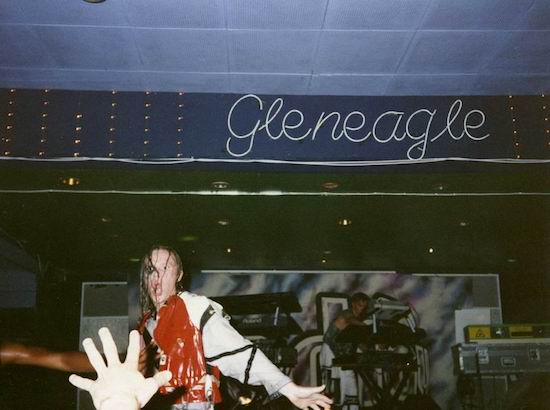
There’s a photo of the late, great Keith Flint from 27 August 1993 in which, typically mad-eyed and soaked as seaweed, he’s seen howling from the stage toward a hand outstretched to grab him. More photos show him and fellow Prodigy dancers Maxim and Leeroy Thornhill flailing extravagantly in a room that could, if it weren’t for the spaghetti-like sign above them spelling “Gleneagle”, easily be mistaken for a big parish hall.
That Friday night in the Ballroom of the Gleneagle Hotel, Killarney, Co. Kerry has long been storied as one of the unparallelled parties of Irish gig history – one where, mid-tour, an electronic act on the cusp of stardom ventured where few international artists of the time would bother and subsequently wrecked the gaff.
In a venue more used to showbands and weddings, The Prodigy were hosted and supported by local brothers Steve, Moss, Martin and Joe O’Leary, better known as burgeoning rave act, The Fourth Dimension. Formed that year after a while of organising parties under the Wild Noise banner, the brothers’ sound bolted excitedely from hardcore techno, breakbeat and acid to Irish trad on albums Over Ground and Around The Day In Eighty Worlds, while their live sets became the stuff of legend thanks to their foxy-haired hysterics and unbridled sense of craic. They would go on to play alongside Braintree’s world-conquering rave outfit over 13 times in the following three years, their grinning, gleeful performances making for a complementary pairing with The Prodigy’s rabid intensity.
The Fourth Dimension called it a day in 96 following a tour with Scooter, but they left behind more than enough bounties to keep the story alive, with talk of their radiant oddness and propulsive Kerry zeal bubbling quietly in forums and in YouTube comment sections to this day. Tracks like ‘Late Arrival’ and ‘Train Of Thought’ boasted flourishes of Dutch trance, while elsewhere cuts like ‘Let Loose’, ‘Nemesis’ and ’Storm (Remix)’ were donk-cum-sesiún gems that wouldn’t go amiss now in sets by DJ Bus Replacement Service or literally anyone who plays Bangface.
An appearance on 2TV in 1994 highlighted the bemusement of the national media toward music that was so playful and strange it worked ("do ye have Beats Per Minute?"), while a now legendary performance at Cork’s hallowed Féile in 1995 serves as a reminder of just how ready, willing and able Irish crowds were for batshit local sounds – once they were given the place to hear it.
Photograph from TheProdigyOnTour blog
Fast forward a quarter century and Ireland’s south east proves still to be a crucial hub where the sounds of the country’s undergrowth can congregate. This year, on the June bank holiday weekend, Open Ear festival hosted its fourth edition on Sherkin Island, right off the coast of west Cork. Once again, the tiny weekender proved itself to be the most crucial event in the underground Irish music calendar, championing the experimental and dedicating itself fully to the importance of community and collaboration within that world.
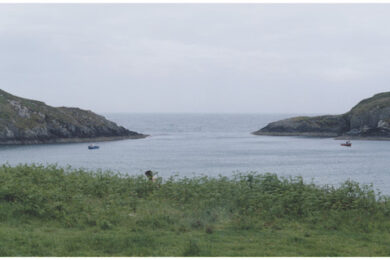
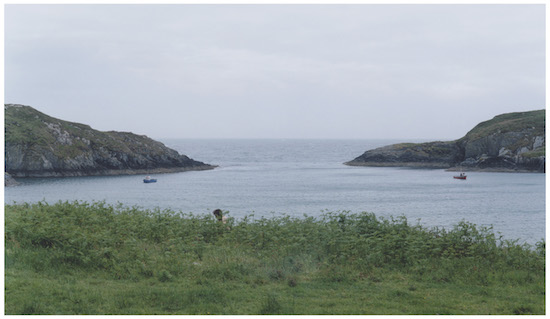
In a lengthy review I wrote of the festival for The Thin Air, I outlined the sheer variety of music featured at Open Ear, ranging from formidable electro and searing drones to experimental folk, avant pop and instrumental psych, with a particular highlight being a once-in-a-lifetime performance of Music For Captives by inimitable Limerick-born, London-based artist, Áine O’Dwyer – a piece which saw her using a walkie-talkie to choreograph a dance of two small fishing boats in the island’s Horseshoe Harbour Bay, all to the layered sounds of seagulls, distant horns and ambient hums, before throwing herself into the sea.
Below, you’ll find some of the best releases to come out of the Irish undergrowth from May and June, with an honourable mentions owed to Junior Brother’s Pull The Right Rope, Goodtime John’s Beauty & Chaos and Le Pizza Galaxie’s ’Fresh Meat’.
From shadowy techno, socially charged Afrobeat and warped affirmations to reflective guitar instrumentals, there’s plenty to sink your teeth into here before we return at the end of Summer.
In the meantime, éistigí.
Jennifer Walshe – ALL THE MANY PEOPLS
In his Quietus review of the album, Dustin Krcatovich described Jennifer Walshe’s ALL THE MANY PEOPLS as being the sound of too many browser windows open at once, with audio running in each. Frankly, it’s hard to think of a better synopsis than that for an album with lyrical content mined broadly and hysterically from Internet detritus, assorted texts, films and video games.
The London-based, Irish avant-garde artist, academic and Aisteach foundation founder outdoes herself on this album, a dizzying head-fuck of word collage, vocal acrobatics and high-def sound design – one that is at times demented and hilarious, at others cruel and dark, often simultaneously. In doing so, Walshe projects the information overload of our Internet existences in front of us, the hyper-dependence and dead-eyed consumption of it all crudely examined as the “worldwide computer god Frankenstein containment policy brain bank”.
Jennifer Walshe at Open Ear by Maeve O’Neill
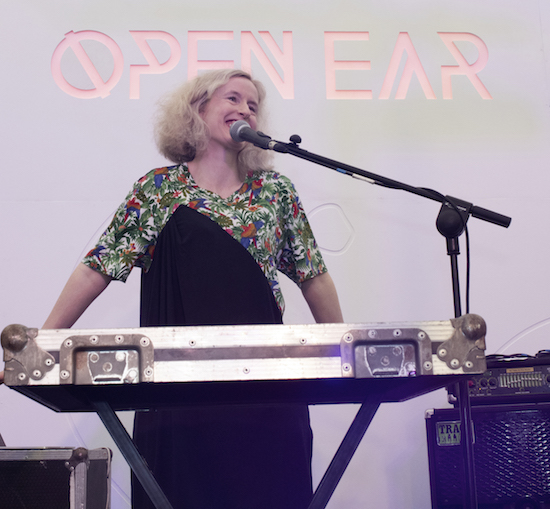
Open Ear witnessed the intoxicating effect of the album’s primary piece, ‘In Glorious Mono’, first hand and, in a way, the audience’s response was a fine snapshot of humanity’s slow descent into joyous passivity and meme-sludge. At first, as Walshe juggles references to celebrity dogs, robots, AK-47s, the Xbox, tampons and massage tables, festival goers seem uncomfortable, sitting on the ground, exchanging raised eyebrows. Soon though, following striking lines like “I want to join the Scouts so I can learn to fire a gun; then I want to get a job so I can buy a gun”, the whole tent is on its feet, clapping and cheering Walshe on as the ideas become more demented, rapid and familiar. It’s comfortable now, the overwhelming half-infos, the base communication, the absurd humour, the swiping romance, the snapshot violence.The performance is jarring, disorienting and relatable in a way Black Mirror hasn’t managed to be in years. When it’s over the crowd yells for One More Tune – because it’s more we want, all the time.
She returns to the stage for solo-voice piece comprised of minuscule lyric snippets from the history of pop music. It’s a bit lighter, and absolutely rad.
Check out the fourth episode of tQ editor John Doran’s New Weird Britain on BBC 4 to hear Walsh giving an improvised performance alongside an AI version of herself, as well as discussing the future of radical music and artificial intelligence.
ELLLL – Glisten
Cork-born, Berlin-based Ellen King continues her prolific year with the spellbinding Glisten EP on Barcelona’s Paralaxe Editions label. Where February’s Febreeze EP on First Second and March’s Confectionary on Glacial Industries saw the Gash Collective co-founder exploring lush breakbeats and propulsive and colourful club workouts, Glisten, despite its title, harkens back to her shadowy 2016 debut, Romance.
Glisten’s three cuts feel like extensions of ELLLL’s billowing live sets, while invoking the likes of Wolfgang Voigt’s GAS or Laurel Halo’s In SItu in their capacity to make something so crepuscular feel so vivid. Verdant and extravagant sounds and samples warp around one another like gnarled branches on ‘Flowers’ and ‘Ride’, while the abstract title track feels like a fog-drenched dark, pierced by torchlight.
Ordnance Survey – Relative Phase
For two decades now, Neil O’Connor has been in the vanguard of experimental and electronic music in Ireland, both in a solo capacity as Somodrone and as keyboardist for spearhead math rock outfit, The Redneck Manifesto. His latest endeavour, Ordnance Survey, finds him inviting a star-studded cast of Irish avant-garde musicians into his creative orbit, as well as bringing Tortoise’s John McEntire in on percussion, all with a view to “[mapping] the worlds of new music, jazz and electro-acoustic music”.
Sending recorded sketches of tracks to woodwind player and electronic artist Sean Mac Erlaine, experimental composer Linda Buckley, and Crash Ensemble cellist Kate Ellis, O’Connor had the contributors improvise over what he had produced. Pieced together, manipulated and polished, the resulting album is a glimmering selection of electroacoustic goodness veering comfortably from cinematic new age and ambience into more heady territory, with John McEntire’s racing percussion on ‘Goya’ giving its gravelly drones and melodic chimes an exhilarating urgency.
Static. – Flow
Released via burgeoning experimental and electronic cassette label Moot Tapes, John Hennessy’s debut album,Flow, under the Static. moniker is a perfectly paced collection of sci-fi sound design, ghostly ambience and techno.
As co-founder of Cork’s beloved Sunday Times! parties alongside Colm K, Hennessy is probably better known as purveyor of house and disco. On Flow, however, we find the producer treading darker terrain, something he exemplified masterfully in his mid-afternoon set on the Saturday of Open Ear. By a cliff drenched in fog, Hennessy’s heaving rhythms and rubbery electronics made for a subtle energiser – plucking the same hissing, spectral strings in a live setting as they do on tape.
Department of Forever – Unseen Pictures
That Steve Fanagan’s work has primarily been in the realm of sound design for TV and film comes as no surprise when listening to his latest project, Unseen Pictures. Released under the Department of Forever alias via new Irish label Wow & Flutter, the nine-track album is a masterclass in subtlety and atmosphere.
Recorded over a few days in improv sessions before being chopped up and rearranged into nine tracks of eerie, industrial drones and powdery noise beds, Unseen Pictures is a transportive listen that will do a lot for fans of HELM, Tim Hecker and Sarah Davachi. Released on tape, it’s also an album for which the cover art makes a perfect companion to its reflective timbre. A smoky, minimal print displaying a block of flats or offices with just one row of lights on ends up evoking the same dreamy melancholy and curiosity that came when you first saw the cover of Original Pirate Material – an unlikely companion, sure, but I’m sticking to it.
Yankari – ‘Change Your Ways (Mago Mago)’

Irish-Nigerian Afrobeat collective Yankari get wheels in motion for their debut album, set to land later in the year via Hipdrop Records, with the release of new single ‘Change Your Ways (Mago Mago)’. An electrifying live force, the band, founded by Gabriel Akujobi and brothers Segun and Michael Akano, has been pushing and evolving the sounds pioneered by Fela Kuti in Ireland for a few years now, while confronting socio-political issues with a verve indebted to that of Egypt ‘80.
For a couple of years now, members of Yankari have been actively involved in MASI, Movement of Asylum Seekers in Ireland, working to raise awareness and support for refugees living in appalling conditions in the country under the heinous system of Direct Provision.
‘Change Your Ways (Mago Mago)’ is, according to the band, aimed at those in power throughout the world, with Mago Mago being a Nigerian phrase used to describe “a person or action of a deceptive or untrustworthy intent”. The song implores those with power and influence to be a direct cause for palpable change, “Attitude, mentality, philosophies and habits will always need to be re-evaluated because change is ever constant,” the band explains in an accompanying text to the track and its visual pairing directed by Darragh Foy. “Collective change begins with the individual. So change your ways so that life doesn’t change it for you by force.”
Yoga For The Ears – Sleep Learning
Having debuted at Open Ear 2018, art collective Yoga For The Eyes – comprised of Digital Druids Eva Richardson McCrea and Coilin O’Connell along with artist Michelle Doyle AKA Rising Damp – returned to Sherkin Island this year with another exhibition. Recontextualising many of the materials used in 2018’s piece, which examined the growing commodification, packaging and flattening of radical, alternative lifestyles, 2019’s installation focussed on “decentralisation, AI, offgrid servers, mushrooms and folk art”, Doyle tells us.
The trio also put together a CD to soundtrack weary travellers on their drive home from the festival. Yoga For The Ears offers a uniquely warped take on affirming recordings and sleep guides, using the spoken word framework and manipulating it with surreal lyricism, vocal alterations, grumbling electronics and field recordings – a delightfully odd salve for festivalgoers whose brains had turned to mulch after a heavy weekend.
Material for the CDs spoken parts include info from Seetec’s website, a passage from JG Ballard’s Manhole, an aftersesh-appropriate spiel about dolphin cognition, and text from the previously featured Repeater Data Dump. Elsewhere, an AI text to speech synthesizer is used to narrate a passage in the Connemara dialect of Irish and another from the point of view of a bioterrorist. Cheery stuff.
Autumns – Shortly After Nothing
Ireland’s answer to Giant Swan, Christian Donaghey’s brand of acerbic, noisy EBM and techno has been wreaking havoc on the fringes for some years now. With releases on labels like Regis’ Donwards, Clan Destine Records, iDEAL Recordings and DKA Records, the Derry producer has also developed an apt notoriety for his harrowing live sets, all industrial clatter and blood-curdling screams. It’s a reputation that has taken him to some interesting places, with an experimental sound installation at Paris Fashion Week 2016 and an improvised live soundtracking of David Lynch’s Twin Peaks: Fire Walk With Me sitting among landmark live sets at venues like Berlin’s Tresor and OHM and London’s New River Studios.
Autumns’ new album, Shortly After Nothing, on Broken English Club’s Oliver Ho’s Death & Leisure label brings another six tracks of caustic electronics into his arsenal, with feral howls and metallic beats ripping the post-punk forms of the tracks to smithereens.
Jonny Dillon – Songs For A One-String Guitar
As Automatic Tasty, Jonny Dillon’s output of crisp analog electronics, acid house and electro has, for over a decade now, distinguished itself with its melancholic undercurrents and dreamy, introspective atmospheres. Releases on labels like Lunar Disko, Photic Records and Sheffield’s Central Processing Unit have showcased a producer for whom, even on the most dancefloor-focussed cuts, emotional resonance and feeling are always at the core.
No surprise then, when the drum machines and synthesisers are packed away, Dillon transmits just as much poignance, if not more, using nothing but a guitar. Far from the Panorama Bar booth, Songs For A One-String Guitar is a culmination of ten years of playing, sketching, recording and learning instrumental pieces that call to mind to the likes of John Fahey, Mississippi John Hurt and RM Hubbert as well as traditional Irish players.
The idea of an album coming together over such a long period, put together in solitary moments of repose from the hysteria of real life, is palpable, and allows us to feel that same sense of escape and temporary respite that Dillon does – particularly in pieces like ‘Turning Invisible In An Imaginary Rose Garden One Evening’ and ‘The Road To Your Door’. Grief and reflections on loss are also portrayed with delicate, freeform playing in ‘A Requiem For Joe Dillon/Light A Penny Candle’ – the latter half which is a piece composed by Dillon’s late uncle for whom the first half is ode. Songs For A One-String Guitar is a simple, raw and honest record to accompany solitary summer days.
Bitflower Bb – Mastalgia
Described as “a companion for dusk walks and light of dawn commutes along Dublin streets”, Bitflower Bb’s Mastalgia is a meditative exploration individual existence within an urban landscape, and how one’s own experience is but one significant blip in a sea of countless others.
Listening to the album from the Irish-Canadian producer and multimedia artist Jennifer Moore, who also releases music and DJs as Dream~cycles, you can almost feel the world slow down around you, each passing object feeling a little more glowy and relevant – with humming synth beds and delicately buoyant beats propping up her hushed vocals. Named after a common, cyclical breast pain that, as Moore explains, so often goes unuttered by those who experience it, the poignance of these six tracks comes, naturally, with a touch of hurt. But really, with music that feels tailor-made to slow down the numbing, isolating dirge of urban existence, there’s a comforting, if momentary, sense that none of that hurt is felt alone.
The Lock-In – .
There’s nothing quite like a live electronic record, and they don’t come much more live than The Lock-In. Comprised of David Kitt (New Jackson), ‘De Freek’ Creaney and Tim Wheeler (Ash), the two-track, half-hour long album is a the unedited, undubbed result of studio jam sessions in Wheeler’s Atomic Studios in New York, 2013.
Recorded on and ARP 2600 semi-modular synth, a Minimoog, a CS60 and a Jupiter 4, the album’s first half, ‘Locked In’, is a syrupy trip with a chiming kosmische pulse and all the glittery chimes of Pauline Anna Strom’s Trans-Millenia Music.
The album is the first release Kitt and Creaney have done together, but their creative partnership extends over 20 years, back to when the pair lived together in Dublin in a house “filled with records and decks and cheap samplers, synths and Casio keyboards”. The pair would jam and improvise together constantly, with Kitt christening Creaney ‘Da Freek’ because of the “bubbly squelchy mad professor synth sounds” that would emit from his room when they were not playing together.
The Lock-In’s history beams with that air of spontaneity and camaraderie and, after a long session over a bottle Hennesy and a bag of weed with Tim Wheeler in his well equipped studio, the trio’s decision to record and, eventually, release the results is nothing less than a treat.