
Primitive. Now there’s a word that’s got so much baggage, it needs its own carousel.
Anyone thinking of using it to describe a culture or art form or person or group of individuals would surely be advised to tread with exceeding care, loaded as its history is with white supremacy, dubious science and steaming ladlefuls of elitism. However – is a punk rock reviews column an arena where it can be deployed in good faith? I, the writer of the column, would like to think so.
The primitive approach is a central plank of punk music, and always has been. Punk musicians are likely to be celebrated for their primitivism than in any other genre, and its status as a broadly negative term has been reclaimed. Obviously, this still allows for (a) punks with breathtaking musical talent and (b) grouchy bastards muttering that “this lot can’t bloody play,” but no other music will give you a greater freedom to work it out as you go along.
The ur-text of punk primitivism is not the Sniffin’ Glue chord diagram, like you thought I was going to say, but ’How To Play Guitar’ by David Fair of Half Japanese. For this reason, I was delighted to see it quoted on this very website by Lancashire musician Kiran Leonard – moreso because he is prodigiously skilled, and occasionally sounds like King Crimson on his new album. There’s also a quote by Jello Biafra, which I can’t locate but is along the lines of, “People talk about how revolutionary it was for a band to sound like the Sex Pistols, but they were really pretty conventional. Imagine if they had actually sounded like Half Japanese!”
All the bands I’m reviewing this time around are somewhere between the Sex Pistols and Half Japanese in terms of their (apparent) ability, adherence to musical structure and chances of winning a Grammy. The last two don’t actually fit, but I’ve put them in anyway because they’ve made great records and I treat this place like my own fiefdom.
First up, though, Montreal quartet No Negative and their debut album The Good Never Comes (Psychic Handshake / Swollen City).
This is as much a psychedelic record as a punk one, stylistically, but any good vibes that accidentally bubble up over its eight songs are fully inverted. It’s as thuggish-sounding as the most fantastical biker movie soundtrack, inert and acrid as a swimming pool full of burning glue, and echoey as your own inner monologue. It has crypto-goth parts played with sharpened flints for plectrums (‘Empty Casket’), invocations to the Great Stooge In The Sky (‘Switched Off’) and, if the photo on the insert is anything to go by, absolutely fuckloads of amps. Its closest recent analogue is probably last year’s brilliant Destruction Unit LP, but that harboured moments of euphoria in its fretboard runs and crescendos; chance would be a fine thing here. Which is not to say that you can’t find joyous abandon in The Good Never Comes, just that you have to submit to it.
Kansas City hellions Wet Ones have no wah-wah guitar, rather a song called ‘Waah Waah Waah’. It’s the opener to their self-titled debut album, which is co-released by Slovenly and Black Gladiator and delivers twentysomething minutes of ear-mangling garage punk intemperance. Their previous bands include Fag Cop, who I never really listened to, but suffice to say that their spirit is at least continued via Wet Ones’ terrible name, and a manner that’s cruder than Australian advertising.
Like an addict forever chasing the high provided by their first hit of whichever narcotic, in a sense I’ve spent the last 12 years trying to replicate the moment when I discovered Coachwhips, John Dwyer’s pre-Oh Sees band. Wet Ones don’t quite make that impossible grade, but they come closer than most, thanks to a volume-centric mastering job (Coachwhips’ Bangers Vs Fuckers is still the loudest album I’ve ever heard), vocals that are so distorted you can’t make out a word and a relationship with the blues that’s less an explosion than a vapourisation. They would have fitted the 1990s Crypt Records undercard, bands such as Bantam Rooster or Los Ass-Draggers, like a studded leather glove, too, but you’d be a dipshit to try and slap a datestamp on this and deem it outmoded. In-the-red bozo guitar raunch remains exhilarating after – shall we say 50? – years, much like drawing dicks on walls does after 40,000.
If the above is, or sounds like, your kind of vulgarity, then scope out the split seven-inch between Sick Thoughts and Black Panties on the Italian label Goodbye Boozy. Both are one-man bands, based out of New Orleans and St Louis respectively, and sound appropriately unlikely to play nicely with others. Sick Thoughts, aka DD Owen, is still in his teens if my stats are accurate, and has attained a certain cult prominence by persistence as much as anything, firing off mini-statements of nasty punk intent with such regularity you fear for the boy’s wrists. His two songs here are titled ‘Shoot Me In My Head’ and ‘Leather Life’, which is kinda perfect, and bully you in a nerdy way, like a hybrid of the Coneheads and Cülo.
Black Panties, meanwhile, is an associate of the praised-in-this-column Lumpy & The Dumpers, and sounds like it: ‘Killing Time’, especially, is viciously loud mindless trash with everything apart from a wailing lobotomo-metal guitar collapsed into a black hole of utter distortion. He also managed to misspell his own band name on the insert to this single. Are either of these fuckos going to be manipulated into becoming the next Jay Reatard (premature death or otherwise)? It’s a no for me, Clive.
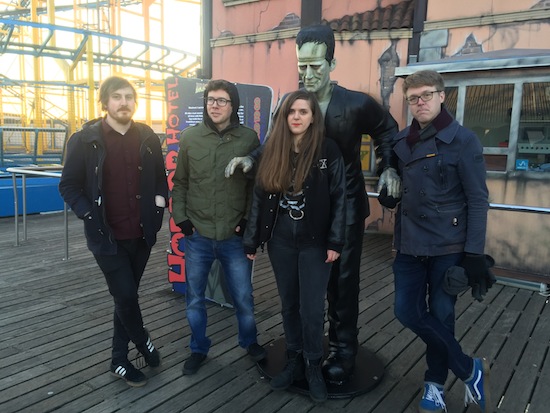
Lower Slaughter picture by Isobel Reddington
Inspiring me, and hopefully you, to drop cash money on the squarest and most poindextrous recording format available – a CD single – are Brighton’s mercurial Lower Slaughter. The Hands EP (Cupboard Music) is the first and only recorded document of the band as was, fronted by Max Levy. Readers hip to Britain’s current DIY indie scene may know King Of Cats, Levy’s solo project – both uncomfortably confessional and guilelessly childlike, the best I can do to describe it is “Happy Flowers if they were a Saddle Creek Records band”. Lower Slaughter, meanwhile, play lurching noiserock that occasionally works the angles (‘Hands’) but is chiefly a showpiece for big fuck-off riffs that call to mind Pissed Jeans, Nirvana and Harvey Milk.
Repurposed on a weird, noisy punk record, Levy’s won’t-eat-his-sprouts vocal shriek feels abrasive in a different way, and not unlike Doc Dart of Wisconsin’s legendary Crucifucks. It will probably be a pitch too far for some, albeit perfectly suited to songs about mucking around in a field behind your house and getting used to a funny-smelling kid in school; Hands, though, does a splendid job of subverting noiserock by stripping it of its machismo, while retaining its power. Moreover, Lower Slaughter have recently replaced Levy with Sinead Young, formerly of Glasgow’s very agreeable Divorce. Watch this space! Or another, more informative one.
There’s almost no information out there about Cold Meat – two girls and two boys from Perth, Australia who recently released a magnificently gofuckyourself hobnail stomp of a six-track cassette, Sweet Treats (Helta Skelta). As with my futile rainbow-chasing of the Coachwhips mentioned above, I’m perpetually seeking a band with a comparable overproof spirit to London’s Good Throb, and Cold Meat snugly plug that gap. Vocalist Ashley Ramsey even goes by the nom de plume Ash Tray, as does Ashleigh Holland in Good Throb – I’m going to assume this is accidental, as opposed to minor league identity theft. Either way, Sweet Treats features songs about throwing up on a baby while hungover, the pisspoor sexist banter one endures as a barmaid, and a cover of the Electric Eels’ ‘Full Of Shit’. The guitar tone is piercingly brutal, and has me thinking that this is secretly an Oi! record, although it would be the only one I know of with a big pink lipstick kiss on the inner sleeve.
NYC’s The Brass, on the other hand, display all the understood trappings of Oi! on Rugged Cross, their debut cassette (released on the Erste Theke Töntrager label in Europe). Relentless, raw-throated paeans to the American working/drinking classes, delivered at menacing midpace, is the order of the day here. They also turn out a cover – ‘Crucified’ by Iron Cross, so overplayed by now as to be pointless really – but, by the time that crops up, have done more than enough to prove their credentials amidst the melee of latter-day superyobs. ‘Treading Water’, which opens the tape, is a complete and utter banger which I’ve listened to about ten times today. “Waiting for the subway train / Waiting to use my knife / Waiting for the first ice-cold beer / Waiting for the end of my life.” Yeah, I know it’s stupid, but so is EXISTENCE, chum. The Brass peak at the start, but the remainder of Rugged Cross is at least solid, with ‘Another Street Kid’ their other dead cert keeper.
If you consider yourself a fan of Oi! but find the idea of bands playing it in 2016 unpalatable – well, enjoy being wrong for one thing, but maybe this archival LP by The Venom might turn your head. ‘Arringtons, Crombies, Anarchy, Bondage is out on US label Radio Raheem, with a hometown pressing on its way from Swansea reissue imprint Punkhouse – The Venom, in their 1979-82 lifespan, were not only the Welsh city’s most ‘orrible punk ensemble, but reputedly keen participants in its football team’s hooligan division. As such, you can slump on your goosedown pillow in your ivory tower, tingly with the knowledge that these songs were made by exquisitely authentic ruffians.
For all that, it does feel like the barrel has kinda been scraped in an effort to justify this project, replete with a big shiny booklet of photos and such. The 16 tracks on ACAB (yes!) include two excerpts from radio shows discussing the band; covers of ‘These Boots Are Made For Walking’ and Sham 69’s ‘Borstal Breakout’; and alternative takes of two of their originals. That leaves ten actual songs, two of which are on a bonus seven-inch for some reason, and several of which are pretty forgettable to be frank. If anything validates this record, it’s the pressing of ‘Saturday Afternoon Trouble’ to wax: a thoroughly disgraceful celebration of the hoolie lifestyle, it crystallises The Venom’s whole world into two perfect minutes, and is probably my favourite Welsh punk song ever. Whether you need to spend fifteen quid or so just to own it is another matter, but that might be cheaper than me smashing your car window and leaving a CDR of it in the glovebox.
Similarly to The Venom, Dallas’ Stick Men With Ray Guns were never properly immortalised on plastic in their time, in spite of a notorious badman reputation. Grave City (End Of An Ear) redresses this with an eight-song hotchpotch of live and demo cuts from their early 80s lifetime; the difference is that there’s virtually no chaff, it hangs together like an ‘actual’ album and they whale away with such oppressive, sludge-drenched abandon that the niceties of the mixing desk are rendered moot. Contemporaries of the Butthole Surfers, SMWRG joined them – plus Flipper and Black Flag – in a slow, tortuous grind while hardcore’s average tempo was approaching warp speed.
‘Christian Rat Attack’ and ‘Scavenger Of Death’ (which vocalist Bobby Soxx released, pre-SMWRG, with his eponymous band) are both lurid, maggoty cankers of songs which serve as one of the foundation stones of noiserock. There’s a bit of Jello Biafra in Bobby’s haughty vocal sneer – a comparison he would have probably dismissed were he still alive; the band considered the Dead Kennedys “full of shit” and blanked them when they were given a support slot in Texas – and the gleeful proto-troll ethos of the Meatmen. Their later recordings, from 1984, introduce a psychobilly twang, ‘Satan Baby’ suggesting a blossoming Cramps fixation. Really, though, you’ll be wanting Grave City for the opportunity to get repeatedly, monomaniacally thumped on the noggin by Texas’ deadliest ever dealers of dirge.
And with that, our celebration of the Primitive ends and we heighten our brows for two final releases… kind of. Uranium Club are from Minneapolis, a city with a storied punk history but not one that’s produced a band I actively care about this century (I’m sure its mayor will be wounded to hear this) – until 2016, and Static Shock Records’ re-release of Human Exploration, previously a locally-circulated cassette. They could be described as postpunk, but seem to crib from the stuff that was either present at punk’s birth or predates it: Wire, The Stranglers and Wilko Johnson’s speed-peppered guitar in early Dr. Feelgood. Throw in the cheesewire intensity of The Wipers and Drive Like Jehu, and a crispy base is created for the darkly comic worldview of vocalist Brendan Wells.
More a speaker than a singer, if you follow, Human Exploration’s best moments are two of Wells’ miniature stories set to music. ‘Prissy Chrissie’ concerns a woman who robs a store at gunpoint, and the clerk who becomes “enthralled” by her (I wonder if Wells is familiar with ‘Come Up With Your Hands Out’ by Alice Donut), while ‘Sunbelt’ relates the experiences of three visitors to Las Vegas, with a sting in the tail. Can’t get enough of this one, and seeing as it first emerged some 18 months ago, it’s high time Uranium Club followed it up.
Finally, a return to that never-futile question occasionally posed by Straight Hedge: can music driven by repetitive electronic beats be ‘punk’? Now me, I’m a lilylivered liberal on these matters, so my answer is – sure, knock yourself out. That’s why Paradise (Sacred Bones) the third album by Brooklyn’s Pop. 1280, is in here. Still, if you’d prefer to think of it as industrial or synthrock or even goth, there’s no shame in wearing any of those badges. Paradise shares some common ground with the 2015 debut LP by fellow NYCers L.O.T.I.O.N: raging against surveillance culture and the war industry via spasmodic drum machines and nasty guitar, albeit sounding derived from mid-80s Swans rather than Japanese hardcore.
Pop. 1280 are hardly an obvious commercial proposition, but beneath their frayed wires and sheets of distortion beats a heavy-rock heart with a yen for alt anthems. ‘Phantom Freighter’ could have caused multiple Woodpecker&blackcurrant spillages on a 1990s goth club dancefloor; the seven-minute ‘In Silico’ is textbook Wax Trax! fodder, overwrought and loving it. Veterans of this whole scene might detect a similarity between the curled-lip vocal snarl of Pop. 1280’s Chris Bug and Tod A, of Cop Shoot Cop, while ‘USS ISS’ shifts matters closer to Big Black’s immense guitar earslaughter, and therefore punk culture. If Paradise had been released in about 1993, Pop. 1280’s toil might have been rewarded with a few late-night MTV plays and a four-K review in Kerrang!, but would have risked them being lost among a spate of techno-metal tryhards. Twenty-three years later, it can enjoy a niche of its own making, and is very effective for that.