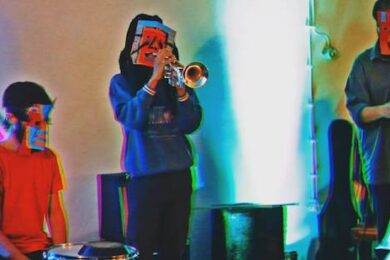


Zarabatana photography by Eloísa D’Ascenção
The fact that Daniel Craig‘s new album seems to have simmered into existence over a full three-year period is far from surprising. The low-end obsession, meticulous detail, and sheer scope of aesthetic put into A Past Yet To Come by the Aussie producer is, no bullshitting, breathtaking. Just listen to the 16-minute opening track for a lesson in Craig’s ‘beat concrete’ approach. Brimming with grim menace, the track seems to see a swathe of non-musical field recordings chopped up and nestled next to perfectly programmed kick thuds and bass hums, somehow finding sequiturs amid the unidentifiable handing feedback and rustle of city din channeled into a sparse soundscape anything but minimal. Perhaps a long walk through a deserted cityscape is the imagery that most immediately springs to mind upon first listen, albeit with a focus on the emotions and thoughts churning inside the walker’s head rather than the emptiness that surrounds them. Semblances (or perhaps memories) of dancefloor logic do slowly emerge as the piece progresses – but by the time it nears the finale, you’ll find yourself shaking your ass to a haunted and all-but-empty metropolis without even realising it.
While the artist purportedly lives in Berlin now (who the hell doesn’t?), A Past Yet To Come was recorded in his far-from-moody hometown of Melbourne. The time taken over the music is so tangible too, with every dynamic lilt or encroaching field recorded hum woven in to the mix with delicate patience. These pieces evolve and take oddball left-turns consistently. (A handclap drops into part 3 nonchalantly, but miraculously it is an incredibly wild moment.) It is ultimately tantamount to an aesthetic manifesto for a new kind of impressionistic minimalism. Demolished club music perhaps. Craig’s debut is a staggering work, intimate in its intensity, intensely careful in its construction, and constructed with an idiosyncratic logic of inspiring originality.
To be fair, taking animated movie soundtracks – specifically Polish animation from the 60s & 70s – as a starting point for a project is far from limiting. The trio of percussionist Jacek Buhl (Alameda 5), guitarist Jakub Ziołek (Stara Rzeka, Alameda duo/3/4/5, Innercity Ensemble) and trumpeter Wojciech Jachna (Innercity Ensemble) did just that when gathering to record the aptly titled Animated Music, invoking the mashup of early electronics, avant-jazz, and childlike primary musical colours from the era. Not unlike the National Film Board of Canada or BBC’s Radiophonic Workshop here in the UK, an incidental blend of an open-ended artistic medium plus access to pioneering technology enabled the Polish Radio Experimental Studio and others to extrapolate a strange and inviting world of sound. Unlike Western counterparts though, the presence of censorship had to be overcome, somewhat ironically inspiring some of the groundbreaking creativity of the era in the country (see Daniel Szczechura’s short films for an idea). We digress.
Despite such an open-ended mission and improvised basis, the trio certainly manage to keep things inviting here. Kuba Ziołek spends a lot of time making bouncy synthesizer lines or deep proto-techno loops, while Jachna’s trumpet and cornet soar mercurially, leaping between mournful, suspect, joyous or enraged quicker than Daffy Duck. Jacek Buhl’s drums provide denser and deeper textures, at times leaning closer to a bassist’s role (particularly when rubbing them toms), or punctuating the mechanical synth arpeggiations that comprise much of the actual ‘rhythm’. Playful, weird, dark, and sad, this is a fine little tribute to a specific time and place in art well worth getting to know, embodying the spirit of Polish animation’s unique aesthetic – and of course the musical lacuna it filled.
Based as it is on Ynys Môn (aka the Welsh island of Anglesey), Sivilised Recordings continues to sound like it’s rather channeling music from another goddamn galaxy. The fifth tape on the imprint is the second by Atlantikwall – one of this column’s favourite tapes way back in 2016 – and the unnamed musician(s) under the guise do exceed expectations with a cosmic slop of tribal psych-noise invocations. The core ingredients of a battered drum circle of endlessly looping percussive bashes, furry guitars, and general pedal scuzz remain thoroughly intact. The vocals however, are put into firmer focus. They’re brought forward in the mix and (somewhat) unmuddied, the stories being told inside these tracks also pulling into focus. They tell doomy tales of "reproduction in the face of impending extinction" or "resource wars fought by farmers in lands encroached by desertification". Third track, ‘Bone Shoots’ event seems to suggest reinstating human sacrifice to try and get the environment back on-side. (This is not endorsed by this column, might I add. Not yet anyway.)
These trippy DIY acid noise rock rituals loop and drone and batter away with intent, pushed into long jams of desperate wailing and gloopy fuzzed out mulch – nonetheless very fun too still. The Master Musicians Of Dyffryn Moor is a similarly anonymous and rural outfit, battering drums against the apocalypse, and located some 100 miles down the Welsh coast in Pembrokeshire. Both Atlantikwall and TMMODM seem to embody a hopefully infectious and very much near-magic (and very Welsh, even when sung in English) approach to music-making. For all its heaviosity and apocalyptic imagery, Atlantikwall’s boundless psychedelic tribalism feels a rugged musical theatre of hope.
Previously two thirds of a Rotterdam-based trio called Sweat Tongue, Goldblum comprises Marijn Verbiesen and Michiel Klein. Their self-titled debut tape sees the pair making their songs in a method that manages to make an emotional order from the seemingly chaotic foundation of collaged flea market cassettes, tape-loops, cheap keyboards, and willfully subdued singing (in both English and Dutch). The resulting tracks are somehow intensely compelling, drawing energy from the duo’s improvised live performances, their fingers and dimly-lit practice spaces and venues tangible in the moody singspeak-driven songs. ‘Come Back Soon’ is an actual slowburn banger, with a bass thud worth nodding your head to. On ‘Spiegelpaleis’ though, a now-unrecognisable snippet from an ancient slice of tape is EQ’d from damp bass hell into razor sharp high-end reality, segueing into a distorted jazz loop (‘Jazz Of Thin Air’), over which an improvised exorcism of mumbling takes place.
It’s more collage work than the initial poppier tracks would have you expect, but this is nonetheless a fantastic intro to the Dutch duo’s lo-fidelity rumblings. It wins from its brevity too, working best as a single-shot, listened to straight through in one go – a short parade of tape-worn snippets chosen with promising adeptness. ‘Broken Bones’ is literally just a single line from a lyric, chopped to sound like the words, "their broken bone’s too deep", a lonely keyboard improvised alongside the loop. It’s far from the colossal conceptual scope of such artists as The Caretakers or William Basinski, but in its three-minute window manages to summon much in the sense of 20th century pop culture spirits, and the buried emotions of long-forgotten radio hits, locked onto centimetres of magnetic tape left only to slowly decay and ultimately disappear.
Portuguese improvisers Zarabatana seem to have wandered far enough that the jazz label simply won’t do any more. A Moondoggy mix of percussion and double bass sets the pace while a spiralling echoey trumpet and knotted guitar hammer away on the opening track. ‘Corno de ganso’, which considering the aggression of its opening aptly translates as ‘Goose Horn’. Within a breezy seven minutes though, the quartet take the tune from noisy ritual to delicate rumination, the players even mimicking charmed bird song. Perhaps inevitably, the trumpet of Yaw Tembe ends up feeling like a lead vocal – but the background is buzzing with weirdo effects pedal sounds, lilting percussive flurries, hand percussion rhythms, and scraped strings and cymbals making this a thoroughly global take on improv. Final track ‘Estepe by estepe’ sees the group moaning atop a rugged guitar lick, drifting out to sea like a sinking car with the driver passed out on the horn, epitomising the bizarrely rich imagery the group manage to summon from a sound so overflowing with varying cultural signifiers as to ultimately signify little specific beyond rhythm and colour. The emotion flows from this improv, while maintaining a heterogeneous sound that makes its origins intriguingly difficult to triangulate. I’m off to dig deep into the Portuguese improv scene.
Consumerism makes monsters of all of us. From the leering cigar-chomping execs, to the Black Friday shoppers punching it up over a games console, to the retail workers wasting their life stacking shelves with plastic crap. It’s also however, one of the few busily shared physical experiences left in the west. Shitting, schooling, and shopping – that’s about all we got left to do together in the physical world. North London art punks I Know I’m An Alien’s Do You Work Here? gets down to tape a half hour blast of brief theatrical, satirical, and surreal (and also somehow hyper-real) anthems for the psychedelic shopping space. The chipmunky vocals, restless energy, lo-fi and keyboard-heavy aesthetic (perhaps resembling the likes of The Mothers or The Residents) straddle the boundary between terrifying insanity and childlike innocence, with madcap tunes like ‘The Customer Is My Friend’ or the consistent reprisal of the phrase "the customer is always right!" quickly sounding the like ramblings of a consciousness long-lost to the repetition and banality of their day-to-day work. The customers also get a word in, mostly brimming with irritating requests or unfound arrogance, such as on ‘Do You Work Here?’, a terrifying trip of cheesy 80s backing music aesthetics and steel-drum aping guitar notes, over which a customer sings "I was wondering if you could help me!".
The overtly socialist I Know I’m An Alien are clearly having a ball playing these absurd and insane little characters, but these are also miniaturised puppet-like avatars for all of us. Hidden inside the laughable irritating tunes and glitzy keyboards and pathetic little characters throughout Do You Work Here? is a satire of not only shops and a tribute to "all the fine persons who work in retail", but also a microcosm for the trolley-pushing monsters and lifeless clerks that buying shit turns us all into.