

The latest episode of Spool’s Out Radio on Resonance FM comprised the standard high quality mix of recent tape releases from across the board that have been providing our Walkmans (Walkmen?) with plenty of rest from the bleak outside world… The show included the likes of Budokan Boys, TALsounds, Elvin Brandhi, and more.
Head over to spools-out.com, or the Resonance FM website to find out more about the show. This episode and others can still be streamed in full via the above, as well as via podcast.
Spanning five years worth of live improvisations recorded by a German duo sparring noisemaking electronics and drum kit, – log p by H (one of the first tape issued by the brand new and mysterious STOFFE imprint from Hamburg) shouldn’t be anything like as cohesive and satisfying as it is. Recorded in a practice room at Hamburg’s FleischGroßmarkt, these six tracks head deep into long rhythmic wig outs, perhaps latently resembling Black Dice or even Boredoms. But overall it’s slower and darker – haunted even. Tracks such as the catchily titled ‘p(AB)p(B)p(A)’ go menacingly nowhere slowly for ten minutes at a stretch.
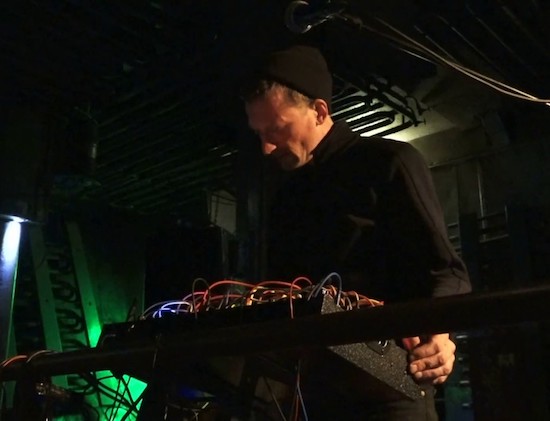
David Wallraf mans the aforementioned electronic noisemaking gear, with online video clips showing him controlling banks of netted synth modules and mixers, yelling inaudible gibberish into processed microphones, turning voltage into a mixture of cycling drones, bass buzz, and leering ambience. The fact that drummer Klaus Frieler is so patient throughout is perhaps the key to what makes H so damn compelling for such a simple duo. He calmly moves forward on the lengthy ‘E = hf’ without ever falling into a motorik loop or pounding angrily; he just calmly sets the pace while Wallraf’s bed of noisy flowers slowly blooms into a breathtaking chaos of bubbling electronics growing angry. They take their time getting there, but H at their peak are something exceptional.
João Renato Orecchia Zúñiga seems a restless and instinctive kind of musician. He’s an autodidact, a sonic experimenter, and a multimedia artist – plus was born in New York City to a Peruvian mother and Italian father if that weren’t enough. Variously playing guitar in 1990s London and composing iMac electronics in 2000s Berlin, Orecchia’s Between Revelations tape is inspired by Johannesburg, a city to which he relocated back in 2005. That evocative title, along with where the music was made, should give you some basic idea about the headspace Orecchia’s inhabiting. Johannesburg is a city often seemingly between revelations – in both the more apocalyptic sense, and in the sense of an overhaul or epitome. It’s alive with promise, and buzzing with energy, and yet full of fear and worry (not to mention a confused identity, to put it lightly). This may be the first music by the artist you’ve heard (it was for me anyway), but the complexity of the album’s thematic context and Orecchia’s long history as an innovating musician, are most definitely vital once you start to listen. This is a mature and unique piece of work, only possible by some skilful and thoroughly inspired hands.
It’s – perhaps somewhat less excitingly something all brought together using modular synths, but the results are massively colourful and anything but cold or predictable. Semblances of a harp sample cower beneath dropping noise bombs on ‘Resonant Travels’, stumbling hand claps, shakers, and 8bit basslines somehow fall into line around a beat on ‘Random Acts’, while ‘Boredoms’ is a lunar eclipse of slowly phasing, yearning synths interlocking. Orecchia’s soundworld is as multifaceted and chaotic as his own summarised bio above, flailing in all kinds of directions, but always keeping one foot firmly grounded in pure sonic experimentation. Penultimate track ‘Not Unpleasant Distractions’ shows off a kind of acid-techno-gone-awry vibe Orecchia could well have at his fingertips, yet deceptively simplistic closer ‘A Calm Man’ seems to precis Orecchia’s MO best. For ten minutes the artist fiddles with and layers and processes a simple looped melodic phrase, morphing a luscious coda into a mutant vibration.
Despite making music together in London for decades now, Spencer Grady and Stephen Lewis sound like they could have spent the last 20 years living in blissful isolation in the wilds of New Mexico. The duo also make ambient folk music as part of a trio called Rameses III, but as a duo – named Padang Food Tigers – their sound is an even more minimal take on heavenly, Hired Hand Americana. Tracks can comprise as little as a lengthy field recorded wind and a half whispered electric guitar melody (‘The Wishbone Delegate’), or as much as an intricately woven multi-part instrumental for banjo, dobro, and harmonica (‘These Are The Beautiful Ones’).
Pianos and tinkling glass also make appearances, yet for its understated breadth of sound, these lethargic, dreamlike instrumentals all inescapably evoke a mood of folksy isolation deep in the twang and dust of the American southwest. That all having been said, the urban loneliness of the capital can in many ways match the kind of unhurried lives lived in places rural. The interleaving dobro twangs of ‘Just Keeps Rolling’, glistening in reverb, instantly took me back to getting woken up by the driver and kicked off a night bus right in the middle of the vast alien grassland of Blackheath in South East London in the earliest hours of the morning. A bemused and lonely walk home, stumbling into an unknown abyss of unkempt greens giving way to cracked concrete greys, felt every bit the frontier land full of mystery, mirth, mythology, and menace.
The way Padang Food Tigers drift is long-earned. This damn tape column’s swimming in more ambient music than a Totnes yoga and massage studio, so I can tell you it takes more than slowing down, turning down, and looping to make music that floats like this. Relatively throwaway moments such as two-minute ditty ‘Left Me For Harry’ appear out of the quiet weighed down with momentous emotion, lumbering at perfect restful speed under the command of a duo uniquely in tune with each other. Simple as it is, this is irresistible and beautiful music that asks nothing of the listener and gives everything. In fact, I’m gonna go into the garden, flip the tape, and start it from the top again right away.
Italian artist Marie E Le Rose has crafted sounds under a few aliases to date. but here we’re talking about the gloriously obvious nom de plume, Moon RA, under which she’s dropping a tape apiece in May and June. First up, it’s mUSICA iN dIFFERENT iNUTILI sERVICES Vol.1 via Ohio’s Unifactor tapes imprint, a chocolate box of synth moods showing off Marie’s instant appeal as a composer able to plot a route straight to the heart of distant and moody places within four to six minute trips.
The promo text for this one namechecks Tangerine Dream right out the gate, and it’s a fair enough comparison – but only in the macro sense when looking at the breadth of their whole career. Phaedra-style mysticism and spacey vibrations feature on ‘We Buy Libraries (Spot Puro)’, hurling cosmic winds past pulsing keyboards. The cavernous music of Zeit comes to life inside the swelling soundscape of ‘Acid SUPERMARKET’. Quirky closing track ‘Room Service’ even brings to mind the arpeggios and rubbery funk of some gloriously kitsch 80s movie score. ‘ASCENSORE’ even adds in some acoustic plucked strings, looped in Le Rose’s setup as they eponymously ascend to heaven. The album’s grab bag of moods is refreshing, above all as the two parts of ‘Game Over’ bathe in the kind of humorous lightness to be found in a Nintendo loading menu – in stark contrast to the more heady music elsewhere on the tape.
Created under wilfully restricted conditions, Promenade Magnétique is a more serious feeling and experimental work from Le Rose. The pieces were composed under simple rules – only using computer, only a determined few pieces of software, only a limited number of ‘sound objects’ – ultimately comprising what the artist cleverly describes as a “field recording on artificial landscapes”. There’s little in the way of logical structure here, but rather intense doses of digital texture; shrill and alien electronic shudderings vibrating inside synthetic echo chambers like the acid flashbacks of an AI. Their sheer alien nature makes this quite unapproachable music, that’s for sure, but it’s yet more evidence of Le Rose’s abilities as an electronic music rambler.
The concept of decomposition as a creative process is hardly new (blah blah Basinski blah blah), but the thought of digitally degrading analogue sounds as a purposeful and precise artistic process had never occurred to me. In the long run too, it’s most likely going to shape much of how we view this transitional period in history we find ourselves at the tail end of. “A column reviewing music released on cassette tape,” they’ll cry. “In 2019? What on Earth were they thinking?” Pixelated scans of photographed grandparents in huge plastic glasses frames, low bitrate rips of Rachmaninoff piano concertos, Renaissance paintings put through an Instagram filter – this will be how much of the 2010s are examined.
It’s also something to do with the process behind this striking experiment by Ecuadorian artist, Daniel Lofredo Rota, aka Quixosis. Here he’s digitally reduced sounds sourced from used cassettes, failed projects, and “devastated records spinning for their last time” down to their molecular components, only to reshape them via fractal processes into wheezy impressionistic textures, into which he can dip a roller and paint vast ethereal dreamscapes of overlapping music to get lost in.
The degradation process removes recognisable edges in the sounds, though ghostly approximations are perceivable: a string section swell, and “aah”ing women’s vocal, the campfire-like crackle of an old record. Rota sets the digitally expanded and music molecules rolling more like a series of streams than loops, running in bumpy myriad directions down a hill until they ebb away at their source. The results vary from the bliss of the opening track to the striking bass rumbles that overpower ‘Antropófago’ (cannibal), but the shape and feel of Quixosis’ process is best typified by ‘Cascada’. Spurting vintage guitar snippets, harp strings, and hiss fly around the sonic field like a broken water fountain, periodically shuddering at Rota’s mad scientist will. The Sama Recordings label describe this as “non-linear” music and “like synthetic forests”, and while there’s certainly something immediately easy-to-understand about these experiments, Sama’s got it right. This is music to get lost in.
After a series of releases documenting some possibilities from the experimental outer reaches of footwork, juke, and dub techno, the outlinestape label from Wrocław, Poland is further opening things up on this first grids compilation. Out the gate, it’s safe to say that for anybody new to these sounds, grids 1 is an ace primer on what the fringes of footwork are sounding like these days. It’s a great shopping list of artists from Japan, Poland, Canada, and the USA, all of whom are taking baby steps deeper into the still unexplored cave network of moods opened up by footwork’s jitter.
Warsaw-based producer Avtomat (from the non-binary-oriented Oramics crew) takes an ice cold backdrop of grainy electronics and tap dances hyperactive drum machines on top in a never-ending tension spiral. Detroit producer DJ Girl (aka Tchan) segues between aggressive ghettotech and jukey breaks for the tape’s most intense three minutes in the form of ‘spirityus’. Both the opening track by Tokyo’s SAUCEMAN and Québécois soundmaker Automatisme both go ultra minimal, the former pairing birdsong with 8bit footwork beats, and the latter eradicating any sharp semblances of beats, leaving behind only the ghost of a dub techno track. Most striking though is the 23-minute epic that takes up the entirety of side two. ‘C.I.A. vs. W.W.F.’ by CRZKNY (a minimal footwork producer from Hiroshima). It’s a vast and gradually unfurling set of dizzying frenetic basslines buried deep in the tape’s hiss, punctuated by shifting riddims. Outlines’ owner Paweł ‘Paide’ Dunajko notes that this vast track was one of the key inspirations behind their previous series of long-form minimal footwork explorations hitting the twenty minute mark – and when taken in all at once, drunk deep and long and restlessly, it’s sure quite an experience. The amount of unfinished business behind minimal footwork and this corner of the electronic music-verse seems more promising than ever.