Credit: Corinne Schiavone
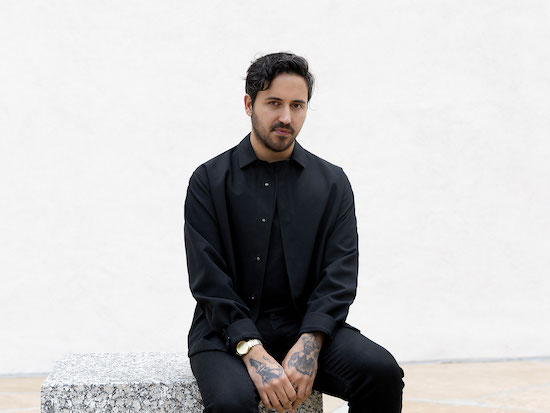
If you’ve ever listened to a Haxan Cloak album you won’t be at all surprised to learn that Ari Aster listened to this music while he wrote Midsommar, the follow up to last year’s traumatic Hereditary. And with that in mind, it makes perfect sense that he asked Haxan Cloak’s Bobby Krlic to score it.
Set in Hårga Sweden, Midsommar centres around a group of five young Americans who are visiting to take part in a 90-year-old solstice festival, which – of course – goes horribly awry. Not purely folk horror, Midsommar is also a break-up story that takes the old adage about a woman scorned to terrifying heights.
Krlic’s score to Midsommar begins with an angelic harp and chorale teaser that you wish went longer than 30 odd seconds but works well to establish the tone of bucolic whimsy. The music jumps immediately into darker territory with ‘Gassed’. A distant-wail precedes the music that makes you feel instantly ill-at-ease. Playing on conventional horror tropes; groaning strings, with bent, atonal whines that sound if they’re being scratched into life by a ragged bow, dissonant harmonics, trembling, sliding and piercing tones. A good start.
“The House that Harga Built” is one of the highlights of the soundtrack, building up to a sublime string melody, with enough emotive swagger to rival the themes of Elmer Bernstein or Johnny Greenwood. Krlic has certainly come into his own with the Midsommar score.
The middle part of the score plays out slowly in a series of ambient tracks, beautifully and sparingly executed with just enough foreboding to build an almost unbearable tension. “The Blessing” feels like the climax of this group of tracks, and culminates in a transcendent theme that rises in tone and pitch, evoking heavenly ascension.
The spell finally breaks with ‘Chorus of Sirens’ which begins quietly enough but is the first track to hint at the wordless, atonal, ritualistic chanting of the villagers. Leading directly into ‘A Language of Sex’ and ‘Harga Collapsing’ these tracks incorporate a small amount of the creepy vocalising Krlic and Aster developed for the characters in the film to sing during rituals.
This soundtrack creates an air of wonder and foreboding, that only very occasionally and briefly plunges you into the darkness. The final track ‘Fire Temple’ is not at all what you might expect. With melodic phrasing that ‘takes you home’, it becomes another crushing lament of beauty and melancholy that uplifts, comforts and refuses conform to expectation.
When it comes to folk horror soundtracks, Midsommar – like many modern folk horror films – doesn’t follow in any obvious way, the legacy of its forebears. Like 1973’s The Wicker Man, Krlic’s music makes use of diegetic folk singing but it’s nothing like the bucolic, folk jollies of Paul Giovanni’s imagination. And while it has the compositional finesse of scores like Luboš Fišer’s Valerie and her Week of Wonders and Mark Wilkinson’s Blood on Satan’s Claw, it sounds nothing like either.
The most iconic horror film soundtracks from the 70s drew upon traditional folk song and folk instruments like the flute, guitar and woodwind, employing a tone of pastoral harmony to counterpoint the unfolding horrors and Paul Ferris’ Witchfinder General and Wilkinson’s Blood on Satan’s Claw rely on a more conventional use of brass and percussion for the ‘horror’ climaxes. Today, however, the music of films considered to be modern folk horrors avoid relying too heavily, or obviously on folk music traditions.
Ben Wheatley’s Kill List and Robert Eggers’ The Witch – like Midsommar – have underscores that fall in line with standard horror convention. Mournful, dissonant strings, jarring percussion and innovative sound design elicits fear and dread compared to the lush, playful orchestrations of the 70s. In his Watcher’s Guide to Folk Horror, Howard David Ingham writes, "Folk horror is often the horror of folk." Could it be that the evolving, darkened soundtrack to modern folk horror films reflects our changing perspectives of the horrors of humanity? Are our evils worse today?
Working skilfully with a modest, mostly-stringed timbral palette, Krlic incorporates the traditional Swedish nyckelharpa (as did Mark Korven for The Witch) and the hurdy-gurdy to underpin the conventional themes and create an unsettling wheezing groan, characteristic of these ancient instruments.
For Midsommar, Krlic and Aster turn their backs on the more obvious traditional elements typical of the folk horror genre, embracing instead a lighter touch; a more dramatic, dreamy orchestral sound which takes cues from old Disney films and the sentimental, easy-listening arrangements of Sinatra that might trigger a new generation’s sense of nostalgia and comfort.