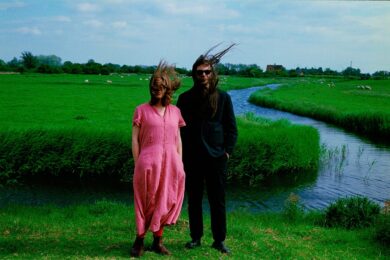

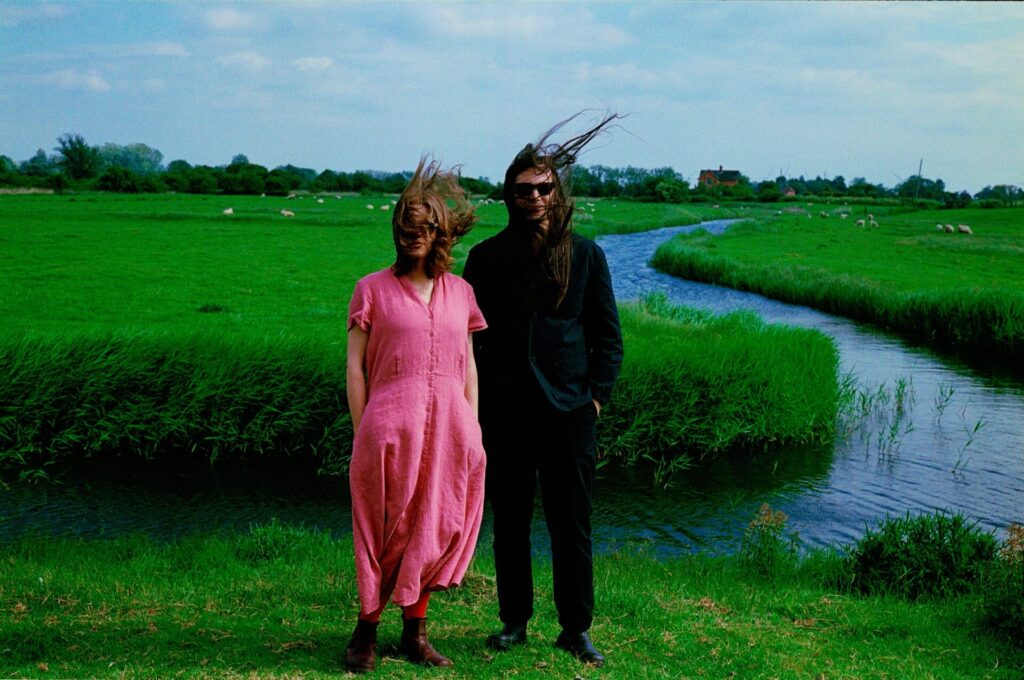
For an apparently new band, Memorials have a surprisingly long history. Verity Susman and Matthew Simms have been making and playing music together for more than fifteen years in various informal configurations all while maintaining their other projects – the much-missed Electrelane in Susman’s case, and Wire in Simms’, which he joined in 2010. Despite this protracted collaboration, the duo only settled on a firm identity in 2022 after they’d already been commissioned to work on a series of soundtracks and gig offers were coming in.
A tour with kindred spirits Stereolab followed and the duo released two of those scores last year. Women Against The Bombs and Tramps! are both fine records: fascinatingly varied, frequently thrilling, but also slightly scattershot with their detours into pulsing electronica, proto-industrial and punk. They proved that Memorials can play pretty much any sort of music they like, but didn’t give too strong a hint of what their debut album proper would sound like.
Just over a year later, here is that debut. Memorial Waterslides is a defiantly wonky, cryptically-titled and always intriguing LP that’s simultaneously more cohesive and far weirder than their previous releases. It’s the duo’s first music on Fire and their signing makes a lot of sense for a label that also has the likes of Jane Weaver, Vanishing Twin, and Death and Vanilla on its books – all artists that explore the same hinterlands of psych, early electronics, folk and jazz as Susman and Simms. On Memorial Waterslides the duo sound freer and freakier than Vanishing Twin’s tasteful grooves – this is as indebted to Sun Ra as it is Stereolab – but there’s still a strong vein of well-honed songcraft here.
‘Acceptable Experience’ opens on a bed of warbling tape loops, following a pair of dueling basslines before Susman’s Farfisa kicks in with an organ riff reminiscent of Clinic in their eerie prime. There’s a sense of barely controlled chaos to the track as the atonal backing spills into the foreground (at one point conjuring the spirit of the BBC Radiophonic Workshop with what sounds like a TARDIS taking off) before Susman pulls the song sharply back into focus with an apparent vision of death: “Turning back to an imaginary hearse / Two white horses pulling towards the door / You’re too late to write the book!”
This sense of mortality and of time running out is a central theme on the album and continues into ‘Lamplighter’ – a musically jubilant track with Simms’ drumming racing alongside the organ and a warbling mellotron. Lyrically, however, this is a ghost story – fraught and haunted, caught in a tug of war between hope and despair. It ends with Susman defiantly declaring “I want to be the one still dancing when the lights come on” but she’s already been confronted with the inevitable future: “The road awaiting us isn’t paved with gold / See the light up at the end / Then find it’s gone out.” Similarly, live favourite ‘Cut It Like A Diamond’ contrasts its lyrical gloom (“Is there an end to loneliness?”) with a riotous arrangement of looping bass, motorik percussion, and a squalling sea of saxophone, all ridden by Susman’s rising and falling vocals.
‘Name Me’ is more subdued: a brief but lovely guitar folk song that allows Susman a moment of unguarded vulnerability. It takes on a funereal tone in its second half as the organ creeps back in, heralding the start of a free jazz collapse that continues into ‘Memorial Waterslide II’ (the first ‘Memorial Waterslide’ having been included in the Centre Pompidou EP, created in response to Louise Bourgeois’ 1992 Precious Liquids installation), the black hole at the heart of the record and a fully chaotic tape machine workout with skronking sax stopping and starting seemingly at random. This will be the point where some listeners tune out and skip to the next track, but repeated plays reveal a brooding collage that recalls Richard Youngs’ deconstructed jazz or Drew Mulholland’s eerie sonic seances.
‘Book Stall’ is more direct – an instantly-winning cut of weirdo pop with its eyes on the cosmos, driven once again by Simms’ tightly-syncopated percussion. While the song ruminates, in the band’s own words, on “collectors and their collections, what becomes of them, what meaning remains”, it draws an imaginative link between book stalls on the Strand and “the outermost reaches of time” before winding up in an observatory. Space is the place, after all.
I mentioned Stereolab at the top and there’s an obvious kinship between the two bands (right down to their very first release being a cassette on that band’s Duophonic label and a ‘lab mug showing up in the video for ‘Lamplighter’). ‘False Landing’ makes this explicit, strongly recalling Sadier and Co.’s own excursions to the outer limits on 1999’s Cobra and Phases Group Play Voltage in the Milky Night, an album dismissed by many at the time but which has matured beautifully. Initially an atonal tape machine workout held together by chic piano chords, it reconfigures itself as a groovy jazz number in its second half before juddering and stuttering into dissolution at its climax. It’s followed up by ‘Horse Head Pencil’, a serene folk song that allows Simms to take the vocal lead over a sparse but beautiful arrangement that initially feels like the album is wrapping up two songs early.
Referenced artists
Electrelane
Smashing The Philip Glass Ceiling: Verity Susman Interviewed

Wire
Low Culture Podcast: Colin Newman On Todd Rundgren’s A Wizard / A True Star
Stereolab
Jet Propulsion Laboratory: Ben Cardew on The Pivotal Role of Stereolab’s ‘Super-Electric’
Sun Ra
Reissue of the Week: Sun Ra – Nuits de la Fondation Maeght
Brian Wilson
Badly Recorded Boy: Author Enrico Monacelli’s Lo-Fi Playlist
In fact, it’s merely an interlude before Memorial Waterslides’ boldest song. ‘I Have Been Alive’ unites the band’s primary modes of loopy experimentalism and pop nous, conjuring an ominous and brooding atmosphere with amorphous drones before the guitar and drums cautiously shuffle in alongside curlicues of celestial synthesiser. It’s tense, uneasy, “continually spiralling”, but Susman anchors it all with a visionary vocal that witnesses fog coming down across the hills as the song itself is swallowed up in a cloud of noise.
The album closes with ‘The Politics Of Whatever’, a sorrowful sort-of-duet that finds Susman saying goodbye to a friendship or romance that has run its course, harmonising against herself in a way that unexpectedly evokes Brian Wilson. It’s a particularly melancholy moment on an LP full of them, but while Memorial Waterslides (the title itself a perfect juxtaposition of the bleak and the playful) is shot through with a sense of longing and an awareness of the passing of time, it’s also a joyful celebration of creativity, and of a band who appear to have ideas in abundance. “At what age do you stop wanting more?” Susman asks on ‘Lamplighter’, a line replete with multiple meanings that has firmly taken root in my brain over the last few weeks of listening to this album. When your band and your record is this good, Verity, then the answer is: never.