
The striking cover art for Urgh depicts a human head recoiling in what looks like shock and agony. It’s one of “founder of human anatomy” Andreas Vesalius’s illustrations, rendered here in RGB layers by the artist Carnovsky, and a perfectly fitting image for an album that radiates abhorrence at recent events, both political and personal.
Developed over a rough couple of years for the band, with both singer Valentine Caulfield and drummer Alex Macdougall battling sickness and enduring multiple rounds of surgery, it nevertheless arrives sounding invigorated and defiant.
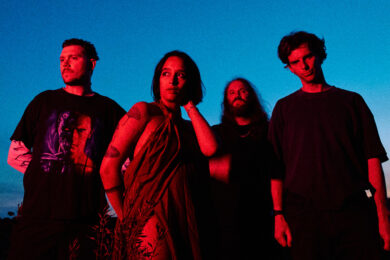
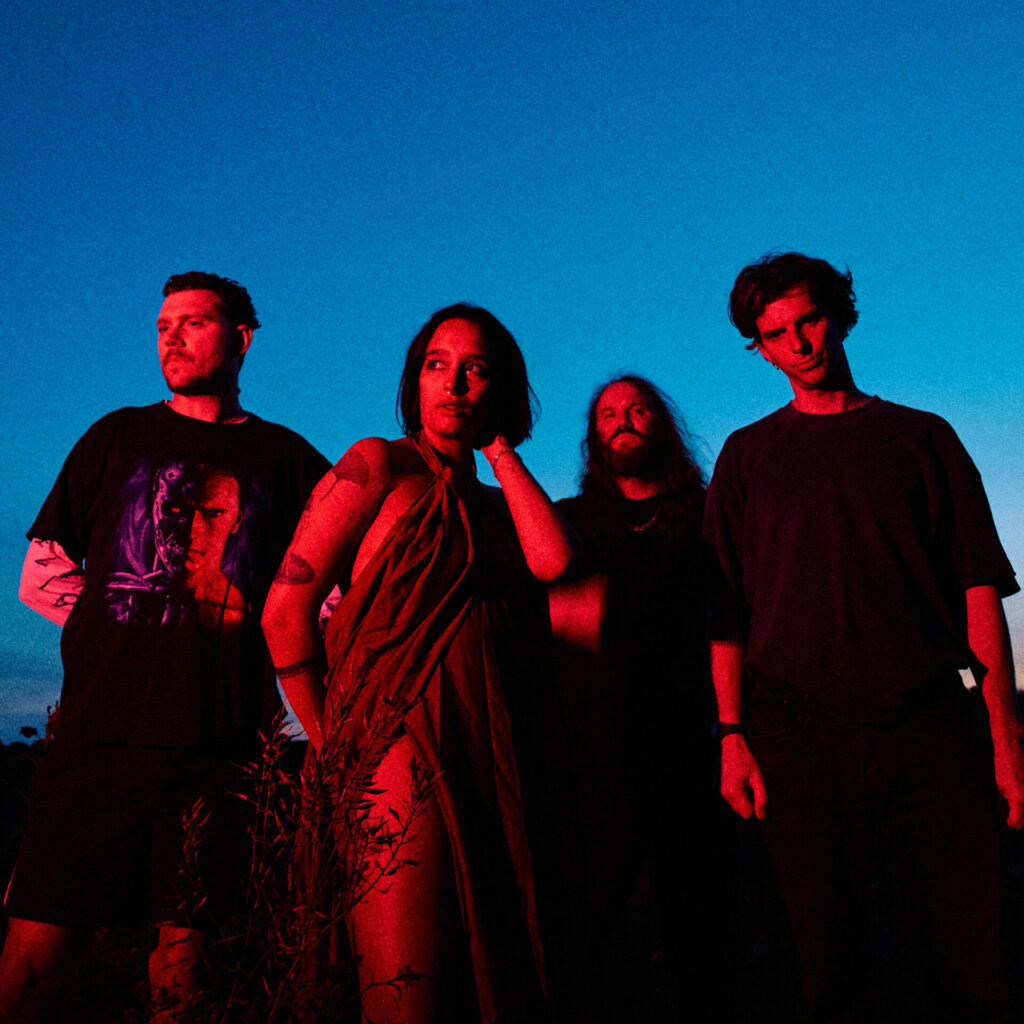
Where their 2023 debut, I’ve Seen a Way, had a hazy, cinematic quality; Urgh is heavier and stranger. The four-piece (Caulfield and Macdougall plus Scott Fair and Simon Catling) have described it as their first “proper band” record, a slightly worrying phrase that evokes images of endless jam sessions. Instead, it mainly seems to point to a more egalitarian approach to the song-writing credits and Macdougal’s expressive drumming bringing a Lightning Bolt-like intensity to the album.
Opener ‘Sevastopol’ wastes no time in deploying an abrasive barrage of noise followed by stuttering down-tempo beats. Caulfield’s francophone vocals are distorted and cut-up, only semi-comprehensible as she recites verses from the Bible, before an eerily synthetic orchestral melody swells up from nowhere. It’s a startlingly odd moment, one that recalls Dean Blunt’s uncanny use of consciously chintzy strings, and the first of several mid-song vibe-switches across the record.
At first, live favourite ‘Magazine’ feels like a throwback to the more accessible songs on I’ve Seen a Way, its opening beat quickly joined by racing polyrhythms. It’s soon overcome, however, by an overwhelming wall of howling feedback and thunderous drumming, as Caulfield’s vengeful lyric reflects on a truly awful personal experience. “Abandonne tout espoir,” she sings, “car ce soir je viens pour toi” (‘Abandon all hope, because tonight I’m coming for you.’) “‘Magazine’ is the expression of the frustration and deep-seated violence I felt while attempting to recover from being raped,” Caulfield told Atwood Magazine late last year. “My therapist encouraged me to channel my anger into something productive, so here it is: my primal, screaming call for retribution.”
It’s the first of several tracks that are shot through with an overwhelming fury. The near-metal ‘Life Hex’ calls out a lying parasite who “parade dans sa bêtise et l’étale devant tous persuadé d’être roi” (‘parades in his stupidity and shows it to all, convinced he is a king’). It could be talking about a dangerous politician – it’s hard not to read the song as perhaps alluding to you know who – or a more local creep who has insidiously wormed his way into your life. Lyrically, the song offers no solutions, but there is catharsis in the band’s cacophonous rage.
Likewise, ‘Sicko!’ pummels the listener with gabba beats and fizzing synths that sound like hospital machinery exploding, as guest rapper Billy Woods adds a few impressionistic verses, bleakly advises, “Buy the farm before you even get sick!” Woods is a terrific storyteller, as last year’s solo album, Golliwog, and Armand Hammer’s Mercy both demonstrated. He ditches the horrorcore vibe here, his rapid-fire delivery and the bands’ technoid soundscape instead recalling the perennially-underrated Anti-Pop Consortium.
But Urgh offers glimmers of unexpected hope, too. The glam stomp of ‘Dodecahedron’ is a rallying cry for the listener to stand and march against the horrors being prosecuted on innocent people every day. ‘Ist halt so’, meanwhile, has a punishing intensity, shifting from eerie found sound collage to industrial grind, before finally erupting into a full on drum & bass freakout, while Caulfield offers a message of solidarity. “De Paris à Gaza et sous les oliviers / Viendra justice pour tous ou justice pour personne” (‘From Paris to Gaza, and under the olive trees / Will come justice for all or justice for none’).
There’s even a note of sensuality to a few of the tracks, with ‘Cursive’ describing the pleasure and pain of a new, possibly furtive, relationship. More importantly, the track itself is an absolute rager: a frenetic near-climax to the record that reminds you just how much fun this band can be. It’s going to sound absolutely monstrous live.
Of course, the politics are easy to miss if you don’t speak French. That’s on us monolinguals, and the passion is palpable even if you don’t know exactly what is being said. All that changes on the final track. On ‘I’ll Ask Her’, for the first time across the two albums, Caulfield sings entirely in English.
“This is a story about a boy… he’s a good mate and that, you’ve known him since school,” she starts, before deploying some of the cliches often used to excuse turning a blind eye to everyday misogyny – “Boys will be boys”; “You wouldn’t let him date your sister, but it’s different, it’s your sister”; “They’re all fucking crazy, man” – the latter repeated enough times that it becomes a distressing earworm.
Sonically, the track finds the band at their most dissonant, Scott Fair’s production and Simon Catling’s synths, all buzzing bandsaws and reversing forklift sirens, make it feel like you’re trapped in some horror movie lair waiting for the killer to strike. There’s a strong beat pulsing through it, but the song really is about Caulfield’s furious vocals. “Women cover their drinks around him / But they’re all fucking crazy man / And his ex went to the police / But they’re all fucking crazy man… Yeah, your friend’s a fucking rapist.”
It’s a potent end to the album, a direct and important message necessarily delivered with zero room for ambiguity or confusion. On Urgh, Mandy, Indiana combine this righteous anger with an incendiary sound and a loud call for unity in dark times. Or, as Caulfield puts it on ‘Ist Halt S’’, “Mais nous marchons ensemble, enragés, solidaires. We walk together, angered, in solidarity.