

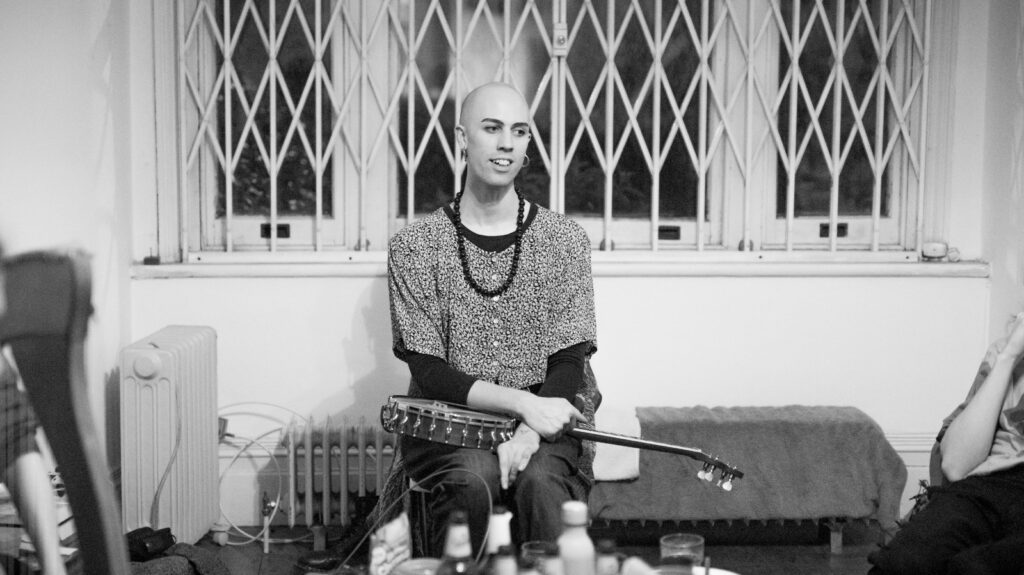
Jacken Elswyth’s new solo album comes from a space somewhere on the borders of reality. A banjo player and, just as importantly, an instrument maker, Elswyth’s solo work has developed alongside her role in the nine-piece Shovel Dance Collective, undoubted folk stars of the 2020s. The Shovel Collective’s music is riotous, joyful and haunting, made within a collaborative framework that creates room for looseness, spontaneity and happenstance. Elswyth’s solo work has the same characteristics. Her playing is commanding but open and relaxed, resulting in some startling accounts of traditional music, and improvised tracks that explore the character and feel of the instruments Elswyth constructs.
Two pieces exemplify the album’s range. ‘Fall of Richmond/Squirrel Hunters’ combines two reels retrieved most recently from the eastern USA. Elswyth’s playing delivers dark, melodic punches as the banjo surges from a low register, over a rich, menacing double bass. There are only two instruments, but the atmosphere is intense and dramatic. It is a particularly satisfying track. It is followed by ‘Coffin Maker’, one of the album’s live improvisations, on which Elswyth makes her banjo dart about all over the place, while Mark Waters plays unhurried bass. The banjo rushes and jumps, full of energy, the creaking of fingers on strings and sound waves on wood filling the track’s space with life. There is no room for doubt that the instrument is talking to us, with a voice that is partly Elswyth’s, and partly its own.
Elswyth’s instrument building adds an intriguing layer of connection and meaning to the music on At Fargrounds. It is an entirely logical activity for a musician, yet unusually intimate. Choosing wood to express the sounds you play provides an extra level of control over the music, but also opens up more direct, less predictable avenues into the nature of sound. The character, provenance and significance of the wood clearly defines Elswyth’s relationship with the music she makes. Chris Joynes suggests that “One might consider her primarily as a worker in wood,” a field of activity inextricably linked to processes of change. Life, growth, death, and resurrection are all held within the cherry, oak or walnut, harvested and repurposed. Folk music is connected to the people who learned it, remade it and passed it on. The meaning of the tunes Elswyth makes her own shifts with every player who picks up their instrument. The music is both anchored in the moment, and linked to a deepening past that lies outside recorded histories, and exists in the minds of those who play, and those who listen.
The album’s title, At Fargrounds, speaks to a sense of otherworldliness. The banjo is a particularly eerie instrument. Because every note resonates with itself, tunes sound as though they are being stalked – followed by a shadow that’s too close to quite glimpse. It is surely the music that would be playing in an enchanted wood, but one haunted by unease, like CS Lewis’ ‘Wood Between Worlds’, or Robert Holdstock’s Mythago Wood, a “chthonic resonator”. Elswyth’s technical abilities are remarkable. She makes the instrument speak in multiple voices, using a fretless mountain banjo alongside a standard version. On the traditional tune, ‘Sugar Hill’, it is clear, plangent and expressive. On the improvisation, ‘Waken Workshops’, it is skittish and disturbed. Elsewhere, the music carries menace. The improvised ‘Who Remembers’ is a creaking, groaning piece, with a banjo being aggressively scraped, and a poltergeist soundscape. It could be the soundtrack to a piece of unsettling 1970s television involving a suburban family moving to a house that doesn’t seem to welcome them, in a wood that’s more alive than they would like.
On ‘White Cockade / Big Sciota’, the banjo sound is soft-edged and fuzzy, like a 78. It is reminiscent of crackly recordings of Margaret Barry, playing her banjo over a shaking connection from the past. Alongside Mark Waters’ bass, Elswyth also plays with Kate Gathercole, on fiddle and harmonium. Elswyth plays the shruti box too, adding simple but effective drone textures. The instruments are minimal, and they are all the album needs.
The traditional tunes on At Fargrounds are studies in the persistence of folk music outside clear definitions of place, time or origin. The longest track on the album is ‘Lost Gander’, at five and half minutes. It packs in a remarkable amount of texture and expression, but also a long, implied social history. Among many others, it was recorded by Mike Seeger on Smithsonian Folkways, in a tense, clawhammer style. Seeger may have learned the tune from Tennessee musicians, Dee and Delta Hicks, whose family passed songs over four generations, dating back to the 18th century. Before then, the tune had probably come across the Atlantic from the British Isles, entering a parallel existence in the rural south of the USA. Elswyth brings it back into a British context, reconnecting with its pre-modern origins both through the music, and the wood that resonates with sounds it may have heard before. Her picking is reminiscent of the bluegrass recordings, but she opens out the notes, stretching them into a pastoral tone, with Gathercole’s fiddle swelling in the background. It could be a tune from the sunny uplands of England’s own rural south. It is a template for association and resonance, and Elswyth’s subtle playing draws from deep within the tune.
At Fargrounds brings together music from across the Western folk tradition, from bluegrass to the Scottish tune ‘A Fisherman’s Song For Attracting Seals’, to ‘The Sussex Waltz’. But the banjo has wider associations, originating in West Africa and brought to the USA through slavery. The instrument is a powerful cultural tool, entangled in the dark roots of American society. Elswyth’s playing expresses a history of connection and consequences, where music cannot be seen as local, or played as parochial heritage, but can only be understood through its links to global injustice. Elswyth’s album is sophisticated and accomplished, a folk thesis for our times. It is a significant achievement, clever and thoroughly enjoyable, brimming with atmosphere, energy and fantastic tunes.