

One of the core strengths of Richard D James as a producer is that he has clearly been many things to many people over the previous three decades. This is to the extent that serious consensus on what it is exactly that he does is impossible to reach. Mention his name to a selection of music fans over a period of time and the sounds/sensations triggered immediately, automatically, synaesthetically by nominative association will cover a multitude of affects and vibes, simply because there is no definable RDJ sound.
How can there be when we’re talking about the artist who made the tweaking Cornish hardcore acid of Caustic Window’s ‘Humanoid Must Not Escape’; the vaporous song of the stones ‘Blue Calx’; the boinging gary-addled oi-oi lunacy of Power Pill’s ‘Pac Man’; the 90s-terminating broken R&B of ‘Windowlicker’; the solemn but childlike clifftop processional of ‘Logan Rock Witch’; the crushing tinnitus-inducing industrial techno of ‘Ventolin’; the heartstring-yanking piano minimalism of ‘Aisatsana [102]’; the sophisticated liquid funk of ‘Minipops 67 [120.2]’.
This, of course, has always been one of his long term strengths – no matter how many folk it has frustrated in the short term – he has an utter inability to give people what they expect or feel they need at any given time. The criticism from people who confidently feel they know better – that he has somehow fumbled the ball – has plagued him since the release of his first album, Selected Ambient Works 85-92 on Apollo in 1992. (That time, initially, unseating some fans of rave and techno, who were howling for more of the breakbeat acid they’d already come to expect from the Analog Bubblebath series.)
It’s true that one of his ‘post-return’ releases, the Cheetah EP (2016), has been slow to reveal its worth to me; I have the sensation that this was an inwards-looking project, created with his back turned to us, his audience, and this feeling is hard to shift. It seemed like these self-imposed boundaries of wrangling with antiquated, notoriously difficult to use kit, were possibly constructed out of boredom and aimless tinkering as much out of the desire to set himself a genuine challenge. It doesn’t matter how many times I listen to it, it all but evaporates the second I lift the needle from the vinyl, and its parallel release with the vital, ear-boggling Soundcloud Dump – the product of a racing mind clearly caught in a feedback loop with an audience via live performances and DJ sets – didn’t help matters. But it feels almost churlish to bring this up as nearly everything else he’s done since Syro in 2014 has been the exploration of a new or newish avenue, albeit with some kind of through line from his incredibly varied past.
It’s funny how some electronic music fans were delighted by the “return to form” signified by the Collapse EP – it was a view I no doubt initially shared – as the more you listen, the less clear it is where we’re supposed to have returned to. Once you get past the idea of blotter chewing acid overwhelm, berserkly foment-filtered analogue synths and intricately, infinitely shifting pointillistically programmed breaks forming a bank of Aphexian signifiers, it’s actually impossible to single out much in his back catalogue that sounds precisely like this.
So, I try to practise being a ‘good fan’; I keep my expectations of what I feel he should be doing to a minimum, and my ears wide open. He has steered me right way more often than wrong, even if I don’t always initially realise it. However, there is one thing I’ve been keeping my fingers crossed for this whole time and that was a re-engagement with the complex, sincere and weirdly emotional core of his music as expressed via an inimitable strain of (Martian) melodicism; for the ‘tunes’ to make themselves felt once more.
In the same way that great writers drive themselves half insane trying to think of original ways of expressing universal experiences while constantly avoiding cliche, great musicians often strive to do something similar. And when I’m listening to tracks like ‘Alberto Balsalm’ or ‘Schottkey 7th Path’ I’m sometimes aware that, no matter how fleeting the feeling, I’m having emotional states I’ve undergone described back to me tonally, even though I would struggle to define them verbally myself. I think we should resist the impulse to carelessly project theories regarding neurodiversity onto people with little in the way of supporting evidence (James and several other key figures in the IDM scene have casually identified as being autistic in recent years), but what I will say is this: musicians who generally seem to have some kind of bar to easy discussion of their emotional landscape or experiential interface with the world, can often seem to express these states more inventively, more intuitively and more precisely without the use of language at all.
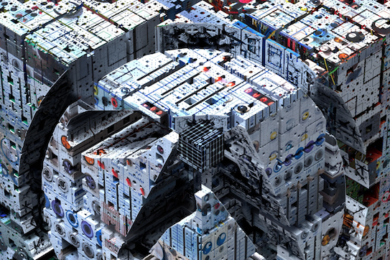
So the idea of a black box recorder for one’s life might, on first encounter, sound very negative, given its obvious connection to aviation disaster, but on the evidence of Aphex Twin’s latest EP, it feels more connected to the sensitivity of the hour that comes with firmly entrenched middle age: it’s message isn’t death but a wonderful sonic dialectic of regret, melancholy and joy. The ‘black box’ of the title could be seen as not-yet-existent technology for recording emotional states; a jar into which you pour the things that you cannot yet say, or, at the very least, would sooner not voice.
Umami, neither sweet nor sour, churchical organs on ‘Blackbox Life Recorder 21f’ keep us in mind of …I Care and SAW, while the intense processing rather than the programming of the drum architecture reminds us that it’s something more contemporary. A cavernous drop, of sorts, just before the end introduces an overwhelming sense of ruefulness, balanced out by a tar thick, window shaking layer of bass drone. ‘Zin2 Test5’ is altogether more skeletal, SAW pads underpinning a rib-rattling rolling b-line and eye-blink breaks, the only track yet to really sink its claws in for me, yet.
As well as a return of a certain kind of melodic sensibility to his music, I’m bowled over by the use of reverb on this EP. Three of the tracks feel like the living embodiment of a very large house with a huge variety of rooms, each being temporary home to individual hits on RDJ’s drum machine, from acoustically dampened broom closets to wide, wood floored ballrooms, an energising treat for the ears. One would imagine this has some sort of link to the title of ‘In A Room7 F760’, the EP highlight, with its washed out rave stabs, unresolving choral synth pads, occasionally interrupting 8-bit bleep bursts, savagely restrained acid burbles and gently narcotic pitch modulated analog tones (another classic Warp signifier, but this time one usually associated with Boards Of Canada), forming merely the framework around which several experiments with different sized and shaped sound environments are carried out. Those still angry that this EP wasn’t an album, should console themselves that there are several tracks’ worth of musical ideas hidden in these abyssal depths; they flicker gloriously around the edges of perception before evaporating once more.
‘Blackbox Life Recorder 22 [Parallax Mix]’ pushes the bass much further out and his FX chain until it’s glowing red hot. The closing track is gothic and sophisticated; weird, heavy and tantalising. And is it just me, or is this music suggesting something really quite freaky, or am I just misreading the signals? If I was looking for music to briefly describe (remind me, maybe) of complex, evanescent emotional states, then I found it in the second half of this EP, and much to love across all four tracks regardless.
Blackbox Life Recorder 21f/In A Room7 f760 is out tomorrow via Warp