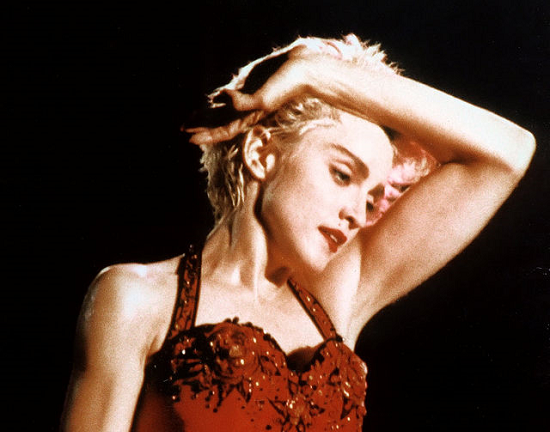
‘Amazing’ from Music
(2000)
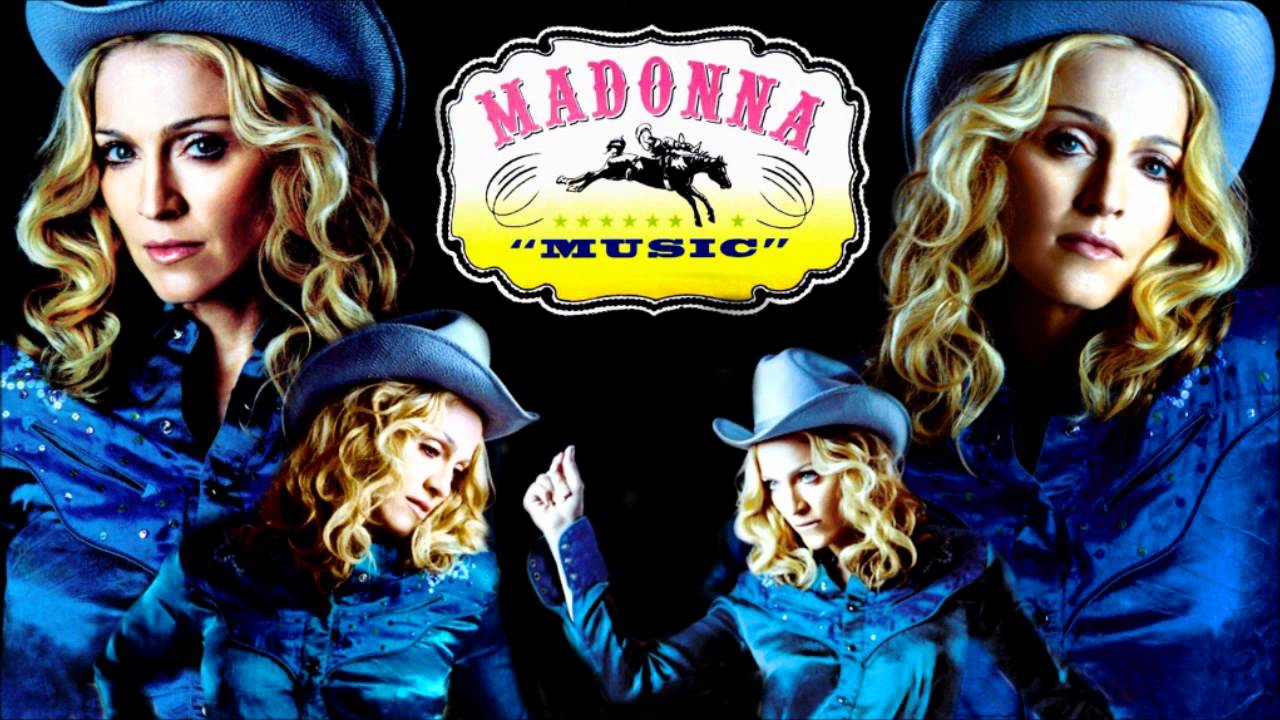
Let’s get one thing straight: cowgirl Madonna is the best Madonna. Not only is that blue satin shirt a certified Look, but a country slash French club banger album just should not, on any level, work – should it? And yet it does, doesn’t it? 2000’s Music, one of the best-selling albums of the noughties, earned Her Madge 5 Grammy nominations, and a spot on Rolling Stone’s 500 Greatest Albums of All Time.
‘Amazing’ is somewhat incongruous with the rest of the Music tracklisting. It’s sans-voice filter; the opening lines make it sound weirdly like it’s from a musical; lyrically it’s cheesy as fuck (“you took a poison arrow / and you aimed it at my heart”). Am I selling it yet? No?
The thing is, it’s the most unmistakably Madonna track on a massively stylistically divergent album. In case you were in any doubt, this song serves as a reminder that the tried-and-tested good stuff still lurks beneath any bonkers flirtations with acid house. Admittedly, yes, it does sound a bit like a twangier, reverbier, less insistent rehash of ‘Beautiful Stranger’, with some minimal gospel backing vocals chucked in for good measure. But where’s the harm in that?
According to a not-to-be-cited corner of the internet, ‘Amazing’ was very, very nearly released as a single – and it sounds like one. I think that tells you all you need to know.
Diva Harris
‘Bad Girl’ from Erotica
(1992)
Penned by Madonna, Shep Pettibone and Anthony Shimkin, Erotica peak ‘Bad Girl’ revealed yet another face of the protean Madonna. Relaying the tale of a woman who is experiencing profound sadness following a failed relationship, it took the blueprint of an FM-friendly pop ballad and imbued it with almost voyeuristic access to private thoughts concerning guilt, self-doubt and conscience – essentially the inverse of the indomitable zeal of Madonna’s first four albums, by and large. While some noted it for being a congé from the highly sexualised image that she had at the time, that cheapened how its lyrical and musical finesse operated on terms that didn’t exclusively concern liberation. And though it was her first single to miss the top 20, peaking at number 36 in the Billboard chart, it holds up as one of Madonna’s most majestic efforts more than a quarter of a century on.
Brian Coney
‘Bedtime Story’ from Bedtime Stories
(1994)
Released as the third single from 1994’s Bedtime Stories, ‘Bedtime Story’ remains one of Madonna’s most masterfully hypnotic deliveries. A minimal house effort co-written by Björk (who was riding high following the release of the game-changing Debut) Nellee Hooper and Marius De Vries, it marked an inspired departure from Madonna’s established pop-R&B M.O. "I couldn’t really picture me doing a song that would suit her,” Björk recalled at the time. “But on second thought, I decided to write the things I’ve always wanted to hear her say." Sure enough, in trademark Björk fashion, it’s served up full-on Jungian realness, with the insistent refrain of “Let’s get unconscious” doubling up as the song’s mantra (something Mark Romanek’s video goes some distance to visually channel.) If it had managed to crack the Billboard top 40, Madonna would have become the third woman in the modern era with the most top 40 hits, behind Aretha Franklin and Connie Francis. It didn’t, but ‘You’ll See’ saw to the inevitable eight months later.
Brian Coney
‘Bitch I’m Madonna (ft. Nicki Minaj)’ from Rebel Heart
(2015)
There’s something quite surreal about ‘Bitch I’m Madonna’. It’s an awkward time capsule from the 2013-15 era, where horn drops ruled the airwaves, note ‘Talk Dirty’ by Jason Derulo and DJ Fresh and Diplo’s ‘Earthquake’. Alongside SOPHIE and Madonna herself Diplo has a production credit here for a drop that for most defines the track. But, the commercial misfire of a single is more than a failed cash grab attempt. For one it boasts some of Madonna’s most audacious lines, “We go hard or we Go home” and “The neighbour’s pissed and says he’s gonna call the Five-O”. Audacious only in context, Madonna was 56 at release and the lyrics did attract the boring horde of ageist jibes. In reality the latter part saw the artist swerve the traps of adult ‘authentic’ and stay true to the materialist attitude that brought her to fame.
Aimee Armstrong
‘Burning Up’ from Madonna
(1983)
I’ll be honest, early eighties Madonna is my favourite Madonna. Long before ‘Like A Virgin’ scandalised conservative parents everywhere and enthralled teenage girls, she was taking no prisoners, demanding to be worshiped by men, whilst rolling around on a dark deserted road. Because why not? (They also probably didn’t have the budget for a better video] Taken from Madonna’s self titled 1983 album, Burning Up showed her potential for incredibly catchy pop songs, whilst being as always, unapologetic about female sexuality. It was the start of a pop persona that would over the next two decades, take over the world. I may [or may not] have had the lace gloves and hairband. I make no apologies for that either.
Lisa Jenkins
‘I’d Rather Be Your Lover’ from Bedtime Stories
(1994)
Though toying with ideas of incest seems like a questionable flirting strategy, it’s basically the bottom line of ‘I’d Rather Be Your Lover’. Track three on Madonna’s 1994 album Bedtime Stories, the song is a sensual, punchy declaration of love that sees the Queen of Pop indulge in fantasies around potential relationships she could have had with her love interest: “I could be your sister, I could be your mother, we could be friends, I’d even be your brother but I’d rather be your lover.” Regardless, the track achieves high levels of sex appeal, aided by an adventurous, circling bass line that stands as the song’s erotic backbone.
Madonna’s part-time lover 2Pac was originally set to perform the guest verse but she ditched his rap when his sexual assault case transpired and enlisted Maverick Records labelmate Me’Shell NdegéOcello to record a fresh verse. An unreleased version of the track with the 2Pac rap still exists online and it’s a gem, featuring a priceless call & response duet that goes, “Madonna: I could be your mother. 2Pac: That’s illegal.”
Luna Cohen-Solal
‘I Want You (ft. Massive Attack)’ from Something To Remember
(1995)
Massive Attack had been originally approached to record a Marvin Gaye number for an upcoming tribute album, and after sessions with Chaka Khan were fruitless, and the other favoured choice Aaron Neville was unable to do it, they got together with Madonna after producer Nellee Hooper suggested her having just worked on Bedtime Stories. Madonna recorded her vocal with 3D in New York and then left the band to finish it off back in Bristol. Suitably impressed with the final work, she chose to bookend her Something To Remember ballads collection with it alongside an instrumental version, and had planned to release it as a single even going as far as promo-ing it, making a video and commissioning remixes, but it didn’t happen. Instead we’re left with a sumptuous, tantalising glimpse as to what a Madonna album would sound like at the hands of Massive Attack.
Ian Wade
‘Love Don’t Live Here Anymore’ from Like A Virgin
(1984)
Only Madonna would have the balls to cover Rose Royce. The original is sublime, however Madonna’s version on the Like A Virgin album is how I was introduced to the song, and I will forever be grateful for that. Not known as a great singer [which I think at times has been an unfair judgement particularly after her work in Evita] she does bring a depth and emotion to the song. It pulled on my teenage heartstrings, whilst I was mourning some unrequited love. Her voice is full of angst, she has always been an artist that has connected with her listeners. There are other songs on the album which of course get much more traction, but for me, this was an overlooked gem.
Lisa Jenkins
‘Love Song’ from Like A Prayer
(1989)
Though uncredited, Prince played guitar on three songs on Like a Prayer. He appears on its chart-hogging title track, ‘Keep It Together’ and ‘Act of Contrition’, but his biggest contribution was ‘Love Song’, a five-minute funk-pop fever dream that – offering full testament to the all-killer Like a Prayer – wasn’t chosen as a single. Co-written long-distance (Madonna later recalled, "I had to be in L.A. and he couldn’t leave Minneapolis, and, quite frankly, I couldn’t stand Minneapolis”) and recorded at Paisley Park, it wasn’t perhaps what critics and fans had in mind. Rather than striking a full-blown, Billboard chart-climbing midpoint between, say, ‘Like a Virgin’ and ‘When Doves Cry’, it delivered more or less the opposite: a sedated and nuanced breather where Madonna and Prince’s stripped-back melodic synergy could take centre-stage. You can almost guarantee this would have made a sizable dent had it been selected as a seventh single from Madonna’s fourth album.
Brian Coney
‘Masterpiece’ from MDNA and W.E. OST
(2012)
Madonna was always a fan of Cesaria Evora, the Cape Verdean singer who captured the essence of ‘sodade’ in her music – that is a profound yearning and melancholy. With its mid-tempo fado-style rhythm and aching strings this song also has that quality of bittersweet longing. Composed with William Orbit for the W.E. soundtrack, Madonna’s film about the affair between Edward VIII and Wallis Simpson, this won Best Original Song at the 2012 Golden Globe Awards. It is one of her strongest ballads, sung with a finely calibrated sense of rapture. Falling in love with perfection or something just beyond reach is a common theme in Madonna’s ballads, and here she explores it with a deft touch, and underlying threat. “Cause after all,” she sings, “Nothing’s indestructible.”
Lucy O’Brien
‘Nothing Really Matters’ from Ray Of Light
(1998)
I love this song (released as Madonna’s fifth single from Ray of Light) for its slow, steady rhythmic start and the way she lunges unexpectedly into the sweeping chorus and vigorous condemnation of a selfish life that no longer serves her. “I realised that no one wins,” she sings in a moment of revelation. The ferocious party girl is a memory. For this song, Madonna used her psychological strategy of pitting two producers against each other, so each would raise their game. According to Marius De Vries, “I had my vision of how the song should be finished, and Will [Orbit] found that off-putting.” As a collaborator De Vries usually left a lot of space for him, but for this he wanted to make his mark. The track begins with a strange, electronic, slightly broken noise. Orbit said, “I hate that noise. It sounds like the DAT’s broken.” De Vries answered: “Yeah, that’s the point.” Despite Orbit’s protest, the breaking DAT stayed in, because Madonna had the casting vote.
Lucy O’Brien
‘Physical Attraction’ from Madonna
(1983)
As an obsessive purchaser of funk and disco 12”s in the early 80s, I was familiar with Madonna but assumed, despite her squeaky voice, that she was black. I bracketed her alongside divas like Shirley Lites, Angela Bofill. Only when I saw a profile of her in The Face did I realise that not only was she white, but styled in the manner of a post-punkette. She was, it turns out, here to usher r&b and pop out of the party frocks and polyester era and into a new modernity.
The profile described ‘Physical Attraction’ as her best song – it was actually written by Reggie Lucas, with whom she fell out, bringing in the hipper John “Jellybean” Benitez to finish production work on her debut album. It’s typically brassy and bouncy but the frankness of the title is what makes it – like Prince, she was here to bring a frank overtness about sex and sexuality to pop, after decades of euphemism.
David Stubbs
Referenced artists
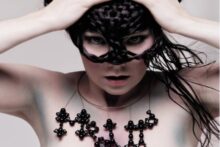
Björk
What We Do With What We Have: Björk’s Medúlla Turns 20
‘Skin’ from Ray Of Light
(1998)
The urgent beat, the tumbling breaks, the taught rough-edged guitar licks, the faultless layering of synths and sounds: Madonna, Orbit and Marius De Vries worked some magic in the lengthy four and a half months it took them to record Ray Of Light, which this tune exemplifies. At 6:21, it sits firmly on the dance end of the pop spectrum, and is exactly that kind of sound you wanted to drown in in a late 1990s warehouse rave, desperate for the fade-out to be indefinitely delayed: it’s a beat you wish would last forever. The lyrics might be borderline single-eye-roll naff (“I’m not like this all the time”, “Do I know you from somewhere?”), and Madonna’s Indian-inflected phrasing a little too close to cultural appropriation than is entirely comfortable in 2018, but the sheer fearlessness of the mix still keeps the intended unironic gravitas intact: it’s a seriously solid track. Similarly De Vries’s recurrent Moroccan flute field recording would feel slightly too National Geographic documentary-esque if its dissonance weren’t – in that way that PJ Harvey chimes with a 1920s Kurdish love song on 2011’s ‘England’ – so damn compelling. Twenty years on, ‘Skin’ has lost none of its power to thrill and to move.
Dale Berning Sawa
‘Waiting’ from Erotica
(1992)
Right up there with her most criminally unsung ballads, ‘Waiting’ is, and will forevermore be worthy thanks to Madonna’s closing obloquy alone ("The next time you want pussy, just look in the mirror, baby.") Zing. But it’s real selling point goes much deeper. Featuring spoken words, and guided by slick lounge-bar production marrying synth, piano, bass, horns and drums, it’s a track that tussles with rejection, unrequited love and vulnerability with supreme subtlety. With Madonna asking: "What happened? What do I remind you of? / Your past, your dreams, or some part of yourself that you just can’t love?" it bridges substance with style, proving that the inward machinations of lust and lost love could be every bit as compelling as Madonna’s more demonstrative, no-holds-barred pop playacting.
Brian Coney
Lucy O’Brien’s book Madonna: Like An Icon is out this week. Purchase a copy here.
Check The Quietus Books pages on Friday for her Essential Top Ten Madonna tracks.