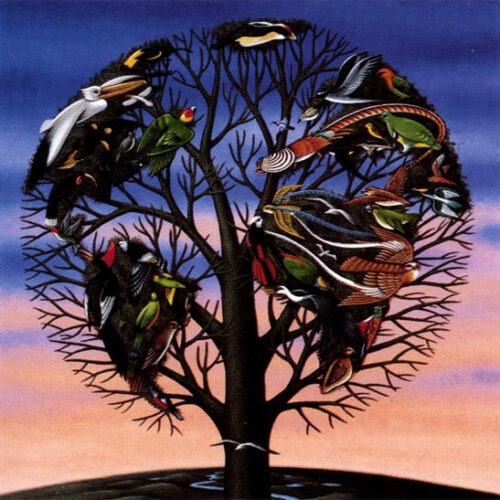

This feature was originally published in 2011 to mark the 20th anniversary of Laughing Stock
There are many remarkable aspects to the story of Talk Talk’s fifth and final album, Laughing Stock. It took a year to make, and most of what was put to tape ended up on the scrapheap. In London’s Wessex Studios, where it was recorded, windows were blacked out, clocks removed, and light sources limited to oil projectors and strobe lights. Around fifty musicians contributed to its making, but only eighteen ended up on the finished album. It was a commercial failure, critically reviled as much as it was praised, and was impossible to perform live. Then the band broke up, forcing fans to wait seven years before its central protagonist released any new music, something followed by almost complete silence. Laughing Stock is also shrouded in mystery: apart from limited comments made during brief bursts of promotional activity to promote their own even more limited work since, the three authors of the record – Mark Hollis (songwriter and founder), Tim Friese-Greene (producer and co-songwriter since their third album, The Colour Of Spring) and Lee Harris (drums, and the only other remaining member of the band’s original line up by the time of Laughing Stock) – have refused to discuss it for years. But the music remains, its reputation growing with each passing year since its release two decades ago: stark, bold, indefinable and the greatest testament to the band.
What’s even more remarkable, however, is the legend that has grown alongside its reputation, best summarised by Alan McGee in a blog written for The Guardian in 2008. “I find the whole story of one man against the system in a bid to maintain creative control incredibly heartening,” he wrote of Talk Talk’s central pillar, Mark Hollis. It’s a popular opinion, reflective of the fashionable belief that the exploitation of corporate powers for the sake of art is a laudable act. Everyone loves David and Goliath-style tales of the little man taking on the giant and winning, and those who care deeply about music recognise in Talk Talk’s story the triumph of art over commerce. In every note and every second of silence in their final two records lies the sound of a man who refused to compromise and took perfectionism to an extreme. The fact that Spirit Of Eden, their fourth album from 1988, and Laughing Stock, 1991’s grand finale, stiffed – relative to 1986’s world-conquering The Colour Of Spring, at least – means nothing alongside their artistic accomplishment and the fact that so many people talk about them in tones of hushed reverence. The record labels, the prevailing wisdom goes, were at fault: they didn’t have the imagination and intellect to recognise these albums were works of genius.
Certainly the argument sits well with romantic sensibilities. Major labels are villains and true artists are heroes. But is the story really so black and white? According to Talk Talk’s manager, Keith Aspden, who battled to secure the future of the band amidst increasingly difficult circumstances, it would seem not. Confronted by McGee’s statement, his response is as uncompromising as Hollis’ art. It is, he says, “Complete invention and wishful thinking by Alan McGee. Mark was always free to do whatever he wanted musically. There was no battle against any system. He created and performed what he could, without obvious reference to others artistically and, as time went by, without reference to commerciality. It was the freedom financially and lack of interference which allowed Mark to indulge himself in Spirit Of Eden, Laughing Stock and the Mark Hollis albums.”
In other words, Talk Talk’s labels were enablers of Hollis’ work. Their financial support, their willingness to support him in his endeavours and their belief in his talent are the very reasons that these albums exist. It’s a surprising, provocative response that goes against the grain of our very understanding of those records, but it’s also an honest and intriguing perspective worthy of closer examination. To do that, it’s necessary to consider the story of Talk Talk’s career in more detail.

Talk Talk had started out as a synthpop band, groomed to follow the success of label-mates Duran Duran by EMI with the pop pleasures of songs like ‘Dum Dum Girl’ and ‘It’s My Life’, later covered by No Doubt. They’d only used synths, Hollis would later claim, because they couldn’t afford real instruments and the musicians required to play them, so, following the chart success of their first two albums, The Colour Of Spring saw them pursue a more ambitious goal with the benefits of the cash they’d accrued. A far more organic sounding record, it birthed further hit singles, but these, it turns out, were not originally part of the plan. According to manager Keith Aspden, “I suggested they didn’t have tracks recorded which could be played on the radio. In order to promote the album effectively they wrote ‘Life’s What You Make It’ and re-worked ‘Living In Another World’.” The result was worldwide chart success and sales in excess of two million.
The band’s hearts, however, seemingly lay elsewhere, in the album’s two considerably more abstract tracks, ‘Chameleon Day’ and ‘April 5th’. It was further in this direction that they chose to travel when EMI sent them into the studio, unchecked, to record its follow-up. The label were hoping for another global chart smash, but instead, as David Stubbs memorably put it in Uncut in 2002, “when they re-emerged, it turned out that they had done what every megapop band talks about doing but so rarely does – i.e. what the fuck they wanted.”
“I think of the final two albums by Talk Talk as siblings very close in age. If Spirit of Eden is the older, pretty & sophisticated big sister who got all the A grades, then Laughing Stock is the wayward, grubby wee brother who got kicked out of school for skiving.”
Kenny Anderson aka King Creosote

EMI’s response was inevitable: they freaked. Spirit Of Eden, like Laughing Stock, is now considered a cult classic, but it’s only six tracks long, defies all notional conventions of pop structures, contains no single – though the label cobbled together an edit of its highlight, ‘I Believe In You’ – and was impossible to tour. Unable to be marketed by EMI’s traditional methods, it floundered, despite some highly complimentary coverage (amidst a fair amount of considerably more confused responses) and a UK Top 20 peak. Relations between the band and the label subsequently became so strained that Aspden began legal action to get them released from their contract. “There has been inaccurate speculation and comment about the court case with EMI,” he says today in an attempt to put the record straight, “but in essence our motivation in the court case with EMI was all about money and an opportunity to secure a better deal with another record company. EMI in our view had misinterpreted the meaning of the clause which specified when they should exercise their option. They lost the case on appeal.”
It’s here that the mythology of Talk Talk starts to take concrete shape. EMI responded by releasing a Best Of, Natural History, followed by an album of unauthorised remixes, prompting the band to sue. They won the case, forcing the label to withdraw the latter from sale, and Aspden went on to secure a new deal for the band with Polydor’s Verve imprint that, he says, “guaranteed full funding for Laughing Stock, without interference from the record company. They took full advantage of that situation and locked themselves away for the duration of recording.”
What went on in that studio strengthens the belief that Hollis was on a crusade to push boundaries and perfect his art on an even grander scale than Spirit Of Eden. Furnished with the opportunity to fulfil his most extreme creative instincts, he bedded down with Friese-Greene and Harris in a working environment inspired by recollections of working with Traffic in 1967 that engineer Phill Brown had shared with Hollis during their first meeting. “There was an effort to create a vibe in the studio sympathetic with the feel of the album,” Aspden remembers, and though Brown’s summary of its ingredients as “oil projections on the walls and ceiling, and no other light apart from a strobe” might be less notable under different circumstances, the duration of recording was to be a long one. “It took seven months in the studio,” recalls Brown, whose previous engineering credits also included David Bowie, Harry Nilsson, Led Zeppelin, Pink Floyd and Bob Marley, “but we took a three month break in the middle. I guess from getting involved to studio recording, mixing and mastering took up a year of my time. It was a unique way to work. It took its toll on people, but gave great results.”
Hollis’ working methods were as intense as the surroundings, driven by his desire, as Aspden puts it, “to try and capture a sense of passion and spontaneity of a performance”. “There’s no way at the point when we go in (to the studio) that we know what this album will sound like,” Hollis commented in an interview recorded for a promotional cassette by journalist John Pidgeon for Verve around the album’s release. “All you ever know – and this would be true of the previous album – is you just go in knowing what the attitude is you want and that’s it. There’s no way I think you can go wrong on that because there is no right or wrong; the right and wrong is an internal thing.”
Hollis believed – according to Pidgeon’s interview – that “the first time something is played it is at its finest, and the minute you try to recreate that it becomes an imitation of something that was originally better… But… the problem with a lot of improvisation is that it meanders away from the point too much. So the thing that this time afforded us was to go in with people that we wanted to play with almost from an attitude point of view, give them absolute freedom in terms of what they play, so that everything they do play is free form, but then to construct an arrangement by taking little sections of that and building that up from there. But that takes a large amount of time because… ninety percent of what you play will be rubbish. If you’re improvising, if you get 10% which is any good then I think you’re doing really well. I think you’re doing amazingly well if you get half a percent!”

Laughing Stock was painstakingly assembled from sessions in which a vast cast of musicians were brought in “to improvise on sections without hearing the full track,” Aspden says. With just a basic chord structure at most, they were encouraged to try out anything their hearts encouraged them to, and then, thanks to the emerging digital technology, any results felt appropriate were employed, sometimes in places for which they had never originally been envisioned. Most of it never made the cut. “It takes a strong discipline to erase 80% of the music you record,” Brown observes. “Few have the discipline to get rid of ‘stuff’.” It is this, as much as anything, that gives Laughing Stock – like Spirit Of Eden, which had used similar methodology – its otherworldly, abstract, innovative character, but, though the procedure sounds random, Hollis himself was a perfectionist, precise in every choice he made, and the album retains a coherent structure, albeit one very different to what his former pop peers were employing.
“The creative route of all the Talk Talk recordings was decided by Mark, even when Mark mentions that Spirit Of Eden was a collaboration or cooperation of musicians, inferring that there was some democracy at play,” Aspden continues. “The choice of what to use and in what context was ultimately decided by Mark alone. I think there might have been difficult moments when whole recordings were scrapped and thrown away, for reasons not always apparent, which some people were attached to. (It was) probably a very bruising and discouraging process to endure at times.”
Anecdotal evidence suggests that this was true. “I had never had this massive psychological overload that the others did,” Friese-Greene told Penny Black Music in a rare interview in 2006. “I don’t think that Mark did either. I can understand why Phil in particular did, though. It took a long time to record. He was in a darkened room for a year listening to the same six tracks. There are albums that have taken longer to make but it must have been a particularly intensive experience and probably what forced him to have a period of readjustment afterwards.”
“There was divorce, breakdown”, Brown recalls. “It was intense. I have never worked on more focussed sessions though. And no – I wouldn’t work in the dark again. It was difficult getting back to ‘normal’ sessions.”
“As I listen to it, I more and more get the sense that the whole album is a mutation of a single idea; that a song is an uncertain thing. I could never imagine the album to be carefully rehearsed and reproduced. Rather, it’s the sound of never-ending process. Not being a progression towards an ultimate end, the whole point is in the doing, of the present moment. Songs begin in silence, and then cut off mid-sentence, guitars and pianos are played VERY slowly and deliberately, Mark Hollis’ voice is almost buried behind the (very quiet) instruments. Laughing Stock is simultaneously more serious, and more fun than Spirit of Eden, and with even fewer nods to convention, even less regard to what people might want. I think it’s Talk Talk’s most confusing album, their cleverest, their most vulnerable, and their best.”
Tom Fleming, Wild Beasts

Hollis had another obsession alongside his desire to capture the magic of spontaneity. “I think silence is an extremely important thing,” he told BBC Radio 1’s Richard Skinner in an interview around Laughing Stock’s release. “It isn’t something that should be abused. And that’s my biggest worry because of the whole way that communications have developed, that there is a tendency just to allow this background noise all the time rather than thinking about what is important.” He elaborated further while talking to John Pidgeon. “The silence is above everything, and I would rather hear one note than I would two, and I would rather hear silence than I would one note.”
This helps explain the fifteen seconds of amplifier hiss that open the record’s first track, ‘Myrrhman’, the huge amounts of space left in final track ‘Runeii’, and the overall sonic concept perfected by Friese-Greene and Brown, who declares second track ‘After The Flood’ to be “probably the best engineering for me in the past forty years.” Drums were miked far from the kit, sounds were allowed to echo through the studio space, mistakes were an integral part of the performance, and the album’s dynamics are entirely genuine, the live feel of a jazz recording combined with the abrasive qualities of rock and the instrumentation of classical music. Hollis was especially fascinated by the sound of Can’s Tago Mago, John Coltrane’s In A Perfect Mood – where “it sounds like the bloke’s setting his kit up” – and Bob Dylan’s New Morning, “because there, if you’re talking about sounds being honest, I don’t think you can get much more honest than that. It just sounds like the band’s in the front room with you.”
Its influence on the emerging sound of post-rock, as well as a whole host of acts since then – from Elbow to Bon Iver – is undeniable. “I hear Mark’s influence in Radiohead and Coldplay, and I think a bunch of young producers have adapted some of the ideas today,” argues Brown, citing Florence & The Machine as another example. But when they delivered the album to Polydor, the label, like EMI before them, were distraught, despite the fact that it was due to appear on their jazz imprint, Verve, which might have seemed well suited to Hollis’ experimental tendencies. The natural kneejerk response from those who applaud Hollis’ aesthetics is to condemn the label: they’d seen what had happened at EMI, so they must have known what they were in for. But Aspden reads things differently. “Polydor were quite reasonably hoping for a more commercial record than Laughing Stock,” he says, “and one which could be played by the band live. They got neither, but they did try to market the album as well as they could, given that there were no radio friendly tracks and no live element to hang any campaign on.”
At this stage, it’s worth remembering McGee’s testament that this is “the story of one man against the system in a bid to maintain creative control”. In fact, there doesn’t seem to be a huge amount of conflict in evidence: Hollis, funded by his label, was once again left alone to record his masterpiece, the label did their best to market it in order to recoup their investment, and bar a handful of interviews grudgingly endured – Vox magazine’s Betty Clarke quoted Hollis around Laughing Stock as saying “If you understand it, you do, if you don’t, nothing I say will make you understand it. The only thing I can do by talking about it is detract from it. I can’t add anything. Can I go home now, then?" – they did little to support its release. One wonders whether McGee’s reaction would have been so magnanimous had Talk Talk been signed to Creation. His label, after all, was nearly brought to its knees when My Bloody Valentine spent two years attempting to record Loveless. Less than two years after Laughing Stock’s release, furthermore, he would force Slowdive to scrap most of their second album – according to singer Rachel Goswell in an interview with Melody Maker’s Ian Watson – after telling them that, “I see you’ve got no songs. They’re all shit.” McGee was protecting his investment, and simultaneously interfering with the band’s creative process. To characterise EMI and Polydor as philistine brutes for defending their right to a commercial product that would reflect the level of their outlay is therefore, one might argue, a little hypocritical.
“Laughing Stock is an incredibly intuitive and bare recording – some songs feel like vapour trails. To me, every sound on the album is about death, like the songs are about to die, like a band of Beckett characters. But at the same time the album is so emotional. ‘After The Flood’ is like crying. After July 22 (the day of the 2011 attacks on Oslo), Laughing Stock was one of two records I wanted to listen to.”
Jenny Hval

Had Polydor’s confusion been unique, it might be easier to understand McGee’s summary of established views about Laughing Stock. The truth, though, is that many people were left baffled. Given the nature of Spirit Of Eden, the album should perhaps have come as less of a shock to anyone who was even half familiar with the band, but Laughing Stock divided critics right down the middle. “Most of the reviews and comments were hostile and negative,” Aspden says, and certainly David Quantick’s 4 out of 10 review for the NME was damning: “The whole thing is unutterably pretentious and looks over its shoulder hoping that someone will remark on its ‘moody brilliance’ or some such. It’s horrible.” There was praise elsewhere, however: “Possibly the most important group we have,” concluded Jim Irvin, then of Melody Maker, while Ian Cranna observed that, while it might “put Talk Talk heavily at odds with the commercial charts where instant success is everything… it will be valued long after such superficial quick thrills are forgotten".
Cranna’s views were prescient. Laughing Stock is now considered to be a masterwork by many, its commercial shortcomings more than adequately justified by its artistic leaps. It’s difficult to listen to, but only initially, due to its alien, groundbreaking characteristics: sounds emerge from nowhere, guitar solos are made up of one solitary note, Hollis’ vocals are often mumbled, even murmured, it leaps from moments of quiet quasi-ambience to rushes of angry noise. It’s also breathtakingly beautiful, uncannily bewitching, unlike almost anything else recorded before or since, and full of moments of melodic, poignant wonder. But if it was an uncompromising album, it also made uncompromising demands of its audience.
“The record is meant to be listened to in one sitting and you can’t appreciate it totally unless you do that,” Hollis told Steve Sutherland in an interview with Melody Maker. “I don’t think it’s asking too much to expect people to at least concentrate on what’s there, actually listen with a totally open mind. I’m not in the position where I need to make the sort of album other people want any more, I can decide what to do and how those ideas get developed, but I hope in the end to be understood for the music I do decide to put out and meaning and sense the music has.”
Hollis emphasised the same theme with Pidgeon, telling him, “I think there’s an amount of work you have to do to actually realise what’s within those albums. Maybe “work” at it is wrong, maybe that’s not the right word. No, all I mean is, you actually need to listen to it. That’s all it is. That you don’t do it while you’re doing other things because I think you’re just not going to pick up on it. It doesn’t require any intellect. You’ve just got to listen.”
Whether these were justifiable expectations is irrelevant: audiences rarely respond to records with the attention that their creators desire, and Hollis knew this. He didn’t care, one suspects, as long as he had pleased his creative muse. He’d made his magnum opus, and that was as far as his responsibilities went. On many levels this is an admirable stance: there are far too many compromises in the world of ‘popular music’. But speculation about his label working against him and contributing to the record’s failure is arguably inaccurate. Hollis himself failed to contribute much to its shelf life once he’d handed it over, and can’t have been too unhappy about what followed given that he returned to the label seven years later with an equally difficult solo album.
Sales, inevitably, were poor, especially in comparison to the band’s commercially glorious days (though an attempt by The Quietus to collect hard data for just how few it has shifted proved fruitless – the record is no longer included in the sales systems of Universal Records, who now own Polydor). Laughing Stock peaked at number 26 in the UK charts and by the end of the 1990s the label had handed the rights back to the band. (Aspden believes the record remains un-recouped). Hollis released a solo album in 1998, and since then not one new song of his own has seen the light of day. Some like to say that this is because the music industry ground him down. Aspden disputes this too: “It’s tempting to blame others for Mark’s retirement,” he states, “but I believe he just ran out of ideas and inspiration and had a chance to lead a comfortable and stress free life with his wife and children. Can’t fault him for that.” Asked what Hollis is up to now, Aspden merely adds that, “the only thing I can say about Mark is that he doesn’t seem to want to be associated with this part of his life at all. Perhaps he always needed a collaborator to realise his musical ideas, but could never allow a true collaboration because he was always determined to have his own way, no matter what.”
“Both The Colour Of Spring and Laughing Stock were so unique in their musical journeys, especially for that period, closer to records by artists like Miles Davis and Terry Callier than the synthpop success they had previously crafted. What blew my mind was the way the records sounded, and the sonic journey, both vocally and instrumentally, you were taken on. They felt so unique, strange, abstract, creating these beautiful eclectic musical collages. The way there are so many layers to the records made you go back and listen time after time, always discovering new parts along the way. Combined with the mythical recording processes they went through to make the records, it’s everything I love in a band and album.”
James Lavelle, UNKLE
The idea that Hollis had battled the system and won perhaps comes from wish-fulfilment on the part of those who see his bankers as even more exploitative than Hollis himself. It’s a projection of our own yearning to see art victorious over commercial blandness. Talk Talk may have needed to protect their legacy from EMI’s attempts to milk the cash cow with a questionable set of remixes – though Aspden points out that “up to that point they (EMI) had been a very accommodating and easy company to work with” – but otherwise the band’s labels don’t actually seem to have been greatly at fault.
“I was more than frustrated by what went on,” Aspden admits. “It was an opportunity which few are given, squandered remorselessly. None of the band speak to each other and there is no contact between Mark or Tim Friese-Greene, something I find particularly sad.” He makes it clear that he still loves Laughing Stock, but adds that, “I felt sorry for (Polydor’s UK Managing Director) David Munns, who had put so much faith and money in the band to be handed something so genuinely artistic but totally unmarketable. (His) honest enthusiasm was ruthlessly exploited, and he was delivered records Polydor had no hope of recouping their considerable investment (on). I think if you take a lot of money and control from someone, even if it’s a record company, there is an unsaid understanding that you should give them something they can sell in return and this wasn’t done. Mark had his cake and ate it all himself.”

Sympathy for the record industry is a rarely expressed emotion, but that doesn’t make Aspden’s take on what went down any less perceptive. The mythology propagated by McGee and those who subscribe to his doctrine is more to do with the Blakeian extravagance of a band who immersed themselves in a darkened recording studio for the best part of a year, bringing at least some of the participants to the edge of a breakdown; who boasted that their improvisations were successful even if only “half a percent” of their musicians’ improvisations were useable; and who then chose to provide virtually no explanation for the record’s existence. “One man against the system” is far too simplistic an analysis, even if it does provide a convenient, familiar narrative, and it’s perhaps time to acknowledge that, as guilty as major labels are of shovelling shit on a daily basis, there are people within their walls who truly believe that they are fostering the making of valuable music and who put their careers on the line for those musicians’ sakes. Hollis’ actions, meanwhile, could even be considered foolhardy: having fed off his paymaster’s generosity, he offered them records that were next to impossible to sell, and the legal battles that followed, in the case of Spirit Of Eden, caused contracts to be adjusted so that (according to an interview Phill Brown conducted with Tape Op magazine) bands and producers would in future be responsible for delivering masters that could be considered “commercially satisfying”. Hollis’ artistic freedom came at a price to others.
Ultimately, it’s unimportant whether or not Hollis was a visionary battling ‘The Man’. Laughing Stock, like Spirit Of Eden, is a magnificent, courageous record that has broadened the horizons of countless fans and musicians, mainstream and underground alike. The story of its making certainly adds colour and mystery to the context in which we hear it, but there’s no need to invest into it undue allegorical weight. The music itself is remarkable enough, and the more we presume to know about it, the less likely it is that the notoriously publicity-shy Hollis – now 56 years old and last heard on UNKLE’s Psyence Fiction in 1998 and Anja Garbarek’s Smiling & Waving in 2001 – will ever return to making music.
“I think without question it would be nice to think maybe someone might hear this album in ten years time and think it was a good album,” Hollis told John Pidgeon back in 1991. “But that’s nothing I would spend time worrying about. I would only think about that when I was making the album… but even then I don’t know if I would think about it. Because you just work within the present…”
And that, perhaps, is how best to hear it: in the present, in one sitting, in gratitude to those who made it and to the people who enabled its creation…
With thanks to Keith Aspden, Phill Brown, Kathy Welch, Paul Sandell, John Pidgeon, Within Without and The Next Big Thing. Phill Brown’s memoir, Are We Still Rolling?: Studios, Drugs and Rock ‘n’ Roll – One Man’s Journey Recording Classic Albums, is available here