History only acknowledges one Sex Pistols. That’s the Sex Pistols that existed from November 6, 1975 (their first show, at Cental Saint Martin’s College in London) through to January 14, 1978 (their last, at Winterland in San Francisco). The purists refine it further: the Sex Pistols only really mattered in those days when punk was the property of an art elite, across the course of their first year and a bit. Yes, yes, the records that tumbled forth in 1977 were insurrectionary, the pamphlets of a radical cult intent on tearing down statues, scorching fields, razing cities and proclaiming nothing less than the end of everything. But the real work had been done the previous year, when contact with the Sex Pistols was a matter of intimacy, when lives could be redirected by a glance from Johnny Rotten, or an ill-disciplined musical guerrilla attack from Jones, Cook and Matlock. This was the group that inspired Joe Strummer and Adam Ant and The Slits and Siouxsie And The Banshees and Generation X and, history records, somewhere in the region of 30,000 people in Manchester who saw them at the Lesser Free Trade Hall in the summer of 1976.
But there’s another Sex Pistols, too. The Sex Pistols for those too young to have been at the Nashville or the 100 Club in 1976. The Sex Pistols for those whose idea of punk was shaped not by fanzines, but by newspapers. Those for whom the idea of the Pistols as the emissaries of destruction was a piece of received wisdom rather than any kind of reality. Those for whom the influence of the Sex Pistols was more apparent in The Toy Dolls taking ‘Nellie The Elephant’ into the charts rather than in their wildness opening the door for The Slits to fling together unconnected musics into one serendipitous whole.
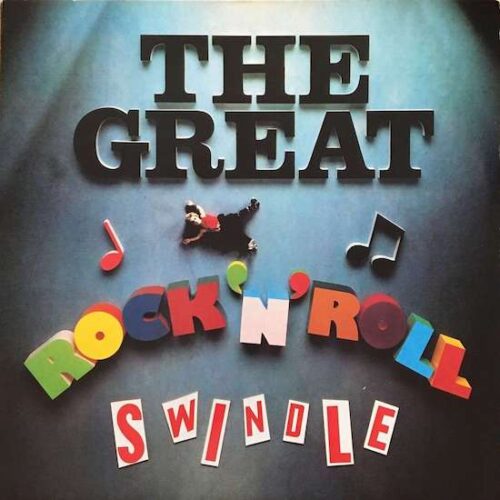
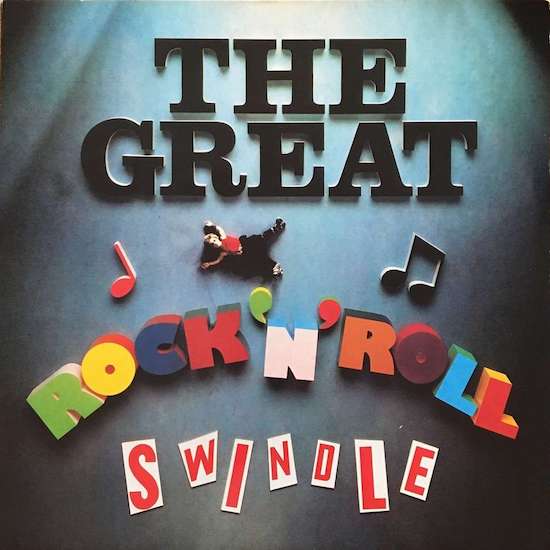
The Sex Pistols that these people – the adolescents of the early 80s – grew up with was the Pistols of Flogging A Dead Horse, and of The Great Rock’n’Roll Swindle. The Pistols as vaudeville, taken from something threatening into something almost comedic. The laughter is jeering, and cruel, but it’s still laughter, not hatred or rage or vitriol. And on The Great Rock’n’Roll Swindle it often feels as if the real butt of the joke is the Pistols themselves. You thought this band could change the world? This band doing covers of ‘Rock Around The Clock’ and ‘Something Else’ and ‘C’mon Everybody?’ This band who you hear falling apart as they rehearse Johnny B Goode, with Rotten insisting, “I hate that! It’s fucking awful! Stop it!”? This band singing ‘Friggin’ In The Riggin’’ for goodness’ sake? World changing? Epoch making? Well, as a pop singer once wondered: “Ever get the feeling you’ve been cheated?”
The Great Rock’n’Roll Swindle was the playground Pistols album. The person who owned it never had to explain the word “Bollocks” to their parents, for one thing. If memory serves, it was cheaper to buy than the only “proper” Pistols album. It was the soundtrack to a film that, at that point, was still a big deal. And it was perfect for the new age of home taping: The Great Rock’n’Roll Swindle would just fit on two sides of a C90 cassette, to be passed around like a samizdat publication, and when you heard it – if you were 12 or 13 or 14 – it sounded like everything, because between the terrible joke songs and the rock & roll songs, it encompassed everything that the Sex Pistols could be. It presented the Pistols in their entirety, as what Malcolm McLaren – if not John Lydon – had seen them as: a huge conceptual art project, that could encompass the most amateurish garage band, the most terrifying punk band, the most oddly compelling strange funk band (The Black Arabs), an experiment in globalising British culture (Louis Brennon’s ‘L’Anarchie Pour le UK’), and in the final knockings of Cook and Jones, the most brutal of yob rock bands.
It’s that latter iteration that was the one that echoed around the playgrounds, and – I suspect – the one that shaped punk in the 80s (one of the lesser Lydon tracks had a similar effect: Minor Threat apparently believed ‘(I’m Not Your) Stepping Stone’ was a Pistols original when they covered it). ‘Silly Thing’ and ‘No One Is Innocent’ bear the same relation to ‘God Save The Queen’ and ‘Holidays In The Sun’ as, say, ‘Mama Weer All Crazee Now’ does to ‘Virginia Plain’: the thuggish, stunted cousin that might appall aesthetes but connects viscerally. This version of the Pistols was still dangerous, if you were a kid (not, doubtless, if you had been around in 76) but it was a very containable danger because it felt predictable. Listening to late-era Pistols felt like being on a fairground ride, whereas the first time you heard Lydon’s Pistols felt like being in a car crash.
Ronnie Biggs symbolises the fissure between the two versions of the Pistols. Whereas the original Pistols were excoriated for being a threat to the very fabric of society, ‘No One Is Innocent’ was banned from the radio for being sung by a Great Train Robber, in exile in Rio de Janeiro. This was “shock” at its most juvenile level; no wonder it worked for 13 year olds.
The divide is at its widest on the two versions of ‘Belsen Was a Gas’. It’s an unpleasant, nasty song, something Lydon later acknowledged when he told Q in 1996 that it should have “ended up on the cutting room floor”. But his version, recorded live at the final Pistols gig, acknowledges the horror of the joke: he gives a remarkable performance, shuddering with horror that, first, he is singing these words and, second, that people are treating them as entertainment. The song ends with Lydon haranguing – himself, the crowd, anyone – “"Be a man / Kill a man / Be someone / Kill someone / Be a man / Kill yourself.” It doesn’t excuse the song, but Lydon’s horror gives ‘Belsen Was A Gas’ a purpose. It becomes about our own complicity in evil, a precursor to ‘Poptones’.
And then you listen to the version sung by Biggs. There’s no horror here, no disgust. In fact there’s nothing bar the sound of a man who, you rather suspect, probably thinks a song about the Holocaust is actually funny. It’s just as vile as Lydon’s version, but in a different way, and for different reasons. Naturally, that’s not how it seemed when I was 13, when it was just shockingly and uproariously transgressive: OHMYGODHAVEYOUHEARDTHIS? It occupied precisely the same space as ‘Friggin’ In The Riggin’’: something that seemed unutterably daring to a kid, but which to an adult now seems pathetic, just like Sid singing “You cunt, I’m not a queer,” on ‘My Way’, a performance that is transformed into tragedy only by the fact of his death. Or, to go back to the original argument, just like The Toy Dolls’ version of ‘Nellie The Elephant’.
But whisper it quietly: I’d rather listen to The Great Rock’n’Roll Swindle than to Never Mind The Bollocks these days. For all the undimmed power of the quartet of singles, most of the rest of the album cowers in their presence, and Chris Thomas’s production – the guitars layered until they resemble a tank battalion – becomes overwhelming. By contrast, The Great Rock’n’Roll Swindle might be a mess, but it’s an entertaining mess, hopping around between styles, singers and even groups. And for all the orchestras, and the sprawl, it’s a far more democratic album than Never Mind The Bollocks precisely because it wasn’t the final expression of what originated as an elitist movement.
It’s the Pistols not as harbingers of doom, but as people: flawed, difficult people.