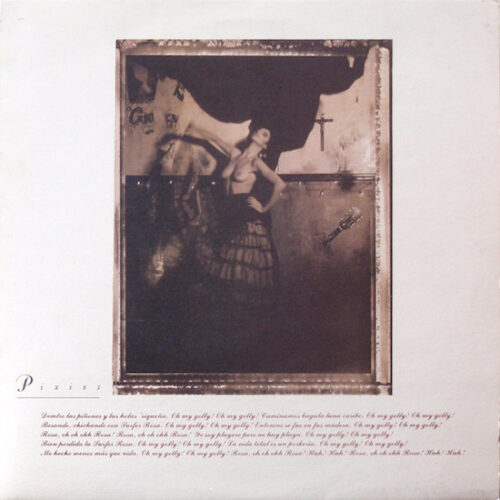

Like the stopped clock, even Billy Corgan is right sometimes. “It rocked without being lame,” he said of Surfer Rosa, the first full-length Pixies album, in a sentence that many of the record’s admirers might find dismissively simplistic, but which is actually truer than a thousand of the more florid pieces of analysis devoted to it.
Surfer Rosa was, and still is an amazing record. It’s Pixies’ best, something that becomes ever more apparent with the passage of time (reviewing Bossanova for Melody Maker in 1990, Bob Stanley remarked that he didn’t really get the genuflection before Pixies albums, since they had so much filler; he’s largely right, but Surfer Rosa is by a distance the one with the least filler). It’s a
landmark record because it doesn’t sound of its time, whereas so many of 1988’s other critical favourites do sound of their time, for reasons of technology or fashion or context: NME made Public Enemy’s It Takes a Nation of Millions To Hold Us Back it’s album of the year, with Surfer Rosa at No 10, which was a perfectly reasonable position to take – Millions is a great, groundbreaking album – but 30 years on, Surfer Rosa is the one that has aged into timelessness rather than becoming a period piece.
I think the reason Surfer Rosa sounds timeless, sounds classic, is that, at heart, it is a very traditional album. Listen to it closely (even better, don’t listen closely; just have it on in the background). It’s not a revolutionary statement of musical intent. It’s a Classic Rock album. No, it doesn’t sound like Boston or the Stones or ZZ Top or any of the behemoths of American radio formats; it’s a bluesless album, a product of the great schisms of the late 70s in which not just punk but hard rock, too, expunged the shuffle from guitar music that wasn’t specifically celebrating the blues. But so much of its DNA is in Classic Rock that it’s easy to see why British audiences seized on it: while satisfying fetish for newness that British music fans like to identify in themselves, because of its dervish noise and lyrical perversity, it offered so many familiar comforts that you didn’t need to be a maven of the underground to love it. Conversely, maybe it was neglected in America because the underground tastemakers noted Pixies’ conservatism, while it remained too leftfield for the actual Boston and ZZ Top fans.
It’s hard to conceive that, 30 years ago, Pixies’ peers might have viewed them as somewhat less than groundbreaking, but they did. In a runthrough of records he had recorded, for Forced Exposure magazine, Steve Albini – who produced/ recorded/ engineered/ whatevered Surfer Rosa, for goodness sake – dismissed this album as “a patchwork pinch loaf from a band who at their top dollar best are blandly entertaining college rock”. Appearing on a late-night ITV music show, Thurston
Moore dismissed Pixies as lame for – wait for it – doing thumbs-ups in the video for ‘Monkey Gone To Heaven’ (while also gushing over Guns N’ Roses. Times were strange).
If you were to pick one classic rock antecedent for Surfer Rosa, it would be Led Zeppelin. Both bands had a similar approach to the dynamics of songwriting: while Pixies’ loud-quiet-loud has been
treated as if it was some kind of Newtonian discovery of a hitherto unimaginable, it’s precisely what Zeppelin had done plenty of times long before: ‘Babe I’m Gonna Leave You’, ‘What Is And Never Should
Be’, ‘Ramble On’, ‘No Quarter’, ‘In The Light’, ‘Ten Years Gone’ – they didn’t use it as unrelentingly as Pixies would, but they used it often and to great effect.
The other huge, unavoidable similarity is in the construction of the sound: Albini recorded Surfer Rosa in the same way Jimmy Page liked Zeppelin to be recorded, with the sound of the room present. At Q Division studios in Boston, he employed exactly the same techniques as Page did with Zeppelin at Headley Grange in Hampshire, using the available rooms to create natural echo and a huge sound that amplifies the spaces between the instruments rather than diminishing it.
“I remember them taking the amps down to the bathroom so they could record the large, large sound for ‘Gigantic’,” John Murphy – the former Mr Kim Deal – told Josh Frank and Caryn Ganz, authors of the
Pixies oral history Fool The World. “Albini didn’t like the studio sound so they took all the Marshalls and all the cables and they brought them down to this bathroom which was completely made out of cement, and that’s where the big echoey sound comes out of it. He didn’t want to use studio echo, he wanted to use real echo."
The clarity of that spacious sound – unusual in the mid-to-late 80s, when engineers and producers were taking advantage of new technology to make records as full and overwhelming as possible – made Surfer Rosa very easy to listen to. It might not be lush, but because it eschews maximalism it means the melodies – the vocal melodies, the guitar lines, the countermelodies of the bass – are always
foregrounded. All its hooks are evident, and for all the ferocity of the guitars, the instrumental set-up never conceals them.
Now, one might plausibly argue that had Pixies made the exact same album musically but paired them with the lyrics of, say, The Wonder Stuff, then history might have been different: would critics have
frothed over the Surfer Rosa with quite the same urgency had they not been singing about incest, violence, more incest, more violence, and sundry other unsettling kinkiness? Had the critics not
frothed – this being an age when the weekly music press still wielded influence – would the indie public have embraced them so wholeheartedly? Had the indie public not embraced them so wholeheartedly, would they have passed into pantheon of great bands, or would they be another of those groups who get occasionally reissued, gushed over in the specialist press a bit, then forgotten again, like The Feelies, a pioneering American indie band who remain consigned to the margins?
Of course, I don’t know, though I think that alternative history is perfectly reasonable. But, in the long run, the more shocking the lyric, the less significant it appears now. ‘Broken Face’, ‘Break My Body’ and ‘Bone Machine’ don’t read like the words of an unhinged and dangerous man, but those of someone who really, really, really wanted people to think he was unhinged and dangerous: it’s so obviously a pose. The better lyrics are where there’s something elusive and mysterious, not when you’re being hammered over the head with a sign reading “You don’t have to be mad to be in Pixies – but it helps!” So ‘River Euphrates’ – and what more classic rock subject could there be than a voyage to the Middle East? Drive a little further and you might reach ‘Kashmir’ – has a real strangeness to it, in its image of riding a tyre, in the simplicity of Francis’s opening lines: “Stuck here out of gas / Out here on the Gaza Strip.”
Better yet is ‘Gigantic’, where Deal’s lyric has a worldly sensuality that Francis’s writing lacked; she was four years older, married, and you can hear her greater engagement with a real world, not least because her first person sounds an awful lot more truthful than Francis’s: “And this I know, his teeth as white as snow,” is an almost perfect opening line, a promise of revelation and desire. She knows; she wants to tell. It’s the tease that entices, the sidelong glance.
Surfer Rosa endures. It will continue to endure. Teenagers will continue to discover Pixies – you see them at the shows – thrilling to the lyrical transgression; adults will continue to listen to them,
reliving a past. Younger bands will continue to acknowledge them – Kings of Leon, of all people, cited them as an inspiration when the two groups shared a bill in Hyde Park last summer. Nowadays, the
notion that Pixies are a classic band isn’t something to dispute. It’s only a hop from there to accepting them as Classic Rock.