


Savage Pencil, photo by Joseph Tovey Frost
Earlier this year, Strange Attractor published Rated SavX: The Savage Pencil Skratchbook, a collection of writing, drawings, art, interviews and ephemera from across the career of the acclaimed underground cartoonist Edwin Pouncey.
From his ‘Rock ‘N’ Roll Zoo’ series for Sounds in the 1970s, to designing artwork for the likes of Sonic Youth, Sunn O))), The Fall and Current 93, under the name Savage Pencil he has established a wild, hallucinatory style – a trip that’s equal parts hilarious and terrifying.
Within the headspinning pages of Rated SavX, you will find illustrated biographies of two Edwardian underground figures – the artist and occultist Austin Osman Spare, whose style of automatic drawing was a major inspiration, and the artist Louis Wain most famous for his anthropomorphic cat pictures whose progressing surrealism has been attributed to an onset of schizophrenia.
Below he discusses both, as well as a lengthy obsession with the author and clergyman Montague Summers, whose strange studies on witchcraft, vampires and werewolves, as well as work on English restoration theatre Pouncey has collected for years.
Tell Me Strange Things: Montague Summers

Photo: Wikimedia Commons
"I first came across Montague Summers when my friend Sandy Robertson came to me with his book Witchcraft And Black Magic. It was one of these pot boiler witchcraft books that Summers had put out and it captured our imagination. He writes in a very arcane type of way. It’s English, but using such an odd, sort of archaic kind of language that’s almost teetering towards Latin. It’s not flowery, more scholarly. He pulls words out that you don’t even know exist like ‘dactyl’ and ‘spondee’; you have to keep rushing to the dictionary. He’s so eccentric and mad, and the subjects he chooses to write about are just extraordinary.
"It just captured the imagination, so we started off on this collecting spree. We were both working at Sounds at the time and we thought that instead of listening to these terrible ‘80s records like Haircut 100 we’d go off and look for Montague Summers books, so off we went! We found that this person Timothy d’Arch Smith had written a bibliography about him so we picked that up. Back then London’s antiquarian bookshops weren’t like they are now, there was quite a lot of them. They all had stock that was festering in cellars, so if you went along and prodded them enough they might unearth something for you. And lo and behold we did find quite a lot of stuff about Montague Summers. It was a case of stumbling across it then adding it to the collection. It wasn’t cheap, you were paying about 25 or 40 quid, but we were working at Sounds and we got expenses and we didn’t know what else to do.
"Most of our other friends were really into Aleister Crowley. We like that as well, but because people like Jimmy Page and Kenneth Anger were big fans of him the prices were ramped up to the thousands. Summers appealed to us a bit more because he was more of an underground figure – this guy, dressing up as a priest, writing about witchcraft and restoration theatre. He’s more interesting than Crowley in a lot of ways, and nobody knows about him. Then when we got Tim’s book it became a touchstone, it showed us exactly what was out there, we could go and look for it. We developed a kind of one-upmanship. People would come around to show you something and you’d go ‘oh well we’ve got The History Of Witchcraft And Demonology and it’s in jacket’
"It’s very mysterious why he was interested in witchcraft and demonology, but I suppose it was because of his Catholic faith. Nobody knows if he was actually ordained as a priest or not because his papers were scattered to the wind when his secretary Hector Stuart Forbes died, but he did believe the devil was real and that witchcraft went on, he was completely convinced by it, and saw his role as a Catholic priest as being to stamp it out. But to my mind he was secretly seduced by it because it was naughty and against the rules.

"As with all the other subjects he was mostly interested in like restoration theatre, which was totally unpopular at the time and still is, it was his aim to show people how good it was and perform it on a stage. He started a theatrical company called The Phoenix and wrote all the programme notes, but I think he was really just interested in the obscurity of it. The same way that we were.
"My favourite discovery was the complete manuscript for his history of The Restoration Theatre, which in fact is the area that I’m interested in more than demonology. His best work is written about the theatre. People at the time slagged him off about it, saying it was clumsy and riddled with mistakes and everything, but I still find that he has this real passion for restoration theatre and it’s really uplifting to read it. You know when you read somebody who really knows what they’re talking about, where they really get into it and drag you into it? You don’t know anything about it at all but you’re just captivated by the fact they’re managing to tell you all this stuff and make it come alive. Even if it is riddled with mistakes, I don’t really care!
"We read in a memoir by Brocard Sewell that Summers’ grave lay unmarked, and that it was in Richmond Cemetery, so we tracked it down. We thought ‘there’s enough people interested in him now, why don’t we start a fund to mark his grave with a gravestone? I think he deserves it!’ It was like one of those Kickstarter projects, but it was all by mail. We got enough money together and erected a stone to him and Forbes who’s buried in the same grave with him. For the script on the stone we put on ‘Tell Me Strange Things’, which is one thing he always used to be saying. Sewell came along to say whatever the Catholic rites are, and everybody who contributed turned up to Richmond Cemetery. I haven’t been there in a while, but hopefully it’s still standing!
"By then quite a lot of people were interested in him again, a kind of revival had happened that’s still continuing now. A lot of his writing that never appeared at the time is coming out. Recently his book of ghost stories appeared and there’s another book of his fiction coming out this month on an imprint called Snuggly Books. Then there were revised editions of his vampire works that came out a few years ago. Interest in him is still there!"
Thee Wiggy Magickal World Of Austin Osman Spare
From ‘Rated SavX’
"Austin Osman Spare is one of the people who influenced me most in my art. I remember reading what he had to say about automatic drawing – trying to achieve a trance state and seeing what happens, seeing what you can conjure up with it. There’s all this stuff about sigils, focussing in on shapes and designs to make a kind of chaos magic happen. I tried it, and to my astonishment after a lot of practise it worked. I didn’t follow his methods to the letter, but I devised my own way of doing it and that’s still what I do now.
"I think the first Spare thing I saw was probably one of his weird portfolios, a book of automatic drawings in this big brown folder, and inside were jut these strange drawings of cherubs and distorted trees and animal forms becoming human. That intrigued me, so I just started reading up about him, finding other bits and pieces. Then I found reprints of The Book Of Pleasure and a load of others at a book fair, so I bought those and, like with Summers, found myself intrigued by him.
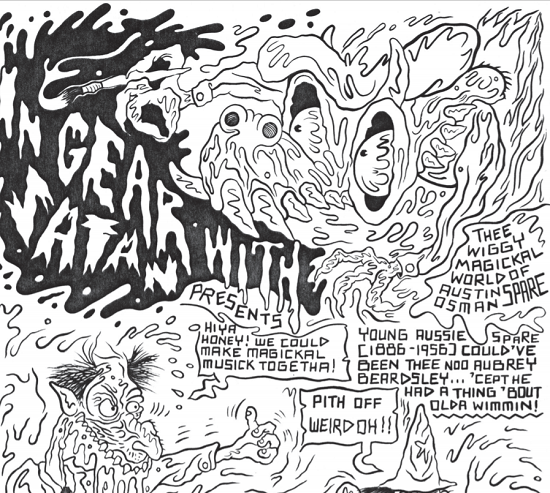
"I suppose what interests me about all these people is that I’m working along similar lines in the way that they’re unknown to most people. They’re the counterculture of their time. Spare came across to me like a 1920s underground artist. He had to show his stuff in pubs to get an exhibition, and published himself. Mostly it’s the more obscure stuff that I’m more interested in listening to or thinking about. I like an alternative viewpoint to what is immediately accepted by everybody else. Sometimes the viewpoints aren’t that good, of course, but sometimes they are! I read about his magical philosophies, the Zos Kia Cultus, but whether I completely took it in is another matter. I was more interested in how he drew. I just liked the idea of getting into a frame of mind where you loosen up and let go and see what happens at the end of it.
"Thee Wiggy Magickal World Of Austin Osman Spare is a comic biography about Spare. Sandy Robertson wrote it and I illustrated it. It starts off with Austin Osman Spare trying to get off with a witch, because that’s what he used to do – he had a thing about older women. He says ‘Hiya honey, we could make magickal musick together!’ and the witch is hobbling away saying ‘pith off weirdoh!’ The next frame is him in Brixton: ‘He turned his back on society in favour of sinister sorcery in South London’. There he was, in a squat or something, working on his magical theories and stuff and everyone thought he was crazy. Then we have his brief relationship with Aleister Crowley, and there’s a frame of him meeting what he thinks are people he knew at a bus stop, but then he realises they’re ghosts of people killed in the blitz. Then the last panel is him drawing a masterpiece on his last piece of toilet paper, even though he’d like to wipe his arse with it. The reason for that is because he would use any scrap of paper he could find to draw on. He wasn’t one of those people who had to get the highest quality paper, most of his work is done on bits of cardboard or whatever came to hand."
Anthropomorphism and Louis Wain
From ‘Rated SavX’
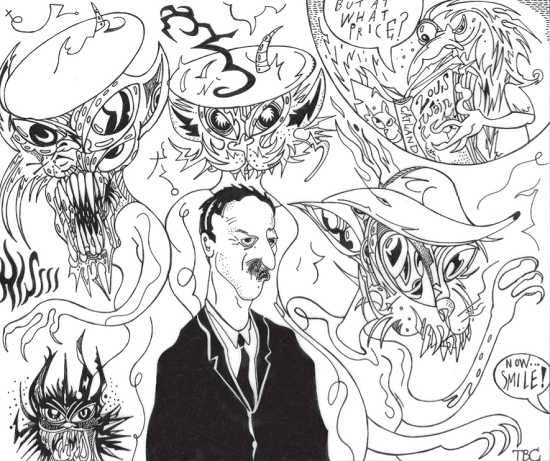
"I knew Wain had drawn all those cats and everything, but I wasn’t that blown away with it. I did like the really psychedelic ones he did at the end of his life when he was going mad, but I suppose everyone did. This was a project that came about through the writer David Quantick. Much like Sandy did with Austin Osman Spare, he wrote a series of pages for me to illustrate about Louis Wain, so I did. The idea was it was going to be a book but it never really happened, so it was printed when we could get it inside the pages of Alan Moore’s underground magazine Dodgem Logic, and then Dodgem Logic folded and we didn’t have anywhere to put the pages so we never really completed it.
"We did use some of the work as our part of a little group exhibition, and I drew a set of postcards. It was a last minute, ‘what can we sell at this exhibition’ kind of idea. I was trying to imitate Wain, really, adding my flourishes to it. On the afternoon of the exhibition I knocked them up, got a set of postcards printed, so I had some stick to sell at the exhibition. I really like the one with the mirror, that’s my favourite. It looks kind of… weird, magical, like some kind of transformation’s going on.
"Right from when I first started as a kid, I always interpreted people as animals. There are a lot more different animal shapes, aren’t there? They’re more interesting, you can do more things with animal shapes than you can with human shapes. Also, I was being bombarded by the stuff that was in my father’s newsagents shop, you’d look at all these comics and they’d be all like that as well. You’d have Harold Hare and Dickie Doormouse and Freddie Frog, you’d look at them and I suppose they’d sink in somewhere in your subconscious and come out, excreted through your art."
Rated SavX: The Savage Pencil Skratchbook is out now via Strange Attractor. You can find out more and purchase it here