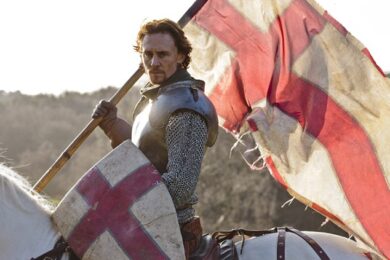
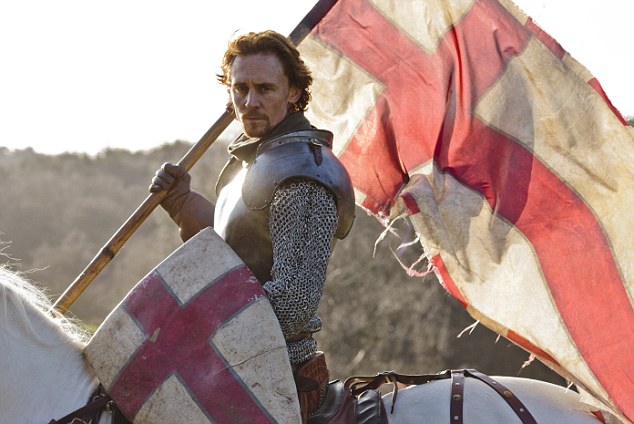
The last working day of 2011, and where better to spend it than in a muddy field near Oxted? It’s 8am, bloody freezing, and a cast headed by Tom Hiddleston are recreating the Battle of Agincourt for a new adaptation of Henry V, the last of the Shakespeare history plays adapted for television as part of the BBC’s contribution to the Cultural Olympiad.
Under the watchful eye of director Thea Sharrock, the rival English and French troops are briefed ahead of the biggest action scene of the film.
After a quick turn around the field, Hiddleston attempts to guide his steed into the heart of the battlefield. But horses are, apparently, not stupid. This one refuses the first three times the actor tries to ride into the mayhem. After a half-speed trial run, it’s showtime. Hiddleston and horse charge through the marauding armies, the actor roaring every few strides, striking down attackers on either side, eyes ablaze. The noise, the energy, the fog as human and horse breath engulfs the warriors, and the sense of danger as Hiddleston and horse head straight for us at high speed.
After a morning spent slaying French troops, falling from horses, and sword-fighting, Hiddleston would have every right to a restful lunch hour. Instead, as 100 or more battle weary troops trudge back past the encampment where some are camping – so committed are they to battle re-enactment – to the unit base, Hiddleston agrees to march across the soggy field to where the last remaining shard of sunlight is casting a beautiful light, so that photographer Charlie Gray can get his shot.
Then, instead of returning to his trailer, he joins the Quietus by the battlefield, in full armour, and spends most of an hour talking 19 to the dozen as his lunch gets cold.

"Fantastic, absolutely bloody fantastic," is his assessment of his morning’s work. "There is something about the adrenaline of shooting a battle where everyone’s blood is pumping. In a way there is no acting required. They have been calling me ‘crazy eyes’, but the intensity needs to be there.
"There were thousands of French troops with fresh legs, a decent breakfast and a decent night’s sleep behind them and meagre hundreds of English fighters who had been marching for three weeks and were dying of dysentery and starvation. Now, I had dysentery once, I got it in India. Firstly the bacteria empty your digestive tracts, then they dissolve it. You have to imagine the English army at this point have maybe a day and a half left in them before they start dying – so the stakes in this battle are so high. Every single soldier had prepared themselves for death, and Henry asked them to – it is in the play.
"Thousands of French nobles – princes, lords, barons, knights, squires against hundreds of ill, sick, starving English yeomen. So that is where the crazy eyes comes from – it is absolutely the instinct of survival. The only thing I can equate it to is once when I was mugged and held at knifepoint. The adrenaline that goes through your body at that moment – this is that but a thousand-fold."
At this point, Hiddleston starts reciting the verse, with a face like Christmas.
"If we are marked to die, we are enough to do our country loss; and if to live, the fewer men, the greater share of honor…"
He finally breaks off, a good few pages later. We ask about breaking Shakespeare out of the theatre and onto the small screen. It is more than 25 years since the BBC finished its last extended run of Shakespeare plays, and, as Paterson Joseph, who plays Henry’s trusty sidekick and killing machine York says, "I wish we didn’t have to have the excuse of the Olympics to do it."
Scheduling the plays on Saturday nights, where they have been disrupted first by football (Richard II), then by Andy Murray at Wimbledon (Henry IV pt I), it’s tempting to surmise that the BBC hasn’t given the plays the best chance of reaching the widest possible audiences.
Still, even ratings around the million mark plus the hope of iPlayer viewings and overseas and DVD sales boosting the circulation, extends the reach of the plays far beyond productions in the theatre.
And the scale of these films allows the battles to be epic, while other scenes can retain a real sense of intimacy. His St Crispin’s Day speech brought some of the cast to tears, we hear later.
"I did ten minutes of the entire film on one day, which was three of what I call the arias," continues Hiddleston. “Because Shakespeare’s poetry is like music, and there are some bravura pieces, which are like operatic arias. When Henry speaks, it is some of the most heartbreaking warrior poetry that has ever been written in the English language.
"I have never shot so much of what the crew are calling ‘dialogue’ on one day. It’s not strictly dialogue, though, is it? It is monologues of breathtaking poetry. The poetry of war. The human race evolves, we invent aeroplanes, motorcars, iPads and yet these words are still so potent. Human nature hasn’t changed. And on film, there are moments you can be so quiet and simple with it."
Hiddleston attributes his love of Shakespeare to two things. Trips to the National Theatre and RSC with his mum during his teens, included three trips to see Simon Russell Beale as Iago in Sam Mendes’s Othello. "I will never forget it as long as I live," he says.
Then there’s a certain Sir Kenneth Branagh, whose continued patronage has played such a huge part in Hiddleston’s recent success.
"The reason I have a career, if I have one at all, is because of Kenneth Branagh. I worked with him four times – Ivanov, at the Wyndham’s Theatre in 2008, two seasons of Wallender, and then he directed me in Thor."
But if Branagh’s Much Ado About Nothing and Henry V are ‘masterworks’, Hiddleston is not trying to replicate his friend and mentor’s performance.
Instead, Hiddleston follows roles in Spielberg’s War Horse, Terrence Davies’s The Deep Blue Sea, as F Scott Fitzgerald in Woody Allen’s Midnight In Paris and a second outing as Loki in Marvel’s The Avengers with a new take on the evolution from playboy Prince Hal to warrior King Henry.
"I think every generation has a go at Shakespeare," he says. "In the same way that Michael Sheen is playing Hamlet right now at the Young Vic. Two years ago it was David Tennant and Rory Kinnear was in between, and he was magical.
"It is like Shakespeare is some kind of Olympic torch to be passed on from generation to generation. Ben Whishaw was two years above me at Rada. When I arrived there, he was preparing to leave, already fully trained and polished and ready to go. I looked up to him and thought my god, look at that, I hope I’m there in two year’s time. So to be standing alongside him, after he has played Richard II in the first of the films, and that they wanted me to be Henry V for this generation is a giant honour."
And with that, he’s back on his horse – once more unto battle…
The Hollow Crown: Henry V is on BBC2 on Saturday 21 July at 8pm