
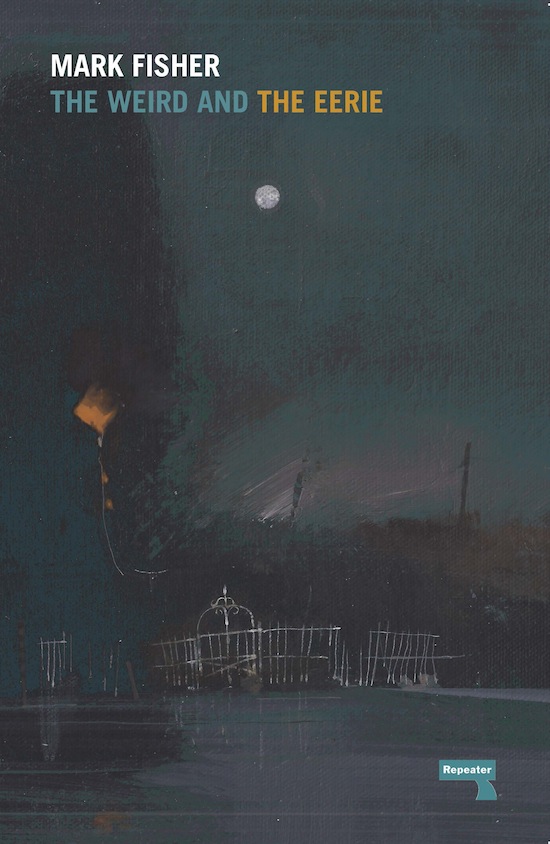
What a difference a few years makes. When tQ started nearly nine years ago it were all ‘liminal’ round these parts. Then we just about survived the ‘unheimlich’ versus ‘uncanny’ wars with nothing to show for it bar PTSD and a gnawing sense that something wasn’t quite right. Now it’s 2017 and renowned author, political theorist and cultural critic Mark Fisher is asking us (in his new book for Repeater, The Weird And The Eerie) to consider the two similar but distinct modes: that of the ‘weird’ and the ‘eerie’. As befits a new work by the author of the essential Capitalist Realism it’s a great read and sets out its stall clearly by dealing with some of the most unnerving, discombobulating and transcendent fiction, film and music of the 20th Century.
It’s the power and familiarity of the source material that gives the book some of its immediacy. [To former or current readers of British comic book institution, 2000AD: Fisher is like Hammerstein from ABC Warriors and Ro-Busters, swinging his giant titanium lump hammer fist at opponents, smashing them to scrap metal. "Here we have Hex Enduction Hour by The Fall… SHKRRRK! And here we have ‘Don’t Look Now’ by Daphne Du Maurier… CRUNCH! And here we have Inland Empire by David Lynch… ZZZSSST!"] He has located a sweet spot… a rich seam of cultural production that is undeniably part of the mainstream but easily retains its weirdness and eeriness, undimmed by repetitive viewing, reading or listening.
It’s instructive as a music journalist to study these terms closely, as to be a music journalist means – 9 times out of 10 – to misuse language. Obviously the weird and the eerie are both preoccupied with the strange. Both are fascinated with what lies outside ordinary experience in terms of perception, thought and experience – they both suggest a fascination that causes apprehension and dread. Both allow us to see the inside from the perspective of the outside.
But what is the actual difference?
Well, he says that the weird is that which does not belong. This mode brings something to the everyday which does not belong there and cannot be reconciled with it. The form that is most appropriate to the weird is the montage; hence the preference within surrealism for the weird combinations. Modernist works of art/culture can often seem weird because we are in the presence of the new; so the shock of the new signals that concepts and frameworks that we’ve previously used are now obsolete. This sometimes exciting or pleasurable feeling is similar to what Lacan called jouissance.
A weird object or entity is so strange that it makes us think that it should not exist. But by the very fact that it does exist means that it is us who are wrong, and that all of the personal rules we have previously used to make sense of the world are mistaken.
On the other hand, says Fisher, we tend to find the eerie in landscapes, which have been partially emptied of the human. We don’t find the eerie in enclosed, everyday spaces. We find it in forests and ruins. The eerie is often tied up with an idea of agency. Who – or what – caused these ruins, uttered the strange howl? The eerie concerns the most fundamental philosophical questions: why is there something here when there should be nothing. Or vice versa. The eerie can also signal a stark disengagement with how a person views the world but it doesn’t produce a shock like the weird does, instead it produces a sense of serenity. The eerie is in fact actually an escape from the mundane and the mundane forces of reality.
As Fisher himself says: “The feeling of the eerie is very different from that of the weird. The simplest way to get to this difference is by thinking about the (highly metaphysically freighted) opposition — perhaps it is the most fundamental opposition of all — between presence and absence. As we have seen, the weird is constituted by a presence — the presence of that which does not belong. In some cases of the weird (those with which Lovecraft was obsessed) the weird is marked by an exorbitant presence, a teeming which exceeds our capacity to represent it. The eerie, by contrast, is constituted by a failure of absence or by a failure of presence. The sensation of the eerie occurs either when there is something present where there should be nothing, or is there is nothing present when there should be something.”
In cultural terms these modes have evolved in a dynamic way over the years and it’s easy to trace this development via The Weird And The Eerie. The weird as a mode often occurs when everyday life (the inside) is contrasted directly with a more metaphysical realm (the outside). Hence a hallmark of weird fiction and films is often the threshold, as symbolised by doors, windows, holes and hallways. One of the earliest examples of the weird Fisher provides is HG Wells’ short story from 1911 ‘The Door In The Wall’, in which a politician becomes obsessed with a door in a wall, which may or may not lead into a mysterious and magical realm and may or may not even exist. He ends the first half of the book looking at David Lynch’s masterful Inland Empire (2006) from nearly a century later which is a nightmarish rabbit warren-like network of nothing but thresholds, with all rational narrative and characterisation absent, and only an overwhelming sense of weirdness left.
An Extract from The Weird And The Eerie
Alien Traces: Stanley Kubrick, Andrei Tarkovsky, Christopher Nolan
Under The Skin presents us with one version of an eerie encounter with the alien: the alien-among-us. (Nic Roeg’s The Man Who Fell To Earth (1976) is another take on this kind of encounter, and David Bowie’s Newton is a cinematic ancestor of sorts to Johansson’s alien, even though Newton’s home- sick exile exudes a romantic pathos that is absent from Under The Skin’s more opaque and unreadable extra-terrestrial.) I touched upon another version of the alien-eerie when I discussed the final Quatermass serial earlier. In this version, the alien is not encountered directly; its physical form, as well as its ontological and metaphysical features, is never disclosed, and the alien is perceptible only by its effects, its traces. We must now examine this kind of encounter with the alien in its own right.
A consideration of outer space quickly engenders a sense of the eerie because of the questions about agency that contemplating it cannot but pose. Is there anything out there at all — and if there are agents, what is their nature? It is therefore surprising that the eerie is disappointingly absent from so much science fiction.
Stanley Kubrick’s 2001: A Space Odyssey is perhaps the most famous example of a science fiction film which bucks this trend, resisting the positivistic pressure to bring the aliens out into the open. The enigma of alien agency is posed by the film’s totem, the monolith, which is something like the paradigm case of an eerie object. (Throughout the film, the feeling of the eerie is reinforced by the association of the monolith with Ligeti’s music, with its sense of awe and alterity.) The monolith’s “unnatural” qualities — its rectilinearity, its flatness, its opaque gloss — force the inference that it must have been produced by a higher intelligence of some kind. The logic here resembles a secular version of the so-called argument from design, which maintained that the functionality, purposiveness and systematicity of many aspects of the natural world compel us to posit a supernatural designer. There is little trace of the theological in Kubrick’s handling of these themes, and no attempt to positively characterise what kind of entity might have produced the monolith. The nature of the intelligence which has intervened in human history, and the purposes of this intervention, remain undisclosed. The film leaves us only some quite minimal resources on the basis of which we might speculate. In addition to the monoliths themselves, there is the simulated hotel room — unnerving in its very banality — in which, at the end of the film, astronaut David Bowman is prepared for his ambivalent transformation into the so-called Star Child. The hotel room might suggest that the intelligence wants Bowman to feel at home, though even if this is the case, its ultimate motives remain obscure: is it care for this human creature, so far from anything familiar, that motivates the construction of this dwelling place, or have these inscrutable intelligences calculated that this would be a better space in which to experimentally observe him?
(The scenes involving the sentient computer Hal, which maintains the systems on the Discovery One spacecraft, pose questions about agency on a smaller scale. Hal does not have a body, even if it has an organ — a red light-sensor — and a voice that is preternaturally calm. It certainly has agency, however, and the nature and scope of that agency — what drives Hal to rebel against the Discovery’s crew —becomes the crucial mystery in this section of the film. In the scenes where we see Bowman slowly, remorselessly dismantle Hal, and we hear Hal begin to audibly mentally deteriorate, we are con- fronted with the eerie disjunction between consciousness and the material hardware that makes consciousness possible.)
Kubrick’s other major contribution to the cinema of the eerie is another “meta-generic” intervention, The Shining. The genre here is horror or the ghost story, so we understand that the undisclosed beings here are spectres rather than aliens (although it is perfectly possible that they are in fact some kind of alien intelligence). In the shift from science fiction to horror, there is also an implied shift from the suggestion that the eerie forces at work in the film are benign, or at least neutral — as we are likely to conclude with 2001 — to the hypothesis that the presiding entities are malign. Malignancy and benignancy are of course relative to the interests and perspectives of particular entities, as Nietzsche’s parable of the eagles and the lambs reminds us. For the lambs, Nietzsche tells us, the eagles are evil; the lambs imagine that the birds of prey hate them. In fact, there is no question of the eagles hating the lambs —actually, their attitude towards the lambs is closer to affection, even love: after all, the lambs are very tasty. What Nietzsche renders in a comic mode, The Shining poses as an eerie enigma, which remains unresolved, in the film, just as it was in the novel.
The Overlook Hotel in The Shining is a massive version of the room in The Stone Tape: a kind of recording system in which the violence, atrocity and misery that has happened in the building is stored up and played back by the sensitive psychic apparatuses of those — like Jack Torrance and his son Danny — who have the ability to telepathically “shine”. Increasingly, Jack is drawn out of the present — which he shares with his wife Wendy and with Danny — into an aeonic time in which various historic moments are conflated and compressed. (This time of schizo-simultaneity is perhaps somewhat akin to the time in which Tom, in Garner’s Red Shift, finds himself.) But the suggestion is that the appari- tions which alternately seduce and menace Jack are creatures like himself, hapless individuals who have been drawn into the Overlook’s fatal influence. What remains undisclosed is the nature of the forces that actually control the hotel. Jack probes this in a scene with the spectral barman, Lloyd:
Lloyd: No charge to you, Mr Torrance.
Jack: No charge?
Lloyd: Your money is no good here. Orders from the house.
Jack: Orders from the house?
Lloyd: Drink up, Mr Torrance.
Jack: I’m the kind of man who likes to know who’s buying their drinks, Lloyd.
Lloyd: It’s not a matter that concerns you, Mr Torrance. At least not at this point.
Who or what is the “house”, and what does it want? Jack asks no further questions, and the film — like the novel — offers no definitive answers. We never see the Overlook’s real management. In the novel, the Overlook’s reveling entities keep repeating the injunction “Unmask!” (a reference to one of the novel’s major intertexts, Poe’s “Masque of the Red Death”). But neither in the novel, nor in the film, do the creatures that have seized hold of the hotel ever fully reveal themselves. It is not so much that they do not show their faces as they do not seem to have faces to show. The image in the novel that seems to come closest to defining their most fundamental form is the swarming, teeming multiplicity of a wasps’ nest. As Roger Luckhurst suggested in his recent book on The Shining, the wasps’ nest image is missing from the film, but was perhaps translated into sound via the inclusion of the micropoly- phonic buzzing of Ligeti’s Lontano.
But what do these creatures want? We can only conclude that they are beings which must feed on human misery. This would make them appear “evil” from a certain point of view —but this is essentially the perspective of Nietzsche’s lambs. After all, most human beings are hardly in a position to judge other entities on the basis of what they feed on.
Another eerie dimension of The Shining is opened up by the fateful powers of the Overlook Hotel. Jack is told that he “has always been the caretaker” of the hotel. In one sense, this points to the “aeonic” time of the hotel itself, the time beyond linear clock-time into which Jack increasingly finds himself drawn. But it could also refer to the chains of influence and causation that led Jack to taking on the position of the care- taker at the Overlook: his own abuse at the hands of his father, his failure as a writer, his alcoholism, his drunken injuring of Danny… how far back does the hotel’s influence go?
Andrei Tarkovsky’s two great films from the 1970s — Solaris (1972) and Stalker (1979) — are extended engagements with the alien-eerie. In both cases, Tarkovsky’s versions went against the grain of the source material from which they were adapted: Stanislaw Lem’s Solaris (1961) and Boris and Arkady Strugatsky’s Roadside Picnic (1971). What Tarkovsky subtracts from the novels are their satirical, ironic and absurdist elements, in favour of his habitual focus on questions of faith and redemption. But he retains the novels’ core preoccupations of encounters with the unknown.
Solaris concerns a so-called sentient ocean planet. Tarkovsky downplays the science of “Solaristics”, which plays a large part in Lem’s novel: the vast range of speculations and hypotheses that have been advanced about the planet. Instead, he concentrates on the impact of the planet on psy- chologist Kris Kelvin. When Kelvin arrives on the space station orbiting Solaris, he finds that his friend Dr Gibarian is dead, and the two remaining onboard scientists are furtive, spending most of their time skulking in their own quarters. He quickly learns the reason for their withdrawal, when a simulacrum of his late wife Hari, who had committed suicide a few years previously, appears, in a state of great confusion, not remembering anything and not knowing where she is. The scientists have come to call these apparitions “visitors”, and each has his own to come to reckon with — messages of a sort sent by Solaris, their purpose and intention unknown. In panic and disgust, Kelvin forces “Hari” into a space capsule, which he sends off into the cosmos. However, Hari — or rather another version of Hari — returns. In one of the most unsettling scenes in the film, we see that “Hari” has no zip on her dress. Why not? Because the planet has constructed “Hari” on the basis of Kelvin’s memories, and the memory of that dress (hazy and incomplete in the way that memories are) did not include a zip.
What does Solaris want? Does it want anything, or are its communications better thought of as automatic emissions of some kind? What is the purpose of the visitors that it sends? You could almost see the planet as a combination of externalised unconscious and psychoanalyst, which keeps sending the scientists undischarged traumatic material with which to deal. Or is the planet granting what it “thinks” are the wishes of the humans, grotesquely “misunderstanding” the nature of grief, almost as if it is an infant gifted with great powers? The film turns on the eerie impasse that arises when mismatching modes of intelligence, cognition and communication confront one another — or, it would be better to say, fail to confront one another. The sublime alterity of the Solaris ocean is one of cinema’s great images of the unknown.
In Tarkovsky’s Stalker, the alien trace is the Zone, a space in which physical laws do not seem to apply in the same way as they do in the outside world. The fairy tale theme of granting
wishes, implicit in Solaris, becomes the major preoccupation of Stalker, which centres on the idea that there is a “Room” somewhere in the Zone which can make the deepest desires of those who enter it come true. The “stalker” is a kind of self-taught expert on the Zone who guides those who want to explore this treacherous and wondrous space. In the Strugatskys’ original novel, the stalkers were part of a criminal network dedicated to extracting artefacts from the Zone. In Tarkovsky’s film, the stalker remains a renegade figure — some of the early scenes show him leading his charges past fences, military checkpoints and gun emplacements — but his motives now are spiritual rather than materialistic. The stalker, with his respect for the Zone’s mystery, his sensitivity to its dangers and its volatility, wants others to be transformed by contact with its marvels. However, the two generically-titled figures who join him on this trip —“Writer” and “Scientist” —prove too cynical and untrusting to explore the Zone in that spirit, to the stalker’s bitter disappointment. It is not only reaching the Room that is perilous — the Room has its own dangers. We learn that another stalker, Porcupine, had gone to the Room after leading his brother to his death. But instead of returning his brother to him, the Room gave him money. In offering to grant them their deepest wishes, the Room presents a judgement on their being.
Stalker is remarkable for the way in which it constructs an eerie space without the use of any special effects. Tarkovsky used an extraordinarily atmospheric location in Estonia: an overgrown space, in which human detritus (abandoned factories, tank traps, pillboxes) is overcome by resurgent foliage, in which subterranean tunnels and derelict warehouses are recruited into a dream geography, an anomalous terrain full of traps that appear to be metaphysical and existential more than they are direct physical threats. Nothing is uniform here: time, as well as space, can curve and fold in unpredictable ways. The audience comes to appreciate the quality of this terrain not so much through what it actually sees, but from what it intuits via the artistry of the stalker. Cautious, always alert to potential dangers, drawing on his past knowledge but aware of the way in which the Zone’s mutability so often renders previous experience obsolete, the stalker invokes a space bristling with unseen menace and promise. Humble in the face of the unknown, yet dedicated to exploring the outside, the stalker offers a kind of ethics of the eerie.
For Tarkovsky, the Zone is approached largely as a space in which faith is tested. He avoids the idea, mooted in the title of the Strugatskys’ novel, that the Zone could be nothing more than an accident. Instead of being a miraculous sign of some kind of providence, the Strugatskys suggest, the Zone and all its “magical” properties, could be no more than the trash unintentionally left behind after the alien equivalent of a roadside picnic. Here, the eerie becomes an absurdist joke.
The question of providence is central to Christopher Nolan’s Interstellar (2014), a film that offers a welcome return to some of the terrain staked out by Kubrick and Tarkovsky in a twenty-first century cinema landscape that has so far had little space for the eerie. The film depends upon the providential intervention of a group of seemingly beneficent beings — referred to as “They”— who appear to be aiding humanity in its escape from a dying planet. Initially, “They” produce a wormhole, which makes travel into another galaxy feasible. By the end of the film, we learn that “They” are not aliens as such; rather, they are future humans who have evolved to access a “fifth dimension” which allows them to step outside the fourth dimension, time. But the alterity of “They” is not compromised by the revelation that they are future humans, because the nature of these humans is not disclosed. Inevita- bly, they must be vastly different from us — the future is an alien country. We apprehend this future species only by some of its traces — the construction of the wormhole and of the mysterious five-dimensional “Tesseract”, in which time is laid out as if it were space, and which Cooper enters at the climax of the film.
The providential intervention is thus revealed as a time loop, in which future humans act on the past to produce the conditions for their own survival. Within this time loop, there are other time anomalies — most notably, the anomaly in which Cooper, the astronaut who leads the ultimately successful space mission, “haunts” his daughter, Murph. In the five-dimensional Tesseract, Cooper desperately contacts Murph, in an attempt to get his past self to stay at home rather than beginning the mission that means he will miss most of his daughter’s life. There’s something strangely futile about this time anomaly. If Cooper was successful in persuading his past self to stay, then the mission would not have got off the ground (or at least he could not have led it); but the very fact that he is in the Tesseract and able to communicate with Murph in the past, means that he must have failed, in that he has ended up leading the mission.
The mission that Cooper leads is an attempt to flee an earth that is literally blighted — crops will not grow, the population is declining fast, it will not be very long before earth is no longer habitable at all for human beings. Cooper is recruited to work for a NASA that has now become an undercover organisation, operating in secrecy. NASA’s leader, John Brand, has apparently come up with two plans to save the human population: Plan A is to launch a centrifuge into space to form a space station; Plan B is to populate one of three potentially habitable planets, accessible through the wormhole near Saturn. These three planets were discovered on a mission a decade earlier. Actually, twelve ships were sent out, but only the three piloted by the astronauts Miller, Mann and Edmunds sent back a signal indicating that they had reached a viable planet.
The film turns on the contrast between a vision of an indifferent universe and one shaped by a kind of material providence (material in the sense that it involves human-technological, rather than supernatural, agency). Some of the most powerful scenes in the film — those on “Miller’s Planet” — show the sublime bleakness of an indifferent nature. This ocean planet, its surface entirely covered by water, is some- thing like the insensate twin of Solaris. While Solaris prompts unanswerable speculations — what purposes and desires does the planet harbour? — Miller’s Planet presents the mute determinism of a world devoid of intent. The tsunamis and stillnesses of the planet’s endless oceans are so many actions without purpose, the product of causes without reasons. The very absence of a purposive agent provokes a feeling of the eerie (how can there be nothing here?). The term “indifferent” is perhaps ultimately inadequate, since it suggests an intentional capacity that is not being used. Mute nature, you could say, is not even indifferent: it lacks even the capacity for indifference. Even so, it is something like the degree-zero of agency, if agency is defined simply as the capacity to make things happen. Miller’s Planet is full of cause and effect; what it lacks is any designing or purposive intelligence.
The desperate scenes on the planet — the crew’s realisation that the planet is a kind of ocean of sterility, incapable of supporting life; their mistaking of a tsunami for mountains; their struggle to avoid being crushed under the monstrous wave — are given added force by the fact that they are aware that — because of the distorting effects of a nearby black hole — each hour on the planet is equivalent to seven years of earth time. We know that this is especially painful for Cooper because of his desire to return to his children. When Cooper returns to the ship, he learns there has been a miscalculation — in fact, twenty-three earth years have passed while they have been on Miller’s Planet. In a wrenching scene, Cooper watches his children’s lives pass into adulthood over the course of a few short minutes, as he watches the messages they have sent to the ship over the course of two decades.
Love — particularly love between parents and children — is a major theme of the film. The love between Cooper and his daughter, Murph, is what ultimately allows Brand’s Plan A to work — this connection between the two of them is what enables Cooper, when he is in the Tesseract, to send Murph the data she needs to solve the equation on which the plan depends. Although the love between the two is the central affective thread in the film, it is tragically thwarted. The two are only re-united on Murph’s deathbed. Because of the effects of relativity, Cooper looks much the same as he did when he left earth; Murph is by now an elderly woman, her life over, and Cooper has missed most of it.
During a scene onboard Endurance earlier in the film, Amelia Brand (John’s daughter) makes a case for love as a force from a “higher dimension”:
Cooper: You’re a scientist, Brand.
Brand: So listen to me when I say that love isn’t something that we invented. It’s… observable, powerful. It has to mean something.
Cooper: Love has meaning, yes. Social utility, social bonding, child rearing…
Brand: We love people who have died. Where’s the social utility in that?
Cooper: None.
Brand: Maybe it means something more — something we can’t yet understand. Maybe it’s some evidence, some artifact of a higher dimension that we can’t consciously perceive. I’m drawn across the universe to someone I haven’t seen in a decade, who I know is probably dead. Love is the one thing we’re capable of perceiving that transcends dimensions of time and space.
Amelia Brand’s declaration about love is far from disinterested. She makes it when the crew is about to decide whether to travel to Mann’s planet or Edmunds’ planet. Brand wants to go to Edmunds’ planet, but her choice is driven by the fact that Edmunds was her lover. Hence her motive for believing that love is a mysterious force, with its own occult powers and capacities. Yet it turns out, in the end, that she is correct, at least about Edmunds’ planet. It is the only viable environment: as we have seen, Miller’s planet is a desolate ocean, while Mann’s is an icy wasteland.
The immediate temptation here is to dismiss this as nothing more than kitsch sentimentality. Part of the power of Interstellar, however, comes from its readiness to risk appearing naive, as well as emotionally and conceptually excessive. And what the film opens up here is the possibility of an eerie love. Love moves from being on the side of the seemingly (over)familiar to the side of the unknown. On Brand’s account, love is unknown but something that can be investigated and quantified: it becomes an eerie agent.
The Weird And The Eerie is out now on Repeater Books