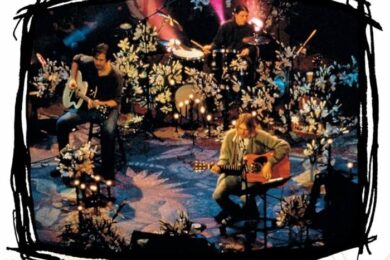

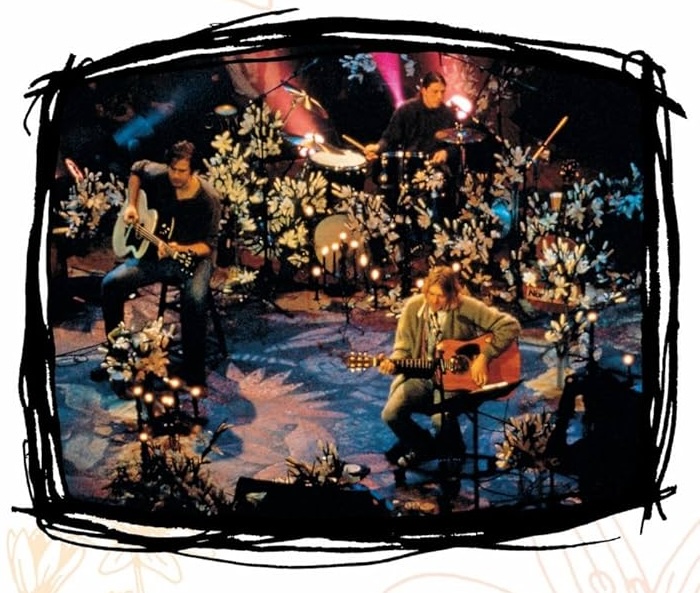
On November 18, 1993, Nirvana performed a long-planned acoustic set in New York for the MTV Unplugged series. The show had been running since 1989 and had become something of an institution. The premise was pretty simple – big name pop and rock artists performed a set of their hits stripped down to acoustic guitars in front of a small, invited audience. The series rests on a very rockist and somewhat self-conscious idea that, somehow, acoustic music is more “authentic” and something that “serious artistes” must be able to do. It wasn’t a very punk concept. Most of the artists who had recorded sets for the series were the kind Nirvana would hate to be associated with – Mariah Carey, Eric Clapton, Sting, Roxette, Rod Stewart, Poison and Stevie Ray Vaughn. The day before Nirvana tracked their session, Duran Duran had recorded one. Recently, however, MTV had tempted some of Kurt’s alt-rock contemporaries including REM, Pearl Jam, Stone Temple Pilots and Soul Asylum, while The Cure had played a great set for the show in 1991.
The band and their management were under no illusions about the debt they owed to MTV – its championing of the ‘Smells Like Teen Spirit’ video had been what put Nirvana on the map, and the network had remained consistently Team Nirvana ever since. More than that, though, for Kurt this was a chance to prove he was more than just “the grunge guy”, more than screaming and volume and smelling like teen spirit; something that was important to him if he was to have a future in music. He was also, however, terrified. Terrified by the thought of doing an entire set without volume and riffs and guitar smashing to hide behind. Terrified of people hearing his music rendered at its most basic. Agreeing to the show had not been a straightforward decision.
Once on board, however, Kurt took the performance extremely seriously; meticulously planning the stage set (candles and stargazer lilies, deliberately evoking a funeral) and choosing songs and collaborators that sent the right message – authenticity, songcraft, the underground. In a way, he managed to make the least punk show on TV pretty Punk Rock.
The setlist, to MTV’s annoyance, was light on Nirvana’s biggest hits (no ‘Teen Spirit’, no ‘Heart Shaped Box’) and included several pretty obscure cover versions, including The Vaselines’ ‘Jesus Doesn’t Want Me For A Sunbeam’ (a mainstay of Nirvana sets since 1991), David Bowie’s ‘The Man Who Sold The World’, three covers by semi-obscure hardcore punks-turned-ramshackle-altockers the Meat Puppets, ‘Lake of Fire’, ‘Oh Me’ and ‘Plateau’ (with the band’s Cris and Curt Kirkwood on bass and guitar) and a closing, definitive rendition of Lead Belly’s ‘Where Did You Sleep Last Night’. Unplugged producer Alex Colleti was initially excited when he heard the band wanted to feature guests, assuming they’d bring Seattle contemporaries Pearl Jam (a pretty absurd idea, as almost anyone who knew Nirvana would have told him). He was less thrilled when he discovered Kurt wanted to showcase an obscure, lo-fi punk band; “Oh great”, he told Mark Yarm, dripping with sarcasm. “I smell ratings!”
Unplugged In New York, as the recording of that night’s performance would ultimately be titled, has, of course, become a classic and beloved Nirvana album in its own right. Kurt’s songs work beautifully stripped down, because of course they do and the choice of covers feel like genius. New content for the band to release showcasing overlooked artists they loved? Of course that’s a brilliant idea. The warm and intimate environment absolutely suited a raw but good humoured performance. Obviously. Except … At the time, none of that was apparent and no-one was sure the set would work at all. Nirvana didn’t want this to look and sound like any other Unplugged show, while the producers at MTV wanted it to look and sound exactly like their previous entries in the series, which usually had a very standardised format. It was creating tensions that could potentially wobble the whole thing off a cliff. Aaron Stauffer of New York band Seaweed remembers running into Dave Grohl before the show. “He kind of gave this face and groaned,” he told Mark Yarm for his Everybody Loves Our Town: An Oral History of Grunge. “‘It’s not going to be good’”. Rehearsals had been stilted, awkward and rambling to the point that Nirvana guitar tech Ernie Bailey was convinced the band were making a terrible mistake. “By the end of the second day I was left thinking at this point it could be a mistake to proceed with the show,” he told The Ringer in 2018. “The rehearsals were so loose, I don’t remember them making it through a full set.” The Meat Puppets’ Kirkwood brothers remember Kurt continually arriving at rehearsals late and obviously high … and if he’d been stoned for the rehearsals, the opposite problem was true of the day of recording – he turned up in withdrawal. MTV’s Amy Finnerty, the band’s biggest champion at the network, went out of her mind trying to track down valium to take the edge off Kurt’s symptoms. Worse, his stomach problems had returned, and he was vomiting blood and bile on the morning of the show. Even the Unplugged format itself strained against Nirvana’s instincts – Kurt’s Martin DB-18 acoustic guitar had a pick-up fitted, essentially making it an electric guitar, which to producer Alex Coletti’s annoyance needed to be ran through effects pedals and into a Fender amplifier disguised as a stage monitor. Krist didn’t even own an acoustic bass and had to be leant one by producers, and Dave struggled to play his drums at anything like the level of delicacy necessary to give the performance the stripped-back feel the format demanded (presumably fuelling Kurt’s recent, privately-stated view that his drummer was “unsubtle”). “Kurt would turn to me and say, ‘Can you play quieter?’” he told Rolling Stone in 2007. “Eventually I said, ‘Do you want me to just split?’ I was barely touching the drums”’ The worry was that his sheer volume would drive everyone else to play harder, completely undermining the intended vibe of the music. At one point there was talk of Dave sitting the show out altogether.
The biggest issue, though, was that the band were terrified. Even after a month of playing mid-show acoustic sets on tour, specifically intended to prepare them for Unplugged, they weren’t used to their music and performances being this exposed. It’s one thing to busk some acoustic numbers at a gig; it’s quite another to do it on TV with every wobble and mistake obvious for all to hear. If the taping was nothing but a succession of retakes and fuck ups then the show was going to be a frustrating experience for the live audience and the band alike – Stone Temple Pilots, who like Duran Duran had recorded their own Unplugged session just the day before, had taken hours to get it right, re-re-recording every song. Most of the press attending Nirvana’s show had also been in the STP recording as well, and no-one was looking forward to sitting through more endless do-overs. Suddenly, the idea of including four songs the band had never played live seemed less than smart. Throw into that a combustible lead singer with a newly-developed tendency to turn full-on rock star diva when things didn’t go his way, and a media hanging on his every move, waiting for him to mess up, and it was a recipe for disaster. The only blessing was that Courtney Love wasn’t there to rock the boat, as she had been doing on tour (she and Cali DeWitt, the couple’s nanny at the time, had intended to fly over from Seattle, but at the last minute decided to stay home and do drugs).
In the end, none of that mattered – though it was a close run thing. Some problems turned out to have easy solutions – producer Coletti was no novice when it came to this acoustic thing, and provided Dave with a selection of alternative drum sticks, notably brushes and hot rods. The latter, which are made from dowling rods taped together, gave the player the feel of standard drum sticks while diffusing a lot of the power of the hits. Dave uses them on nearly every song and has gone on record as saying they’re what saved the performance. Nerves were countered by hard rehearsal. Krist sat up late in his hotel room working out a bass part to Bowie’s ‘The Man Who Sold The World’ (Tony Visconti’s original, intricate line was a little beyond him, at least at short notice) and invited the Kirkwood brothers over to work on the Meat Puppets songs they planned to cover. Amy Finnerty ensured the front row was full of people Kurt knew and loved, herself included. Also in attendance were members of Sonic Youth, old friend turned-manager Janet Billig, members of the band’s touring entourage like comedian Bobcat Goldthwait and Half Japanese singer Jad Fair, familiar faces like Seattle journalist Gillian G. Gaar and, curiously (and less personally familiar to Kurt) British supermodel Kate Moss. Kurt also asked to meet the audience queuing for the show, and knowing he had a crowd of genuine, appreciative fans in attendance seemed to bolster his confidence.
Referenced artists
Sonic Youth
Good Grief: Sonic Youth’s Washing Machine at 30
Meat Puppets
Meat Puppets
Screaming Trees
Talking Drummers: Patty Schemel & Barrett Martin Books Reviewed
The Vaselines
A Scene In Between – A Visual History Of Indie Fashion
Mark Lanegan
Reissue Of The Week: Mark Lanegan’s Bubblegum
More than any of that, though, Nirvana – and especially Kurt – simply rose to the occasion, something which was by no means a given. The band were quite capable of pulling defeat from the jaws of victory; they had always been messy and on their worst days often felt on the verge of collapsing mid-set. They could also be stunning, however. When the stars aligned. When everything was in the right place. When everyone’s moods were good. When it mattered, Nirvana could be absolutely magnificent. This was one of those times. Kurt was in wonderful form – belying his nerves, he seemed calm, relaxed, even enjoying himself. The stage setting might have felt funereal, but the performance itself had a lightness of touch that runs counter to the misery-and-addiction narrative often attached to the band. There’s between-song jokes and endless self-deprecation. “The reason we don’t like to play these two songs back to back is that they’re exactly the same song,” says Kurt of ‘Dumb’ and ‘On A Plain’. “If this doesn’t work, well, these people are just going to have to wait,” he says before ‘Pennyroyal Tea’. “I don’t think MTV would let us play that,” is his response to a frenzied request for ‘Rape Me’. The show feels fun. And when it doesn’t feel fun, it’s because it’s beautiful: Kurt’s solo rendition of ‘Pennyroyal Tea’ is absolutely shattering. It’s his definitive performance of the song, his voice cracking, wringing the raw feeling out of every note. Before the final verse it almost, almost falls apart, Kurt seeming to hesitate just for a second before descending into the final movement and raising goosebumps. The three numbers with the Meat Puppets are brilliant, the songs, reinterpreted through Kurt’s laconic drawl, comfortably taking their place in the Nirvana canon and sitting shoulder to shoulder with the Cobain originals. Probably best of all though is the closing “Where Did You Sleep Last Night”, a song Kurt had been playing on and off since 1989, when he and Krist recorded it with Mark Lanegan and Mike Pickerel from Screaming Trees. That version featured on Lanegan’s solo debut, The Winding Sheet and is one of that album’s highlights, but it’s edged out as the definitive take (outside of Lead Belly’s own) by the harrowing performance that capped Nirvana’s Unplugged set. It’s too easy, in retrospect, knowing what was happening in the background, knowing where Kurt was heading, to project any number of emotional resonances and unnecessary context onto that rendition. You can insert your own interpretation of Kurt’s pain into his howls and screams as the song hits its climax. It’s hard to deny that he’s channelling something in those moments. He seems to put his entire soul into that vocal, absolutely losing himself. Maybe he really was interpreting an ocean of pain. Maybe he just really, really loved that song. Either way, as he howls that final “the whole … night … through” it brings absolute chills. An incredible moment. Beauty. Pain. Catharsis. Whatever – insert your own interpretation here. It’s the capstone on a fantastic, definitive Nirvana performance that, thanks to its release as a live album the following year, has taken a place in the band’s body of work that it absolutely deserves. Truly one of their finest moments. And they didn’t have to do a second take of a single song.
Adapted from NIRVANA: A detailed guide to the band that changed everything by Marc Burrows, published November 30 by White Owl books