
"Around here, Quiet Riot, Mötley Crüe, and Ratt are the heaviest in the world. So if that’s heavy, we must be molten steel."
He may have been virtually unknown at the time, but Jeff Hanneman knew what was coming when he offered these words to the heavy metal fanzine Whiplash back in 1983. Alongside fellow Slayer guitarist Kerry King, who typed the interview, the 19-year-old maligned the L.A. metal scene’s “state of mind” compared to Slayer’s modest but “totally hardcore” faithful. It never made it to print but, 40 years on, it reads like a declaration of intent from a band that was soon to transfigure heavy music forever.
Formed in the Huntington Park area of California two years earlier, Slayer – Hanneman, King, vocalist/bassist Tom Araya, and drummer Dave Lombardo – were situated on the distant borders of the New Wave Of British Heavy Metal’s glammy hangover Stateside but by summer 1983 and the huge groundswell of Kill ‘Em All, they had drawn up their own radical alternative to the post-Van Halen dross of Poison and Mötley Crüe.
If Metallica’s debut was a necessary response, the “molten steel” of Show No Mercy was a hefty escalation. Released via Brian Slagel’s Metal Blade Records in December 1983, it amped up bludgeoning thrash via the breakneck intensity of hardcore punk, creating one supremely satanic salute. Today, having spent four decades languishing in the long shadows cast by riff delicatessens Hell Awaits and Reign In Blood, its status as a singular exhibition of raw thrash glory – and a harbinger of extreme metal – is now overdue. At its best, Show No Mercy was darker, faster, and heavier than the rest, and holds up as Slayer’s most authentically vital release.
When the “Big Four” of thrash (Slayer, Metallica, Megadeth, and Anthrax, for those at the back) rose out of the underground between 1983 and 1985, a common aspiration was to elevate – and possibly even transcend – the style of Iron Maiden and Judas Priest. In 2009, Kerry King acknowledged how this played out on Show No Mercy, singling out Maiden’s M.O. as a template the band had no issue exploiting. “It’s essential to emulate your heroes to help you find what you need to become,” he said.
It’s a mindset that spurs on the galloping triplets and high-pitched howls of ‘Crionics’, ‘Metal Storm / Face The Slayer’ and, most emphatically, ‘Evil Has No Boundaries’. Doubling down on their earlier track ‘Aggressive Perfector’, the opener revises the taut riffwork of Priest via the raw jouissance of Damaged-era Black Flag. It is obvious theatre – a full-blown send-up to match the setting – but Tom Araya’s blood-curdling opening refrain (“Blasting our way through the boundaries of Hell/ No one can stop us tonight”) makes Kill ‘Em All opener ‘Hit The Lights’ sound like thrash’s only marginally more menacing answer to ‘Rock And Roll All Nite’ by Kiss. Compared with Neil Turbin’s ceaseless Halfordian shrieks on Anthrax’s 1984 debut Fistful Of Metal, the results are infinitely more intricate and believable. For all its unholy drama, one aspect – sheer believability – set Slayer’s debut apart from the strained codpiece cosplay of early Anthrax and the brain-numbing technicality of Megadeth on their 1985 debut Killing Is My Business… And Business Is Good!
Taking in demo tape trading, fanzines like Whiplash, and independent imprints including Metal Blade and Megaforce, thrash’s origins in the Bay Area of California echoed hardcore punk’s synonymity with the underground that bore it. For Slayer, lead songwriter Hanneman especially, there was a further love of both the attitude and aggression of hardcore bands like T.S.O.L and Dead Kennedys circa Show No Mercy. Speaking about the latter, he said, “They inspired Slayer in a lot of ways because we fed off it and we wanted to mimic that energy. I was just getting out of the metal thing with Priest and Iron Maiden, and I was listening to a lot of hardcore when we started.”
Lending a heavier hue to an already formidable palette, this broader love of fucked-off sounds fires up an all-timer. Where Metallica headed a more finessed amalgam of Diamond Head and the Misfits on songs like ‘Motorbreath,’ Slayer’s first facesmasher, ‘Die By The Sword,’ went one further. Also conjuring the fist-clenched foreboding of Venom’s 1981 debut Welcome To Hell, it cued a decade of aggression via briery riffs, gut-punch shifts to rival ‘Angel Of Death,’ and a tapped solo from Hanneman that predates Metallica’s Grammy-winning ‘One’ by a half-decade. And who hasn’t got time for metal’s all-time most commonly misheard couplet, “My name’s Tony/ I’ve got some bacon”?
With the thrash scene being constantly redefined from one week to the next, Show No Mercy hit like a long exposure shot of four young musicians aching to make their mark. Hitting the shelves three weeks after it was recorded and mixed in one night in November 1983, just as Metallica debuted irrepressible new songs like ‘Fight Fire With Fire,’ there was the very real sense that every one of its 35 merciless minutes mattered. Admittedly, Kill ‘Em All didn’t slack, but at 51 minutes, it can feel never-ending by comparison. (Sorry, Cliff, but ‘(Anesthesia) – Pulling Teeth’ was a little extra and ‘No Remorse’ is, to quote Malcolm Tucker, longer than a fucking Leonard Cohen song.)
Keeping their contempt compact meant Slayer struck gold on their debut, not least its decimating closer and title track. While it baffles how Araya manages to fit in decrees like “In Lord Satan we trust!” into such barrelling meter, Megadeth’s better blitzes (‘Last Rites/Loved to Deth,’ ‘Mechanix’) are let down by ex-Metallica guitarist Dave Mustaine’s I’ll-show-you histrionics. If history has shown us anything, it’s that playing tendon-wrecking riffs while singing is theoretically impressive but, in this instance, it’s the equivalent of rubbing your belly and tapping your nose at the same time… very, very spitefully.
As they grew their “totally hardcore” fanbase en route to Reign In Blood and beyond, Hanneman and King would naturally lean towards more chaotic shredding. On Show No Mercy, their solos occupy a promised land of flow, frenzy and sheer imagination. As well as eclipsing the insultingly inoffensive speed metal of Anthrax 1.0, the blitzing trills and pinch harmonics of ‘Tormentor’ reimagine Kirk Hammett’s axecrobatics on Kill ‘Em All highlights like ‘Whiplash’ with raw, brute force.
Sure enough, with ‘Dittohead,’ ‘Necrophobic,’ and other destroyers yet to come, Slayer would get faster. As would Show No Mercy. “We would play them [live] pretty fuckin’ fast,” said Tom Araya in an interview with tQ in 2010. “Then it just kept getting faster. “Show No Mercy was more of a rock & roll tempo. It was upbeat, but not like we are.”
It’s offhand, yet Araya’s “but not like we are” nods at the defining genius of Show No Mercy and Slayer’s towering legacy in general: the art of shock value as musical theatre. Besides perhaps Arthur Brown and Alice Cooper (whose ‘I’m Eighteen’ Anthrax slightly defiled on Fistful Of Metal), Araya immediately earned his stripes as music’s longest-serving suspender of disbelief – and metal’s supreme Roman Catholic-cum-ersatz Satanist. On evil-obsessed rippers and long-time live staples ‘The Antichrist’ ("TORTUREEEEE!!!!!!"), he embarked on four decades showing that you can embrace diabolical dramaturgy for a living and partake of the Body of Christ on a Sunday.
In a 2004 interview, he said: “People thought we were serious! Back then you had the Parents Music Resource Center (PMRC), who literally took everything to heart. When in actuality you’re trying to create an image. You’re trying to scare people on purpose.”
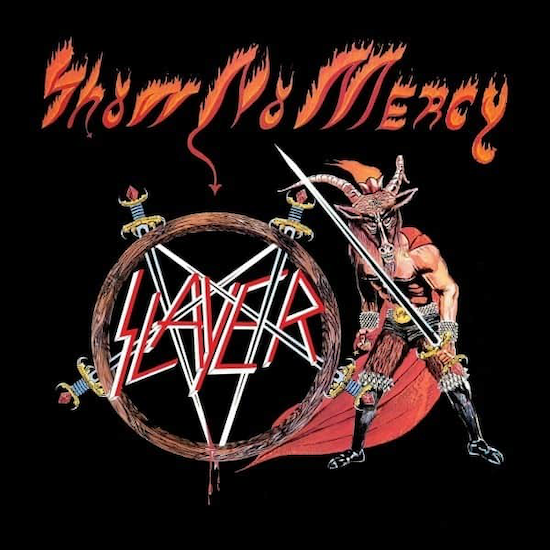
In retrospect, the presentation of Show No Mercy could have only truly unsettled a member of the PMRC. With its cartoon Baphomet on the front and quaint “Side 666” on the flip, it was – like so much important horror art – an expertly delivered pasquinade that shone Giallo-red light on Western anxieties in the mid-1980s. It’s this measured accommodation of fun, ferocity, and Mercyful Fate-like infernalism that sets something like ‘Black Magic’ apart from pure-cut classics such as ‘Seek And Destroy’. With Araya’s breathless musings on being “stricken by the force of evil light,” and 18-year-old Lombardo on the warpath, it’s a four-minute blueprint for Slayer’s legendary counterbalance of ecstasy and everyday evil – theirs, yours, and mine, too.
In that same unpublished 1983 interview where he dragged the L.A. scene’s “state of mind,” Ratt and other main offenders, Hanneman revealed: "Kerry and I don’t get inspired. I just sit down and start fucking around with the guitar and come up with a riff or chord pattern then make it as heavy and evil as possible."
Listening back, it’s thrilling to consider how much that M.O. lifted Show No Mercy above so much of the competition. In the long balance sheet between it and Kill ‘Em All, it lacked the era-defining force of ‘The Four Horsemen’ and the sheer crunch of Paul Curcio’s production, but it was no runner-up. It could be argued that it sounds like it was recorded in a coatroom with a couple of mics from a pawn shop, but therein lies the reverby, old-school charm that was lost with Rick Rubin’s slick, compressed production on majors like Reign In Blood. Tom Araya put it best when he later asked: “I guess we could go in and redo it, but why ruin it?”
Five years since the final lineup of Slayer bowed out with one of music’s most resounding farewell tours, the very notion of a “Big Four” can feel curiously unreachable. But revisit Show No Mercy back-to-back with, say, stone-cold Kill ‘Em All classic ‘Metal Militia’, and it’s clearer than ever just how much more Slayer and Metallica were running mates than outright rivals. And respect where respect is due: despite arriving with a speed metal cover of ‘These Boots Are Made for Walkin’, which songwriter Lee Hazlewood called "vile and offensive,” as the old dictum goes: Mustaine pretty much Wrote ‘Em All.
As for Anthrax, while Fistful of Metal didn’t necessarily pinpoint the epicentre of thrash to their hometown of Queens, New York, it undeniably placed them on the map. Of course, the catalyst was the Bay Area, largely thanks to albums like Show No Mercy. While Darkthrone and Obituary credit it for shaping extreme metal in the late 1980s and beyond, Slayer’s debut may not hold the title of their most revered, best-produced, or outright evil record. Even so, it remains unmatched in terms of authenticity, raw brutality, and unashamed fun. Slayer’s aim was always to be notorious, the fastest, and the heaviest. Their debut stands as a testament to their relentless pursuit of those goals.
The 40th anniversary edition of Slayer’s Show No Mercy is out now via Metal Blade