


The notion that Devo are some sort of ‘novelty band’ still persists in certain corners in the UK, by those who perhaps only remember the odd single here and there, but this misconception does a huge disservice to a band who were pioneering in so many ways. That they have been cruelly treated seems to be a view shared by many of the people gathered around me eagerly anticipating their set at Oya Festival in Oslo – most of the people I talk to, ages ranging from their early twenties to mid and late sixties, tell me that this is their first time seeing Devo live and there’s a palpable excitement buzzing through the crowd. We might consider ourselves especially fortunate, given that for a long while, it seemed as if this gig might never happen. I’ve previously caught them live twice by chance, in San Francisco in 2002 and New York two decades later, and when I interviewed Mark Mothersbaugh and Jerry Casale for tQ in 2018, there was talk of doing a farewell tour in perhaps a few years, but things had gone very quiet on the European front until the announcement of this current trek around Europe. I’m sure I’m far from the only person in the crowd tonight who considers them to be the greatest punk band of all time but with the added elements of the pure synth tones and robotic demeanour of Kraftwerk.
Their schtick of yellow suits and red energy dome hats and depiction of humanity as devolving rather than evolving combined with their mocking but playful evocation of corporate identity may be a little confusing to some, but it is hardly less authentic than the traditional punk uniform of torn clothing and safety pins appropriated from the American scene by Malcolm McLaren. Devo’s aesthetic was formed in part by the fact that its core members were witness to the Kent State shootings of protesting students by American soldiers on 4th May 1970. It contains elements of satire and self-mockery (“We’re all Devo”) but it is also deadly serious, and arguably far more subversive than the Sex Pistols swearing on Bill Grundy live on ITV. As Jerry Casale said when I interviewed him in 2018: “We couldn’t believe the stupid myth of rebellion that was still going on – that rock bands were dangerous and rebellious. We laughed at that, which is why we said in our press releases: “Rebellion is obsolete in corporate society.’”
The appearance of fictionalised ‘Big Entertainment’ mogul, Rod Rooter, on film at the start of the show, both from 1980 and the current day, seems kind of goofy and a little OTT until you remember that in 1978, Richard Branson flew Devo out to Jamaica and attempted to convince them that John Lydon should be their new singer after the dissolution of the Sex Pistols. Interestingly, Lydon formed Public Image Ltd almost immediately after it became apparent that was never going to happen, with its decidedly corporate conceptual aspect presumably at least in part influenced by Devo, as no one else was doing anything remotely like that at the time. Add to that too, the fact that David Bowie and Iggy Pop spent some time together listening to Devo’s demo tape, with Bowie expressing an interest in producing them and Iggy initially wanting to record the songs for himself, and that Brian Eno and Neil Young were also early fans, then a picture of their true importance and pre-eminence begins to emerge. The now craggy face of the aged Rod Rooter, his hairy chest bedecked in OTT gold jewellery, gets a decent laugh from the audience, as he introduces them saying: “They could have been playing big stadiums, like Kid Rock. But no, they wouldn’t play ball with yours truly and now they’re about as popular as the Delta variant”.
A procession of classic Devo images follows—the radioactive waste drums and worker outfits from Neil Young’s Human Highway, the French fry suggestively zooming through the hole in a doughnut, Booji Boy in a crib sticking a metal fork into a plugged-in toaster. Devo have always had a very strong visual identity, at times bordering on the surreal, but also with a definite pop art element. It’s perhaps unsurprising that Jerry Casale had a later career in directing commercials and Mark Mothersbaugh became a very successful soundtrack composer for both films and television. Neil Young famously told the band off for selling merchandise, telling them that this was “not rock and roll”, but Devo have consistently been aware of and played up to the contradictions in their image, taking the notion of satirising the process of music corporation focus-group demands on their artists as recently as their last studio album, Something For Everybody in 2010.
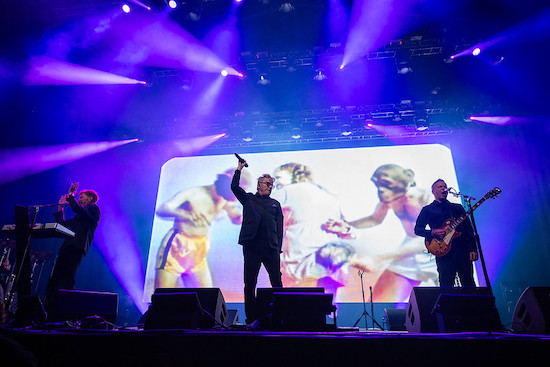
All of this schtick would be irrelevant, however, if they didn’t have the tunes to back it up. Fortunately, the tunes they have in abundance, and (perhaps unfortunately) their notion of human devolution has weathered the test of time far better than I think any of them suspected it ever would. ‘Don’t Shoot (I’m A Man)’, from Something For Everybody, with its title derived from the ending of George Romero’s classic 1968 movie Night of the Living Dead, opens the set in a typically high energy fashion. The three surviving members of the band are all in their 70s now, with Jerry Casale having recently celebrated his 75th but the level of energy they bring, particularly Casale, is electric. Devo shows are always filled with people dancing and this one is no exception. The most enthusiastic group of people dancing near me appear to be in their early twenties, which is always a great indication of ongoing relevance in my book. Joining Jerry Casale, Mark Mothersbaugh and Bob Mothersbaugh, are Jeff Friedl on drums and Josh Hager on additional keyboards and guitar. Their regular drummer, Josh Freese, is a wizard behind the kit and it’s not hard to see why he’s been chosen as the new drummer in Foo Fighters, with whom he is currently on tour. Friedl himself is clearly no slouch either, as initially I had presumed him to be Freese. Josh Hager also proves himself a strong presence onstage, particularly when stepping forward to execute guitar duties on tracks like ‘Mongoloid’.
The first half of the set is all mid-period Devo, with some wonderfully kinetic tunes like ‘Peek-A-Boo’ from 1982s Oh Oh, No! It’s Devo and Going Under from 1981s New Traditionalists inspiring the joyous multi-generational crowd into rave-like levels of dancing. It’s when the band return after a brief, Carl Sagan-inspired video gives them time to change into their iconic yellow jumpsuits and energy-dome hats, however, that they begin to really take off into the stratosphere. Friedl’s primal, tribal-sounding drumming during ‘(I Can’t Get No) Satisfaction’ fits perfectly with Casale’s bass and Mark Mothersbaugh’s enormous guitar sound that issues from a guitar with an effects pedal duct taped to it. ‘Uncontrollable Urge’ is exciting as it ever was, with its legendary dance move with the band members tightly knit in formation, jumping up and down in unison. ‘Mongoloid’ sounds amazing, with that monstrous guitar riff, Casale’s robotic bass, Friedl’s powerful drumming and Mark Mothersbaugh’s sci-fi keyboards.
‘Jocko Homo’ is introduced by Jerry, who asks the crowd: “How many of you think that de-evolution is real?” Many hands around me rise in the affirmative. Indeed, the notion seems sadly undeniable in our current political and environmental state. Casale adds with a world-weary smile: “The USA is swimming in some pretty deep filth right now”. Yet the self-identified “house band on the Titanic” still has some exuberance to spend. ‘Jocko Homo’ seems more relevant and powerful than ever, and if dancing while the ship goes down is all that we can do at this precise moment in time, then that’s what this pre-apocalyptic party is going to be about. ‘Smart Patrol/Mr DNA’ is an energetic highlight, the band going really off the rails in the second part of the song. Mark Mothersbaugh delivers the line “This monkey wants a word with you!” with demented fervour, while Jerry Casale bangs his hips repeatedly against his bass guitar. It looks potentially painful and I wonder if he’s wearing some kind of groin protection under his shorts. It is simultaneously wonderful and ludicrous, that element of almost adolescent rebelliousness so long-running in the band’s aesthetic that they can still pull it off now far better than many younger punks, even after 50 years of doing it.
We get ‘Gates Of Steel’ and the band leave the stage to the sound of the ‘DEVO Corporate Anthem’. There are shouts for an encore, but it seems we’ve reached the curfew and the set ends a little abruptly for those who know that there should still be three songs left to come. Worst of all, there’s no Booji Boy to end the show – a shame, as Mark in his weird Booji Boy mask has become a slightly uncomfortable but still hugely welcome sight for Devo fans. I’m thankful at this point that I’ve still got the London show to come. As great as it has been, seeing one of my all-time favourite bands playing to a festival crowd in Norway, there’s still one last time to see those spuds in action. Booji Boy, London needs you!