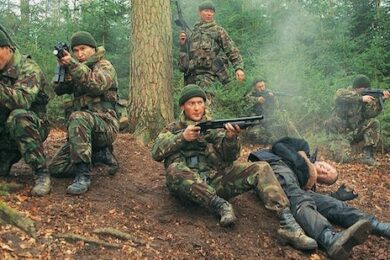

Twilight quickly descends on a group of soldiers in the Scottish Highlands, what was once a cheerful, banter-filled routine exercise of shooting blanks, becomes a blood-spattered nightmare as howls fill the air. It’s life or death. Run. Later, a soldier is discovered eviscerated on the hood of a jeep, the jaws of a werewolf wrapped tightly around his neck. Snap. Neil Marshall’s 2002 horror film Dog Soldiers teams man against beast, masculinity against societal gender norms. Scene after gory scene made a lasting impression when I first saw it aged 15, and two decades later it still has a very special place in my heart, not least from watching it through a gradually developing queer lens.
Horror can be a tricky beast when it comes to LGBTQ+ representation. If we do make an appearance, it often comes with a distinct lack of humanity, compassion, and consideration. On one end of the scale – the worst – we’re completely tone-deaf, damaging stereotypes as seen in 1991’s Silence of the Lambs, where the only sensical thing to do with something ‘other’ is to show them as a cannibalistic cross dresser. Faring better, we’re out, proud people allowed to form romantic relationships in 2019’s It: Chapter 2, before being brutalised and violently murdered. Faring best, sexuality and gender aren’t relevant – we just are, as seen in the Fear Street trilogy. But there is still work to be done.
However, LGBTQ+ people have been showing two fingers to the genre’s disregard for them, digging beneath the surface and finding representation in less obvious ways. Characters like the eponymous young woman in 1976’s Carrie are terrorised at school, marginalised by peers and reduced to a joke. Though not explicitly queer, Carrie’s experiences are relatable for many LGBTQ+ people. The Craft, from 1996, follows a group of young women alienated by their peers who find empowerment anyway through witchcraft – an allegory for queerness if ever there was one. Even readings of 2001’s Jeepers Creepers have found homoerotic undertones.
The dominance of screaming, blood-soaked cis-heterosexual characters in horror films can make it difficult to relate to what we’re seeing on screen. Generally speaking, not only do we not give a crap if they’re stabbed 25 times, but just seeing these people – however heavily stereotyped they are – can be triggering and a reminder of those that oppress us in our everyday lives.
Dog Soldiers could have easily been a cliched mess. It follows a group of cis-het male soldiers as they are hunted by a pack of werewolves, first in the Scottish Hylands and then an abandoned cottage. The film frames so much more than gendered stereotypes who, isolated, scared and with no hope of survival, could have fought for power and control – to be the alpha male. But we only see this with the howling antagonists. The recruits are complex, unafraid of showing emotion, their loyalty unwavering in the face of stinky dog breath and almost certain death. As a queer man, Dog Soldiers is one of the most refreshing, entertaining, and relatable horror films I’ve ever seen.
Whilst Dog Soldiers doesn’t completely shake off gender stereotypes, they are rarely distracting. Chris Robson’s Joe lives for ‘the game’, obsessing over the fact he has missed an important England vs Germany football match. For Joe, it is as much part of his identity as being a soldier – about being part of a community of like-minded people. Ordinarily, sport isn’t something I enjoy. Football tends to drudge up memories of having a ball pelted at my head at school, followed by a string of homophobic slurs and even now, walking past a group of people playing can make me incredibly anxious. I’ve long associated football with a certain ‘type’ of man, but Joe defies this stereotype. He is an everyman for every person who has ever felt so deeply passionate about something that they cannot imagine their lives without it.
Fear is an integral part of Dog Soldiers. The film considers that a group of puny human beings are confronted by giant, slobbering, mythical, nightmarish creatures that want to kill them, and runs with it. The soldiers do what is natural to them – fight – but Marshall doesn’t consider them sociopaths who aren’t capable of emotions. Though becoming more infantilised as the film goes on, Leslie Simpson’s Terry shows what fear can do to a ‘macho man’. He loses his bearings and is completely overcome by the situation. Sean Pertwee’s Sergeant Wells – ‘Sarge’ – is Dog Soldiers’ father figure – adding humanity and depth to the story. One touching scene sees the soldiers talking about their fears, with Sarge offering not seeing his ‘missus’ again. Another scene sees him tell Liam Cunningham’s Captain Ryan that he’s ‘scaring my lads’. A massacred cow makes them all almost shit themselves. Not a trickle of macho bull crap.
One of my favourite characters is Darren Morfitt’s Spoon. The clown, the one who is inevitably going to make you laugh, the one who has no qualms about putting himself in danger if it means protecting his colleagues and friends. A standout scene sees him deliberating the silence following an intense, tragic story before deciding that yes, now is the time to crack a joke. It perfectly highlights the craft gone into the film.
At its core, Dog Soldiers centres firmly on what it means to be human – no matter your sex or gender. I feel welcomed, included and, dare I say it, represented. Sure, none of the soldiers are LGBTQ+ but that isn’t all I or any other person in my community is. Watching this over and over (and over) again, it feels quite brilliant to know that Sarge and the boys would welcome me into the squad with open arms.