We find Enid, the protagonist of Censor, Prano Bailey-Bond’s debut feature film, caged in an airless office, the walls seeming to close in. Older men smoke cigarettes, reverentially quote Shakespeare, talk over her and comment on her carefully concealed looks. She intently watches video nasties on VHS – Driller Killer, I Spit on Your Grave, Cannibal Holocaust – taking notes as she goes. A foot-long syringe pierces a screaming man’s pupil. Another is lobotomised by a Black and Decker. “Eye gouging must go,” she writes. She is there to “protect the public” from the degradation of such extremity. What motivates such explicit expressions of tortuous pain, a colleague asks. “Male inadequacy and revenge catharsis,” she quickly responds.
When I speak to Prano Bailey-Bond, I ask if she agrees that many of the notorious video nasties of the 1980s were motivated by "male inadequacy and revenge catharsis,” as diagnosed by Enid (played by Irish actress Niamh Algar, known for Channel 4 series Deceit and The Virtues, as well as the Ridley Scott sci-fi Raised by Wolves).
“There’s so many different directors that you can’t put a blanket on all of them,” she says. “But some of them – for sure. Some of the violence against women in these films is really hard to watch. It’s genuinely brutal. Either that person making the film wasn’t thinking, or they don’t like women.”
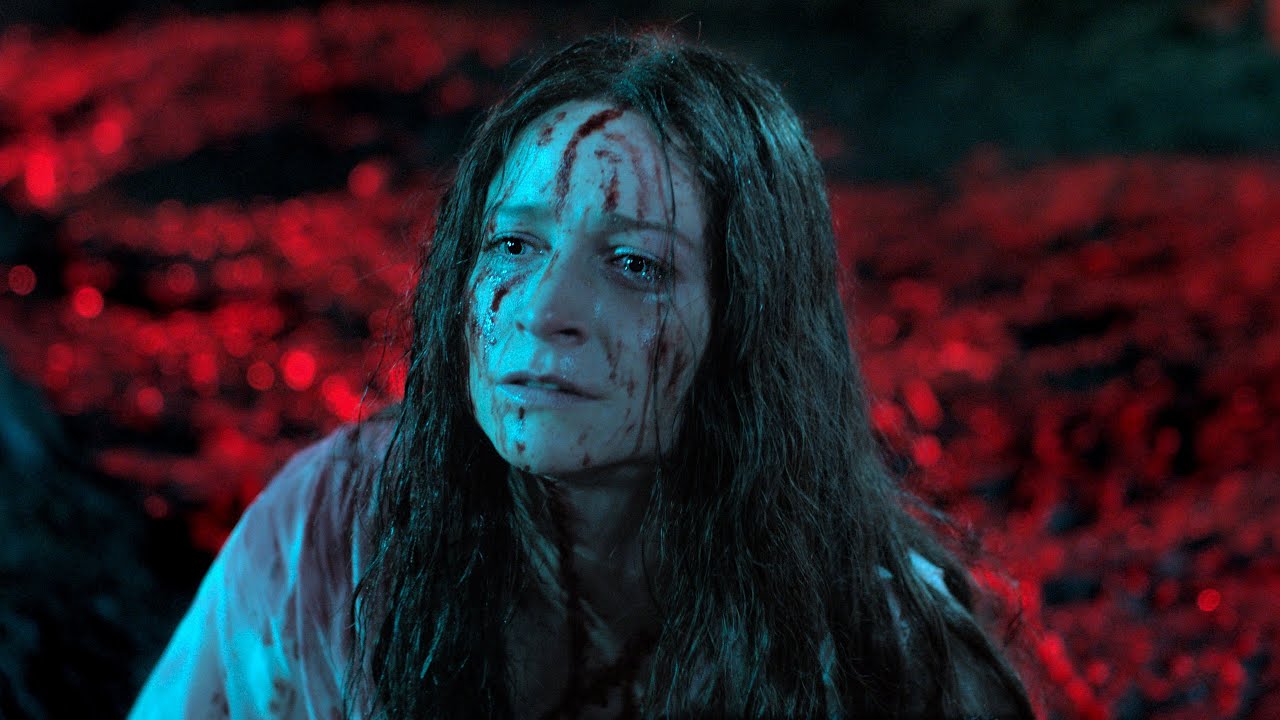
After her shift at the censors, we then watch Enid walk alone through concrete underpasses beneath inky London skies, before stopping a woman of her own age who she seems to know, only to realise they’re just an irritated stranger. At home, Enid’s TV set shows the Orgreave riots and a Margaret Thatcher speech; it’s the mid ‘80s, in the thick of the culture wars, and deep in the moral hysteria of video nasties. Enid is visited, or haunted, by a vision throughout the film – in the same grainy, gaudy hues of a low-budget movie, we see young girls playing near a dark cabin deep in the woods, one daring the other to enter.
Is this something from a film she is forced to censor, or is it a traumatic, tamped-down memory – or a fusion of the two? Enid herself seems unsure, until she is given a film to censor, a horror movie by an enigmatic director that seems to recreate, on screen, her own memories of the woods.
Within just a few minutes, Bailey-Bond has set the scene for a multivalent double-helix of a movie; one capable of exploring the inner depths of Enid’s psyche whilst also displaying a reflexive literacy in the age-old subject of violence upon women. “I think it’s difficult to assume the intentions of a director, in any situation,” the filmmaker says of the video-nasties that inspired this film. "Some of the violence towards women in films like Blood Feast for example – I actually find some of the images in that film quite beautiful. That might upset some people for me to say that, but I find them so fake. It’s not a realistic film. That seems to tell me something.”
And then there’s I Spit on Your Grave, a rape-revenge film with a particularly notorious rape scene, but still often celebrated as a quasi-feminist film. “It’s a difficult film to talk about, because the main character gets her revenge,” Bailey-Bond says. “But it’s such an unrealistic form of revenge for someone that has gone through what she’s gone through. And that rape scene really is horrible. It’s very real, and very difficult to watch.”
Bailey-Bond grew up in rural Wales, watching video nasties like The Evil Dead, Texas Chainsaw Massacre and Hysteria from a teenage perspective. Before production started on Censor, she watched as many of the so-called video nasties as she could. Today, she describes The Witch That Came From The Sea, an obscure 1976 American horror by the unheralded Matt Cimber, as “an absolute masterpiece.” Few people have such a grip on the subtleties that lie within a whole genre of films that were banned wholesale, or heavily redacted, by Thatcher’s government.
Censor is released at a time when censorship, on a civic level and in our online lives, has become a current and live issue. Movements like #MeToo, Black Lives Matter and the ongoing campaign advocating for more transgender rights are now fully integrated into our day to day lives, and so-called cancel culture seeming to dominate the minds of concerned columnists every time one opens a weekend paper.
Bailey-Bond implicitly refracts these issues through the prism of a genre horror film, discussing them intertextually through the inversion of an age-old paradox in film academia, the so-called Final Girl theory popularised by polemicists like Camille Paglia; that video nasties, and films that depict violence against women, can actually be viewed as feminist, as the female victim is afforded the opportunity to exact revenge against her male aggressors.
“I have a bit of an issue with the Final Girl,” Bailey-Bond says. “Lots of people have written very intelligently about it. But, for me, I’ve never found it a useful term, because it bundles lots of female characters into one thing. And they’re not, they’re all different. What we’re seeing now, with more women making horror, is much more complicated female characters. It’s not just a woman going out to revenge somebody. They’ve got their own demons, which isn’t just caused by a man doing something horrible and violent to them.”
But if we’re to buy into the idea of a new age of horror films helmed by emotionally literate women, then should we expect such depictions of trauma to be conscious of those who have gone through such experiences in real life? Did Bailey-Bond think about this, or was she confident in her ability to interpret, in filmic terms, the loss of a family member?
“I certainly felt a responsibility for the idea of losing a family member and not knowing what happened to them,” she says. “I haven’t had that happen to me, thankfully. I haven’t been in a situation where someone’s gone missing. The closest thing I’ve gone through is losing my dog, as a kid. That’s not the same at all, but I remember how traumatic that was. There are other things I’ve leaned into in my personal life.
"But I also read a lot of first-person accounts. I found an essay about ‘ambiguous loss’ and what that does to somebody. There’s something really exhausting about ambiguous loss, about never being able to get closure. That linked into the idea of the relationship between fiction, reality and the imagination – this cycle of emotion and action, and never really knowing. That for me sounds like the worst sort of torture.“
Ambiguous loss: it’s difficult to think of a better phrase for the core of this potent, coiled film, surely one of the most intriguing and nuanced horror movies made in recent years.
Bailey-Bond is the latest talent in a new movement of genre horrors directed by millennial women, each of which, in its own unique way, evolves horror’s traditional fetish of female fear (see: Saint Maud, The Babadook, Prevenge, Relic and Make Up) by exploring ambiguous loss. Let us hope they are not censored by the public or anyone else – and finally speak their truth.
Censor is now playing in UK cinemas