
Sunset in Ohio, 1995. Kids cycle home in Gap-style tees. Two sisters, chasing each other, tumble into a garden of fireflies. One is an androgynous skater type, her mop dyed blue. The younger one is girly. Both listen keenly to their beautiful scientist mother (Rachel Weisz), testing their knowledge of the fireflies’ bioluminescence. But the older girl’s tense glance at Weisz stains the moment. It’s as if she knows she’s in a Disney film: such happiness isn’t real.
Knowing you’re in a performance, of femininity and family, is something many of us recognise, far too late. Throughout Cate Shortland’s Black Widow, the filmmaker mounts a meta commentary on the gender performance of big-budget action movies, like her own. With this long-awaited film on the dystopian family history of the most ruthless Avenger, Natasha Romanoff (Scarlett Johansson), Disney seems willing to rear a new generation of sceptical princesses.
Over time, this meta element has grown across The Avengers’ stories. You might be tempted, as I once was, to dismiss them as Kentucky Fried fantasy, but Marvel’s Avengers are blockbuster cinema’s Homer, crackling with the fuckups of America’s heroism. The character-led writing, particularly in the new school of Disney+ TV spinoff shows WandaVision, Loki and The Falcon and The Winter Soldier, which this year gave us a new, Black Captain America (Anthony Mackie), questions free will, racism, sexism and military patriotism. America’s guilt over its residual, supremacist attitudes, Marvel suggests, lurk beneath that proud banner of stripes and stars. Nothing is what it seems.
Sure enough in Black Widow, when Daddy Romanoff (David Harbour) comes home with armed vehicles on his tail, bullets flying, the saccharine family scene explodes. To calm the little sister, their father plays her favourite song, Don McClean’s classic, ‘American Pie’. Those famous lyrics, a country lullaby whirling faster and faster (“This’ll be the day that I die”) assume ominous overtones as American cops shoot to kill and we realise we’re watching a foreign family viewed as a threat. It’s a thrilling opening, a Von Trapp family escape for a post-Trumpian world.
The film purports to reveal the real Romanoff, a bad exotic girl saved by do-gooding America. Black Widow is a Russian loner, possibly an ex-spy, a mercenary, certainly an assassin with, as she says darkly in 2012’s The Avengers, “a very specific skill set… I didn’t care who I used it on.” Brain-washed by a programme called The Red Room owned by megalomaniacal oligarch Dreykov, who turns girls into killing machines, Black Widow regrets her past, but isn’t pious. In the scene just quoted, she fakes tearful remorse to trick a malevolent god during an interrogation. Johansson, her eyes shaded with a hurt she cynically trades for information, is a feline creature of creamy deceit. You can rely on her to kick the patriarchy’s ass. Bye Bye, Miss American Pie, thought I, settling down to watch, with my pre-teen.
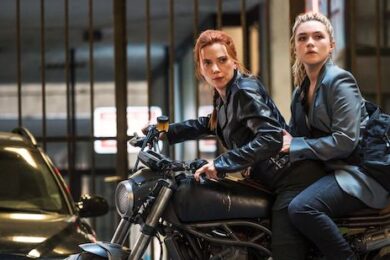
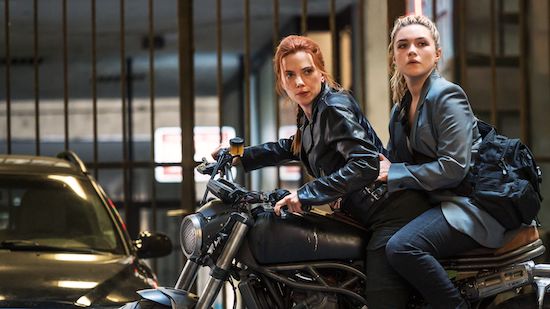
For the first half of the movie, at least, Shortland delivers a fresh take on family comedy by incorporating all-female hand and knife combat, especially ferocious between the grown-up sisters, finally reunited in Bucharest. Teaming up, Natasha’s younger sister Yelena (Florence Pugh) deadpans, “Great plan. I loved the part where I almost bled to death.”
Black humour underscores the film’s violence between the ‘Widows.’ Kidnapped as girls by Dreykov, starving, bruised, clinging to cuddly toys while shipped in crates, their plight is shown in a blue-lit Adam Curtis-like title sequence, accompanied by Nirvana’s ‘Smells like Teen Spirit’. Only one in 20, we later learn, survive to perform their weaponised femininity. So it’s more than sisterly ragging when Yelena asks Natasha, imitating her trademark acrobatic landing, with a head-flick, “Why do you do that thing with your hair?” It’s funny to take down the coolest Avenger by calling her “a poser”, but it’s also something that only another bullied woman would do.
The domestic fight between the two sisters, smashing down plates on faces, is a Freudian reworking of their enforced adaptation of family roles. Strangling each other with curtains, the cords around their necks suggest umbilical cords and fallopian tubes. Lying exhausted, they face each other like twins in a lost womb. And indeed, after Dreykov murdered one of their mothers, he ripped out the childrens’ entire reproductive systems. The two now agree to end Dreykov’s reign over the Red Room, and set the other Widows free.
Other Marvel female heroes – Scarlet Witch/Wanda, Captain Marvel, Sylvie (the female Loki) – are foreigners or exiles. As migrant women of the universe, they comment on America’s need to control femininity. With increasingly weathered faces, they’re growing beyond the bionic, pink-cheeked Supergirls of yore. The careworn, fine features of Sophia Di Martino, as Sylvie in Loki, express her suffering. Even beauties like Wanda (Elizabeth Olsen) no longer sport the unlined faces of, say, Wonder Woman. These women have real ‘90s grunge-metal childhoods and days of depression. Having battled ill winds, their grey morality challenges America’s black and white view of itself as a force for good.
WandaVision, one of TV’s most unusual recent sci-fi dramas, unmasks the lie of American cereal-box goodness. Wanda Maximoff first appears in the MCU films as a stereotypical, Commie-block terrorist. When billionaire inventor Tony Stark (aka Iron Man)’s trigger-happy, American-style bombings kill her parents, she volunteers to be subject to the experiments of Hydra, a Nazi-like organisation, in order to gain powers to kill him. After switching sides – as Marvel’s women often do – she goes on, as an ex-Avenger, to reveal the States’ commercial promises as equally authoritarian.
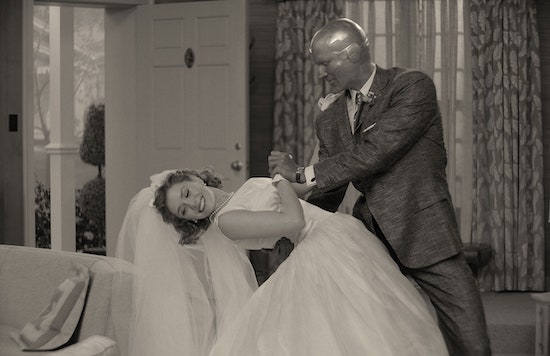
In WandaVision, we learn that Wanda grew up comfort-watching the American sitcoms her parents bought on the black market. The show opens as a skit of I Love Lucy meets Bewitched. Wanda stars as a ditsy suburban bride and secret witch facing 1960s gender challenges like cooking for her husband’s boss. Slowly, through antidepressant ads and a disintegrating screen that reveals Wanda is being watched by the FBI, we see that, as in Black Widow, this dream of domestic bliss is disgustingly manipulative.
Wanda’s beloved, Vision (Paul Bettany), is a cyborg, a saintly sentient weapon. Broadly a pacifist, Vision’s character critiques American nuclear armament. Forced to watch him die twice (first by her own hand at his request), Wanda, understandably enraged by the cost of superheroism, recreates Vision and compels the residents of a suburban town to live in her American sitcom, controlling their minds. Powered by grief, her self-generating fantasy even allows her to breed magical children. Finally confronting her cruelty, she isolates herself in deeper study of her powers, suggesting that women can do better than imitate the tyranny of men.
Wanda self-breeds. Captain Marvel also has an alternative family structure. In Captain Marvel, Carol Danvers, played by Brie Larson, is an American flying ace. Brawny and mischievous, she co-parents with flying buddy Maria Rambeau (Lashana Lynch) and there’s a lesbian subtext with her mentor (Annette Bening), a scientist whose explorations result in Danvers acquiring super-powers. All three women thwart a dirty war between Danvers’ adopted alien planet and another alien race, who’ve been reduced to refugees. Given that the meta-joke in this film is Top Gun, the film aligns alternative family structure with a turnaround in America’s glorying in military might, justified by making foreigners a threat.
It’s only when Captain Marvel overthrows the advice of her alien patriach, Jude Law, to mind her temper, that her powers are unleashed. Female rage offers a catalyst for the powers of Captain Marvel and The Scarlet Witch, two of the most invincible heroes in the Marvel Universe – but is oddly absent from Black Widow.
Johansson has said that being mother to a girl has forced her to reconsider Disney’s lecherous first glimpse of Black Widow in 2010, when Natasha stalks in slinky office clothes as an intern with vicious martial arts skills in Iron Man’s office. He, like a Harvey Weinstein-esque predator, scrolls through Natasha’s lingeried web photos before pleading with girlfriend Gwyneth Paltrow to hire her.
“I want one,” he says to her, like an executive couple cruising for a threesome in Chateau Marmont. Later, Iron Man’s right-hand man, Happy, spies on Natasha getting changed in his car.
In the run-up to the release of Black Widow, Johansson distanced herself from these embarrassing scenes. She worked closely with Shortland, who said that she didn’t want Natasha’s trauma to “drag down” the film. But how much better if they’d had the guts to build on that blue-lit, surveillance camera title sequence and Nirvana’s grimy, savage anthem. Shortland barely skims Natasha’s self-disgust, instead, in the tormented words of Kurt Cobain, she resorts to “a denial” of female rage.
“What hurts you,” Rachel Weisz tells her two daughters, “makes you stronger.” But this cliché ennobles child abuse. Some kids don’t get stronger; they just get hurt.
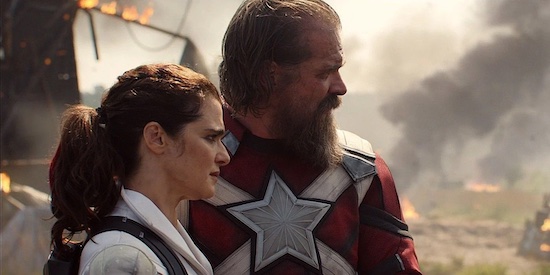
I also wondered why the film gets stuck, in its final third, in the patriarchal spy movie genre that it mocks. The often hilarious family humour, centred around the sisters’ father, a Russian superhero with middle-aged spread and sexist bragaddocio, becomes a distraction. Rachel Weisz is Sphinx-like, wincing with inscrutable tenderness, and the complex solidarity between Johansson and Florence Pugh (looking a smacked cherub), more strangers than sisters, feels authentic. But there are too many thrills and not enough emotional spills.
Shortland anticipates such criticism with another Marvel meta-joke, showing Black Widow hiding out in a mobile home, watching Moonraker. Black Widow’s final showdown with Dreykov (Ray Winstone) reprises that film’s space HQ. Here’s a Russian baddie gesturing gloatingly at screens; and another version of Jaws, the metal-toothed henchman, is played by The Taskmaster, Winstone’s metal-fused prize warrior, terrifyingly dwarfing Johansson.
“I kept thinking,” Shortland recently told ComicBook.com, “about women that have been attacked on the street.” But despite such talk, the relative delicacy of Johansson’s body, disturbingly effective when she fights The Taskmaster in soft civvies and home-style braids, is underused. And Winstone is obscene, but too camp to be frightening. Licking his chops over “the only natural resource the world has too much of… girls”, he references real human trafficking. In the last report from The United Nations, 79% of victims were female.
But Dreykov’s evil is barely glimpsed, because Shortland erases his battered women. Without overly disturbing young viewers, we could have seen girls isolated in cells, forced physical training and body bags thrown into space. Instead, The Red Room looks like a studio for podium dancers (the after-club for that couple at the Chateau Marmont, perhaps). Rather than CGI explosions and a Bond satire, I would have preferred prolonged psychological warfare that culminated in Natasha breaking Dreykov’s mind, rather than his boy toys. Instead, the film switches focus to boring old feminine redemption. Black Widow must atone for killing Dreykov’s daughter; she must be loyal; she must be good.
By blenching from the realities of female abuse, Black Widow forfeits the power of rage. Ridiculing her sister’s heroic status, Yelena says, “pain and suffering is every day and we are still trained killers.” But the problem of suffering isn’t eliminated by women joining hands. It needs fists, too. By positing female pain as a problem “over there”, in Russia, or space, or somewhere we never see, Shortland never quite admits the rottenness of the American Pie.
Black Widow is streaming on Disney+ now