

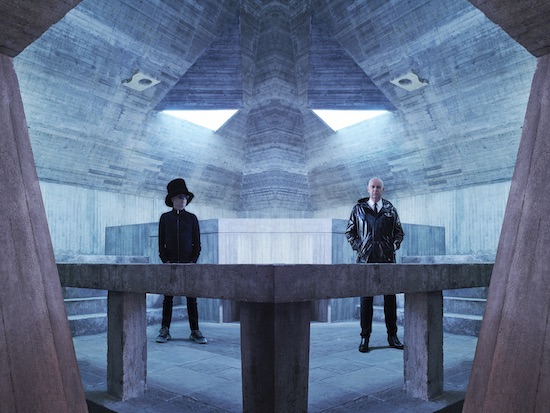
Photo credit: Phil Fisk
The Pet Shop Boys have exited the United Kingdom. Hotspot, the duo’s third consecutive record produced by Stuart Price, finds Chris Lowe and Neil Tennant holed up in Berlin and dreaming of still greener – if imaginary – pastures (the record was largely recorded at the city’s Hansa Studios, a space they’ve used for the last ten years or so).
On opening track ‘Will O The Wisp’, with its synth-heavy, oscillating opening redolent of Madonna’s ‘Hung Up’ – itself a Price production directly inspired by Lowe’s vacillating, jumped-up take on early disco – Tennant observes a “free spirit” in a “battered leather cap” who must be “getting bored” climbing off of a train in clubland “in search of love and laughter.” The will-o’-the-wisp in question could be seen as an embodied desire, on the part of Tennant and Lowe, to return to the state of grace afforded by the dance floor.
Indeed, ‘Dreamland’, the record’s almost criminally poppy lead single featuring British synth-pop act Years & Years, eulogizes the “free land” of the unconscious, where “you don’t need a visa / you can come and go and stay right here.” “I’m so tired of my homeland,” sings Tennant, dancing around the Brexit issue in a veiled manner less ironic, as is his lyrical propensity, than it is underdeveloped. Running away to Germany or drifting off to sleep are temporary measures in the face of a dismal political situation that has endured since their self-diagnosed “imperial phase” of the late eighties.
‘Happy People’, the third track, deepens the theme of disconnect between the personal and the political. “Happy people living in a sad world” loops over rave keyboards punctuated by spoken verses celebrating moments that boost the spirit when “the world gets in the way” – the triumphant feeling at the end of a summer’s day, falling in love in the suburbs, the thrill of the hi-hat, you know the clichés as well as I. ‘I Don’t Wanna’ narrates the story of a forlorn and isolated man, “a guy so shy he doesn’t feel that he has any sex appeal” – an incel? – who overcomes his reluctance, “summons up the energy,” and goes out dancing. Mark Fisher, writing in 2013 about the secret sadness behind contemporary dance music, echoes my skepticism: “It’s hard not to hear these records’ demands that we enjoy ourselves as thin attempts to distract from a depression that they can only mask, never dissipate.”
‘Monkey Business’, a song featuring a digitised vocal that would sound at home on Daft Punk’s ‘One More Time’, whose throbbing bassline and string section punctuation Price seemingly airlifted from a Chic composition, is Hotspot’s danciest number as well as its weakest conceptually, with none of the Boys’ trademark ambivalence. Instead, Tennant reaffirms what he has already admitted: “I’m not dealing with the real world any more.” One is reminded of the 2018 New York Times story about Erik Hagerman, ‘The Man Who Knew Too Little’, who swore off of reading the news after the election of Donald Trump. But even the compromised Times admits that “living a liberal fantasy is complicated,” a sentiment all but absent from Hotspot.
Lest we take them too literally, the slowed-down, acoustic guitar number ‘Burning the Heather’ attempts a classic Pet Shop Boys narrative inversion, opening with the lines: “You’ve got me all wrong / I’m not that guy / I’m just the singer of the song in my mind’s eye.” Tennant can hide behind the author function as much as he likes, but I simply don’t believe him. Nearly every song on Hotspot communicates a desire central to the duo’s oeuvre: to get away from contemporary life by hitting the club.
Much well-deserved ink has been spilled over the Pet Shop Boys’ nineties embrace of pre-AIDS gay culture in the face of the epidemic; intelligent critics read 1994’s Very as a celebration of “the club scene as an almost utopian domain of consensual choice and pleasure,” to cite Simon Watney. A decade and a half later, the morality police have put down their weapons; the battlefield is no longer the dance floor but the border.
Hotspot concludes with ‘Wedding in Berlin’, an assimilationist anthem set to four-on-the-floor hi-hats and a repeated snippet of Wagner’s Bridal Chorus: “We’re getting married / a lot of people do it / doesn’t matter if you’re straight or gay.” While Very contained a remake of the Village People’s gay classic ‘Go West’, Hotspot is content with an uninspired reimagining of a heterosexual standard.
Lowe and Tennant have always been romantics, ironic or otherwise. Hotspot retreats further into the domain of dreams – the worlds mutually created and sustained by couples both straight and gay – and in so doing backs away from the harsh reality Tenant and Lowe share with their countrymen.