
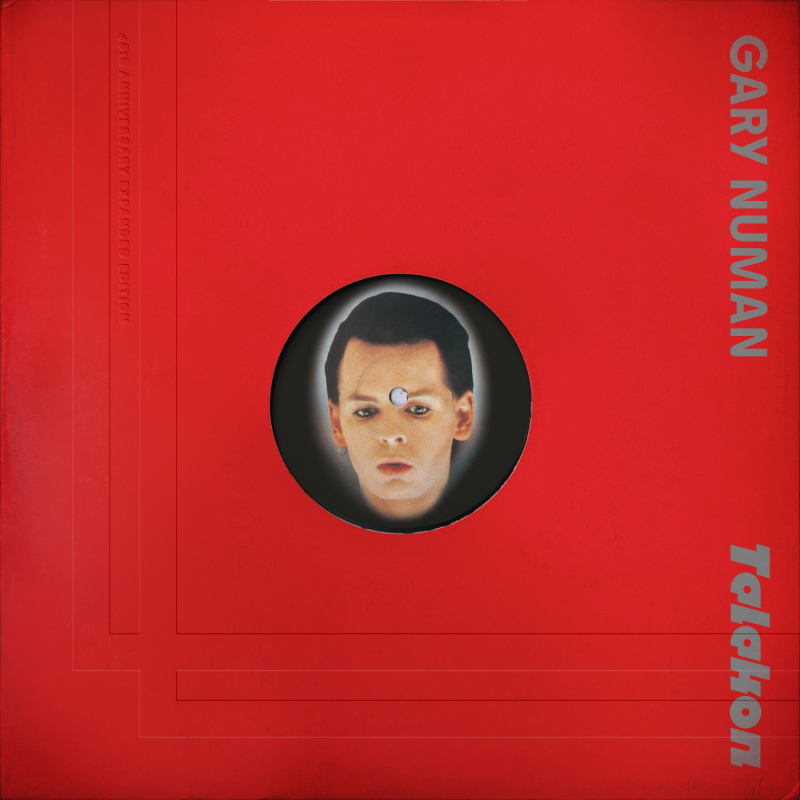
Gary Numan was treated by both the press and his synth pop peers as an upstart, a non-art school normie parodying the genre’s pioneers in craven pursuit of commercial success. Yet not only did Numan’s music sound distinct from early Ultravox, Human League or David Bowie, he was odder than all of them – putting the ‘alien’ in ‘alienated’ – and, given these artists’ popwards turn in the 80s, the least artistically compromising. Whether Numan’s cyborg ‘mach-man’ through-branding derived from artistry, autism or conscious capture of a cold conjuncture, it resonated with its recessionary times. Rather than neutralising him, the fact that Numan voted for Margaret Thatcher, should have valorised him: not just for the authenticity of his plasticity but – with his mournful wail emerging between power-banks of steely electronics – as the ghost in the societal machine.
With 1979’s Replicas exploring humanity’s place in a technology-driven, aggressively authoritarian society, the line that leapt out of ‘Are ‘Friends’ Electric’s siren-warning sci-fi was “it hurts and I’m lonely”. The clinical perfection of late-1979’s The Pleasure Principle was more overtly contemporary-focused, with ‘Cars’ – hymning industrial automation’s creation of human atomisation – making Numan an international pop sensation. Yet on the mesmerising ‘Complex’ and unnerving ‘Observer’ it’s not humans’ relationship with machines that’s alienating, but their relationship with each other.
This would become the central theme of autumn 1980’s Telekon, conveyed not just by Numan’s fractured, impressionistic lyrics but his use of more organic – human – instrumentation in creative tension with the glistening technology. Paul Gardiner’s bass is foregrounded on the jerkily spacious ‘The Aircrash Bureau’, followed after two minutes by ‘Fade to Grey’-writer Chris Payne’s viola, then after four minutes, a gorgeously rippling acoustic piano, before reverting to its opening spacious sterility. Inverting this trajectory, the synths only enter halfway through closer ‘The Joy Circuit’ – its title fusing the organic and electronic – then vie for domination with viola and piano for the track’s second half, before synthesis is effected on the fade. With ‘The Joy Circuit’s last verse declaring, ‘Tell me of your pain/ Love it, love it”, crossed wires are endemic to Telekon’s thematic. So ‘I Dream of Wires’ articulates replicant nostalgia – “I plugged my wife in just for show” – and features an anomalous funk guitar-line amid its android circuitry.
Becoming public property split Numan’s psyche into disparate fragments. While being obligingly self-cloning on ‘This Wreckage’ – “This wreckage I call me would like to meet you” – at other points he longs for distance, effectively for more alienation: “I need protection from the likes of you” he declares on the title track, as its robotic vocal and melody is regularly disrupted by eruptions of maverick jazz piano. On ‘Remind Me To Smile’ he complains of being “in this cold glass cage”, an object, imprisoned by the gaze, yet far from being distancing, the track’s long drum machine intro now sounds woozily nostalgic. Equally, despite the track’s alienation from fans – “Move from my window, leave me alone/ Keep your revivals/ Keep your conventions/ Keep all your fantasies” – Numan’s call and response with the backing vocals is not just punkier than anything he’d done since his 1978 debut, but it also appears to invite audience participation.
This contradiction expands on the lovely, eerie ‘Sleep By Windows’. Beginning as rebarbative, Numan near-rapping in clipped tones, “You can scream if you want to/ but I won’t unlock the door”; however the chorus’s warning wail of “I don’t love you” is undermined by the inquiry, “do you dream?” and finally “do you cry?” This half-denied longing for human connection is mirrored musically by the way the synths – conventionally heard as ‘cold’ – positively yearn here against Cedric Sharpley’s mechanically man-machine drums and Gardiner’s metronomically circling bass: the electronics fizzing, burbling, cooing in wonder.
This desire for connection is more direct on ‘Remember I Was Vapour’, belying its title to assert the mach-man’s humanity: “Remember, I need others… Remember I am human/ Remember, I feel just like you”. But the song’s assertion of sociality (“there’s nothing here but us”) is destabilised by the squelch of machine percussion and the synthetic swooshes cutting across its piano and bass lines, taking over between 3:00-42, before organicism is reasserted for the last minute. On the penultimate, Cluster-esque ‘Please Push No More’, a piano ballad on which Numan almost sings, these contradictions are first reasserted – “And now I need no one/ I miss you” – then rationalised. “We are close, we are hurt/ So that was love/ And love she kills me” Numan declares. No wonder John Foxx and Andy Warhol wanted to be machines: being human hurts. Yet, paradoxically, Numan’s synths are at their most gorgeous on the instrumental middle (2: 28–3:52) and closing sections (4:13–5:30 here), the machines – humming, sighing, keening – sounding like they long to be human.
The exclusion of Numan’s brilliant 1980 singles, ‘We are Glass’ and ‘I Die You Die’ was mysterious enough on the original album, given their thematic links to Telekon (alienation; simultaneous toughness and fragility). Particularly as ‘I Dream Of Wires’ had already appeared that year, performed by the underappreciated Robert Palmer with Numan’s band and much the same arrangement. With both singles added to the 1998 CD, it feels pyrrhically pedantic to revert to the vinyl track-list at this stage. This is somewhat compensated by the inclusion of the astonishing, unreleased, ‘Like A B Film’, its cutup lyric capturing the album’s themes not just of atomisation and alienation, but of trying to communicate and connect across them.
The shift to a sunnier, non-dystopian synth pop by newcomers Depeche Mode and Soft Cell, the remade Human League and the Kraftwerk of Computer World, made Numan seem a relic as much as a replicant, making it even harder for him to connect to his audience, with creative confusion ensuing. But with Telekon’s themes played out for real in the automated, atomised 80s, Numan’s vision can now be reassessed as enduringly relevant not just to its moment but to a present indebted to the 80s both musically and politically.