“For Richard Kirk,” says Stephen Mallinder, as his first words of the evening on stage. A mighty roar erupts inside the former Victorian steel forge in tribute to the late founding member who passed away in 2021. It dissipates into the strange, eerie opening of 1980’s ‘The Voice of America/The Damage is Done’, rumbling through the vast space.
The sense of anticipation leading up to this moment has been intense – a steady, rising giddiness fills the room as though there is a leaking gas pipe. The chatter of accents suggests people have travelled across counties and countries to be here, from Chicago to Sweden. If a bomb went off, Sheffield’s rich lineage of electronic and experimental music makers would be severely depleted, as the room is filled with everyone from former chart-topping pop stars to members of beloved cult post-punk bands. The sense of occasion is pronounced.
It’s been 50 years since Cabaret Voltaire played the infamous first gig that ended in a riot, so unready were the student crowd for the antagonistic attack of their earliest work. This kind of half century milestone is usually reserved for heritage rock bands, so it feels slightly strange to be thinking about them in these historic terms, but it only serves to illuminate just how staggeringly ahead of their time they were. When most groups were still aping Roxy Music, Bowie and T-Rex, these lads were carving out a singular sonic future that would take years for people to catch up with.
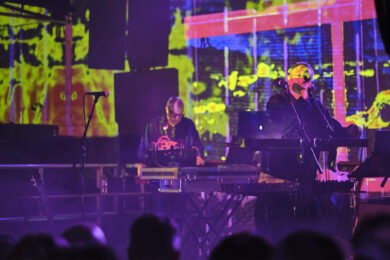
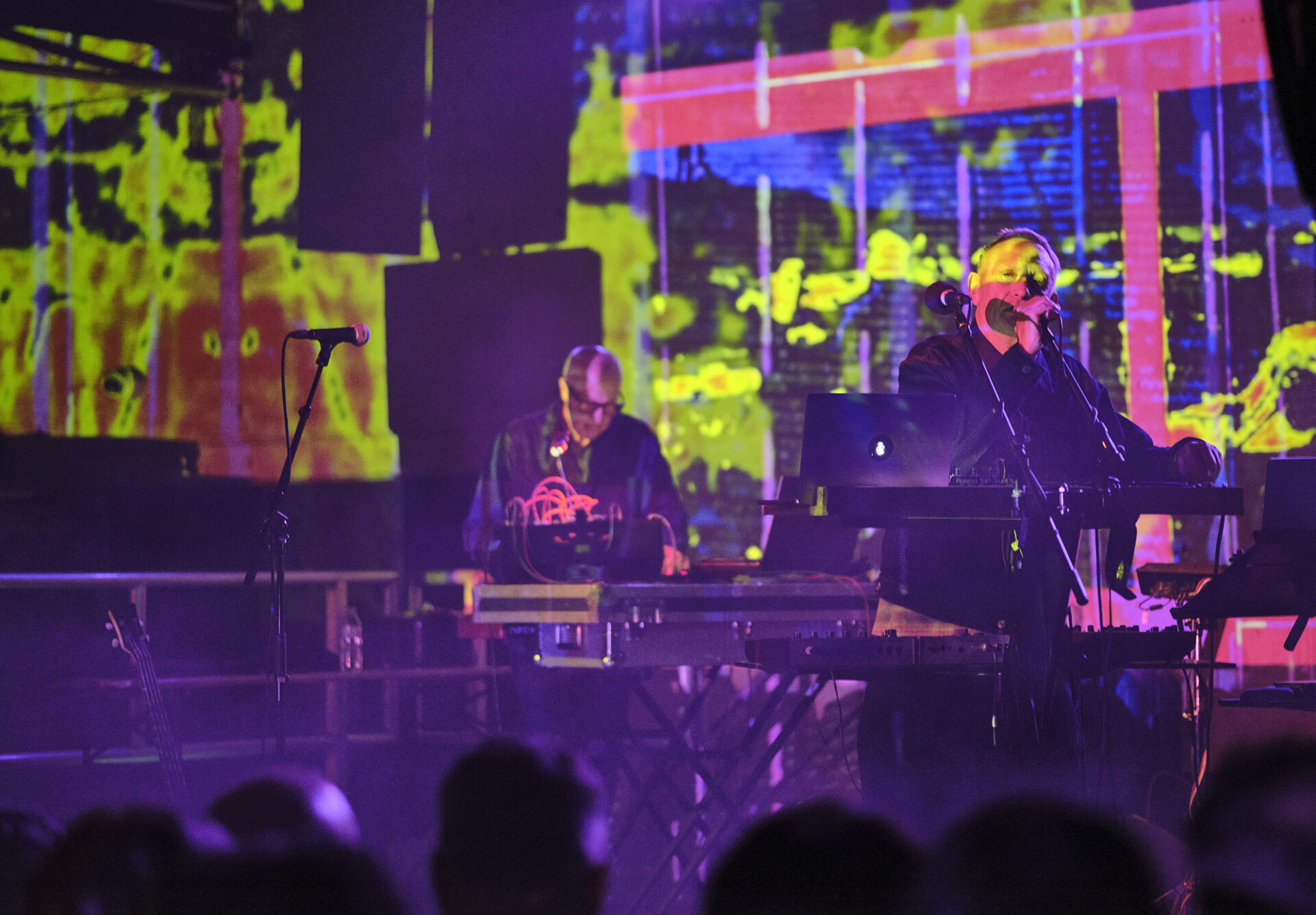
Watson and Mallinder, both now in their 70s, turn up with added firepower from long-time friend and collaborator, Eric Random, and what should have been Benge from Mallinder’s other outfit Wrangler. Illness put a stop to this and so Oliver Harrap, drummer of The Moonlandingz, heroically steps in at the last minute to deliver a highly commendable and dynamic performance.
Given that Watson left the group in 1981, you might expect a set heavy on Cabs’ earlier period. Instead, it’s a run of material from 1983’s The Crackdown that kicks things off properly, ultimately setting the tone for the evening. There’s the moody yet grooving ‘24/24’ and the propulsive yet fractured drive of ‘Why Kill Time (When You Can Kill Yourself’), while Random’s guitar playing on ‘Animation’ is searingly abrasive as it slices through Watson’s modular synth, creating a gloriously arresting fusion of noise and melody.
The group have promised no new material as part of the reunion, to pay tribute to Kirk’s invaluable and irreplaceable presence in the band, but there is a new track of sorts. Back in 2012, Watson returned to Sheffield to create a sound map of the city for an installation. For it, he made a recording of Tinsley Viaduct (a two-tier road bridge that was the first of its kind in the UK). Tonight, that is spun into a wonderfully deep bit of musique concrète, with booming bass, grumbling drones, and steam-like hisses that engulf the room. It’s a bold choice to play such a piece at this juncture in the set but it comes off fantastically, slowing the room down as the sounds of the city fill it, recalling the kind of composition Cabaret Voltaire may have made in the early days, but with high-fidelity recordings they could have only dreamed of.
This acts as a neat bridge into terrain that gets a little darker and moodier. ‘The Set-Up’, from the band’s 1978 debut EP, still throbs vigorously, exuding a suffocating sense of claustrophobia they were so skilled in creating. Similarly, ‘Landslide’ from Red Mecca, plays out like a prolonged paranoid pulse – the sonic equivalent of something unknown breathing down the back of your neck.
At the halfway point, a snippet of Allen Ginsberg’s ‘Howl’ plays through the PA. As it reaches the line “the supernatural darkness of cold-water flats floating across the tops of cities contemplating jazz” it stops dead after the line “contemplating jazz” as ‘Crackdown’ kicks in with drum hits that crunch like snapping bones. The late, great Dave Ball programmed the drums on the original recording, and it becomes a moving tribute.
It’s followed by an utterly phenomenal run, from the slow, grinding, yet deeply rhythmic unfurling of ‘Spies In The Wires’ to a taut, punchy ‘Just Fascination’ to the rave-like charge of ‘Taxi Music’. By the time they land at ‘Yashar’, the potency of the performance almost becomes overwhelming, with the weight and force of it hitting on a brutally physical level. The more overtly dance music cuts, such as ‘Sex, Money, Freaks’ and ‘Easy Life’, land with equal rib-tickling intensity.
There is something symbolic and significant about hearing this music through a huge PA in a space that is typically a nightclub and not a gig venue. Not only did the Cabs lay so many of the foundations for the evolution of electronic music, which is heard in places like this week-in, week-out, but it’s almost as though now technology has finally caught up with their original sound and intentions. Hearing this music, at piercingly loud volume, through an immaculate system, adds remarkable clarity and clout that, coupled with Dan Conway’s sprawling visuals that coat every inch of the room, sucks us all down a fearsome vortex into total immersion.
By this point, ‘Nag Nag Nag’ feels like an inevitable outing but little can prepare you for just how ferociously the song hits. It’s a jolt to the senses to realise this was a piece of music made over 45 years ago and how little has ever, truly, sounded like it since. It’s the ground zero before what would evolve into electroclash/dance-punk all those years later. ‘Nag Nag Nag’ is such an unrelentingly visceral piece of music, violent yet rhythmic, akin to being cornered in a ring and taking punch after punch, except you come around feeling grateful for your bloody nose and broken teeth at the end of it.
It’s such dichotomies that make Cabaret Voltaire such a thrilling outfit. It’s rare for a band to be able to lean on material that is abrasive, gritty, jagged and hellishly noisy as easily as they can pull out industrial funk, electro pop, via nods to grinding techno, slippery acid house or ghostly post-punk. Tonight, they deftly glide between the lot.
They bow out on an ecstatic version of ‘Sensoria’ – also a fitting full circle moment to play it at the festival that is named after the same track – before Mallinder announces how proud they are to be performing this first show in Sheffield, as he and Watson warmly embrace on centre stage. It’s a moving end to an evening that has sincerely shattered expectations of what it was going to be.
Aside from the quality of the performance and material, one of the most beautiful elements of this evening is that nobody ever really thought it would happen. When Kirk was under control of the Cabaret Voltaire name, he was intent on making it purely about forward momentum and refusing to ever perform older material. While this was an admirable pursuit very much in line with the forward-looking ethos that had always driven the group, that didn’t remove the appetite to hear old music that had gone decades without being performed. And with a crowd made up of an age range that literally stretches from teenagers to pensioners, there’s also significant numbers of people who, myself included, never even got near a chance to hear any of this the first time around. This results in an elated sense of unity as old memories are reignited and new ones being forged. The feeling of goodwill in the room afterwards is as palpable as the sense of anticipation that was in there leading up to it.
Of course, you cannot overestimate the importance of Richard H Kirk to Cabaret Voltaire and it’s understandable that many may feel this could never be a true Cabs performance without him – just as many felt the same when it was a solo vehicle for him – but tonight exists to further emphasise and celebrate his significant contributions and legacy. His snarling assault may not be present on stage tonight but thanks to the thoughtful, loving, fierce renditions laid out by his co-founders tonight, who have more than done him proud, they will continue to echo on long, long after.