“The hurdy-gurdy roars like an elephant!” declared none other than Ritchie Blackmore to me a few years ago, a statement that I dismissed with a highly patronising “Sure it does, Ritchie” at the time. Having recently listened to Pharoah Overlord’s bewitching new album Louhi, though, I realise now that Blackmore was completely right. Played and produced with respect and care, as it is on Louhi, the hurdy-gurdy sounds monstrous, a demonic drone that matches the heaviest guitars with ease.
Another compelling reason to listen to Louhi is that Aaron Turner contributes guest vocals and guitar. A veteran of the American post metal bands Isis, Old Man Gloom and Sumac, Turner’s CV makes him perfect for Pharoah Overlord, itself a spinoff from the Finnish psychedelic rock band Circle, formed in 2000.
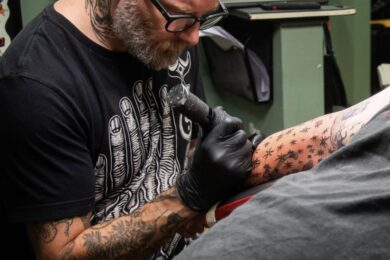
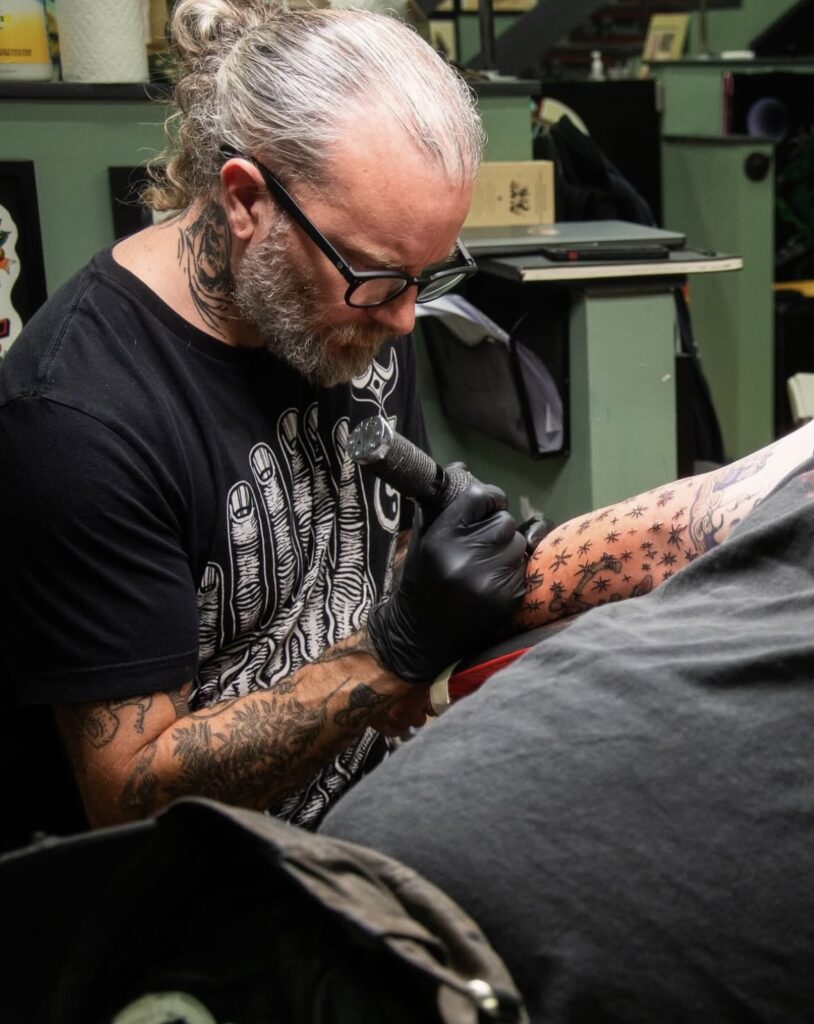
Born in Massachusetts in 1977 and raised in New Mexico, Turner studied at Boston’s School Of The Museum Of Fine Arts in the 1990s before establishing the Hydra Head label and building a formidable career as a musician. He’s now a member of Mamiffer, with his wife Faith Coloccia, and runs the SIGE record label as well as recording solo music and guesting with any number of musicians: notable collaborators have included Stephen O’Malley of Sunn O))) and Justin Broadrick of Godflesh. As well as being a recording and touring musician, Turner is a graphic artist and, most pertinently for our purposes here, a tattoo artist at Dark Age Tattoo in Seattle. His art is an amalgam of influences: there’s graphic-novel and comic-book vividity in there as well as spiritual symbolism and fantasy elements that make his social media pictures a compelling gallery.
What does the act of piercing a fellow human’s skin mean to him? Let’s find out.
The Trump regime isn’t good for tattoos… or anything else.
Tattoo bookings are going down right now. I think that’s partially because the economy is uncertain, and quite a few people are losing their jobs. Getting tattooed is a luxury, and a lot of people are nervous right now, because the cost of living continues to rise. We’ve definitely seen a decrease in the other businesses we’re involved with, too. Records are selling less. My primary band, Sumac, is going to put a hold on booking shows in the USA for the foreseeable future. Our drummer is Canadian and he’s coming over next week to do a tour in the US with us, but after that he wants to wait for a while before booking anything else, because it just seems so uncertain. I can’t blame him. I know a lot of people from other places who are choosing to avoid the US, too. It’s hardly an isolated experience to live under a cruel, erratic and ultimately idiotic ruler, though: it’s just our turn right now. I feel a small urge to flee the country, but I think we’ll try to stay the course and do our best.
Tattooing is an exercise in humility.
At the risk of sounding immodest, I have confidence in my abilities as a visual artist and a musician. I feel like for what I’m attempting to do, I do it well, and I know how to do it, and I know how the tools that I use work, at least well enough to put them to use in the way that I intend to. However, I knew nothing about how to tattoo before I actually started doing it three years ago, so there is a greater risk involved, in the sense that when I make a piece of art as a visual artist, it only reflects on me, and really only impacts on me in a bigger sense. Similarly, when I’m making music, even if I’m doing it with a group, what we do only reflects on us. When I’m making art on someone’s body, though, that is something they have to carry with them, and something they will look at, potentially for a lifetime.
Tattooer and tattooee go through the experience together.
There are certain areas of the body that are generally recognised as being particularly painful for a tattoo, such as the sides of the abdomen, the kneecaps and the palms of the hand. It varies, though: some people might find one spot exceptionally painful, and other people might find that same spot easy. I don’t like the idea of inflicting pain on someone, but what I do think is beneficial is when people go through the experience and they feel that they have withstood something: they have passed through a trial. I feel like I have helped them do that, and that I’ve been a participant in that experience with them. That’s one of the things that I find really compelling as a tattooer. The experiences that have been the most rewarding for me have been where a very palpable connection is formed with the client, and when there is a sense of intimacy and a deeper shared experience.
Pain can be transcendent, as long as you’re prepared for it.
There is a way in which you can fortify yourself mentally and physically to withstand the pain of a tattoo. I know from my own experience as a person being tattooed, there were a few times where I didn’t really consider what was about to happen. I was taken off guard and suffered in a way that was beyond my expectation and pretty hard to take. For that reason, I always try to mentally prepare my clients, unless I’m working on someone who’s already heavily tattooed, because they know what they’re in for. If it’s someone that’s getting tattooed in a painful spot for the first time, I’ll have a discussion with them and warn them about it. That’s my responsibility, because I don’t want someone to just blithely walk into that experience and then be completely taken off guard by it.
It’s important to apply your own standards to your art.
One of my self-stipulations when I was getting into tattooing was that I didn’t want to do much of anything besides my own artwork. Otherwise, for me, there’s no point. That’s not to disregard the practice that many other really great tattooers go through of doing other people’s artwork. I think there’s great value in that: it’s just not something that I felt I wanted to do. I also didn’t feel I could do it, in much the same way that I’m not a technically proficient musician. I don’t know how to read music, I don’t know theory, and I can’t play certain types of music with any real proficiency. Likewise, I can’t draw in a realistic way. I don’t have a firm grasp of anatomy, so if someone wants, for example, a realistic human form rendered in exquisite detail, I couldn’t do that for them on paper, much less on their body. I wouldn’t be doing a good service for the people who might be expecting that of me. With that understood, I will do just about anything if people are okay with me filtering it through my particular lens, as long as it’s not subject matter that I find abhorrent.
Balance your focus with your state of flow.
For me, entering a flow state has been possible in very limited durations while tattooing, partly because the technical aspect of it is still something that I very much have to focus on. It’s almost like the early stages of learning a song, where you still have to build muscle memory, so you can’t really sink into the energy of the piece because you have to think so much about what you’re doing. That’s where I am with tattooing most of the time. I have found, in certain instances – especially if the session has gone on for two or three hours – that I can begin to sink into the flow of it, and the technical side becomes the background and the image taking shape enters the foreground. For me, that’s where it becomes a really pleasurable experience.
Tattooing keeps me stimulated.
Creating a tattoo is a formidable challenge, and I’ve learned that that is something I thrive on. Taking on something that I feel has an inherent level of risk and potential failure built into it is gratifying for me. Now that I’m in my late 40s, at a time when the vigour of youth is dissipating to a certain extent, I feel like it’s really important for me to engage in practices that are challenging, not to keep myself young, but to keep those neural pathways open and to continue growing and evolving.
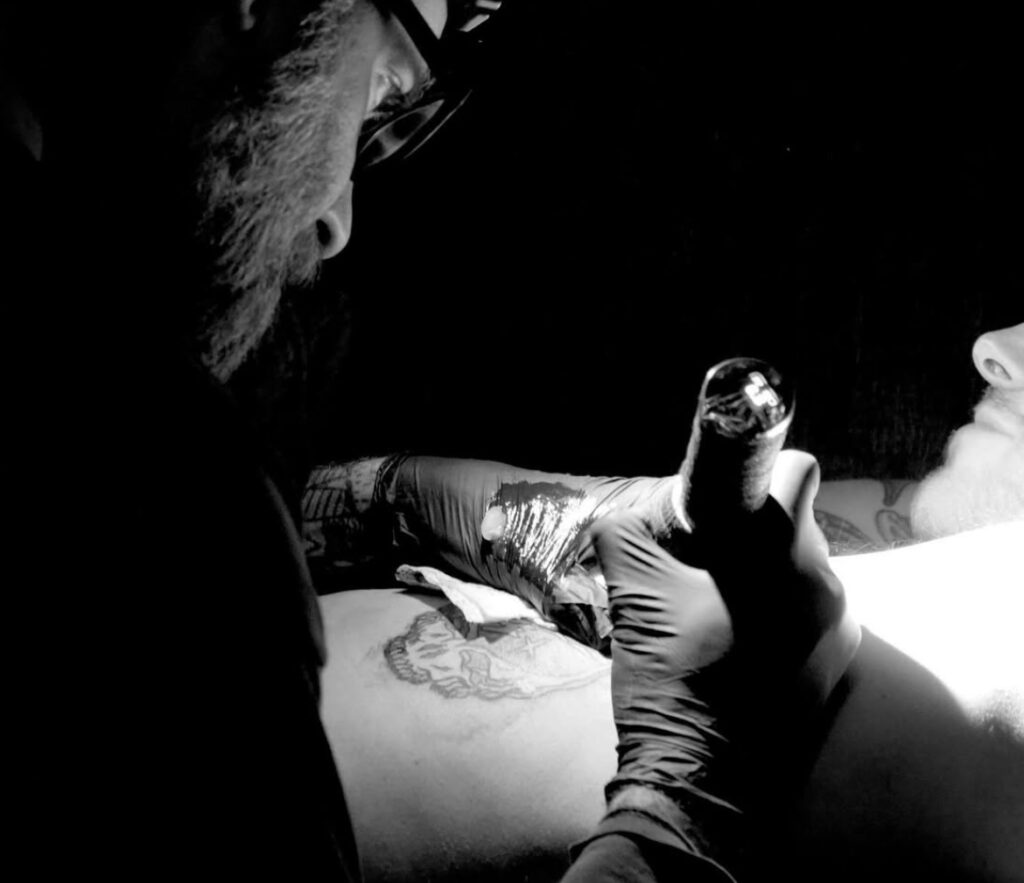
Tattooing allows me to socialise.
I have never been a person that was adept at socialising just for the sake of it. I really need some kind of creative context in order for me to feel engaged and energised in a social capacity. I was a pretty introverted kid, and because of our cultural values, connecting on an emotional and personal level with other people – especially with other males – was extremely difficult, yet it was something I still yearned for. That first transpired as a music fan, finding people who liked music that I liked and having that as a basis of connection. Later, that evolved into playing music together, spending time with other people and connecting with them through the factor of musical energy. With tattooing, I’ve had sessions with folks that resulted in a finished tattoo, but no real connection between us – but there’ve also been instances where I really feel like I have forged a bond with someone, and that bond continues to be deepened when these folks come back to me.
Tattooing is a sacred ritual…
Music obviously serves largely as entertainment for many people, but for me, it has been a portal to transcendence, and a way to enact communal ritual. It doesn’t always achieve that, but it does at times, and I’ve experienced something similar in tattooing. I remember one session that felt truly transcendental: I knew the person was suffering from the pain, but I also knew that it was a cathartic experience for them. Combined with a song that was playing at the time, there was a moment in there where everything coalesced into something that felt, in a way, sacred. I believe that marking ourselves has that potential within it. It can also be utterly trivial, of course, but I think there is transcendence within tattooing. For me, that’s tattooing at its best, where you can act on that higher level.
…but you’re still allowed to have fun.
On the more trivial end of things, there’s a part of me that is still a teenager that loves heavy metal album covers and silly comics. Sometimes I just want to draw a skull with no real intention behind it, and I need to have an outlet for those more juvenile tendencies. I just want something that looks menacing and absurd and revolting, and sometimes I need to indulge that part of my artistic personality. Tattooing has definitely provided that, in a way that’s fun – and I need fun in my life, because a lot of the art that I do is very serious, intentionally so, but sometimes it also just needs to be frivolous and ridiculous.
Pharaoh Overlord’s new album Louhi, featuring guest vocals and guitar from Aaron Turner, is out now on Rocket Recordings