
Two of the many shows I caught in London over the last few months have invited me to reflect on the relationship between the young musicians today whose work I find so exciting, and their predecessors in the so-called ‘second revival’ of the mid-20th century. The first, at St. Giles Church In The Fields, was a tribute to the legendary Les Cousins club that occupied a site in nearby Greek Street between 1965 and 1972, headlined by one of the many whose career it incubated, Bridget St. John.
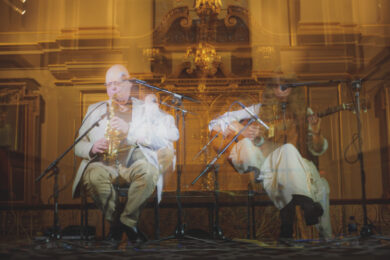
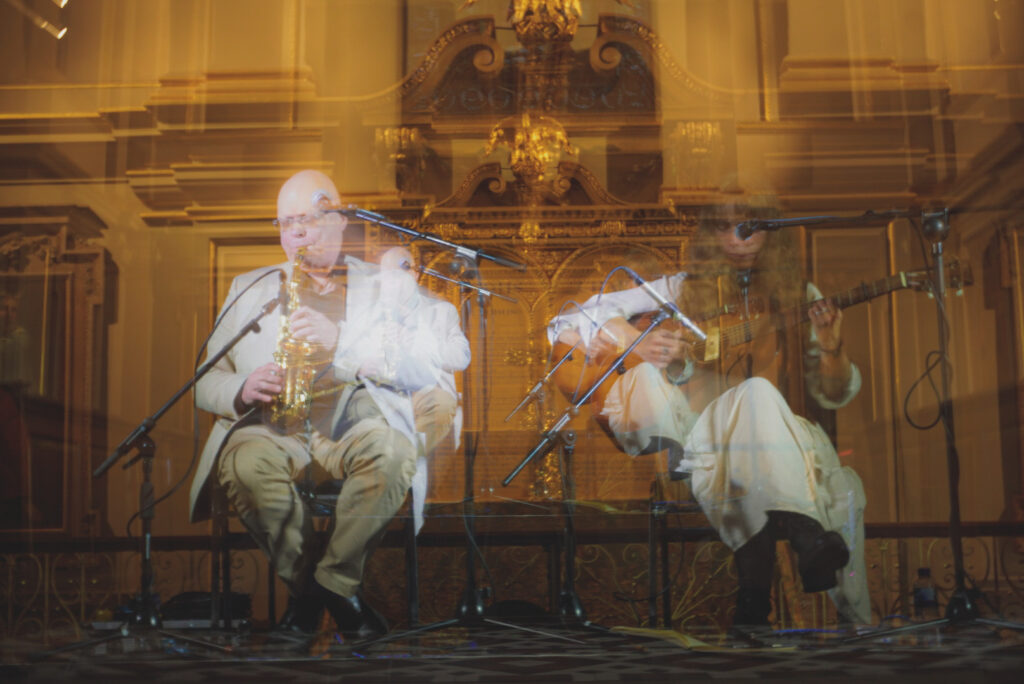
As well as guitarist Sam Grassie, support came from the Cornish painter and musician Daisy Rickman. As well as material from her March album HOWL, she performed part of her show in duet with John Altman, exploring the latter’s work with another Les Cousins alumnus, Nick Drake. With Rickman’s low voice proving perfect for evoking Drake’s rich melancholy, and Altman’s saxophone cutting through the atmosphere of her guitar playing, it seemed to tap into something deeper than nostalgia – not just recounting these old songs, but re-inhabiting them. “It was really special,” Rickman says a few weeks later, speaking to tQ over the phone from her home in Cornwall. “We hadn’t rehearsed, so we ran through the songs just once before the soundcheck.” It was also an honour, she says, to support St. John, “one of my biggest female folk influences from that time.”
The second show was at the scene’s most regular London haunt, the MOTH Club in Hackney, where a host of musicians including members of Goblin Band, Shovel Dance Collective and Brown Wimpenny celebrated what would have been the 80th birthday of The Young Tradition’s Peter Bellamy. A somewhat chaotic mixture of live performances (including an impromptu song from a member of the audience) and the recollections of veteran music journalist Ken Hunt, its most moving moment came at the end, where everyone who had performed that night delivered a collective rendition of ‘When I Die’, a song recorded by Bellamy in 1979 that felt fitting given the musician’s early death by suicide in 1991. My personal relationship with Christianity is complex, however the song’s message of salvation in God managed to transcend its religious trappings thanks to the intense atmosphere that can be conjured by communal singing. Recounting its chorus as an audience: “When I die, when I die, I live again,” it felt as if Bellamy really did live again – not through the power of God, but by the power of the young musicians recalling his spirit.
Mataio Austin Dean, a member of Shovel Dance Collective, was one of the performers that night, and joins me for a drink a few days later outside his East London art studio. “I wasn’t sure if Peter Bellamy’s widow, who was there, liked what we were doing, but she did say that he would have been happy and amazed to know that all these people who wouldn’t have been alive [at the same time as Bellamy] are carrying on what he’s doing.” One of the reasons often cited for Bellamy’s suicide was what he saw as a lack of appreciation, Dean notes. “But we can see now that he is appreciated, by us.”
Bellamy is a big influence on Dean, particularly the “confrontational nature” of his singing with The Young Tradition. When he started singing folk songs himself, “what I wanted to do was like what Peter Bellamy was doing – to get people in and shake them.” Indeed, Dean – who learnt to sing during sessions with the UCL folk and world music society while he studied at Slade, fuelled by cheap gin to a backing of raucous drinking in the ‘pub-themed’ student bar where they’d meet – has a voice that can shake you to the core. “That’s where I learnt to sing loudly,” he recalls. “I remember once there was a person being carried out by four men because they were so drunk, and it was like something from Pirates Of The Caribbean, people chucking stuff and going mad, and I was perfectly audible.” It was here, too, that he first encountered the raucous coal miners’ song ‘Byker Hill’ (Shovel Dance Collective get their name from a lyric in the song about a pig who dances when hit by the garden tool), and then later on he encountered Bellamy’s version with The Young Tradition. “I thought, ‘this is fucking sick!’”
And yet, Dean is no carbon copy of Bellamy. His singing isn’t always confrontational, for one thing, particularly in Shovel Dance Collective whose music draws power from softness just as much as harshness. “Peggy Seeger, when I spoke to her, told me how every song has its own performativity that you have to embody in a different way, because they’re all trying to do different things,” Dean explains. “Maybe on some songs you’re meant to be grating and confrontational. On some songs you’re meant to lull someone into comfort. Then, you can use that affect in different ways.” Dean’s Marxist politics run deep in his performances, for instance, but he incorporates this in different ways depending on the needs of the material. “A wedge song is a song that you think is about one thing but is actually about another thing. Other songs are full frontal.”
Similarly, however much Rickman admires Bridget St. John, she too is not just imitating. “I think it’s always special to find female or femme musicians within that world, who aren’t as well-known as someone like Nick Drake,” she tells me, echoing sentiments expressed by another Les Cousins veteran Rose Simpson of the Incredible String Band during a talk earlier that day about her experience as a woman in the 1960s and 70s scene. “There were a lot of things that now look like humiliation almost, like the fact that we didn’t get paid!” Simpson recalled.
Another of Dean’s heroes is another of English folk’s totemic women, Shirley Collins. He interviewed her recently on film, a section of which recounting Collins’ memories of Bellamy was played at the MOTH Club night. “It’s a bit grandiose of me to say, but I try to imagine I’m doing the same thing as she does,” he tells me, but stresses that this is not in a stylistic sense, but a philosophical one. For them both, in folk music it’s the songs that hold the power, more so than the artists who sing them, and it is their predecessors wielding of that power that inspires them more than comparatively ephemeral things like production and instrumentation. “Some people who come to trad stuff, their only point of reference is the 60s folk revival, and they’re establishing themselves in relationship to that or in opposite to that. I don’t see myself as doing that. I like to think that we’re going back to the same source material that Shirley Collins was looking at – the traditional singers, the collections, the manuscripts.”
It’s the way in which the new scene is handling this material with such care, while also filtering it through their own intensely charged socio-economic context, that makes it so captivating to me, and it’s that sense of white-hot energy that was also so present in the 1960s that provides me with a rhyme between this scene and that one. When speaking about St. John and her contemporaries, Rickman evokes Brian Eno’s idea of ‘scenius’ (in his words, “the intelligence of a whole operation or group of people) being more important than genius. Says Rickman: “It definitely feels like that was present at [St. John’s] time in folk music, where it was still quite new and there was lots of underground stuff happening.” It felt special, she says, to hear that still present in St. John’s singing, “a really powerful experience to see in the live realm.”
Perhaps what was really special about that experience, and that of taking part in the motley rendition of ‘When I Die’ at the MOTH Club, is that it is the sound of the enduring spirit of that 60s scenius meeting the new one that surrounds us right now – two sceniuses, interlocking with one another like the orbits of binary stars, one burning fresh from the stellar nebula, the other a shimmering white dwarf.
RóisMo LéanSelf-Released
Keening, or caoineadh, is a form of vocal lament for the dead in Gaelic Celtic tradition that predates Christianity, where women would wail at the side of a coffin during a wake. Nearly extinct by the 20th century, very few recordings of authentic keening exist, but Fermanagh born, Belfast-based Rose Connolly – who performs as Róis – takes two of them as the basis of her new EP Mo Léan, one from an unknown singer on the Aran Islands in 1955, and another performed by Kitty Gallagher for a dead child and recorded by Alan Lomax in Letterkenny in 1951. Connolly samples the recording and weaves them into the fabric of a record exploring wider concepts of death, grief and catharsis that at times reaches astonishing potency.
With its bursts of crystalline electronics, darkwave-inflected synths, quaking basslines, industrial beats, tolls-for-thee bell chimes and cold vocal distortions, there is plenty of gloom to be found on Mo Léan, and yet this is only one small part of the record’s emotional scope. For Connolly, a powerful and shapeshifting vocalist, death can be a time of unvarnished beauty, too – explored best on her deeply moving rendition of the hymn ‘Oh Lovely Appearance Of Death’, where her voice cuts sharply through drifting ambient backing – and even of humour; on ‘Death Notices’, she plays the role of a newsreader, their broadcast bookended by a warped theme tune, announcing in deadpan that sadly, today there are no death notices at all. It’s one of a series of short interludes across the record – the rest of which are called ‘Angelus’ after the devotional bells broadcast on Irish television and radio at 6pm each day, directly before the evening news – where the record’s incredibly deft touches of production are best felt.
On closer ‘Feel Love’, meanwhile, she takes a bold stylistic turn into avant-pop as she sings from the perspective of a figure on their deathbed. As death looms, the dying one reflects not on terror, but on love, and the satisfaction that they will soon return to the earth and the cycle of life, death and rebirth. It hurtles upwards and upwards and upwards on a refrain of “Feel love” with a euphoria not unlike the similarly-titled Donna Summer song that (consciously or unconsciously) it recalls, growing more and more intense until at last it explodes with a final blast of mutated organ.
Frankie ArcherPressure And PersuasionWipe Out Music
Northumbrian musician Frankie Archer’s new EP Pressure And Persuasion picks four songs centred on women and girls, exploring how the expectations these figures faced remain remarkably – and depressingly – consistent, however many centuries have passed. It opens, for instance, with ‘Barbara Allen’, the world’s most collected ballad, which concerns a dying lord who orders his servants to fetch him the titular woman, believing one kiss from her will save his life, and who is refused even after his promises of wealth and treasured possessions, with Allen citing his flirtations with other women and leaving him to die. Allen has often been painted as a frigid, uncaring figure – in A Book Of Old Ballads in 1934, for instance, an illustration by HM Brock is captioned ‘The Cruelty Of Barbara Allen’ – but Archer’s version reframes her as a woman who stands up staunchly in the face of insidious patriarchal pressure. “I don’t owe you anything / I didn’t ask for your attention,” comes a drifting refrain. Or, as Archer states plainly at the track’s end: “You don’t owe them anything, and nor does Barbara Allen.”
So too are we invited to reconsider the central figure on ‘Lovely Joan’, a farm girl minding her own business to whom a man offers a gold ring in exchange for her virginity, and who tricks the man out of his ring and his horse, as a canny operator rather than a criminal. ‘Fair Mabel Of Wallington’ – whose sisters have all died in childbirth and so attempts unsuccessfully to resist her mother’s pressures to marry and bear an heir and ultimately joins them in death – is the most tragic of Archer’s heroines, while ‘Elsie Marley’ provides welcome counterpoint, telling the true story of a vivacious and well-loved innkeeper’s wife who refused the drudgery of labour so not to dull an infectious joie-de-vivre.
As well as a striking vocalist, Archer is a fiddle-player of considerable ability. It soars upwards from the fray, melancholy and magic, on the second half of ‘Lovely Joan’, and dances a shimmering jig on ‘Elsie Marley’, but it’s ultimately just one element in an aesthetic mixture that draws far more from experimental pop production. Everything is applied with subtlety – deathly vocal manipulation and grim ambient noise on ‘The Maid Of Wallington’ to emphasise the song’s enveloping gloom; an icy electronic beat on ‘Barbara Allen’ that captures the protagonist’s steely spirit.
Stick In The WheelA Thousand PokesFrom Here
A Thousand Pokes is bookended by two pieces that are unlike the others. Where the rest of the record is sprightly and raw, drawing mainly from a palette of rugged guitars and galloping drums, opener ‘Crystal Tears’ and closer ‘Steals The Thief’ distort that sound into great heaving waves of droning doom. Kearey’s vocals – sharp and direct elsewhere on the album – are hardtuned to the point they take on an eerie and transcendent quality, floating above the fray. The words she’s singing on ‘Crystal Tears’ are compiled from the lyrics that Nina Simone cut out of the song ‘Let No Man Steal Your Thyme’ for her version, ‘In My Prime’, words that themselves concern the idea of exclusion and rejection. On ‘Steals The Thief’, she sings directly about a recent fascination for the band – the way in which the upper-class Victorian folk collectors, from whose work much of the modern canon is drawn, were deeply problematic. In short, the upper-class collectors who travelled the country gathering the songs of ordinary people were doing so with a certain agenda – to fetishise the cultures they found, to fit them into 19th century ‘noble peasant’ stereotypes, and to erase the messier, more genuine aspects of these peoples’ lives. (“He took their words, from their own / Paid them promise, all turned to dust”) Kearey sings. Together, these two songs frame the record as an effort to restore what has been erased – whether the words in ‘Crystal Tears’ or the realities in ‘Steals The Thief’.
As native Londoners, Kearey and bandmate Ian Carter have long been interested in articulating the character of their home city through their music, and A Thousand Pokes is no different. With that guiding concept of restoring what is ignored, however, this record feels particularly focussed, given that theirs is a city full of people who are themselves being forgotten and overlooked – under the weight of rampant capitalist greed, displacement and gentrification. The songs between the transcendent bookends present the sound of a London in which this is not the case (and notably draws from sources other than the collections of the aforementioned Victorians, such as a 15th century devotional from nuns at Isleworth, an ancient street cry, a Tudor satirical ballad, nursery rhymes and more). Whether imagining death as an East End hitman or celebrating the mugging of an unwitting aristocrat at the hands of wily women, the record teems a messy, gritty, complicated, occasionally brutal feeling of aliveness.
Web RumoursTravelling CircuitsSelf-Released
Web Rumours is the project of Australia-born, Berlin based Em Burrows, whose new LP Travelling Circuits is the product of a residency in the New Forest, and sees her exploring a longstanding love of British folk. The twist is the way in which she does so, drawing heavily from a parallel passion for 1980s electronic pop that’s defined the rest of her work. The melodies she weaves here – crisp, driving, direct – demonstrate a considerable ability when it comes to crafting synth pop; remove the folk songs, and this is really a collection of eight deliciously steely pop instrumentals. What’s most gratifying, though, is how they do interact with the folk material. This isn’t just an exercise in letting the synths push these ancient songs into strange new directions, but the reverse as well. ‘Maid In Bedlam’ tells the story of a woman who has gone mad in the absence of her love, the narrator’s instability emphasised by the wooziness of Burrows’ spiralling synths and doubled-up vocals. ‘The Battle Of Otterburn’ – a ballad commemorating the famous Scottish victory over the English in 1388 – becomes a more pensive reflection on the costs of war. For ‘Lovely On The Water’, one of English folk’s most moving reflections on grief, Burrows is bold enough to eschew lyrics entirely, so confident is she in the power of her elegiac instrumental.
PoejiNantSquama
Poeji is a collaboration between Mongolian vocalist Enji – who won acclaim for her 2023 album Ulaan – and Bavarian drummer Simon Popp. While Enji’s vocals are powerful but largely wordless expressions (with the mazing whispers of ‘Ybbs’ the exception) that charge each track with deep emotion, Popp’s earthy percussion serves as an equal harmonic partner and not just a rhythmic engine. In their respective solo careers, both have leaned perhaps most heavily into jazz, and you can feel that style’s exploratory instincts all over Nant, as well as elements of dub, musique concrete and avant-garde composition. What’s most interesting to me, however, is the way these experimental techniques are used as a method to explore instrumentation from across multiple traditions, from wooden slit drums to an Indian shruti box, Tibetan singing bowls to an Irish bodhrán. By using them as tools in such an exploratory practice, stripping away extraneous ornamentation, Poeji are able to delve deep into their universal qualities. It’s for similar reasons, the band explain in accompanying press material, that their project’s name was chosen for the fact, that it translates as different things in different languages – both the Slovenian word for ‘Sing’, and a rough Japanese translation of ‘Poetry’, for instance.
Kevin FowleyÀ Feu DouxBasin Rock
Kevin Fowley’s childhood gives a neat idea of what makes this EP so intriguing – in one room his French mother would sing lullabies, and in another his Irish father would play Donegal tunes on the fiddle. Although he was inspired by his father, parallel encounters with the unvarnished music of Mississippi John Hurt, Skip James and Davey Graham saw him pursue his own path on the guitar. À Feu Doux combines all of the above to bewitching ends as he performs four traditional lullabies in French. On the first, ‘Ne Pleure Pas Jeannette’, Fowley allows his singing to meander and drift while subtly distorted, hypnotic guitar bestowing a gentle psychedelia befitting that strange space between wake and sleep. The ten-minute ‘Á La Claire Fontaine’ abstracts things further with the woozy inflection of Caimin Gilmore’s double bass, while the instrumental ‘Le Coq Est Mort’ moves from a straightforward and sparse guitar melody to a climax of unsettling abstract weirdness. It’s worth noting that, as with so many of the most memorable childhood encounters, there’s plenty of darkness contained in these songs’ narratives as much unrequited love as requited, one character is condemned to be executed – and it’d be unfair to reduce this intriguingly complex record to the status of comfort blanket. That said, closer ‘Aux Marches Du Palais’, about lovers who plan to make a bed with flowers at every corner, so big that a river runs through it from which the king’s horses can drink, in which they’ll lie until the end of the world, is about as lovely as it gets.
The Standing Stones, Alasdair RobertsTwa BrothersL-13 Light Industrial Workshop
The Standing Stones is the latest incarnation of the collaboration between Jimmy Cauty and Jem Finer – founding members of The KLF and The Pogues respectively – who announced themselves last year as Local Psycho And The Hurdy-Gurdy Orchestra. Back then they erected ‘The Gurdy Stone’, a 12-ton piece of slate, in a field in Sussex to mark the release of rabid debut single ‘The Hurdy-Gurdy Song’. A year on, the project appears to have morphed. Now taking a “hiatus from megalith building”, they’re going by The Standing Stones. It’s described as a new band entirely, whose debut single ‘Twa Brothers’ also features vocals from Alasdair Roberts. The singer also recorded the song as a slow-burning nine-minute epic for his 2005 LP No Earthly Man, and this new version has a similar simmering energy. The difference here is made by the interventions of Finer, who provides twisted lashes of hurdy-gurdy that snake their way around Roberts’ steady singing, and of Cauty, whose production pushes this ancient song into distinctly contemporary territory, with the use of samples from police radio traffic and news broadcasts blended into a thick and gloomy beat. At first, it appears as if Cauty’s sampling of reports describing real-world stabbings and shootings is done at random, or perhaps as a crass attempt to add some grit, but when considering the context of the original song, which recounts one brother’s death at the hands of another, its air of violence feels entirely appropriate.
Referenced artists
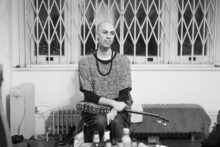
Shovel Dance Collective
Chthonic Resonator: At Fargrounds by Jacken Elswyth
Bridget & Kitty, Resonant BodiesBetwixt & Between 11Betwixt & Between Tapes
The third 2024 release in Shovel Dance member Jacken Elswyth’s Betwixt & Between series of tapes – each of which is split between two artists in an effort, in her words, to explore the “sympathetic resonances and complimentary contrasts across traditional, improvised and drone / ambient musics – and the second to feature in this column, comes from two duos – London singers Bridget and Kitty and Sheffield project Resonant Bodies respectively. There’s a pleasing asymmetry here in that the former is unaccompanied and the latter entirely instrumental. Bridget and Kitty’s work is finely hewn and deliberate – their voices interlocking in intricate harmony as they present four plaintive songs with a stark beauty that belies a deep relationship with the material. For Resonant Bodies’ longform contribution ‘Cowering Fossil / Deluge of Memories’ there’s a contrasting sense of tentative exploration – nyckelharpa and hammered dulcimer probing and prodding until melodies take shape before your ears which then start to quicken and slow in lopsided leaps and bounds.
Tarta RelenaÉs PreguntaLatency
Tarta Relena’s second album begins in Classical Greek, the voices of Helena Ros Redon and Marta Torrella I Martínez interweaving beautifully as they sing a poem by Sappho of Lesbos over meditative synth arpeggios. Less than two minutes long, it ends by descending into babbling whispers, which in turn provide the segue into ‘Mille Risposte’. Now, the two vocalists have shifted into Italian, their singing just as beautiful but now possessed of a newfound steeliness, while the synths morph into a sinister simmer. Then, ‘Tamarind’ warps the voices (now in Spanish) through heavy electronic processing, so that they begin to levitate in transfixing isolation. This record is presented, somewhat understatedly, as an exploration of multiple vocal traditions from across the Mediterranean. Its methods of doing so are dizzying. Drawing on equal measures of secular and religious influences, inspired as much by flamenco as Hildegard Von Bingen, or by avant-garde electronic production as Georgian laments, they also sing in Latin, Ladino and their native Catalan. The record is so constantly shifting in language, timbre, style and tone, the singers’ voices looping around and around each other like a vortex, that its impermanence ends up becoming its life-force.
Wire WormsThe First To Come InSelf-Released
Leeds underground outfit Wire Worms’ new record is a loose concept album inspired by mummers – amateur theatre groups who would visit house to house performing ritual plays around the winter solstice. Singer Luke Carroll is, indeed, a theatrical presence, lingering on every word and imbuing it with appropriate melodrama. His co-vocalist Jasmin Brown an eerie, ethereal counterpart to his earthly boisterousness; mummering, after all, contains elements of both the magical and the practical – part ritual and part money-maker during the barren winter months. Drawing from a diverse and forward-thinking instrumental palette of doom metal, jazz, scrappy indie rock and electronica, at times the record is appropriately rough around the edges, as on the straight-up rabble rouser ‘Bring Us In Good Ale’, or the slinky ‘Riding The Stang’ – the only non-traditional song on the album, written about ‘charivari’ customs in which a member of the community would be shamed with a discordant serenade and the clanging pots of their disgruntled neighbours. At others, though the band unleash proper power. Their version of ‘The Abbots Bromley’ is a lurching beast. A droning ‘Poor Old Horse’ recorded with fellow Yorkshire agitators Hawthonn in a rural church delivers haunting, ancient melancholy.