

They heard me singing and they told me to stop…
That was when it clicked. The realisation that of all the many things the world’s biggest indie-rock band wanted to be, and of all the many things they were doing a damned good job of being, foremost among them was ABBA.
Because if you and your band could be anything, anything at all you wanted – if you had the means, and the status, and the acclaim, and the chops, and the trust of your audience – then why wouldn’t you be ABBA? Why wouldn’t you emulate the greatest and most beloved group of its era? Isn’t that what you would want for yourselves?
These days, my life, I feel it has no purpose/ but late at night the feelings swim to the surface.
I would put ‘Sprawl II (Mountains Beyond Mountains)’ up against any other song of this pop-bedazzled century in the confidence that it will hold its own. It would be the first example I’d pick if I wished to summarise Arcade Fire to someone who hadn’t heard them. This despite it being an anomaly in their catalogue, with a lead vocal by Régine Chassagne rather than Win Butler. It is still the most emblematically Arcade Fire thing I know. Not that Arcade Fire are ever less than emblematically Arcade Fire. But there is nothing they are that isn’t to be found right there, full-blast, in that song.
So, yes. That was when it clicked. That here was a band who are not only brilliant, which they are, but are also not held back by the belief that indie-rock = serious business, which it is. That inside this very good, sombre rock group, the one whose first album was titled Funeral, was a very good bubblegum pop group, not fighting to get out, but flying out with “Godspeed” ringing in their ears. A group who understood, just as ABBA did, that serious business and shining-eyed ecstasy, darkness below and scorched sugar on top, are not merely compatible but complementary. That it’s all pop music, and hierarchies are bogus.
I loved them even more, then. But I still didn’t know just what a good pop group they are. I didn’t fully understand until this week, when I saw them play York Hall, a boxing venue in London’s Bethnal Green, alongside a few hundred other lucky stiffs. Now, it’s easy to be seduced and overwhelmed by music, to be infatuated with the last thing you saw, so I’m not going to say anything so hyperbolic as, “This is the best gig I’ve ever been to,” or some such. I’ll just say that right now it’s definitely in the Top 1.
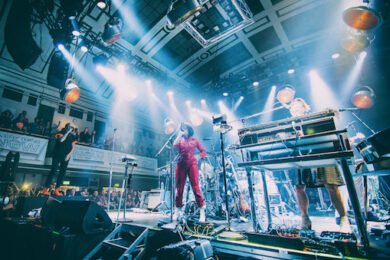
It helps that, aside from those watching above in the gallery, nobody need be further than 30 feet from the stage. This is set up on the small, square centre ring, the instruments and mic stands ranged all around the perimeter. You get through the doors, eventually – there’s no haste, no panic, no jostling, and the queue stretching around the corner and far up the sunny evening street is moving briskly enough – and into the hall, and you can either try to guess where the ‘front’ is or just pick a spot. And every spot’s a good one. We’re all down the front. If Win Butler isn’t facing your side of the stage, he’ll turn around in a minute, or stand up on a stack in the centre, his tangerine high-tops and the matching tips on his short sleeves among the few flashes of colour in a monochrome ensemble; the others are Sarah Neufeld’s lipstick and, principally, the scarlet jumpsuit worn by Chassagne, to which the eye is drawn magnetically at whatever corner she occupies at that moment. It feels like a special effect, and it makes for a perfect visual representation of the band’s music: black-and-white – more black than white – embellished and illuminated by these roving, vivid splashes daubed upon it.
Those who didn’t care for the James Murphication of Arcade Fire’s sound on Reflektor probably won’t be too keen either on the forthcoming Everything Now, whose title track kicks things off. Murphy isn’t involved this time – Thomas Bangalter, Portishead’s Geoff Barrow and Steve Mackey, ex of Pulp, have worked on the album – but the new songs are even more in the spirit of LCD Soundsystem than the last lot. Which in my book is a splendid thing; indeed, my only complaint about Arcade Fire is that they’re not LCD Soundsystem, and vice versa. If Arcade Fire were formerly in the business of anthems, they’re now in the business of bangers. These are absolutely storming dance-pop tunes. With, of course, loads of singalong “Na-na-na”s and “Woah-oh-oh”s. I mean, Bangalter or no, they’re not daft.
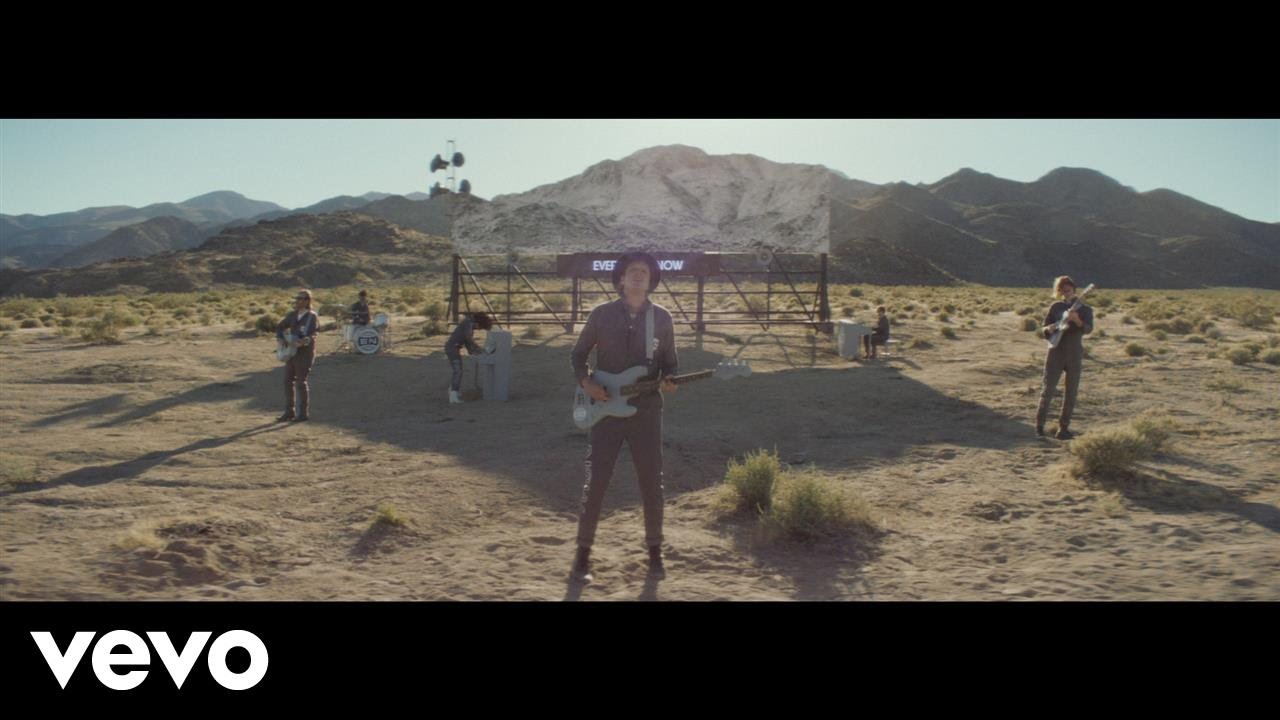
One of Arcade Fire’s principal gifts, given their multi-instrumentalist technical prowess, is to do such a convincing, such a thrilling impersonation of a mob-handed rabble teetering on the brink of a shambles, when they’re nothing of the sort. They know exactly what they’re doing and when to do it; in terms of competence in performance, they’re only marginally more anarchic than a North Korean military parade. But as they race and rampage and cavort around the four-fronted stage – swapping instruments, microphones, roles, vocals – it feels as if, at any moment, the whole business might collapse into sonic rubble. It’s one hell of a gimmick, and a big part of what makes them so electrifying. So even as ‘Everything Now’ surges through its disco paean to sensory overload; even as ‘Chemistry’ crushes all before it with a one-two stomp reminiscent of Led Zeppelin’s proto-disco-rocker ‘Trampled Underfoot’ (I wrote about disco-rock elsewhere recently, and now regret I didn’t hear these songs in time), and the exuberant electropop of ‘Signs of Life’ sets every pair of hips in the place shaking; even though you cannot mistake this for anything other than a seriously tight band playing seriously tight tunes… somehow, you still do. Somehow they maintain the illusion of only just holding it together.
It works retrospectively, too. It takes songs whose recorded versions have flaws or longueurs and puts them through the banger machine. ‘No Cars Go’, on their first, self-titled EP (when, Pink Floyd-style, they still had a “The” to their name), is a trebly, staccato thing with more than a hint of very early New Order. Nothing wrong with that; but here, it is a pure, seamless rush. ‘Here Comes the Night Time’ soars above the studio take’s ever-so-slightly awkward dub and distinctly hokey steel-drum Caribbean-isms (yes, I know they have a core member from that part of the world, but that doesn’t change the hokeyness). While songs which are great on record are nothing short of jaw-dropping. I have known few moments in my gig-going existence so transcendent as ‘Sprawl II’ itself. The penultimate ‘Neighborhood #3 (Power Out)’ is, in every sense, immense. For all its scale and force and fury, what sends it over the top is the tinkling of Chassagne’s xylophone. She ends the number slumped beside an adjacent keyboard, pressing down a chord, as if she and the instrument are wringing the last drops of sound and energy out of one another. After 30 seconds of hanging about in the pit, the band is back for an encore of ‘Wake Up’. This is no arena, but I don’t think I’ve ever heard an arena crowd make so much noise. And I’m sure I’ve never before heard an arena band, in any type of venue, deliver a set without a single dull or turgid second in it.
Most bands that make it to arena status either start out with a light touch and get solemn (Depeche Mode, for instance) or start out solemn and get more so. Arcade Fire have reversed the process. The more popular Arcade Fire become, the more overtly poppy they get – and, paradoxically, this is no less substantial a gamble than, say, veering off into experimentalism, because either way you risk alienating the fans who took you into the big time. Yet like almost all great rock groups, they still look and act like a gang. Just not that kind of gang. More like a gang of high-school misfits who gather to smoke weed in the bleachers in a 90s movie about the 70s.
This figures. Some acts have a big subject, and Arcade Fire’s is adolescence. (‘Us Kids Know’ was the informal title accorded that first EP.) That’s been one of pop’s biggest subjects from the first ascent of rock & roll. But nobody has ever captured as Arcade Fire do the strangeness, the otherness of teenagerhood; the weird and bewildering out-of-body experience it can constitute, watching yourself and your life as if remotely. Which may be why, the further away they get from it, the more piercing is their account of it. They always see it as something in the past: “We used to wait, we used to wait, we used to wait…” Yet the odd thing about that is, so do many teenagers. It’s a time when last week can seem like another life, when revelations come and go at a manic rate. It’s this adolescence that Arcade Fire record – the one undergone by those out of place not only in their own town but in their own flesh, in their own home and school and age group, those on whose suburbs the city lights shine, calling at them, “Come and find your kind”. The kind of adolescence documented in the last new song they play, ‘Creature Comfort’ (which, incidentally, is their most LCD-esque thing yet):
Some boys hate themselves /
Spend their lives resenting their fathers /
Some girls hate their bodies /
Stand in the mirror and wait for the feedback /
It goes on and on, I don’t know what I want /
On and on, I don’t know if I want it
What do “us kids” want? It never really changes, even as we age, which is why Arcade Fire songs ring so true to anyone still connected to those teenage emotions many years on – and I suspect that’s most of us. To feel, for a few incandescent moments, at ease in oneself: the right person, in the right place, in the right skin. Music does that for you like nothing else. The feeling of wanting to dance, not like no one’s watching, but like you’re happy for anyone to see. Just as this boxing hall-load of people are doing. It’s not a gig, it’s a huge rave-up, and I’ll bet many of those in it have seldom been happier. Arcade Fire are a party band now. Maybe they always were; but now they’re one in excelsis. “If this is heaven, I need something more…” Not me. This will do. This will do fine.
Photo: JF Lalonde