
All photographs of Ti Agrikol by Emma Volk
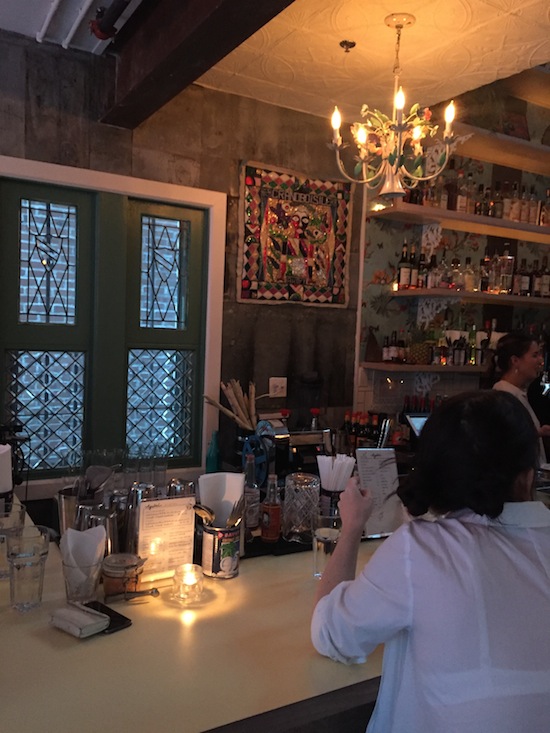
A black Pioneer DJ mixer rests atop a wooden altar that’s carved intricately, displaying a Haitian countryside scene. Behind hangs a framed Haitian tapestry, featuring two mermaid-like creatures.
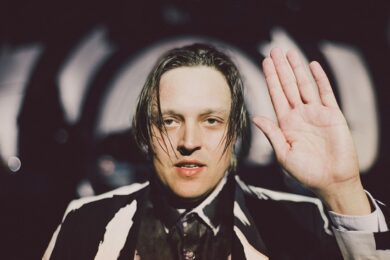
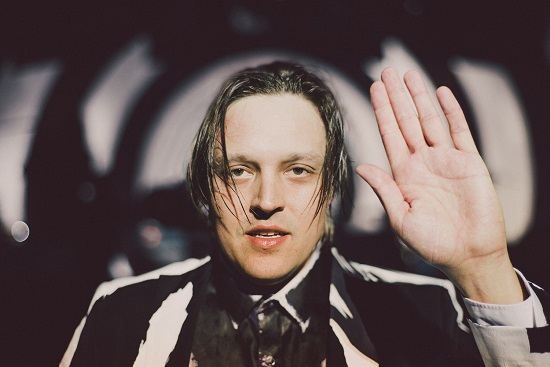
Arcade Fire frontman Win Butler fiddles with the wires jutting out from the mixer. He’s wearing a black trench coat, and a wide-brimmed black hat. He stares down, his identity hidden. Not that it matters – there are only seven people in the bar, Ti-Agrikol in Montreal, and it’s not clear that any of them know the long-legged Texan scheduled to DJ tonight has headlined Glastonbury, won a Grammy, and performed with David Bowie.
Butler surveys his creation. He looks a bit disappointed that the space is almost completely empty, but he’s in good spirits anyway. He slips behind the bar to chat with three members of his staff. Then, he disappears, even though his set as DJ Windows 98 was supposed to start 15 minutes ago.
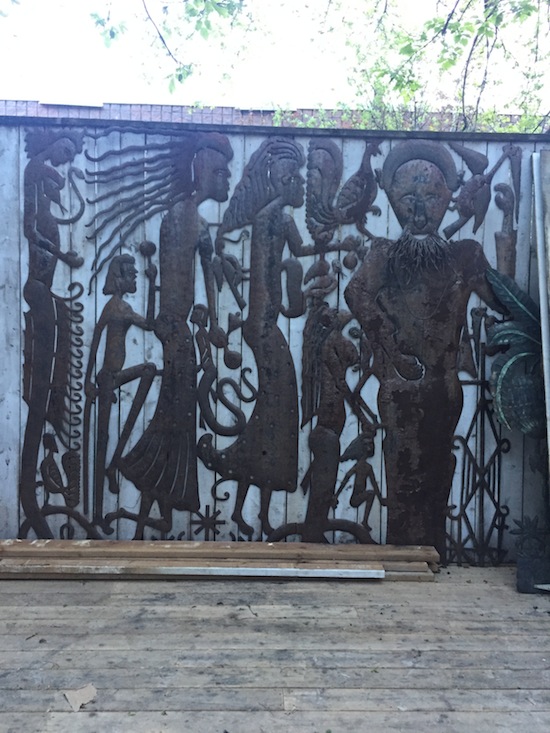
Butler returns, and the crowd has shrunk. He fidgets with the mixer some more, then sneaks into the courtyard out back, where leftover metal garbage cans pierced to look like Haitian metal art sit among discarded tarps and soggy planks of wood. The cans once surrounded Butler’s bandmate and wife, Régine Chassagne, while she belted her lines to ‘It’s Never Over’ across seas of adoring fans at arenas around the world. At the time, the cans looked gorgeous, but compared to the massive metal display of serpents and roosters and bearded men adorning the back wall of Ti-Agrikol’s courtyard, they now look like a cheap imitation.
It doesn’t matter that Butler is slouched outside among the Haitian metal art and discarded Reflektor tour supplies as the sun goes down and the smell of Haitian chicken sneaks out of the restaurant next door. He isn’t hired entertainment – he’s Ti-Agrikol’s part-owner.
His bar is a beacon of Caribbean cool in frigid Montreal. The cocktails are $8, citron-heavy, and delicious. When Butler finally starts his set, more than an hour late, he simply clicks play on a track on his laptop and leaves the DJ mixer for the bar. He seems afraid to draw attention to himself.
But then he settles in, as does the small crowd. The transitions are abrupt at times, gorgeous at others, like when Butler fuses ‘Sexual Healing’ and an instrumental Haitian konpa track. He bobs and sways behind his silver Macbook – it’s Apple sign obscured by a photo of the citadel, a massive stone fortress built among the forested mountains of northern Haiti.
The singer’s obsession with Haitian music, art, and the culture of Kanaval (the Haitian word for carnival) can come off as strange, or worse – as a cynical ploy to recycle the music and culture of the world’s first black republic to make his Montreal bar, and his indie rock band, that much more interesting. Yet, Butler’s love for Haitian music is genuine, and, to me, his bar seems less a trophy case or a money grab than an attempt to distill one perfect night in Jacmel, Haiti, into a dynamic, liveable space.
Three years earlier I was in a guesthouse in Port Au Prince watching Arcade Fire play live on the Jimmy Fallon show. Watching the performance with me was my host Pastor Ernso. He was incredulous when I told him the band would be in Jacmel the next day. “Those blan? What are they gonna do in Jacmel?”
A valid question. When I reminded Ernso that it was Kanaval weekend, he spoke with a paternal wistfulness: “Those guys, they’re gonna love it man. Kanaval in Jacmel. It’s the best.”
The next day, even as he stumbled out of the ocean in Jacmel, exhausted looking, the orange evening sun calling attention to his pale frame, Win Butler managed to cast an imposing figure.
Somehow, the ten-person band, their equipment, and a sizeable camera crew made the journey from the snow-covered sidewalks of New York to a beach town in Haiti in less than a day. It had to have been a long trip.
Standing on the beach next to Butler, after he had dried off and gotten dressed, I couldn’t help but wonder how the massive load of blan and instruments forced its way through the Kanaval traffic that made the already arduous mountain passes separating Port Au Prince and Jacmel nearly insurmountable.
But, before I could ask Butler how the band managed to make the trip, he was peppering me tersely with questions, trying to figure out precisely why I was there. He seemed relieved when I assured him I was not an obsessive fan who braved traveling to a remote part of a foreign nation just to see him play.
With this barrier cleared, Butler became much more friendly. When our conversation turned to Jacmel, he lit up. Butler readily declared his love for the town, and seemed genuinely in awe of its artisans and musicians. Eventually, though, he needed to return to his hotel and get some rest.
We went our separate ways, but after a few steps Butler called out to me. When I turned around, I found the intense, overpowering stare that Butler cast upon millions of television viewers just the night before fixed squarely on me. Clearly, something was bothering him.
“You have a place to stay right?”
I told him I have some friends who live a couple blocks from the beach, and I’ll be sleeping on their floor. Butler cracked a grin.
“Good. It’s, uh, gonna be a late one.” He isn’t kidding.

It was past midnight and the band still hadn’t taken the stage. Thousands of Haitians had steadily poured into Jacmel’s Plas Tousen Louveti, a cobblestone square that wouldn’t be out of place in Montreal.
In fact, almost nothing about the scene would have been out of place in a wealthy North American city. The musicians and the crowd, however, were almost exclusively Haitian. The show was free, and meant as a kickoff to Jacmel’s Kanaval weekend. The following day, parades would last all day, and the Haitian bands who had flocked to the coast will play on top of massive, multi-story floats in the streets until the wee hours.
In the week leading up to Kanaval, advertisements for the Arcade Fire show were unavoidable, even in Port Au Prince. Walls were painted, flyers were printed, and radio hosts frantically called out the names of each group on the 11-band bill:
“Symbi Roots! J Perry! DJ Tony Mix! 45 Soldiers! Lakou Mizik! Hotmen Rap! DJ Gardy! RAM! Bel O! Kreyol La! Arcade Fire! Jakmel 21 Fèvriye!”
With their professional set-up and intense marketing campaign, it was clear Arcade Fire didn’t want to just play in Haiti. They were far too ambitious for that. Instead, Arcade Fire wanted to headline Haiti’s biggest music festival, even if they had to create it themselves.
Although their rationale for putting on a show for thousands of Haitians could be construed as uniquely egotistical, Arcade Fire have a track record of thoughtful involvement in the country. Band member Régine Chasssagne is the daughter of Haitian immigrants who fled the country during the repressive rule of dictator Jean-Claude Duvalier. Chassagne’s uncle, a Haitian intellectual, authored a book chronicling the abuses of the Duvalier regime. On Arcade Fire’s debut album, 2004’s Funeral, Chassagne followed suit, memorialising the generation of children never born because their parents were slaughtered by Duvalier’s secret police, the Tonton Macoute, on the searing track, ‘Haiti’.
A few years later, during the 2007 Neon Bible tour, the band began donating a dollar of every ticket sold to Partners in Health (PIH), the widely respected global health charity. At the time, their contributions were modest (they were mostly playing churches and small clubs). Through this programme, they have raised more than a million dollars for PIH’s work in Haiti.
In recent years, they have convinced other artists to join them, creating the charity Plus One. Marika Anthony-Shaw, one of Arcade Fire’s violinists (and a member of PIH’s Board of Trustees), left the band – she works as Plus One’s CEO. Bands from across the musical spectrum (The National, Macklemore, The Arkells) have since gotten on board.
A month after the Haiti earthquake, during the 2010 Super Bowl, Arcade Fire fans were undoubtedly shocked to hear the band’s most beloved song blaring through their television sets as part of an NFL ad dedicated to “The Best Fans on the Planet”. After all, surely this would be something that would pain the punk history-obsessed Butler: a song he wrote being used as a tribute to football “fanhood” during the most highly-corporate sports event of the year. But the band allowed the NFL to license the song as long as they donated the proceeds to PIH in support of their earthquake relief efforts.
A few weeks after the earthquake, Régine Chassagne penned a heartbreaking and intelligent op-ed for The Guardian, requesting post-earthquake support for Partners in Health. At a show in Montreal, Arcade Fire announced they would match donations to PIH’s earthquake relief effort, up to a total of $1m. Shortly after, Chassagne co-founded Kanpe, a charity that regularly partners with PIH, working to provide farm animals, seeds, and ongoing economic aid to families in need.
Although Arcade Fire didn’t perform at the Hope For Haiti Now telethon held a few days after the earthquake, Butler and Chassagne did meet with Paul Farmer of PIH in Montreal the morning after the tragedy, as Farmer notes in his book Haiti After The Earthquake.
Arcade Fire’s post-earthquake involvement in Haiti represented, in many ways, a new, more intelligent breed of celebrity charity. In interviews, Butler and Chassagne typically came off as thoughtful and intelligent. They espoused pride in Haiti’s revolutionary past rather than highlighting the perceived neediness of Haiti’s current population.
While today it is nearly universally accepted that the relief efforts made by large international NGOs following the 2010 earthquake were a failure, few had the foresight that Arcade Fire displayed in constantly stressing that donations be made to reputable, thoughtful organisations like PIH.
Meanwhile the band’s fame continued to rise steadily until February 2011, when they officially entered the celebrity realm by beating Eminem, Lady Gaga, and Katy Perry to take home the Grammy award for album of the year.
Then the band vanished.
In August 2013, veves, chalk drawings used to summon lwa (spirits) in Haitian Vodou ceremonies, began appearing on sidewalks in New York City, Montreal, and Rome. The drawings all contained the word “reflektor", the title of Arcade Fire’s upcoming album.
The band’s street marketing campaign culminated with the release of the album’s first single and title track, accompanied by a tense, gorgeous, Vodou-indebted music video shot by students from the Artists Institute in Jacmel.
As the press cycle for the album ramped up, both Butler and Chassagne gushed about the influence Haiti had on Reflektor. That was when Butler made his claim that the record would sound like “a mash-up of Studio 54 and Haitian Vodou” while Chassagne said the album was “almost an homage to Kanaval”.
In late September, a month out from the album’s release date, NBC aired a 30-minute Arcade Fire special immediately following Saturday Night Live. From the moment the special began, Haiti’s influence on the band’s new music was obvious.
Performing in a kitschy Caribbean-themed Salsathèque, Arcade Fire wore all-white costumes, reminiscent of the universal white uniform Haitians wear to Vodou ceremonies. The proceedings kicked off with a quick, visceral ra ra beat, cranked out by long-time Arcade Fire drummer Jeremy Gara and two Haitian percussionists, Willinson Duprate and Verrieux Zile, who joined the band during the recording sessions for Reflektor. At first, Richard Reed Perry’s guitar screeched; then as the percussion settled into a smooth, steady groove, Perry’s guitar let out the jangly, unadorned tone often employed by Haitian konpa acts like DP Express.
The instrumental intro carried on for a few more moments with the frontman nowhere to be seen. Then, after pushing through the crowd, Butler finally joined his bandmates on stage. He ripped a microphone from an impostor sporting a Win Butler look-a-like papier-mâché head modelled after the masks worn by revelers in Jacmel during Kanaval. With his dejected impersonator out of the way, Butler was finally free to seethe the damning opening verse of ‘Here Comes the Night Time’:
"When the sun goes down
When the sun goes down, you head inside
Cause the lights don’t work, yeah nothing works they say you don’t mind
But here comes the night time
And the missionaries
They tell us we will be left behind
Been left behind
A thousand times, a thousand times"
When Butler finished mocking missionaries, he turned his attention to praising Vodou, the Haitian people’s much maligned, brutally misunderstood, popular religion, the very thing missionaries seek to destroy:
When I hear the beat, the spirit’s on me like a live-wire
A thousand horses running wild in a city on fire
But it starts in your feet, then it goes to your head
If you can’t feel it, then the roots are dead"

Butler was fondly recalling a Vodou ceremony while performing on primetime national television. He knowingly described the process of being possessed, or "ridden," by a spirit, serving as the spirit’s "horse" as it danced to the hypnotic Vodou beat pounded out by a group of drummers.
As he sang about Vodou, the fans in the club danced along gleefully, it’s not clear what percentage of viewers watching in America understood what he was talking about.
Given that nearly every aspect of Reflektor‘s rollout and a great deal of its sound was directly inspired by Arcade Fire’s involvement in Haiti, it didn’t take long for the press to levy accusations of cultural appropriation against the band.
The Atlantic published a lengthy piece in which reporter Hayden Higgins criticised the band for their frequent use of Haitian symbols, lamenting that they repeatedly employed the "mysterious, exotic" image of Haitian Vodou to stir up interest in their own album, particularly through the use of veves – drawn Vodou symbols – in the initial stages of promotion.
Much of his piece relied on the argument that if Arcade Fire were going to release music that was Vodou-inspired, and call it such, they had a responsibility to first educate listeners on what, precisely, Haitian Vodou actually was.
Yet, the normal paradigms that protect artists from accusations of appropriation might not apply in Arcade Fire’s case. They have taken their inspiration to unprecedented extremes. Many bands have written songs inspired by the plight of others. Butler wearing all white and singing directly at Haitians, addressing them as you while discussing their religion in ‘Here Comes The Night Time’ is at best a unique artistic choice, and, at worst, deeply condescending. But, in ‘Here Comes the Night Time’ he plants himself firmly on the side of Haiti’s poor, viciously condemning the double standards nonprofit workers and foreign missionaries accept, with a precision only someone with a deep knowledge of Haitian culture, and a deep love for Haiti’s people, possibly could.
Despite the attacks, the critical reception for Reflektor was almost unanimously positive, with one other notable exception. In a tirade against what he saw as Reflektor’s lack of “wit, subtlety and danger” Chris Richards of The Washington Post declared that Arcade Fire “sound like gigantic dorks with boring sex lives.”
In an interview with Rolling Stone, Butler responded to this criticism with gleeful arrogance: "I’m a superdork because I play with David Bowie. Bruce Springsteen wants to cover my songs because I’m such a dork. I’m not a dork, I’m a fucking rock star."
Perhaps Butler’s response to The Atlantic article would be a similar ‘fuck you’. The band invited ten Haitian artists to play with them in Jacmel for the Kanaval show, and all of Haiti’s biggest stars, such as DJ Tony Mix and Kreyol La, not to mention most respected veterans such as RAM, took them up on their offer.

When Butler finally sauntered towards the front of the stage to the polite applause of thousands of Haitians, it was nearly impossible to reconcile his meek expression with the rock star arrogance he displayed in the Rolling Stone interview.
As he looked out at the sea of faces in front of the stage, he likely saw more confused stares than anxious, excited smiles. He sheepishly introduced the band and then one of the most recognisable riffs written this century roared out of his guitar amplifier. At the front of the stage, Richard Reed Parry smacked a massive floor tom twice, then banged a tambourine off his drumsticks.
They seemed intent on winning over the crowd through sheer force. Most in the audience, however, looked on calmly with arms crossed, bobbing their heads steadily. That is, until Arcade Fire belted out the second wordless chorus of ‘Wake Up’, and fireworks launched into the sky above them.
As the set continued, the atmosphere lightened. Some tracks were clearly better received than others. The crowd danced to the dark, infectious groove of ‘Reflektor’, but seemed rather unenthused by the dub-inspired ‘Flashbulb Eyes’.
Butler and co. quickly recovered, however, transitioning into the frantic, guitar-heavy onslaught of ‘Neighborhood #3 (Power Out)’. Butler’s mood shifted, and he addressed the crowd solemnly.
"This is a song about the 12th of January."
Those in the crowd who spoke English, or at least recognised the date, immediately fell silent and gazed painfully at Butler, who plucked the first somber notes of ‘Crucified Again’, a B-side he wrote in the fallout of the 2010 earthquake.
While some in the audience were overcome with anguish, then catharsis by the track’s end, many continued to chatter casually. The quiet murmuring of Haitian Creole provided a gorgeous canvas for the sparse instrumentation of the song. For those able to understand him, Butler’s bitter, disillusioned lyrics cut particularly deep.
They unleashed their most Haiti-ready tracks near the end of their set. First came the disco-indebted ‘Mountains Beyond Mountains’, which takes its name from Tracy Kidder’s biography of Paul Farmer, followed by ‘Here Comes The Night Time’. This time around, they performed the track alongside a bona-fide Vodou band (Rara Fanm came out to provide a massive section of Haitian ra ra horns and drums) in front of an audience that was no stranger to the complicated dance between Haitians and the missionaries who seek to "save" them. The set ended with one more collaboration, as they invited members of RAM onto the stage to perform an especially rousing rendition of ‘Haiti’.
As Chassagne shrieked her eulogy to deceased Haitians in breathless French, Butler strummed his bass, eagerly taking in the performance, looking like far more of a "dork" than he would perhaps care to admit. After all, in this place on this night, Butler wasn’t a world famous rock star – he was a member of the warm-up band for his heroes in RAM.
As they filed off the stage to make room for RAM, who were headlining the event, the band seemed genuinely humbled to have performed alongside so many renowned Haitian acts.

The Jacmel show would eventually be distilled into a series of clips for Arcade Fire’s 2016 film, The Reflektor Tapes. Many of the film’s most dramatic performances come from the show, including Rara Fanm shaking their long red and blue skirts as they perform an extended horn, drum, and shout intro to ‘Here Comes the Night Time’.
Win Butler quite literally tried to capture Rara Fanm’s energy and bring it back to the United States. In a DJ Windows 98 set at South By Southwest, he kicked proceedings off by manipulating a recording of the Haitian group. Arcade Fire made similar attempts to bottle up Jacmel’s Kanaval spirit on the Reflektor tour, beaming in footage of the Haitian countryside and toting around giant papier-mâché heads made by a Haitian artist. In Brooklyn, the heads were worn on stage by dancing A-list celebrities, though Win Butler was probably a bit more star struck when Paul Farmer slapped an un-amplified tambourine along to ‘Wake Up’ onstage at Arcade Fire’s show in Boston.
After the tour for Reflektor wound down, Arcade Fire moved forward on another "art project" to transport Caribbean Kanaval culture to mainland North America. Chassagne and Butler partnered with restaurateur Jen Agg and her husband Roland Jean to open up Agrikol, a Haitian restaurant in Montreal. At Agrikol, the beer of choice is Haitian – Prestige – and each table is given a jar of spicy piklè, rather than ketchup or salt. It all bears more than a passing similarity to The Olofsson, the historic Port Au Prince hotel owned by RAM frontman Richard August Morse.
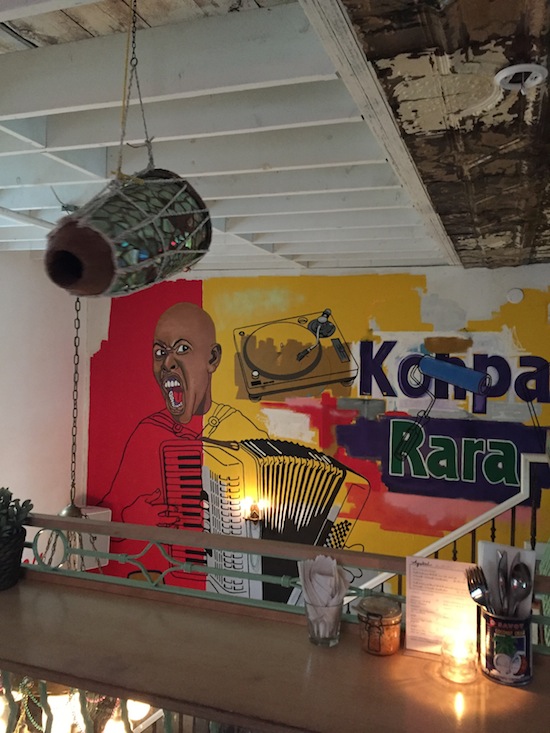
One of Agrikol’s upstairs walls features selections from Butler and Chassagne’s art collection, while another is adorned with a massive mural that includes the words "konpa" and "rara" alongside a depiction of a bald Haitian accordionist. Although the Haitian music that’s constantly playing is invigorating, Agrikol is too crowded for dancing. Perhaps this is why Agrikol’s owners opened up the bar – Ti-Agrikol – in a separate building next door. It features DJs and live entertainment often, although it’s hard to imagine any performer blending into the space nearly as well as DJ Windows 98.
Butler’s DJ set at Ti-Agrikol is eclectic, but distinctly Caribbean. The playlist he chooses from has ‘Kanpe Kanaval’ in the title – the conga-heavy mixes, 80s pop hits, and dub tracks were likely thrown together for the Kanaval-themed fundraising festival Arcade Fire headlined a few months ago. Every other act on the bill was Haitian.
During their set, Arcade Fire debuted a cover of ‘Ke M Pa Sote’ a Haitian hit by the legendary mizik rasin act, Boukman Eksperyans. Paul Beaubrun, the son of two Boukman Eksperyans members, joined Butler and Chassagne to sing lead vocals for his parents’ biggest smash. He couldn’t resist begging the crowd to “Jump! Jump! Jump!” along to the Haitian classic. They did.

At Ti-Agrikol, however, the jumping is kept to a minimum – except when a member of a tight-knit pack of college-aged boys finds it funny to soar through the air like a drunken swan, kicking his legs up and clearing out the centre of the dance floor. He elicits chuckles from both his friends and DJ Windows 98, who alternates between carefully adjusting knobs and watching the reactions of his ten or so guests on the dance floor.
Though the crowd remains small, Butler keeps the atmosphere lively, and most stay until the end of his four-hour set. Butler seems content to take a break from fronting one of the world’s biggest rock bands to make a tipsy audience dance to his fusion of familiar American pop and obscure Caribbean influences; this is, after all, what Win Butler does best.
About two hours in, Butler plays the opening piano trill of ‘I Want You Back’, then drops most of the track out, electing to play Michael Jackson’s vocal over a supremely danceable conga beat. The three women who have been begging Butler to dance, the enamoured young couple, and the college friends are all delighted by the mix.
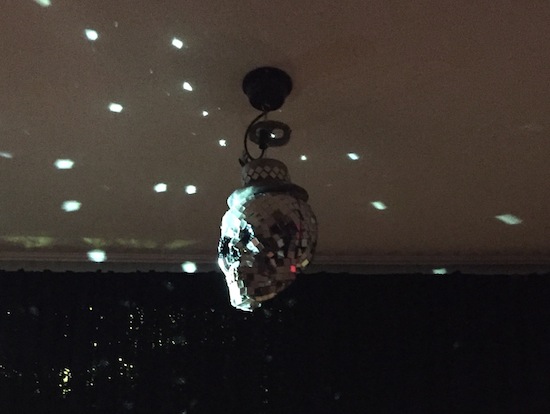
But, the track cuts out abruptly. There’s silence for a few moments. Then, the shrill cacophony of a steel drum band covering the Jackson 5’s Motown classic shakes Ti-Agrikol’s disco ball. The crowd resumes dancing, and Win Butler grins, unabashedly proud of his creation.