All photos courtesy of the Bob Young Archive
“It’s the marker, isn’t it? It’s the ‘BANG! Yes! You found it.’ Like now we know where we are and we can go on,” says Alan Lancaster. “On Piledriver, we nailed it. We really found ourselves, we found our sound.”
It might be odd to think it now, but there was once a time that Status Quo was one of the most drastically evolving acts around. After initially gaining fame with the psychedelic pop nugget ‘Pictures Of Matchstick Men’, Quo would find themselves bouncing around on Top Of The Pops in flowing shirts and bold patterns to match their seemingly complicated music. The band struggled to figure out who they really wanted to be and found increasing frustration with the corner they’d painted themselves into. Labels, managers, producers and stylists defined their existence and tried at every turn to corral them into the ‘pop band’ image.
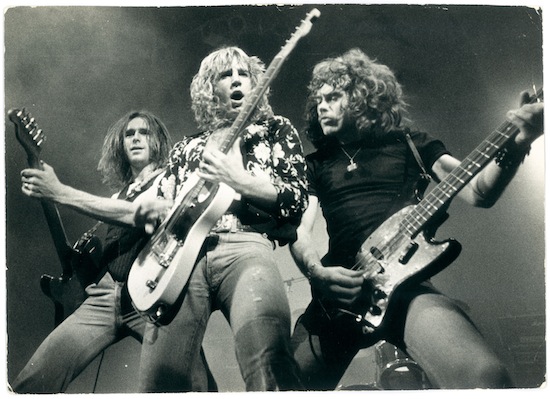
Despite the pressure, by 1972 Status Quo had gone through a massive change in music and style, so much so that their record label Pye was happy to see the back of them. The frilly shirts, bouffant hairstyles and cryptic album titles of the psychedelic 60s variety had given way to long hair, denim and hard rock. The change was a drastic, but natural one as the line-up of Francis Rossi (guitar and vocals), Rick Parfitt (guitar and vocals), John Coghlan (drums) and Alan Lancaster (bass and vocals) moved remarkably in sync from one era to the next. The two albums that preceded Piledriver, Ma Kelly’s Greasy Spoon and Dog Of Two Head, showed the glimmers of the band’s now-famous style, but Piledriver would be the first time that Status Quo boogied and shuffled their way into a trademark. Based heavily on the fashion of a single Doors tune, Quo found their rhythm, and the result was their biggest success to date. While not feeling inclined to take on the respective indulgences of the glam and prog movements gaining ground around them, Status Quo began to cement their position as denim-clad boogie rockers.
Piledriver is currently seeing a reissue in honour of the band’s upcoming shows, which are to be the last to feature the album’s line-up, known as the Frantic Four. When they first got back together for gigs last year they were welcomed with sold out shows and grown men weeping with happiness, such is the lasting effect of the band’s 70s period.
“There is something special about Coghlan, Lancaster, Parfitt and Rossi,” says Rick Parfitt. “I can’t put my finger on it. It’s frayed around the edges, it’s not perfect, and nobody quite knows where the endings are. Piledriver just had something very special about it. It’s a great album cover and it’s a great album.”
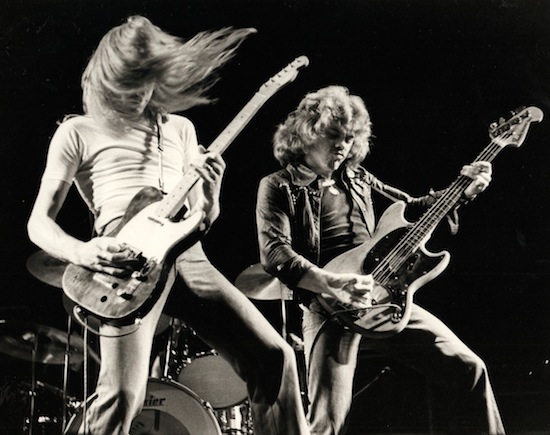
Feature continues after photograph

Before their last London shows at the end of the month, the band took a look back on the album that marked the birth of the Quo as many fans would like to remember them.
Francis Rossi: If you go back to ’65, we had more of a rocky thing going than ‘Matchstick Men’ at the time. I was trying to write a song that was like Jimi Hendrix’s ‘Hey Joe’ and came out with ‘Matchstick Men’ so we went to record it. This record became a huge hit. After the initial success, the band were no longer successful and we decided we didn’t want to wear that kind of clothing anymore and we wanted to go back to something similar to what we’d done before the success. And we became known for it.
Alan Lancaster: At Pye Records we were in our evolutionary days, if you like. We sort of graduated while we were on Pye and our producer at the time John Schroeder (a very good producer) realised it was going in a different direction, the bluesier boogie direction. He let us have a bit of free reign, and that’s when we made Ma Kelly’s Greasy Spoon, which was the start of the change, then we did Dog Of Two Head.
FR: We’d come to a point with Pye Records where we were kind of manufactured somewhat. We were taken out and told what to wear, what to play, how to do. We had a crossover with managers and we were doing something similar to what we’re doing now, but Pye really didn’t see it.
AL: We realised we had to get out of it because they would always see us as the glammy pop band that we were being marketed as at the time. But it was such a natural change we probably would have made Piledriver as it is either way. But Vertigo came and they gave us a free hand to go into the studio and self-produce.
FR: Management called in the guy who ran Vertigo records. For some reason Vertigo was seen to be a very cool label. It’s a good thing I didn’t know that back then or I would have said, “No, don’t do that.”
Rick Parfitt: Changing the label was a step up I guess. Vertigo was a bit more trendy and a bit more hip. The promotion was much better, it was a bigger record company, more up to date and I think the timing was great. It elevated the band to where it wanted to go.
FR: We were listening to a lot of Chicken Shack at the time, which were Stan Webb on guitar and Christine McVie – though she was Christine Perfect at the time – of early Fleetwood Mac, Taste, coupled with all the Little Richard and some of that 50s stuff we drifted through. We would sit by the side of the stage and Chicken Shack would start, “2… 3… 4… dunk du dunk du dunk du dunk” and an hour and a half later they’re still doing it. And we’re thinking, “This is fucking great! Why aren’t we doing this?”
RP: On our first European tour, Francis and I went out to a club. The Doors’ ‘Roadhouse Blues’ came over the sound system. There was this couple dancing really kind of slinkily to this dunk-du-dunk-du-dunk-du-dunk kind of rhythm and I just looked at him and he looked at me and the hairs stood up on our arms. We thought, well, we’ve got to play that! That was really the start of the Quo style of music, the 12-bar blues shuffle rhythm.
John Coghlan: I remember we were in Germany in a club and this ‘Roadhouse Blues’ came on and the audience loved it, they were leaping about, having a good time, so we put it in our set and it paid off.
RP: We had just started touring and immediately we started to rehearse this ‘Roadhouse Blues’ track and it became very popular. Alan Lancaster sang it and he sang it really, really well. And we just did a completely different version of it than the Doors, much heavier and in the Quo style that we were just beginning to find. So we started playing that and then we started writing stuff like ‘Don’t Waste My Time’ and all kinds of things that had that sort of shuffle rhythm. It just became the trademark and people just loved it.
JC: I’ve always played a lot of stuff with what they call four-on-the-floor, four beats to the bar on the bass drum. Played hard and loud, that’s what makes the people leap up and down and do that Quo dance, shuffle. A lot of drummers don’t play four-on-the-floor, they do two to the bar, it doesn’t work, you have to play four to the bar, for the shuffle, which I’m pleased to say I’m good at.
RP: I like to imagine other bands going, “Look, I’ve come up with this song that goes dunk-du-dunk-du-dunk-du-dunk” and the other members going, “Well, we can’t do that because we’ll sound like Status Quo!”
AL: Piledriver was one of our natural albums. Our first big hit. We were playing that stuff on stage in concert and usually when you’re recording you’re making an album and you haven’t played the stuff before and you’re getting it all together and writing and then the album is made and then you realize when you’re playing them live that the recording was a lot better. But with Piledriver we were playing that stuff live and when we went into the studio we were ready to go! So that’s what I mean by natural, we didn’t have to work on the songs or write too much in the studio.
JC: I think we knew what we wanted. We didn’t want to be told by a producer how it should be. We didn’t want to spend all our time trying to explain how we want to go in one direction and have him trying to pull us in another way. He would want it to be really commercial and we wanted it to be more heavy.
FR: We used to sit in a circle at the IBC Studios in Portland Place, London. We’d be making the album, there’s the smell of kebabs and we’d be smoking joints.
JC: I’ve never smoked cigarettes in my life because I hated the idea of it, but I remember having a joint because in those days as far as I was concerned it was pretty mild and it was pretty harmless. It was part of that scene. But I had to be careful because if I smoked too much I couldn’t play!
AL: We very much played as a band, we didn’t do much of that one at a time stuff that bands do today. All of that stuff on Vertigo was played live. None of it was played individually like playing in the studio on your own – except for the vocals, we always did the vocals separate.
FR: All of a sudden the engineer would come in and say, “You’re going to have to stop”, because the Chinese embassy next door was sending morse code messages and they were coming through our amplifiers! It was hilarious at the time. Someone’s sending a message to China, do-do-do-doo-do-doo-do-do, all you’d have to do is sit down and work it out!
AL: It was a lovely big room with high ceilings and it had a fireplace in it. It was a massive so you could all play in it together and the sound wouldn’t smash your ears when you played hard. We’d play in the soundroom together and we used to call it the ‘magic circle’, all facing one another with John behind us and the lovely high ceilings would just pass it out and we would play and play and play, and in a few takes we’d have it down.
RP: I think Piledriver holds up because it was of its time and there is some beautiful songs on there. There are some classics like ‘Big Fat Moma’ and ‘Paper Plane’ and the now very famous ‘Roadhouse Blues’ which was actually responsible for kicking off everything that we do.
JC: ‘A Year’, ‘All The Reasons’, ‘Big Fat Moma’, they’re great songs and those three guys are great songwriters, as is [Quo roadie and collaborator] Bob Young.
AL: I wrote ‘A Year’ with Bernie Frost, a guy that John had introduced us to. He had this one line, he played it for me once at my house, “da-da-daa-da-da-du-da da-da-la,” he says, “that’s all I’ve got”. I took it from there. It’s got a certain vibe, we thought about playing it live, but it’s quite a down sort of song. When you’re young the things you think about are sex or death, and I guess sexual death is what that song is about! Losing someone you love. ‘A Year’ was one of those one-offs, I was just trying to make a nice dramatic song.
RP: One of the tracks that I really love on there that was really unusual for us was ‘Unspoken Words’, it’s such a lovely song. I don’t think we’ll be doing it live, but we’ll be doing things like ‘Big Fat Moma’ and ‘Paper Plane’. You know what? I love every track on that album! I think ‘All The Reasons’, it’s just such a beautiful song. I wrote that about my wife at the time.
JC: I love ‘O Baby’ it’s like early blues to me! We’ve been playing that one for the Frantic Four shows and it goes down great.
RP: I came up with the title of Piledriver because it was so heavy and I thought Piledriver was quite applicable to Quo at that time. It’s one of my favourite albums. I love all the albums from that time. We lost our way for a bit after that, in the mid-80s and 90s we lost our way, we got into drugs and everybody’s head started going off in different directions whereas before we were like one. Once the drugs crept in, everything started to go mad. It all kind of fell apart and of course the animosity crept in and Alan went to live in Australia and John disappeared somewhere. But for us to get back together for these reunion shows, and be friends all these years later, it’s been brilliant. People who had their Quo jacket hanging up in their wardrobe for the last 30 years are going, “Is this really true?” The reaction was amazing.
FR: It’s a learning curve for me because I hear ‘nostalgia’ and I think, “Puh! Bad word." But it’s not! We all have nostalgic feelings about all sorts of things. I could see these people at the shows and they were crying.
JC: When someone told me that, that there were grown men crying, I said, “Christ! We weren’t that bad were we?”
FR: It’s not necessarily my decision to end it now, but it can’t go on without me, and I’m not going! [laughs] I think it’s fine to have it one more time and then that’s it.
RP: Getting the band back together was a platinum moment, it was shiny and wonderful. This time with the line-up it will be gold, and I do not want it to go down to silver and then to bronze. I don’t want that to happen. I want to go out on a great high. So this is definitely the last time we’ll do it… definitely… maybe [laughs]. Maybe definitely.
Piledriver Deluxe Edition will be released on March 24 via UMC. The Frantic Four Reunion tour will start its UK run at the Hammersmith Apollo in London on March 28; head to their website for full details and tickets