

Joel McIver
I wrote Ice Cube: Attitude in 2002: it was my fourth book of the 25 or so which I’ve written since 1997 and, I think, the first one that was any good. It’s funny: as a relatively inexperienced writer, as I still felt I was even after three books, I didn’t have much confidence in my work and wasn’t sure that it would turn out that well. As a result I put everything I had into the Cube book, actively trying to shed fresh light on his life and career, while being fully aware that a white, middle-class guy from Somerset might not be everyone’s idea of an author ideally placed to comment on Californian gang culture. To my relief the book sold well and received positive reviews, and not merely in fanzines and what have you: for the first time in my career, larger magazines such as Uncut took notice. After a decade, Ice Cube: Attitude, whose rights reverted to me ages ago, has been reprinted by Foruli Classics with a new introduction. Here’s an excerpt, which I’ve taken from the chapter which covers Cube’s role in the excellent 1997 film Three Kings, still his best movie apart from his debut in Boyz N The Hood eight years before.
Three Kings was previewed on 27th September 1999 and made an immediate splash among reviewers and audiences. Let us be in no doubt here (a change from the recent mixed responses to the semi-good, semi-lame films Ice Cube had appeared in since the mid-90s): Three Kings is an excellent piece of movie-making. Superbly scripted and directed with effortless panache by David O. Russell, its setting (the final chaotic months of the Gulf War) and message (partly anti-Bush, partly anti-consumerist, but intriguingly not wholly either) were entirely unprecedented – and the cast was, quite simply, to die for. Add to this a significant budget ($48m), plus experts in location scouting (California and Mexico), photography and special effects, and the result is truly gripping.
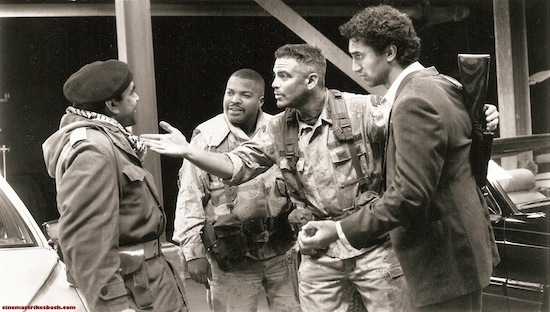
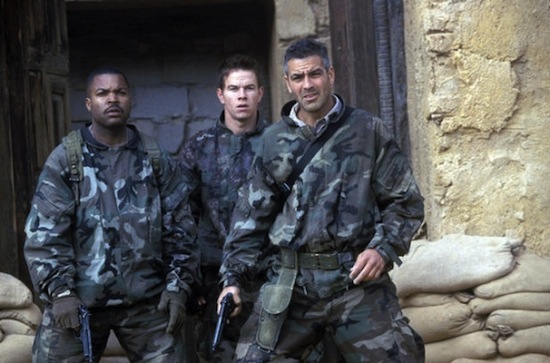
And yet on first glance the plot seems merely like a beefed-up treasure-hunt movie. It’s the end of the Gulf War. Saddam Hussein’s Iraq has collapsed under Western attack, with the leader gone to ground, its infrastructures crushed and its people traumatised. A few divisions of American soldiers are waiting for the command to pull out and go home, although communications are sporadic and the general air of chaos that pervades the Iraqi desert communities also extends to the US military, who have no clear idea of what their role is, if a war is actually happening and even if they’re allowed to shoot people (the film starts with this exact query: Mark Wahlberg kills an Arab soldier and isn’t sure if he’s just committed a heroic deed or a simple murder). Four soldiers convene. Their leader is Major Archie Gates, played by George Clooney, heartthrob and recent inheritor of the Batman film role. Clooney’s roguish/disarmingly attractive character is typical of those which he had adopted to great effect in films like his Quentin Tarantino/Roberto Rodriguez-helmed debut, 1996’s From Dusk Till Dawn (in which he “emerged as full-blown film star”, raved Variety) and later Out Of Sight and Ocean’s Eleven. Gates notes that one of the other soldiers, Troy Barlow (Wahlberg), has found a map which seems to indicate that hidden treasure in the form of gold bullion stolen from Kuwait is located nearby. Along with Chief Elgin (Cube), a deeply religious, working-class army reserve member from Detroit, and Conrad Vig (played by director Spike Jonze in his first major acting role), a simple but appealing redneck straight out of Deliverance territory, the four men plan to steal the gold for themselves, with Barlow, Elgin and Vig persuaded by the charismatic Gates to play along in return for a share of the wealth.
So far, so standard adventure-story – but as the film progresses, several themes come into play which turn it into a fascinating social and political exposé. The soldiers come across the loot and are about to leave the scene – an Iraqi village – when the inhabitants beg them not to leave. It suddenly becomes clear that the locals will be rounded up and executed by Saddam’s Republican soldiers (true to actual fact, the populace had been exhorted by President Bush to rebel against Saddam, but had received no Western support in this and the dictator’s troops were exacting cruel vengeance for their rebellion) if the Americans leave. Gates’ team elects to take the villagers with them, effectively turning their selfish search for riches into a humanitarian mission. Their motives have been reversed at a stroke, and a powerful criticism has been levelled at their country and its leaders.
The second major theme is explored in detail when Barlow is captured by Iraqi soldiers, tied to a chair and tortured extensively. His torturer, a young man whose family has been killed in bombings by the Western forces, makes him drink oil – both the currency and the cause of the Gulf War – after learning that his victim is a new father himself. He is eventually freed but, suffering from shock, barely survives a sniper attack. His friend Vig dies in the same scenario.
Thirdly, Russell cocks a snook at consumerism. The media are everywhere (Gates and his soldiers are tailed by a persistent news reporter) and there is an amusing interchange between Barlow and Elgin throughout the film about whether or not the Lexus or Infinity cars are available as convertibles.
Ultimately the three men conquer all the odds and get away with it, but not before the film has been variously a farce, a grim parable and a violent horror story. Its multifaceted nature seemed to appeal to audiences (Cube later said: “I like how the movie shifts gears. It’s like going from comedy, then it goes into the heist, and then there’s this action and then… it turns into a whole different thing”) and it’s easily the best thing Russell or any of the actors (including Clooney) have done, before or since, although some might prefer Wahlberg’s stylish Boogie Nights for its glossy chic. All the performances were superb, with Clooney a resilient, war-torn leader (at one point he uncovers an Iraqi corpse, to silence the younger soldiers’ naïve complaints that they had seen little ‘action’), Wahlberg a troubled everyman, Jonze a kind of doomed court jester and Cube – at last – in the perfect role for his brooding, almost sullen acting style.
“Chief is basically from Detroit – you know, seen a lot of violence,” he explained to The Michigan Daily. “Very religious man. Basically in the Army Reserves and making a little money on the side and isn’t expecting to be caught up in the war. And he gets caught up in the war. He relies on the training, but he is going to rely on the same thing that got him through the streets of Detroit, his Lord and savior Jesus Christ… I think Chief is somebody you want on your right hand."
Elgin has both gravity and nobility. A telling scene occurs early on the movie when Vig the redneck is using the terms ‘sand-nigger’ and ‘dune-coon’ when referring to the Arabs. Cube’s character warns him not to use these words near him – the threat of righteous violence is tangible – before the scene becomes surreally hilarious when the two men agree that ‘towelhead’ and ‘camel jockey’ are acceptable synonyms. And when Barlow is rescued, pale and silent, from his torture session, Elgin informs him with sympathy that he (Barlow) is in shock. This short sentence is full of pity – that Cube invested these few words with so much power is an achievement worthy of a far more experienced actor.
“The first time I saw Three Kings I was like, this is something,” Cube told The Daily Bruin. “I didn’t think it would be liked by so many people”. This is perhaps due to the vision of David O. Russell, who had evidently picked a subject which audiences wanted to respond to. He also knew his actors and their careers: Ice hadn’t had a real chance to stretch himself as an actor since Dangerous Ground, after all, with the Friday and Player’s Club roles amusing rather than demanding – as Russell told Student.com: “[Cube] was the first person I cast… I saw his work in Boyz N The Hood. He’s gotten to do a lot of commercial movies, like Trespass or Anaconda, but I think this is a real chance for him to show his chops. He’s quite serious as an actor, and he’s very professional, and he’s a no-nonsense kind of guy”.
Russell then recounted a story in which he saw Cube squeezing the contents out of a Taco Bell taco: “We were sitting in the lobby of the Holiday Inn in Casa Grande, Arizona…he saw me looking at [the taco], and he said, ‘You think that’s strange?’ I said, ‘Well, yeah, I guess’. And he said, ‘That’s what makes me me.’ That is pure Cube, he’s just totally, shamelessly confident about himself and his choices”.
The director was obviously delighted with Cube’s seamless performance: “He bought that character big time. To pull off that toughness combined with that vulnerability… Cube prays in this movie, you know, that’s really vulnerable. When was the last time you saw a character pray, sincerely? It’s not a joke, it’s not a goof, and he pulls it off, with a lot of integrity”. The famous ‘sand-nigger’ scene had not been an easy one to include, added Russell: “[The US] had this alliance with the Saudis and other Arab nations, but war always makes the enemy a racist enemy, so it’s very confusing. We’re supposed to like certain Arabs and not like other Arabs… the Arab advisers said, ‘We don’t want you to have this conversation in the movie,’ where… ‘towelhead’ and ‘camel jockey’ are perfectly acceptable. And Cube, a black man, says ‘Exactly’. Cube’s agreeing with him”. The conversation would be offensive to both Arabs and blacks, he was warned, but Russell insisted that it stay in the script for the sake of veracity: “I said you have to have that in there, because that’s where these guys are. It’s meaningless otherwise, when they hang out with the Arabs, if they haven’t started at that place”.
Although the movie was a triumph, Cube had initially been unsure whether to get involved, as he told the Guardian: “I wasn’t sure about it. Wasn’t sure at all. Because it’s offbeat, it’s not your typical… movie. But once David O. Russell explained what he wanted to make then, yeah, I was cool with it”. The wheel had come full circle, it seemed, in one respect at least. Remember Ice-T’s uncertainty at playing a cop in New Jack City back in 1991? It was now Ice Cube’s turn to feel that he might be on thin ice: “You know, it’s funny, ‘cause if you asked me back in ‘91 would I ever be in a movie as a soldier, a US soldier, I’d have said get the hell out of here. Hell no! But that’s what I like about the film – we showed there were a lot of people on both sides who really didn’t want to be there”.
The broader implication of this last statement is simply that Cube feels the desire to educate. Asked whether the film’s indictment of both Saddam and Bush had attracted him, he answered with enthusiasm: “Oh yeah… I love any time you can enlighten people to mistakes, that’s how I started my career. It definitely turned me on. Plus I like the interaction of the soldiers and the Shi’ite Muslims”. Whether he says this last sentence from a Nation Of Islam perspective, or simply from someone angered by the West/East imbalance of wealth, is not clear – but his global appreciation of what the film means certainly is, not least the film’s title itself. As he told the German BZ Aktuell, the soldiers’ turn from greed to good, ultimately bringing the people out of Babylon (or its equivalent), is a direct reference to the Three Kings of the Bible.
The political agenda of the director went deeper than a simple anti-White House attack. Russell was also targeting the American Way itself, to a certain extent, which made the film’s box-office success even more unexpected. He told Michael Sragow at Salon that “I knew there had been a whole side to the conclusion of that war that had been buried under a sea of yellow ribbons. I thought it was scandalous that it hadn’t really been told. Many of the soldiers I met who had experienced it felt – strongly – that there was something hypocritical about the end of the war. And then, when I continued my research, I found… that some of the stuff the media had ‘previewed’ had happened, to a degree never brought into our awareness”.
The media’s control over how the war was perceived had given him a genuine desire to tell the truth about the hidden events, it seemed: “Everybody’s image from the war was of computer images, which dehumanizes the whole thing. So I wanted to show what it was like to live with a gas alarm and know that different kinds of gases are in the air. I wanted to show what it was like to meet Iraqis face to face, and what it was like to see all this stuff stolen from Kuwait. Getting the information out was a powerful motivation for me”.
Ice Cube may well have been the first person Russell cast, but as he revealed to SplicedWire, there was another contender for the Chief Elgin role – a very surprising choice: “I wanted either [Cube] or Charlie Hayes, who played third base in the ‘96 World Series Yankees. I think now he plays for the Giants. He’s not an actor, but I love his energy”. Personal qualities over-ruled acting experience, it seems, when it came to casting this part: “[Hayes is] very focused, quiet, solid, intense, no nonsense. Cube has that in spades, and that’s how I cast him… I thought he really hadn’t had an opportunity since [Boyz] to do some serious acting, which is what he wanted to do, which is why there’s no songs of his here. He wants to separate himself as an actor and take it seriously… I cast people who I think feel real and think feel right for the part and have a passion about it”.
As for the anti-consumerist message, alongside which Cube’s almost spiritual role is in stark contrast, Russell was very clear about his motives: “I knew that consumer culture was going to be a big part of the movie. Everything I read… showed that this was the first war where [they] had their CD players over there, some guys had Watchmans and they were watching the war they were in on TV. And there was a lot of stuff stolen from Kuwait, which is one of the richest countries in the world, and all the goodies of America are over there, from blue jeans to lime green Cadillacs”.
The making of the film was both tough and enjoyable, it appears. Ice Cube later told a fan during a webchat that both Wahlberg and Clooney enjoyed plenty of female attention (“Man, that George Clooney just turns down pussy all day long”), while Wahlberg recounted how everyone wanted to watch the filming of his torture scene: “It wasn’t fun. George and Cube and a bunch of guys who were not in that scene would come to watch”. Russell explained that the others had stepped on the wires leading up to Wahlberg, managing to hurt him temporarily. Add to this the military training the cast underwent, and the learning curve must have been both steep and exhausting – Russell said: “They had three days of going shooting, then [the military advisers] got them comfortable with the M-16 [rifle], they gave them the lingo of the war, then they had a four-day mission where (after) we built our sets, they did an assault on the town and stuff like that”. However, he admitted that the cast had at least slept in the Holiday Inn, rather than in a camp.
It later emerged that director Spike Jonze had kept himself busy during the filming by making his own mini-documentary on Ice Cube, using a single hand-held camera. This was eventually edited and issued on the DVD version of Three Kings as An Intimate Look Inside The Acting Process With Ice Cube, a semi-tongue-in-cheek title which reflects the subject matter – Cube does indeed spend some time explaining how he gets into the mind-set of the Chief Elgin character – but is more illuminating for its depiction of the on-set activity
The publicity which the actors did as the film went to release was light-hearted but sober, with Clooney pointing out perceptively: “There is a danger… as we go through this [publicity] process, that Cube and Mark and Spike and I, and David, too, are going to suddenly become experts on the Gulf War… Since we sort of go after the George Bush policy in this a little bit, that’s going to become a hotbed. So, suddenly we are going to become these experts on something that we don’t know enough about to be the experts on. We know some.”
Their knowledge (or lack thereof) of their subject didn’t stop many critics from piling praise on the film. The Chicago Sun-Times’ Roger Ebert said: “Three Kings is some kind of weird masterpiece, a screw-loose war picture that sends action and humor crashing head-on into each other and spinning off into political anger. It has the freedom and recklessness of Oliver Stone or Robert Altman in their mad-dog days, and a visual style that hungers for impact”. Slate’s David Edelstein went one better than the Stone/Altman comparison, holding Russell up as a kind of mad genius: “The movie takes the view of a mordant social scientist who recognizes that consumerism has become the true world religion… Three Kings is not the first anti-war movie in which opposing soldiers have recognized themselves in one another before pulling the trigger, but it might be the first to make the point in a way that has nothing to do with liberal humanism”. Wesley Morris at the San Francisco Examiner crowed: “Three Kings, in all its ragged, sand-swept glory is still a work of strangely bold, distinctly American pop art – proud to be ashamed, ashamed to be proud, unafraid to ignore its commercial bearings ‘cause it can laugh all the way to MENSA before it stops at the bank… [It] is a post-colonial, post-war, action-heist-comedy-satire-farce-screwball circus that’s like MAS*H being churned by a sneering, over-amped organ grinder.”
It seemed that Ice Cube could at last boast a bona fide classic film to stand alongside Boyz N The Hood on his resumé. But as usual, he wasn’t about to wait around for the plaudits to come to him – his next project was already underway. Although the ripples from Three Kings had not yet died down, Cube’s next appearance in public came only one month later, when a new film in which he played a cameo was released. The movie was a Mack 10 vehicle called Thicker Than Water, and it’s perhaps just as well that Cube’s role was a minor one – the movie was received with lukewarm reviews at best. Talk about peaks and troughs…

The reissued edition of Ice Cube: Attitude is available now, published by Foruli Classics