

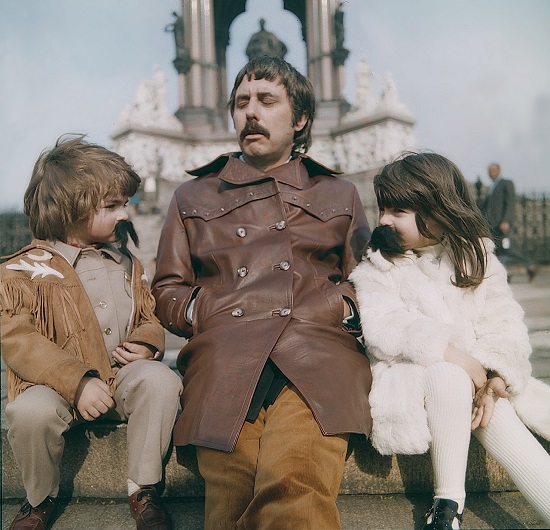
In a smoky bar in Berlin, we are drinking a toast to the memory of Lee Hazlewood. Wyndham Wallace, tQ contributor and Lee’s manager at the end of his career, has just revisited their stormy eight-year relationship in his terrific memoir Lee, Myself And I. Beginning with an eccentric appearance at Nick Cave’s Meltdown Festival in London in 1999, Wyndham helped steer Lee to an autumnal comeback, forming a deep bond with him, only to watch him die of renal cancer in 2007.
A cult singer, songwriter and producer who helped shape the careers of Elvis Presley, Duane Eddy and Frank Sinatra, Hazlewood is best known for his Nancy Sinatra duet ‘These Boots Are Made For Walking’, a transatlantic chart-topper in 1966. But his musical legacy is much deeper and stranger than his handful of pop hits. It featured long periods of exile in Sweden, a self-sabotaging allergy to fame, a short-fuse temper and an overactive bullshit detector.
Full disclosure: Wyndham is a friend of mine and we both write for some of the same publications, including tQ. Hence I was initially wary of doing this interview, which could smack of matey nepotism. But then I read his book, which is warm and moving and full of Lee’s gloriously prickly humour. More like a rites-of-passage non-fiction novel than a music business memoir, the time-scrambled narrative zigzags between London and Berlin, Las Vegas and rural Sweden. Stewart Lee provides the foreword, while Nick Cave and Steve Shelley make cameo appearances, a measure of Hazlewood’s evergreen high standing in connoisseur circles.
A man of sudden mood swings, great generosity and endless stories, Hazlewood liked to characterise himself as a "redneck Indian cowboy singer". He insisted music was purely a job, not an art form. But as Lee, Myself And I proves, the real story was richer and darker and much more complicated.
So here we are in Berlin, not far from the Markthalle where I met Lee at a dinner party almost ten years ago, as recorded in your book. My memories of that night are a bit blurry, but he knew he was dying by then, right?
Wyndham Wallace: Yes, he did. He’d come here to record a duet with a German indie punk legend called Bela B. They’d agreed he could also use it on his final album Cake Or Death if he liked it. But he knew he was dying by then, though he was still in the treatment stages so there was hope. I don’t think it had truly sunk in with me at that stage, either.
Even so, I recall him being full of boozy bonhomie that night. He was teaching me high-level swearwords in Swedish. I bet you wouldn’t get that on a night out with Van Morrison.
WW: I’ve not met Van, but something tells me no non-Swede swore better in Swedish than Lee did. The first word he ever taught me when we went to Stockholm together was unspeakable.
Speaking of the unspeakable, Lee’s penis features quite prominently in the book. Do you think that would have made him proud?
WW: I’m pretty confident that he’d take a swing at me if he knew, but I suspect he might chuckle afterwards and buy me a double Chivas with extra ice to nurse the bruise. It’s not like he wasn’t a little bawdy himself at times. And it’s not like I’m dissing his girth.
Dissing My Girth. That should totally be the title of your next book. Chivas actually features heavily in the book, as it was Lee’s favourite drink. You even tried to get the company to sponsor him at one point, but they turned the idea down flat. Why?
WW: I think they felt they were far above handing over money to an old man who wasn’t a familiar name. At least they replied, which was more than Lee Jeans did. Chivas Presents Lee Hazlewood was perhaps a bit topsy turvy. Lee spent his nights presenting everyone with Chivas! When he lived in Ireland he insisted that his local bar stock it or he wouldn’t drink there. They learned it was in their interests pretty fast.
There is an old proverb that says, before speaking about another person, ask yourself three questions: is what you say true? Is it kind? Is it necessary? As long as you meet two of these criteria, then go ahead. Does your book pass this test?
WW: Is it kind? I think so, yes, though I’ve tried to remain honest about what I saw and felt. I certainly don’t pull my punches about the darker side of Lee’s nature, nor indeed about some of my own foibles. But there were things I could have written and in the end didn’t feel the need to share. They didn’t contribute to the story of our friendship, and that was the focus of the book. As for whether it’s necessary, only time will tell, but it’s certainly true that there’s no other book on the shelves about Lee, and I believe there’s enough interest in him to justify its existence. I’ve no idea whether he’d agree with that assessment, of course. But I think it helps build a picture of the man, and people seem to be enjoying it so far.
You express great affection for Lee in the book, though he was clearly short-tempered and irascible at times. Did you forgive him at the time, or has that come later with hindsight and reflection?
WW: In all honesty, I think I was like a little lapdog much of the time I was around him, my tongue hanging out, waiting for praise and whatever bit of his big bloody steak he’d toss from the table. I mean, this was Lee Hazlewood! He’d written not only classic pop like ‘Boots’ but also weird, extravagant, out-there things like ‘Some Velvet Morning’. Have you heard his songs? If you dig into his old albums they’re just brimful of extraordinary tracks. My Autumn’s Done Come is a masterpiece about growing old, and he wrote it in his thirties. ‘Tippy Toes’, with Nancy Sinatra, is just about the sweetest song ever written about watching your kids grow up. And ‘Come On Home To Me’ is probably the bleakest but most beautiful tune you’ll ever hear about missing your ex. And his voice was just astonishing. Plus he’d discovered Duane Eddy! It was incomprehensible that he’d settled for me.
But as time passed, and I came to collaborate with him in greater depth, I recognised that he respected my work, and my awe turned to what I can only describe as love. And if there are two groups of people that I’m always swift – perhaps too swift – to forgive, it’s people I’m scared of and people I love. So yes, I liked him a great deal, even when he was at his most volatile, and I was never slow to forgive him, because, well… he was Lee Fucking Hazlewood!
One of my favourite bits is where he fires you for having a migraine. It’s like a scene from an indie-rock version of The Devil Wears Prada.
WW: Yeah. That was a good morning.
I also like the book’s time-jumping, non-linear structure, which feels more like a novel than a music memoir. Was there a reason for scrambling it like that?
WW: I don’t read many music biographies, and I wanted to write something that I’d enjoy reading. My favourite music book is probably Nico: Songs They Never Play On The Radio by James Young, because it doesn’t pretend to be anything other than a memoir that tries to shed light on a secretive musician at a point in her life where she’d left the glamour and high life behind. That allowed me to think about approaching my book in a non-historical, non-traditional biography way.
It felt important that people understand what Lee meant to me as an artist, and the best way to illustrate that was by flashing back to how I first stumbled across his music. I also believed that to simply recount our interactions from start to end was going to get pretty dull. I knew him for eight years, after all, and a lot of what we did was fairly routine music business stuff. So I decided to focus on the first months of our relationship, and the final 18 months or so when he really opened up to me and allowed me to feel part of his family.
The period covered in the book also touches on some dark events in your life. Has writing this helped you to come to terms with deeper stuff than merely your relationship with Lee?
WW: Well, as you know well from evenings that we’ve spent together over a drink or nine, I’m prone to a certain amount of melodrama, while at the same time cursed with a British stiff upper lip. So I’m inclined to suggest those times weren’t really that dark when you compare them to the hardships that others have suffered. But they felt relevant to the book I was writing, because they impacted upon my relationship with Lee. So I tried to loosen my upper lip a little, and that’s why I included them. I didn’t write the book as therapy, honest, but it probably did help, because it forced me to think about why I behave the way I do in certain situations. It also made me address my penchant for people who are sometimes not terribly kind to me, but who I nonetheless can’t get enough of. I haven’t quite solved that one…
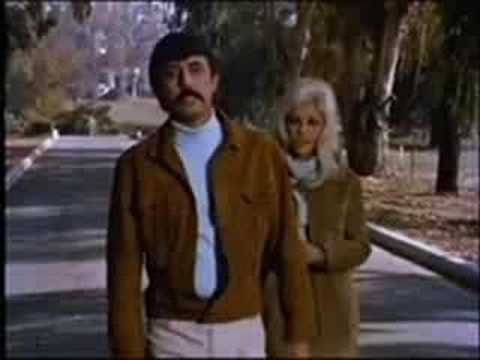
Lee claimed to be more interested in money than art, and always demanded a hefty payment for his services. How much do you think was that a philistine pose?
WW: Lee started out writing songs which he’d take to LA on the Greyhound bus and perform to publishers, cap in hand, hoping they’d sign him and pay him for those tunes. Initially he was unsuccessful, but he persevered, starting up his own label and publishing companies, finding musicians with whom he wanted to collaborate. And he soon recognised that songwriting, like all work, needs to pay its way if you want to make it a business. So I don’t think it was a philistine pose, more a simple recognition that if someone valued what he was doing then they should pay for it.
The idea that artists don’t need to be paid for their work is a pretty destructive one for culture, and Lee simply never accepted it. Nor should anyone else, unless they volunteer to work for free. He gauged the value of each individual piece of work from the money that it generated, but that doesn’t mean that it was the only value he found in his work. It was simply the most basic value, and he didn’t see why it was necessary to pretend that it was unimportant.
Before you worked with him, Lee turned down overtures from Beck, Nirvana, Sub Pop etc. If he had embraced them do you think he could have enjoyed a full Johnny Cash-style autumnal career revival instead of the more cult-level comeback he enjoyed under your management?
WW: I don’t know whether his songs are built for that kind of comeback. He had songs that started with spoken-word tales about drunk dinosaurs and funeral home workers drinking all their embalming fluid. I also don’t know if he was built for that kind of comeback either. I doubt he’d have wanted to find himself caught up in that kind of whirlwind: he was never very comfortable being in the spotlight, except for short bursts of time, and on his own terms. I suspect that’s why he enjoyed living in Sweden so much in the early 1970s: he could enjoy success on a small but manageable scale.
A lot of older artists reinvent themselves nowadays in that 6Music, boutique festival, elder statesman mould. I guess Lee wasn’t interested in playing ATP or recording with Jamie xx or whatever?
WW: I think Lee would have been up for doing things like ATP, and initially I even talked to Barry Hogan about a show before the offer came in from Meltdown in 1999. But in terms of encouraging him to perform with other artists I had very little influence, and he wasn’t terribly interested in new music. From time to time, these opportunities would come our way, or he’d have me chase them, but they were unlikely, to say the least. He worked with a Eurovision Song Contest Winner in Norway in 2005, I think it was, and at one stage I tried to get Pet Shop Boys to work with him on what became Baghdad Knights for his last album. It wasn’t his priority to be hip. I wish that Pet Shop Boys collaboration had come off, though. It would be like the dark side to Dusty Springfield’s ‘What Have I Done to Deserve This’.
Lee and the Pet Shop Boys! That could have been great… or a duet with Pharrell maybe?
WW: Yeah. About Pharrell…
Or with Colin Farrell at least?
WW: About as likely.
Lee’s fractious dealings with music journalists are probably the funniest parts of the book. And yet he enjoys huge critical respect. Was he just a thin-skinned diva or did he have a point?
WW: Lee was impatient with people he considered fools, and the music journalist’s trade has its fair share just like any industry. But he also had no patience for inaccuracy, and by the time his comeback was underway much of what was supposedly known about him was little more than hearsay. He’d disappeared so comprehensively that no one knew where he’d been, or what he’d been doing, and the arrival of the internet only helped spread these rumours. So when people wandered in and asked him about his relationship with Nancy Sinatra, for instance, it was not only a question he’d been asked thousands of times before, but it was one he’d settled thousands of times before too. And he had no fear of letting journalists know this. In all honesty, there were certainly times when I felt he was unnecessarily rude. But I don’t think he was a diva. I think it was a survival technique.
So what happens after publication? Any musical events planned to help promote the book?
WW: I can’t say too much yet, but I’ve had talks with a musician I admire very much about him putting together a special band to perform some of Lee’s songs with prominent artists as guest singers later this year in London. We’ve got some great confirmations, but there are still a few details to sort out. I’d also really like to do something similar, if on a smaller scale, in the US, or indeed anywhere that seems sensible. There are so many artists out there with love for his records that it seems like a wonderful excuse to celebrate him.
Lee’s songs have been covered by Primal Scream, Jarvis Cocker, Nick Cave, Alison Goldfrapp, John Grant, Billy Ray Cyrus and dozens more. Do you have a favourite cover?
WW: The one that always comes to mind is Stephen Jones from Baby Bird and Luke Scott’s version of ‘We All Make The Flowers Grow’ for the Total Lee! tribute album I put together in 2002. The way they actually sample him is wonderful, and their take offers the same sense of wry, world-weary resignation as his did. The most terrifying is Crispin Glover’s version of ‘Boots’… That’s just deranged. I wish I’d known about that before Lee died. Christ knows what he’d have made of it. I’d actually defy anyone to come up with a nuttier cover version of any Number One hit.
Yes, that is one of the greats. It’s like William Shatner without the subtle understatement. If Lee was around to read your book, how do you think he would react?
WW: Well, actually he read a little bit of it before he died, though he had no certainty at that stage that it would ever become a book. He seemed OK with it. If he saw the whole book, though… I like to think he’d advise me I’d wasted my time and then quietly tell his friends about it. It’s pretty affectionate, let’s face it. He’d probably just tell me I’d gone soft.
There was obviously a warm bond between you and Lee at the end. He even ended up calling you his "fourth child". Deep down, did you need him more than he needed you?
WW: Honestly, I can’t speak for Lee. But when I think about how his decision to work with me, and the friendship that followed this, validated my existence, it’s hard not to think that, to at least some degree, I helped validate him in turn just a little by helping to show him how much his work was loved. In fact, even, at the end – as I recount in the book – I helped remind him just how damned good he was by playing him old recordings he’d made but not heard for years. His response to hearing those songs choked me up completely.
I very much doubt he actually needed me, though. If he’d never have met me, I’m sure he’d have got on with his life just fine and have had to do less of those interviews he hated so much! I don’t really know what Lee needed. I just know that he must have got something he wanted out of me, and that I did it in such a way that he took me under his wing, and I definitely got something out of that. I mean, the man was my hero. And that was before I even met him.
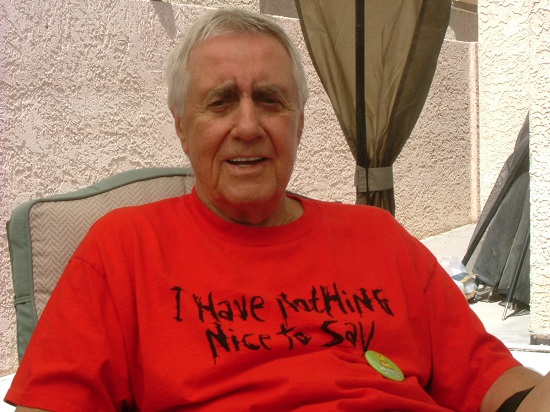
LEE, MYSELF & I
MY AUTUMN’S DONE COME
The following excerpt takes place in early July, 2006
Lightning claws the sky like bony fingers, throwing the mountains that surround Las Vegas into sharp relief. The phrase ‘shock and awe’ keeps coming to mind, the way the sky is lit an immaculate vision of an otherwise now heartless euphemism. There’s no sound, just a wild beauty to the storm, and as we prepare to descend into the desert, its proximity is unsettling, although I still can’t stop myself watching. There’s nothing else to look at anyway: beneath us lies mere emptiness, a barren wasteland that stretches as far as the eye can see.
That’s until the plane banks around and there, laid out before us, are lights twinkling like golden coins, a hint of the treasure trove that pilgrims to Vegas seek. The aircraft bounces and shakes as we head down over the plain in which this shrill, surreal city is settled, the famed strip of casinos looming larger and larger in our view, while around us the mountains are bathed erratically in violent bursts of phosphorescence. It’s a suitably theatrical arrival for the weekend that lies ahead.
Lee Hazlewood is dying of cancer. He knows he may not have long to live, and he’s not making any secret of it. It’s been that way right from the start.
‘I’m off to the hospital for a while Monday,’ he’d written to me, a year or so earlier, breaking the news of his illness to me in a typically frivolous fashion. ‘I spent 12 hours with these folks on Friday while they took gallons of blood and stuck me with spears. They then spake ‘it seems you have a mass’. I inquired was this a Christ-mass, a Catholic-mass, or just a mess-mass.
‘Anyway, I refused to stay in hospital Sat & Sun, told them I had more important things to do—with fear-lined faces and over active tear ducts they let me go. So I spent the weekend working on arrangements with Lars Samuelson in Paris. I’ll go back tomorrow for a biopsy to see if I have the big ‘C’. If so, I’ll take none of their treatments until I return—middle of April.’
The trip to Paris had been set up to enable him to begin work on a new album. Even before he began, he warned it would be his last, although its morbid title, Cake Or Death, was in fact borrowed from a sketch by one of his comedic heroes, Eddie Izzard. The confirmation of his renal cancer following these initial tests had done little to soften his resolve, and even his more pessimistic observations on the subject continued to be delivered with that distinctive wit.
‘Every month is a year at my age. My green fruit buying days are over.’
The invitation to celebrate with him a year later was similarly succinct.
‘My last (?) birthday party is July 8th in Vegas. Try to make it.’
When he put it like that, it was hard to refuse. With Lee, most things are.
Jeane meets me at Las Vegas’s McCarran International Airport. She and Lee are so different that his closest friends never saw their relationship lasting more than a matter of days.
‘They thought I was just dating her because she was a barmaid,’ Lee likes to laugh. ‘Why would I do that? I only drink Scotch. I don’t need a barmaid to fix a Chivas on the rocks.’
When I first met them, I took their relationship at face value, but familiarity has underlined how unlikely a happy couple they are. Quite apart from the fact that she’s around twenty-five years younger than him— and her politics skew to the right of his broadly liberal minded Democrat values—he’s a brooding poet with a dark, if sometimes unsubtle, sense of humour: a blend of Tommy Lee Jones, Robert Duvall, and Lee Marvin. She, on the other hand, is a cartoon character, a whirlwind of one-liners, laughter, and indiscreet stories, as excitable as Shelley Winters playing Charlotte Haze in Stanley Kubrick’s Lolita. Lee would no doubt abhor such casting, but since his favourite film is apparently The Terror Of Tiny Town, his own choices might not be any more appropriate.
Jeane delivers me to the Sunset Station Hotel & Casino, five minutes drive from their house in the Vegas suburb of Henderson. I visited this hotel once before, losing $700 in a catastrophic, two- afternoon gambling spree when all I was trying to do was keep Lee company. The place is vast, a labyrinth emitting an endless, chiming noise that stops just short of cacophony, row upon row of bright, flashing lights repeating uniform patterns. Around the playground of machines and poker tables lies a ring of restaurants and souvenir stores. The place is a monument to consumerism, and the cuisine on offer reflects this. Gamblers stagger to and from their filling stations, flashing American Dream currency, but Lee favours a place where he can cash in points he’s earned as a casino regular. It’s called, inevitably, the Feast Buffet, and it’s an all-you-can-eat experience that offers food from every corner of the globe: Mexican, Italian, American, Asian, and the catchall ‘International’. There is, of course, a separate section for desserts.
This is where Lee meets me for lunch the day after my arrival. I wait for him outside the entrance, marvelling at décor that allows the casino to host the illustrated, kitsch golden sunset that justifies its name whatever the season. I spot Lee limping inconspicuously towards me through the crowds, supporting himself on a silver-topped cane that he switches to his left hand so he can shake mine firmly.
‘Hey, Bubba!’ he says, his eyebrows briefly raised above the rim of his sunglasses.
‘Hey, Lee,’ I smile, as he releases his grip. Then he slaps me on the back and we embrace.
Lee presents his ‘boarding card’ at The Feast Buffet’s ‘check-in’. They subtract points from his grand total, allowing us to pile our plates high with food. He’s on good form, happy to be out of the house while Jeane continues her endless preparations, and in an impressively talkative mood right from the start.
‘I remember I heard this DJ one day,’ he says, in a voice so deep I expect lightning to illuminate the painted horizon. I’m still arranging the food on my plate that I scavenged from the various display cabinets: in front of me, the bones of various small animals glazed with sweet sauces lie among overcooked rice and a token vegetable or two.
‘He was playing some funny little country song, but about halfway through he interrupts it and says he’s playing the wrong side of the 45, takes it off, and doesn’t say what the song is. So I pull the car over onto the side of the road and I call the guy. “What was that song?” I ask, and the DJ says, “Hey, Lee, nice to hear from you.” “Yeah,” I say, “but what was that song you just played?” “Oh, that? That was a mistake. I meant to play the other side.” “Yeah, I heard you, but what was it?” And the DJ tells me, and I tell him to send me a copy of the single, and that was “Did You Ever”. Soon as I heard it, I knew it was a winner. I knew it was a hit. Of course we changed it a bit for Nancy, added some flutes and stuff. But it was the same song.’
I love these grand fables, although Lee’s perhaps more precise when talking about his family. Today’s all about his daughter Samantha, and how proud he is of her recent promotion. Predictably, his recollections of an era when rock’n’roll was a truly subversive movement tend to appeal to me more. Fortunately, he can be easily directed.
‘I remember going to a club,’ he says, picking at a chicken leg, ‘where there were all these kids eating sugar lumps. And I asked a friend what the hell they were doing. “Oh, they’re taking acid,” he said. And that’s why I wrote “Sugar Town”. And, by the way, none of the radio stations knew I was writing about kids taking acid, but that’s ’cos the censors only see things literally. That’s all they care about. It’s like “Boots”: “You’ve been messing where you shouldn’t have been a’messing?” Messing? That’s the F-word in Texas! When someone tells you they’ve been out messing around, you know they didn’t spend the night alone!’
Sometimes Lee’s eyes glisten with glee at the things he’s done, just as they do when he recalls his family, the girlfriends he had, the parties he attended, the Hollywood house he once kept, and of course the money he’s made. Lee loves his money, and he probably knows what he was paid for every job he’s ever done—and, quite possibly, the price of every steak he’s ordered. Nonetheless, despite his fondness for cash, rarely was a man less flash. I only discover he’s paying for my hotel when I arrive at reception, and after this first lunch he leaves me with his boarding pass and its PIN number, telling me to visit the Feast Buffet at his expense as often as I want.
Lee also talks about his health. He’s candid, aware of the fact that time’s now against him, and impatient to complete the deal for Cake Or Death: he wants to see it ‘escape’ before he’s ‘in his urn’. To look at him, he still appears reasonably healthy, but he gets tired more easily and suffers from countless aches and pains. He explains how his blood is spreading the renal cancer through his body, and says his cat, Chewy, found the latest evidence: a lump on his skull.
‘By the way,’ he adds, ‘the cancer’s not in my brain yet, though some people might question that.’
He’s due to attend the Mayo Clinic in less than two weeks for radiotherapy, and after that they’ll put him on pills ‘so experimental they’ve not even given them a name yet. They’re called DX132 A Piece Of Shit or something. The doctors don’t know if they’ll work or not. But, if I’m going to die, I may as well help someone on my way’. He tells me how the doctors presented him with a leaflet that listed all the possible side effects. He says he read the first two symptoms and gave it back.
‘I’ve spent my life trusting and depending upon the power of my subconscious,’ he explains. ‘I don’t want to read what my body might do, because then it’ll do that. If I don’t know, then I might not notice.’
He speaks in a matter of fact way about the possibility of losing his hair, of the scars he already has from treatment, of the operation on his kidney that left the stomach muscles on one side of his belly limp.
‘I know this lawyer who I don’t have to pay to sue their asses. We just split the winnings. And I’m gonna get them for that fuck-up, those miserable sons-of-bitches.’
He means it, although it’s something he’s been telling me for quite a few months. Later on, he confides there are other people who, over the years, have screwed him, often financially, that he also wants to sue, but he’ll have to leave it to his family once he’s gone, assuming they’re not already too busy squabbling among themselves. When he names names, I can see why he’s waiting.
Conversations with Lee can last for hours. If he has an audience, he revels in it. His daughter Samantha will accuse me a day or two later of being a little ‘goo-goo-ga-ga’ when I talk to him, but I’m so grateful for his patriarchal presence in my life that I’ll never apologise for humouring him.
Just how far he’s taken me into his closest circle becomes yet more evident when we meet for dinner later on. Jeane pulls up outside the hotel and I spot an eight-year-old hanging out of the back window. I correctly assume it’s Lee’s granddaughter, Phaedra, her name inspired by ‘Some Velvet Morning’. To this day, Phaedra thinks the song was written about her, and she loves to sing the line from the chorus, ‘Phaedra is my name.’ Lee has rewarded her by re-recording the track for Cake Or Death with her vocals. It’s a moment of well-deserved indulgence.
Phaedra sees me approach the car.
‘Bubba!’ she yells, big blue eyes gleaming. ‘Grandma, it’s Bubba!’
‘You must be Phaedra,’ I say, and, while I have no idea how she’s recognised me, we soon become friends. We travel to a nearby steakhouse, where we order more food than any of us can eat and Phaedra cheats at Tic-Tac-Toe on her tablemat.
‘You know what the first thing she said this morning was?’ Jeane asks me, looking at Phaedra, who’s sipping on a glass of pink lemonade.
I shake my head politely. I know the answer, as it happens, because Lee already told me on the walk from the car, but I’m interested to see if he was telling the truth.
‘She woke up and stretched,’ Jeane laughs, ‘and then she said, “Is Bubba here yet?”’
Lee confesses that he’d never realised they spoke about me so much.
On the drive to the restaurant, during a staring competition to which she’d challenged me, Phaedra had become a little overexcited, so Lee insists I sit in the front on the way home. He doesn’t need the noise. Phaedra, never one to pay much attention to restrictions, leans forward between the seats, spotting the clock on the dashboard. It’s just gone 8pm.
‘I’m going to miss my favourite show,’ she whines.
‘And what’s your favourite show?’ I ask, twisting round to speak to her.
‘I don’t know,’ she says innocently. ‘I’ll have to see what’s on.’
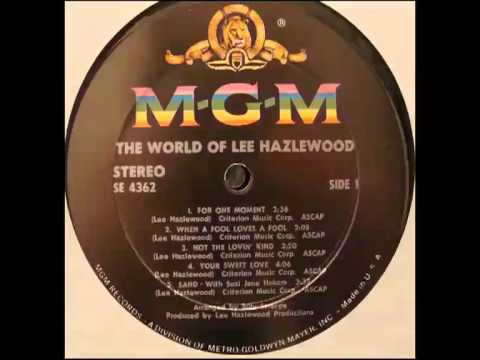
Lee, Myself & I: Inside The Very Special World Of Lee Hazlewood – with a foreword by Stewart Lee – is published by Jawbone Press on May 19, 2015. Launch parties for the book will take place in London on May 21 at Rough Trade East and in Berlin on June 11. For further details, visit the Lee, Myself & I Facebook page. Wyndham will be reading from the book at three dates on Quietus editor John Doran’s An English Trip book tour: Eastside Projects, Birmingham, May 22, The Old Police House, Gateshead, 23, and Outlaws Yacht Club, Leeds, 25