

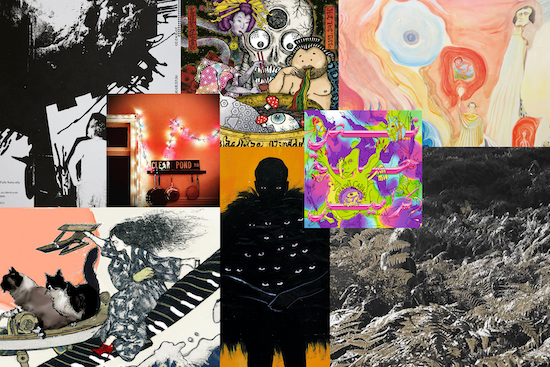
This edition of your regular best-of-the-month roundup marks my first since returning to tQ after a Summer sabbatical in order to focus on some extra-curricular writing, in which time it’s been curious to observe how I feel about tQ when I’m not here. It’s an enormous privilege, I’ve realised, to spend so much of my time not only listening to music, but sharing what I think is brilliant with our readers. Essentially, as Joni Mitchell once put it far more succinctly, you don’t know what you’ve got ’til it’s gone.
It’s been properly joyous to dive back into it all, and to poll my Quietus colleagues for their favourites too from another bumper month in brilliant new music. I dearly hope there’s something you haven’t heard before, and something that you like in the list below.
All of these picks, as well as all the other excellent music we’ve covered at tQ this month, will also be compiled into an hours-long playlist (also a bumper edition covering two months rather than one) exclusive to our subscribers. In addition, subscribers can enjoy exclusive music from some of the world’s most forward-thinking artists, regular deep-dive essays, a monthly podcast, specially-curated ‘Organic Intelligence’ guides to under the radar international sub-genres, and more.
To sign up for all those benefits, and to help us keep bringing you the kind of music you’re about to read about below, you can click here. And read on for the best of the best from September 2023.
Patrick Clarke
ALBUMS
Pharoah Sanders – Pharoah
(Luaka Bop)
If one were petty-minded, one could do the maths. ‘Harvest Time’, a track which has undergone a change of fortune over the 47 years since it was recorded, lasts for 20 minutes. A new box set, released this month by Luaka Bop with that track placed front and centre, costs 50 quid. That’s £2.50 per languid minute, presuming that’s all you came for. It’s hard to feel languid with a calculator in your hand perhaps but time is a relative concept – especially when one is adrift in the beautiful bardo-like fathoms of this track – and who can put a price on beauty anyway? The word isn’t snatched at random; the bardo is the transitional state between death and rebirth in some schools of Buddhism, but also it makes a workable metaphor for the position some groundbreaking artists find themselves in when moving out of one well-received, red hot phase of creativity and preparing to make a necessary move into another. And at such a crossroads is certainly where Pharoah Sanders found himself in 1976. His important work with John Coltrane – Ascension, Om and the only recently resurfaced glory of A Love Supreme: Live In Seattle all from 1965 – had sadly ended with Coltrane’s death in 1967. His work as a sideman for other luminaries – once playing a key role on albums such as Alice Coltrane’s Ptah, The El Daoud (1970) and Journey In Satchidananda (1970) – had petered out in relative terms; and even his own sparkling run of albums on Impulse! – including Karma (1969), Thembi (1971) and Black Unity (1971) – had hit the buffers. In a move that would perhaps have been inconceivable even three years earlier, Sanders accepted an invitation from low key Staten Island-based DIY label India Navigation to make a record. The label was named after a barge that carried garbage across Lake Erie, something that was perhaps prophetic on some subconscious level.
Certainly Bob Cummins, a fanboy of the downtown avant jazz scene who had made his money as a lawyer for Western Union, had bitten off more than he could chew, if the tracks from the initial session are anything to go by. He had built a makeshift studio in the large cement room of a former spring water factory in Rockland County just north of New Jersey, and he simply wasn’t ready to host a recording by this particular jazz luminary. The problem was that Cummins’ idea was to record Sanders live in a sax and bass duo but found himself being persuaded, strong armed perhaps, to record a largish ensemble “rock record” instead. And silly Billy that he was, he agreed. ‘Love Will Find A Way’ – which would go on to be a Sanders live staple – is an exploratory R&B record with charming but faltering vocals from the man himself before a short but satisfying slice of squealing tenor, then happy to cede the floor to Tisziji Muñoz’ optimistic and rainbow-toned guitar solo. It’s just a damn shame that Greg Bandy’s super hot, uptight drum breaks and Clifton Chase’s Blue Note-style funky organ sound like they were recorded in, well, an abandoned concrete room in a former spring water factory by someone who clearly didn’t quite know what he was doing. The other B-side track ‘Memories Of Edith Johnson’, a blissful recollection of Sanders hearing his aunt sing selflessly in church, ego-free and in support of collective worship, is a slightly better as a document but permanent damage had been done to his trust in Cummins. Kudos then to Bob for persuading the saxophonist to come back for a second session, from which the glorious ‘Harvest Time’ arose. One can only imagine the stress that Cummins went through trying to up his game, but he was met half-way by Sanders who scaled down his group to himself (strictly sax and percussion this time), Steve Neil on bass, Muñoz on guitar and, in some respects most importantly, his wife Bedria Sanders on harmonium. Bedria and Pharoah had been married for less than two years, she was a trained piano player but it was his idea that she pick up the Indian harmonium for the first time on this session (which was also the first time they recorded music together). He asked her to name the song, harvest being her favourite time of year, while the name can also be taken to represent the approaching bardo of winter.
The pulsing drone she creates, texturally, at least, recalls Tulsi’s vibrational tanpura on Journey In Satchidananda, both spiritual odysseys, but with ‘Harvest Time’ emphasising the corporeal over the metaphysical; the romantic over the devotional, this essentially being a statement of a couple in love. There is a second album consisting of two 1977 festival recordings of ‘Harvest Time’ from Belgium and Switzerland and both are impeccable in every respect but they perhaps lack the jaw-dropping presence of the original (here excellently remastered) where you can almost sense a seismic volte-face occuring. What had been ham-fisted in Cummins’ first session with Sanders – to the extent that the saxophonist always hated the album – ended up being mercurial and blessed in their second. And Pharoah Sanders’ rebirth after a short season in the mid-70s creative bardo? Well, it definitely heralded a new era of simplicity where hypnotic repetition could be more easily embraced. It’s hard to imagine his performance with Floating Points on Promises (2021) without ‘Harvest Time’ happening first. This is a beautifully curated boxset with enough supporting material of books, photos, flyers, posters and so on, to keep the most ardent of armchair jazz fiends sated and calculator clutchers out there should at least bear in mind it still only comes in at a tenth of the cost that a good quality copy of the original album often goes for.
John Doran
WaqWaq Kingdom – Hot Pot Totto
(Phantom Limb)
I just love WaqWaq Kingdom – they are so giddy and spangly, and their magpie-like Hoovering from genres and styles is becoming a really distinctive hot pot (yep, that’s the album title) of bubbling bass and candy crush tops. They call it ‘minyo footwork’, which is a thing now (see also J/P/N by KASAI on Chinabot), but it’s more like minyo dancehall. This new one’s about ecological collapse, but occasionally via Kiki Hitomi’s lyrics, sometimes features more lateral takes – the first track takes from sumo wrestling calls, and the tongue-twister title takes from two words: hotpot and ottotto, the latter meaning the Japanese equivalent of “oops” – something you say when someone nearly takes a tumble. Highlights are the gamelan jangle and soda pop fizz over low rider bass on ‘The Tower’; the candy crush drop and snap on ‘Eye Candy Man’; Hitomi’s high velocity flow on ‘Buri Buri’, and the rubbery dancehall swagger stretched over the whole production to make the album bounce.
Jennifer Lucy Allan – read the full review here
Piotr Kurek – Smartwoods
(Unsound)
Emerging harmonies, micro-sounds, and punctuated playing of acoustic instruments merge into a non-intrusive atmosphere. The music does not explode; everything sounds close to the ear, intimate, like you are in a small room with all the musicians. Kurek joins acoustic layers with electronic modulations, sometimes going so far that we don’t quite know the source of the sound at any given moment. There are tracks when the harp sound is distorted, the brass is stretched, and an electric guitar weaves over everything dreamily, as you can hear in ‘Klamm’ or ‘Noa’. It reminds me of soundtracks to fairy tales, acid early music, and baroque suites. But each time, something doesn’t fit with the label. He is somewhere between. That’s what makes the album so unusual.
Jakub Knera – read the full review here
Various Artists – Disco Discharge Presents Box Of Sin
(Demon)
Long term readers of this site will know how much Luke Turner and I adore the work of label Disco Discharge. We ran one or two essays by Saturday Night Forever: The Story Of Disco author Alan Jones, heralding the launch of the original CD compilation series with such tantalising names as ‘Pink Pounders’, ‘Cruising The Beats’ and ‘Disco Exotica’, before I interviewed original compiler Mr Pinks himself. (And lest it be forgotten, it’s thanks to Disco Discharge that we first clapped eyes on this site’s favourite photo, that of ‘construction workers’ in their smalls and hard hats having it large at Bond’s International Casino, NYC, in 1980.) Over 16 compilations and a series of artist specific reissues by the likes of Voyage and Tantra, a very pleasing aesthetic was unveiled, one that eschewed deathless northern soul-style obscurantism while avoiding any obvious rehash of mainly played out wedding-disco standards. Instead we were treated to a curatorship that was comparable to the extremely knowledgeable yet relaxed vibe that Soul Jazz brought to, say, their New Orleans and reggae compilations: putting wildly innovative tunes next to smash hits, with deep cuts next to evergreen standards. Finally after a gap of ten years the compilation series has been resurrected, the main differences concerning quantity and a temporal shift.
While the original series covered a lengthy enough period, its spiritual core could easily be located in the 1970s, A Box Of Sin is firmly ensconced in the full stretch of the 1980s. You now get five CDs instead of two, but with no noticeable decline in quality, just a shift in focus. Mark Wood, of Duckie residents Readers Wives, is the compiler but the spirit is the heart of the dancefloor at Heaven. Early on a thumping long version of the chart destroying ‘Jump (For My Love)’ by The Pointer Sisters rubs shoulders with the kind of club music that New Order and (future) Pet Shop Boys were clearly all over in the mid-80s such as ‘I Like You’ by Phyllis Nelson. The sequencing isn’t chronological, more designed to mirror the trajectory of a long DJ set; opening pop fare by Hazell Dean and Taylor Dane giving way to tougher beats and stripped down arrangements; booming synths and chanted refrains. In among crucial cuts by The Flirts, Divine (her barefaced but fabulous ‘Blue Monday’ rip ‘Love Reaction’) and Lisa is Man 2 Man Meet Man Parrish’s ‘The Male Stripper’ freshened up in its US club mix guise. Any compilation that can deploy a track as pulverisingly brilliant as the Non-Stop Ecstatic Dancing-mix of Soft Cell’s ‘Memorabilia’ and not flag afterwards deserves some kind of award. Keeping the pace up are other 12” mixes by big hitters Frankie, Animotion and Dead Or Alive, not forgetting Scarlet Fantastic’s glorious ‘No Memory’ and the disco-not-disco of ‘No GDM (Dedicated to Quentin Crisp)’ by Gina X. Things go berserk and all over the shop on CD 4, ‘You Came: Bouncing Bops At Poppers O’ Clock’ which opens with the Ian Levine remix of ‘New Beginning (Mamba Seyra)’ by none other than Bucks Fizz. Now while the vocals of Bobby, Cheryl, Mike and Jay will always remain too vanilla for my tastes, there’s something insane about this slice of Lion King-Balearic, which fans of Donna Summer’s ‘State Of Independence’ would be well advised to check out. There’s some proper avoidable fluff by Dollar, Sam Fox and Barry Manilow here but Wood saves the day with Laura Brannigan’s disco metal ‘Shattered Glass’ and Bronski Beat’s 145 bpm wipeout ‘Hit That Perfect Beat’. The final disc does a delicious handbrake turn, landing us in a house crossover zone, with copper bottomed bangers from Joe Smooth, S’Express and Ultra Naté. All round, a very welcome return. More please.
John Doran
Lou Venturini – Enter Love
(Accidental Meetings)
Once its initial Rian Treanor-type rhythms have been dispatched, the title track works with a dragged-backwards funk that reminds me a bit of early-millennium UK dance oddities like Jamie Lidell and Si Begg, or even the proto-hyperpop of early Max Tundra. ‘Contradictions’ is a rhythmic tapestry with a complex weave, Venturini’s vocals singsongy and muttered in equal measure, something ‘Fruit Falls Naturally’ maintains.
Noel Gardner – read the full review here
Yumi Hara – Groove Study
(Bonobo’s Ark)
Backed by Henry Cow’s Chris Cutler and Tim Hodgkinson, Japan-born London-based composer Yumi Hara re-imagines Arnold Schoenberg as funk rock, reggae in 7/8 time and more besides. Like the cabaret band in a Buñuel film or a prog album dreamed up in the fug of high fever. Groove Study is an album that never sacrifices its thrilling groove at the altar of its bewildering complex rhythmic patterns.
Robert Barry
Apostille – Prisoners Of Love And Hate
(Night School)
Much like his fellow Glasgow resident, Kasparis is longing for a past now gone, grasping for those halcyon days which, as with these almost recognisable ear worms, remain just out of reach. There’s a rose-tinted sense of more innocent times on Prisoners Of Love And Hate. The touchstones might be all over the musical map (and perhaps a little unexpected from a former member of caustic, confrontational punk acts The Lowest Form and Anxiety) but there is an odd sense of internal logic to it all. It’s as if we’re experiencing a hopeful musical landscape distilled through the kaleidoscope of Kasparis’s tastes and experience. The album acts as a time machine, bleeding in choruses, hooks, leads, and instrumental palettes from a range of eras, across constantly shifting airwaves. It’s not so much damning the hedonism of Whigfield, as sharing a sense of despondency that it is no more. That hanging in there is the best that can be hoped for until such a time that it is possible to return to an era of our choosing.
Jon Buckland – read the full review here
Anjimile – The King
(4AD)
At the outset of Anjimile’s first full-length album since signing to 4AD, we are treated to dense and mobile vocal harmonies sat within a warm hiss. Indeed, almost violent saturation is something of a bedrock for the album. All things seem pushed towards a threshold of harmonic distortion that reeks of simmering anger and threat. This suits Anjimile’s voice extremely well. I could listen to this rich singing indefinitely. Musically, he draws from some interesting places, notably importing the pattern-based composition that Philip Glass and the like borrowed from the African continent. Things are subsequently a glorious mix of American folk and diasporic investigation, which connect seamlessly to Anjimile’s Malawian heritage.
Jon Buckland – read the full review here
Abadir – Ison
(Svbkvlt)
I’m always inspired by the lucid explanations that accompany the releases of Egyptian DJ/producer Abadir, be it his exploration of the intricacies of the human voice on Pause/Stutter/Uh/Repeat or the mixture of Arabic rhythms and Western dance music forms of Mutate. The intent behind his work is usually very precisely laid out, his art contextualised through critical theory and music history. His new album Ison takes an autobiographical turn, taking us back to his Christian upbringing as a member of Cairo’s Coptic community. The title refers to the low slung drone note that accompanies the main melodic chant in Greek Orthodox Church. There’s a deeper meaning to each track title, references to standard hymns of the divine liturgy, tributes to his grandmother and other "flashbacks". In contemporary electronic music circles, the Christian musical tradition ostensibly remains peripheral, bar the interest for the work of Hildegard Von Bingen. On Ison, we see it transformed and repurposed in a completely unique way. Ison is an uplifting concoction of various Christian choral traditions, field recordings of church bells and holy masses, and Abadir’s Proustian musical reminiscences from his childhood years. This results in a serene, soulful sonic fiction, a sort of "choral club music", presented through a cutting-edge electronic music lens.
Jaša Bužinel – read the full review here
El Kontessa – Nos Habet Caramel | نص حبة كراميل
(Bilna’es بالناقص)
The album’s title (Arabic for “half a piece of caramel”) brilliantly translates its playful character. This is also encapsulated in the flashy, freaky cover with its amorphous alien entity, frog, rabbit and other oddities veiled in psychedelic colours. Designed by El Kontessa herself, it functions as a tongue-in-cheek counterpoint to the more rugged and distorted character of her productions. Musically, the album sits somewhere between the mahraganat deconstructions and Egyptian bass of ABADIR, Zuli and 3Phaz, the cutting-edge Arab club music of Deena Abdelwahed and Toumba, and the raw polyrhythmic jams of Hakuna Kulala’s Authentically Plastic.
Jaša Bužinel – read the full review here
Kristin Hersh – Clear Pond Road
(Fire Records)
A sonic chiaroscuro rendered in self-assured brushstrokes of acoustic guitar and cello, with occasional touches of mellotron, bells, glockenspiel and ambient field-recordings, Kristin Hersh’s new solo album sits intimately close to the listener’s ear, offering both immediate accessibility and a wealth of mysterious depths that open up with repeated listening. Understated opener, ‘Bewitched Reruns’, begins with a fragile acoustic guitar figure but soon flourishes in subtle increments with swelling strings as if to suggest a burgeoning backdrop for Hersh’s melancholy but luminous vocal. It’s a simple device, cinematic in its effect, that establishes the album’s personal yet universal tone from the onset. ‘Constance Street’ mixes diaphanous mellotron passages with choppy guitar and an infectious, double-tracked vocal, whilst the end of side one offers album highlight, the epic ‘Thank You, Corner Blight’. If one were to consider 2022s noisy 50 Foot Wave album, Black Pearl as one sonic polarity and Clear Pond Road its antithesis, then the wide-ranging scope of Hersh’s talent becomes demonstrably apparent.
Sean Kitching
TRACKS
Slauson Malone1 – ‘Voyager’
Slauson Malone is dead, long live Slauson Malone1. Celebrating an upcoming new album EXCELSIOR and (in relative terms at least) an easier to parse sound, Jasper Marsalis has added a numeral to his moniker while distilling what it is he actually does: hip hop/R&B played with an avant jazz sensibility that suggests an American who has recently spent some time in London. His new home Warp is spot on for someone who seems to have as much playful love for IDM deep processing as for the sonic possibilities of using concrète in a popular music context.
John Doran
John Francis Flynn – ‘Mole In The Ground’
The first taste of Dublin folk scene outlier John Francis Flynn’s second album takes an anti-establishment song that found relevance a century ago, and retools it masterfully via sweeping guitars and bold spoken vocals to confront the capitalist ills that blight his home city.
Patrick Clarke
Art Feynman – ‘Early Signs of Rhythm’
I have a feeling Art Feynman thinks this is, like, a harder, grittier, more no wave-y Remain in Light. It actually sounds more like Haircut 100 remixed by LCD Soundsystem, but – surprisingly – that’s… quite good, actually.
Robert Barry
Gazelle Twin – ‘Black Dog’
Gazelle Twin’s much anticipated return finds her channelling her otherworldly musical powers inwards for the first time, confronting the looming darknesses of childhood through enormous, horrifying lurches of sound.
Patrick Clarke
ØXN – ‘Cruel Mother’
The opening two minutes of OXN’s second single delivers what we’ve come to expect from Radie Peat – that transfixing voice, thick with emotion, presented a capella – before her bandmates build layers of sublime darkness, gothic arpeggios and gorgeous drones, that pull it into stranger and stranger territories.
Patrick Clarke
Dog Sport – ‘Cylinders’
The debut single from Liverpool’s Dog Sport is as dynamic as they come, a heaving cut of gothic post punk, based around an incisive, undeviating tidal wave riff.
Patrick Clarke
Bonnacons Of Doom – ‘Signs’
Longstanding mirror-masked psych outfit Bonnacons Of Doom’s new single is their most hypnotic to date, an everlasting synth loop and eerie wordless vocals weaving their way in and out of one another as a slow and mighty crescendo of noise builds in the background.
Patrick Clarke
Mendoza Hoff Revels – ‘Dyscalclulia’
Ava Mendoza of Unnatural Ways has played guitar with everyone from Matana Roberts to Negativland, via a notable recent excursion with William Parker on his Mayan Space Station LP. Here she summons the various spirits of Slayer, Death and Sonny Sharrock while Devin Hoff (bass), James Brandon Lewis (sax) and Ches Smith (drums) riff hard and then let fucking rip alternately. Roll on the AUM Fidelity album Echolocation.
John Doran
Pidgins – ‘This Simple Hack To Fix Your Stomach’
A Mexico City-based project of American expat Aaron With and Mexican percussion master Milo Tamez, Pidgins’ music is dazzling in its textural scope and complex in its aims – ‘to transform the oral and rhythmic methods of traditional trance rituals by phasing metric, melodic, and rhetorical phrases – yet so consistently beautiful that it never gets bogged down in its own depth.
Patrick Clarke