
I’ve recently moved house and my head feels as cluttered as the space around me, but I’ve tried my best to pick through the last three months’ releases and bring you the best new music from the French fringes. I’ve packed as much as I can into the reviews below but there are other superb releases that are represented in the latest Rockfort mix – the second album from the beguiling Roxane Métayer, a raft of great music on the Coax label (I’ve plumped for something from Simon Henocq and Philippe Foch’s Herz album), maximalist electronics from Imer6ia’s Translucid, Agar Agar’s witty synthpop, rising indie-pop darlings En Attendant Ana, a selection from London-based Clémentine March’s new EP and the progressive garage rock of Delacave.
The arrival of a new Tachycardie release, Autonomie Minérale, makes this as good an occasion as any to pay tribute to the questing, polyvalent creativity of drummer and composer Jean-Baptiste Geoffroy. His is one of those names I’ve found cropping up repeatedly in the credits of releases I’ve loved over the past decade – he’s a member of impish post-hardcore duo Pneu, who are themselves part of the Voltron-like supergroup La Colonie Des Vacances, but can also be found thrashing kitchenware and deconstructed drum kits as half of another superb duo, Institutrice, and has plied his trade in numerous other bands (Papaye, Binidu and Gablé to name a few). His releases in 2022 included an album of hydrophone recordings of two interconnected seawater pond in Brittany (Intertidal Dripping Music), the unsettling ambiances of Unstable Music To Sleep While You’re Awake and Porous Talk, which captured the chattering of chunks of chalk, terracotta and freestone as they were dropped into water. (It turns out that there’s a Renaissance French composer with the same name, so perhaps he’s built a time machine too.) On his latest album as Tachycardie, he has pursued his interest in minerals, combining acoustic percussion with sonic emanations from struck stones and a home-made synth. The tracks are vivid combinations of wet and dry, smooth and hard, organic and electronic material than can be meditative (‘D’érosion), explode into a controlled frenzy (the first half of ‘Parties Sud Puis Nord’), or even drift into the realm of clammy, tribal techno (‘Collision Au Sens Strict’). Stone-cold brilliance abounds.
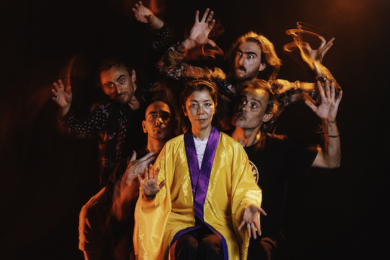
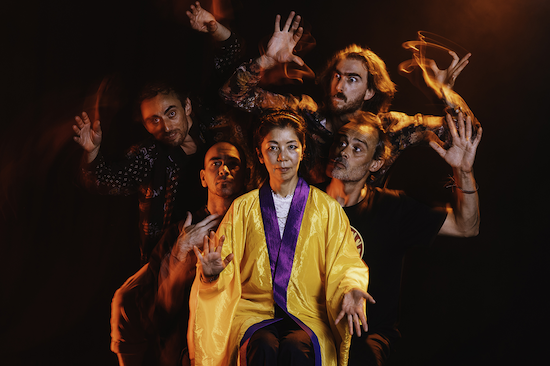
Speaking of supergroups, PoiL are past masters at merging with other outfits to create new, many-limbed entities; the last time they featured in this column it was via an outrageously entertaining fusion with label-mates Ni called PinioL. Their latest adventure finds them teaming up with Japanese singer and satsuma-biwa (a type of Japanese lute) player Junko Ueda to form PoiL Ueda. Born in Tokyo but based in Europe as far as I can tell, Ueda is steeped in the epic storytelling style associated with the instrument, and this debut collaboration with the French band is based on the 13th-century text The Tale Of The Heike (or Heike-Monogatari), about rival clans vying for power. No such struggles are apparent in the music though; this new pairing seems like a marriage made in heaven. The album, fittingly for an epic tale, essentially comprises two long tracks that are broken down into several parts. PinioL’s usual jazzy heaviosity anchors the music but there are so many moments of delicious disorientation, as you lose your bearings in the wooshing and rattling transition from ‘Kujô Shakujô – Part 1’ to ‘Part 2’, or the passage in ‘Kujô Shakujô – Part 3’ when the tricky-but-lithe groove and reptilian riffs suddenly give way to a blizzard of bleeps and wubs and rattling percussion, before the track ascends to a Magma-like climax of massed vocals. I was unfamiliar with Ueda’s work and I sadly can’t understand the words but her vocals are, unsurprisingly given her musical background, hugely, dramatically expressive, fierce and sharp. She rocks, and so does PoiL Ueda.
“We live in an era in which comparison is the alpha and the omega… we all know my friends that compare rhymes with despair.” These are the words of writer, DJ and producer Crystallmess on ‘Kesh’, which appears midway through the debut album Al Hadr (‘the present time’ in Arabic) by French-Algerian artist Sabrina Bellaouel. I’ll heed the warning then and won’t mention any other artists successfully fusing R&B and contemporary club sounds – but if that description is enough to whet your appetite, then there’s a good chance that Al Hadr will be like nectar to you. Produced in collaboration with InFiné label-mate Basile3 among others, it beguiles from the opening moments of ‘Ain El Fouara’; a few words in Arabic are like an incantation that peels the album open, unleashing a gale of fluttering, reversed autotuned melismata. Bellaouel, who studied ethnomusicology at Goldsmiths, switches between English, French and Arabic and her delicately expressive vocals are re-pitched, stretched and chopped across a record that’s replete with similar moments of rapture – fittingly there’s even a track called ‘Rapture’, which matches symphonic synth swells to a scrunchy trap beat and, as with every other song, constantly folds new and gorgeous details into the mix. From the spine-tingling house of ‘Eclipse’ and hyper-R&B of ‘Legit’ to lush, hushed ballads ‘Clémence’ and the title track, and thumping, rock-y finale ‘Goodbye’ – a duet with Bonnie Banane – Al Hadr is very special indeed.
I’ve previously discussed La Tène as part of the constellation of artists surrounding the La Novià collective and France (the band) a>. The core three-piece of the outfit are actually predominantly Swiss (Cyril Bondi and D’Incise), although hurdy-gurdy player Alexis Degrenier is French, and familiar names like France/Tanz Mein Herz’s Jérémie Sauvage, Guillaume Lacroux and La Novià’s Jacques Puech are among the additional personnel – enough to get this release over the line and into my column. And I want their new release Ecorcha/Taillée here because it’s brilliant, their most engaging album to date. When I spoke to Degrenier, he was keen to point out that La Tène’s music isn’t fundamentally about improvisation – rather the focus is on incremental change within a strict framework. You can hear this immediately on ‘Ecorcha’ (for La Tène, a single album equals one track to a side), which starts as a wheezy waltz, like a dusty clockwork mechanism springing to life, draped with ribbons of drone and with Lacroux’s 12-string (I think) picking out an endlessly cycling eight-note motif. New elements drop in as the piece progresses, the rhythm is filled in and cabrettes (bagpipes) start to lead the dance. On the second side, new territory is opened up by ‘Taillée’, it’s Rosalia-inspired reggaeton beat gelling perfectly with plangent folk instrumentation. At under 15 minutes it’s as close to ‘pop’ as La Tène have got so far, and it’s also a stroke of genius.
Le Diable Dégoutant translates as The Disgusting Devil, a name as sinister and blackly comical as the music on this wonderful release, Fleur De Chagrin on tape label La République Des Granges. Pauline Marx is the devil woman behind these twenty brief and delightfully cranky sketches, fruity loops and skewed chanson. The rapid-fire approach is part of the album’s appeal, adding to the sense that you never know what’s around the next corner except that it will be somehow both joyful and a little sinister. Some tracks are barely more than little sonic skits, like ‘Chant Animal Post Apo’ (‘Post-Apocalyptic Animal Song’, I think) which lives up to its title and proposes 50 seconds of distorted mooing and honking, or ‘Les Vaches Musiciennes’ (‘The Cow Musicians’) which consists of what sounds like cowbells, looped and bitcrushed. These moments provide the peculiar punctuation between more developed songs like ‘Complainte De La Bête’, with its bobbing and plopping rhythm wayward keyboard lines and wobbly Autotune, or waterlogged folk song ‘Ingurgiter Ton Image’. Over the sounds of crackling twigs and mic noise, Marx sings the almost-a cappella ‘Chant Pour Dissuader L’Être Aimé De Sortir La Nuit’ with the distracted, disturbed air of a young girl who’s the only survivor from a plague village.
Frédéric D Oberland is a regular in this column thanks to his work with bands including Oiseaux-Tempête and Foudre!. This new solo outing, Solstices, on the superb Zamzamrec label is largely comprised of material captured during a live performance at Petit Bain, a floating venue moored in the south-east of Paris. The tracks here, fittingly, are both satisfyingly weighty and buoyant; you can pick out affinities with his Oiseaux-Tempête work, such as in the Middle Eastern-inspired minor scale melodies and quivering alto sax of ‘À Notre Nuit’, but this is pure, uncut Oberland, untethered from band dynamics, bathing in a warm, fizzy flow of electronics. ‘Penspermia/Pneuma’ and ‘Quatres Épaves d’Acier’ are exemplary cosmic odysseys (a Stephen Hawking sample even crops up on the former), building thick smears of synth layer upon layer, while it’s a surprise that the powerfully distorted kick of ‘Worst Case Scenario’ didn’t sink the whole boat. The final track, ‘Cosmos Bou Dellif 2.3’, recorded at a festival in Gabès, Tunisia and featuring trio Awled Fayala, is perhaps the most thrilling of the lot, a veritable tempest of zukra (Libyan bagpipe), percussion, sax and bass drones that groan like a giant waking from slumber.
Next up, two of France’s finest practitioners of baroque indie pop are both back with fine new work. The last we heard from Orval Carlos Sibelius (real name Axel Monneau) was on 2019’s Smulkios Detalés, for which the songcraft placed on the backburner in favour of fondant electronic miniatures, but Territoires De L’Inquiétude is the fully-fledged return of the kind of ornate psych and power pop last heard on Ordre Et Progrès (MMXVII).His art lies not just in the florid arrangements – winding staircases of chiming guitar, gloopy synths and wide-eyed harmonies – but in the balancing of vaulting chord sequences with bittersweet sentiment, as on the single ‘Vinyle’ which finds him wishing he could be a vinyl record, “so that I could have a sublime sound”. The (rather moving) impression at times is of someone creating a magical, atemporal bubble for themselves in a vain attempt to keep the harsh realities of the present at bay. It’s a delightful alternate reality to step into, though, taking in as it does the medieval stomp of ‘L’Origine De Nos Viandes’, the Cocteau Twins-y tracery of ‘Ma Famille, Mon Métal’ and the loping, sunspotty ‘Le Mont Glorieux Des Possibilités’.
Forever Pavot’s Emile Sornin, meanwhile, builds his own fantasy worlds that are steeped in exotica and vintage synths, the French school of 20th-century arranger-composers like the recently departed Alain Goraguer (several tracks here recall the fusion of Isaac Hayes’ Shaft soundtrack and French prog of Goraguer’s music for animated classic La Planète Sauvage), library funk and synth pioneer and soundtrack wizard François De Roubaix, whose work echoes through the rapid cascades of analogue arpeggios that feature so prominently in ‘La Mer À Boire’ and ‘L’Idiophone Du Moyen Age’. You can’t get by on the allure of ‘soundtracks for imaginary films’ alone, of course, but Sornin’s work is terrifically entertaining, offering a front-row seat for tense car chases (‘Dans La Voiture’) and crime dramas (‘La Mains Dans Le Sac’). Inevitably, given the overlap in influences, there are moments that recall Air – the opening of ‘Les Enjambés’ echoes ‘Playground Love’ – but it’s hard to imagine the latter creating anything as screwy as the (only slightly) overegged TV news bulletin theme ‘Les Informations’.
Finally, I just about have space to squeeze in this excellent recent recommendation of an artist I was previously wholly unaware of. La Croix Des Cros, on Lyon-based label Bamboo Shows, is the second album from Jonquera. The blurb bandies about names like Heldon, Angelo Badalamenti (you can clearly hear echoes of the latter on ‘Le Dormeur’ with its sinister brush-strokes and guitar twang) and Ennio Morricone as reference points, and fair enough – the music here doesn’t pale by comparison. Jonquera’s is a gloriously widescreen sound that encompasses folk, country, noise, psych-rock, shoegaze, dub and much, much more, but the most impressive thing about La Croix Des Cros is the fact that all these sounds are corralled into such a distinctive vision. The album is rich with sonic surprises and unexpected juxtapositions; I have a feeling I’ll be exploring its corners and crevices for a long time to come.
Rockfort Quietus Mix 33 – March 2023
Roxane Métayer – ‘Baume Paralume’ (Marionette)
Le Diable Dégoutant – ‘Complainte De La Bête’ (La République Des Granges)
Tachycardie – ‘Collision Au Sens Stricte’ (Un Je-Ne-Sais-Quoi)
Poil Ueda – ‘Dan No Ura Pt 1’ (Dur Et Doux)
Jonquera – ‘Chemin Des Planètes’ (Bamboo Shows)
P Foch & Simon Henoch – ‘Grens’ (Coax Records)
Imer6ia – ‘Earthbeat’ (lavibe)
Sabrina Bellaouel – ‘Rapture’ (InFiné)
Agar Agar – ‘Dude On Horse’ (Cracki)
Clementine March – ‘Isolated’ (Lost Map)
Forever Pavot – ‘La Main Dans Le Sac’ (Born Bad)
En Attendant Ana – Same Old Story (Trouble In Mind)
Orval Carlos Sibelius – ‘L’Idéal Défunt’ (Fondation Arcana)
Frederic D Oberland – ‘Quatre Epaves D’Acier’ (Zamzamrec)
Delacave – ‘Stranger In The Day’ (Teenage Menopause)